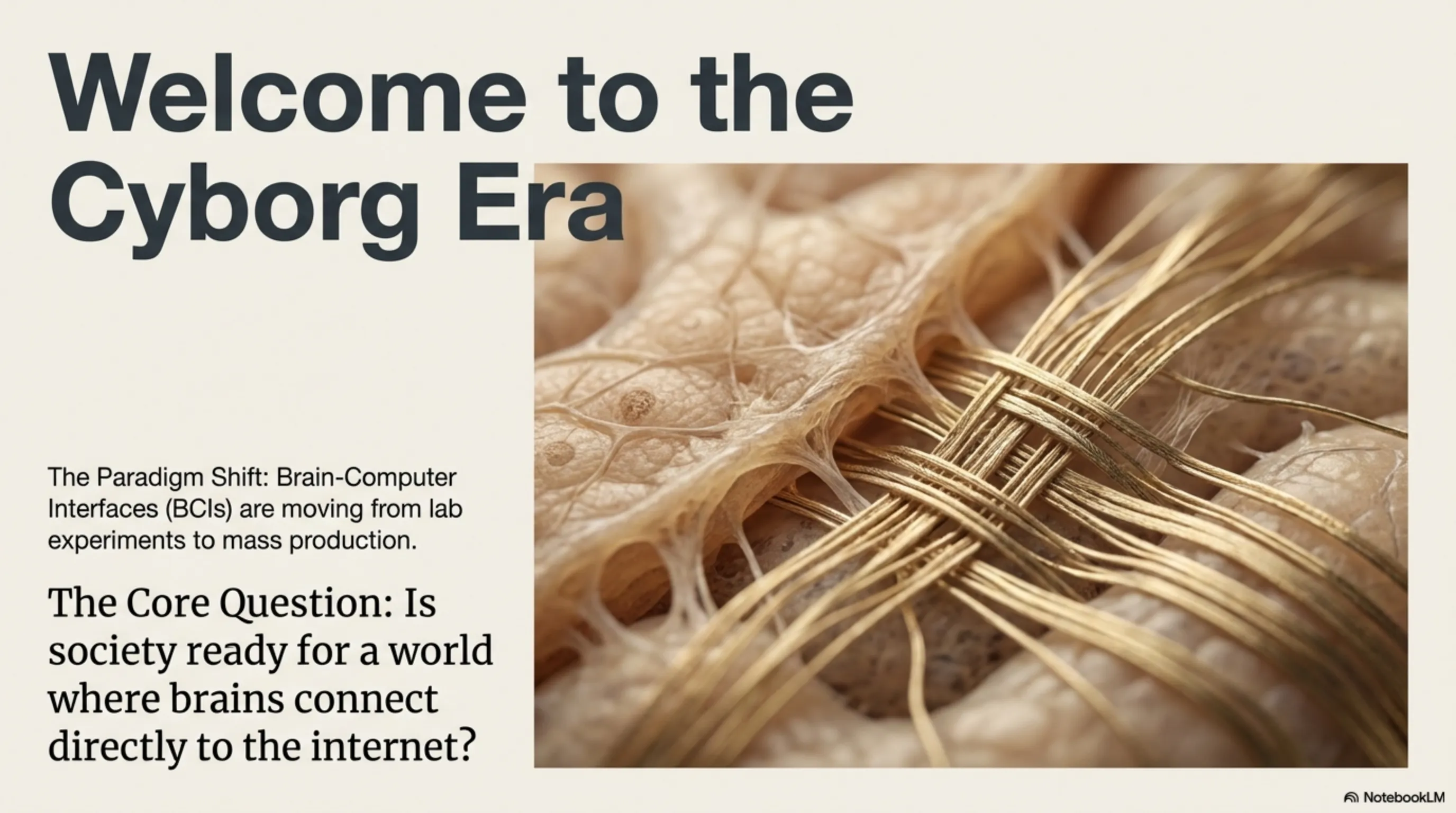
On December 31, 2025, Elon Musk announced that Neuralink will begin "high-volume production" of its Brain-Computer Interface in 2026 — with nearly fully automated surgery. This is no longer a science fiction experiment. With $650 million in fresh funding, FDA breakthrough status for speech restoration, and a target of 20,000 annual implants by 2031, Neuralink is moving from lab to mass production. The Neuralink N1 technology features 1,024 electrodes on ultra-thin threads (4-6 micrometers) that are placed into the brain with micrometer precision by the R1 robot. These flexible threads can move with the brain, reducing inflammation and increasing longevity. Surgery that used to take hours now takes less than one hour — and is fully performed by the robot. In September 2024, the FDA granted Neuralink's speech restoration device "Breakthrough Device" status — a signal that this technology can transform patients' lives. Currently, Neuralink focuses on three groups: quadriplegic patients who can control computers with their thoughts, ALS patients whose thoughts are converted to speech, and in the future, blind patients whose vision will be restored. Noland Arbaugh — Neuralink's first patient — received the implant in January 2024. He's a quadriplegic patient who can now control a computer with his thoughts, play games, write emails, and make music. He said: "This is like a superpower." The second patient — Alex — received the implant in August 2024 and can now play video games, do 3D design, and even learn Chinese. By the end of 2025, Neuralink wants to have 20+ patients. But Neuralink isn't alone. Synchron with its minimally invasive approach (through the jugular vein) already has 10 patients — but only 16 electrodes. Blackrock Neurotech with its Utah Array (96-128 electrodes) has decades of experience — but rigid electrodes that can damage brain tissue. Precision Neuroscience with surface electrodes has lower risk — but lower signal resolution. Each approach suits different applications: Neuralink for precise control, Synchron for simpler applications. The risks are real. Cybersecurity: Researchers have shown that Brain-Computer Interfaces can be hacked — and hackers can read or even alter thoughts. Privacy: If Neuralink can read brain signals, who has access to that data? The company? The government? Insurance? Employers? Social inequality: If Neuralink can enhance cognitive abilities, only the wealthy will have access — and this could lead to a new class divide. Identity and consciousness: If part of your brain is a machine, are you still "you"? The future? Enhancement — upgrading healthy humans. Elon Musk says the ultimate goal is "symbiosis with artificial intelligence." Imagine you could download information directly, communicate telepathically with others, enhance your memory, or boost your intelligence. This is no longer science fiction — it's the future Neuralink is building. Some believe this could lead to an arms race. Others believe it could lead to a better world. The reality? Probably somewhere in between. Neuralink says security and privacy are top priorities: end-to-end encryption, local data storage, and full patient control. But is this enough? Society needs to talk about Brain-Computer Interface ethics — before it's too late. This technology can save lives — or destroy them. The question is no longer whether Brain-Computer Interfaces will come to market. The question is: How will we as a society deal with this technology? How will we use it? And how will we ensure it benefits everyone — not just the wealthy? Welcome to the Cyborg Era. The line between human and machine is blurring — and the future is now.
On December 31, 2025, Elon Musk announced that Neuralink will begin "high-volume production" of its Brain-Computer Interface in 2026 — with nearly fully automated surgery. This is no longer a science fiction experiment. With $650 million in fresh funding, FDA breakthrough status for speech restoration, and a target of 20,000 annual implants by 2031, Neuralink is moving from lab to mass production. But is society ready for a world where brains connect to the internet? Welcome to the Cyborg Era — where the line between human and machine is blurring.
From Experiment to Mass Production: Musk's Historic Announcement
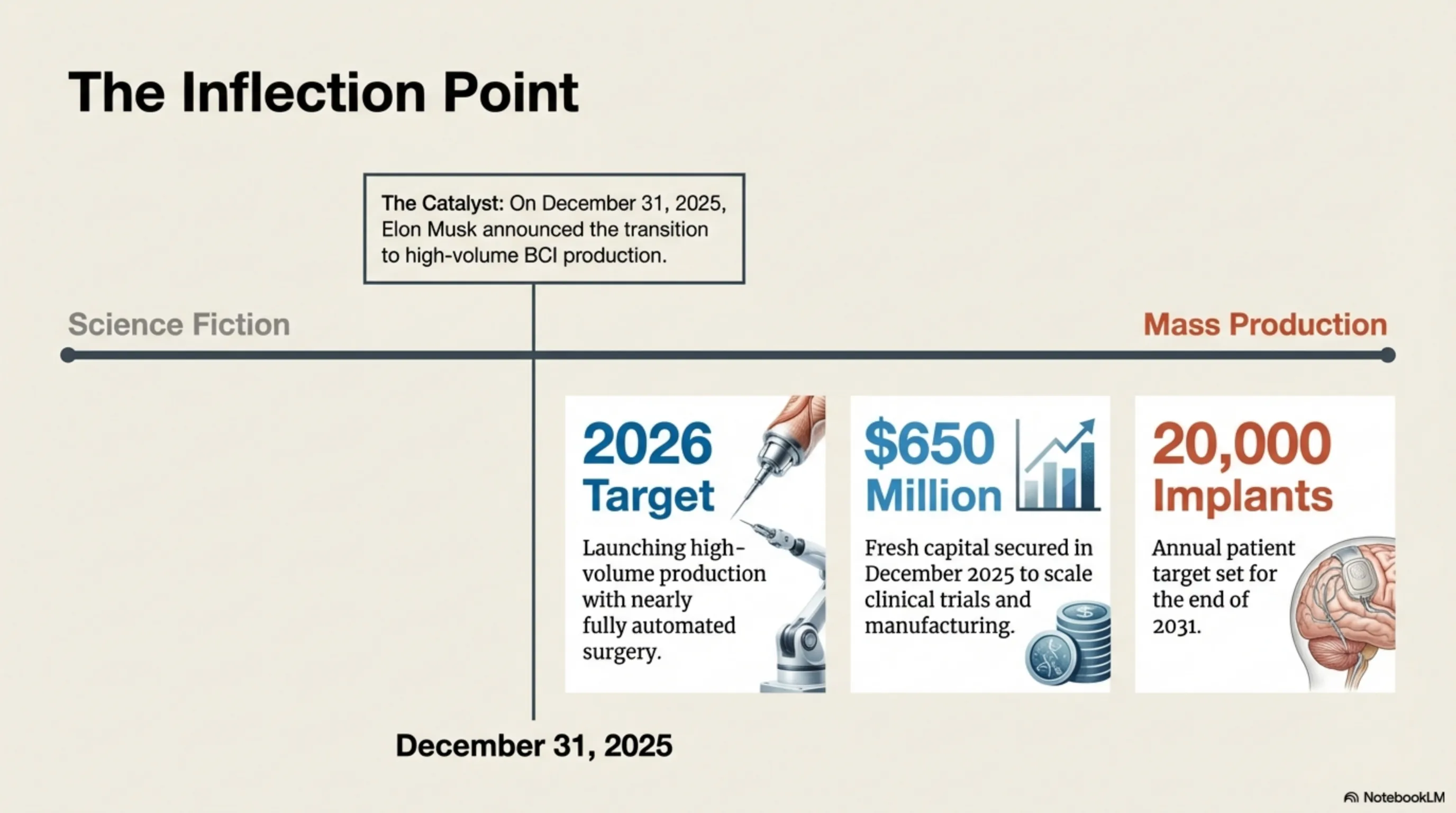
On the last day of 2025, Elon Musk made a historic announcement: Neuralink is going into "high-volume production" in 2026. What does this mean? It means the company is no longer conducting limited trials — it's preparing for mass production of Brain-Computer Interfaces.
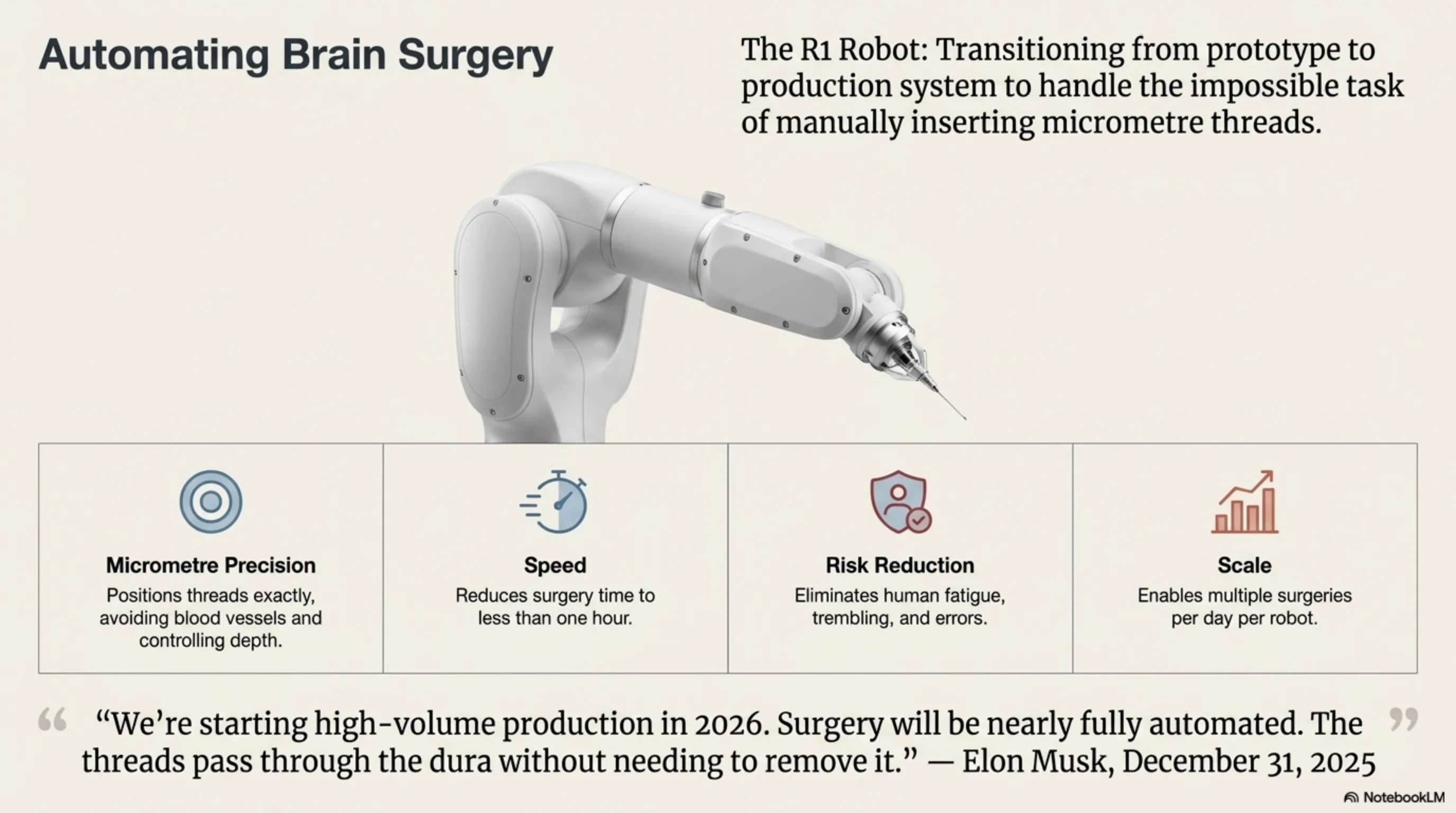
But this isn't just about production. Musk also announced that implant surgery will become "nearly fully automated." This means the company's R1 robot — which can place ultra-thin electrodes with micrometer precision into the brain — is transitioning from prototype to production system.
Why does this matter? Because brain surgery is one of the most complex and dangerous medical procedures. If Neuralink can automate it, it can reduce costs, minimize risks, and scale up. This is the difference between a few dozen patients per year and thousands.
"We're starting high-volume production in 2026. Surgery will be nearly fully automated. The threads pass through the dura without needing to remove it." — Elon Musk, December 31, 2025
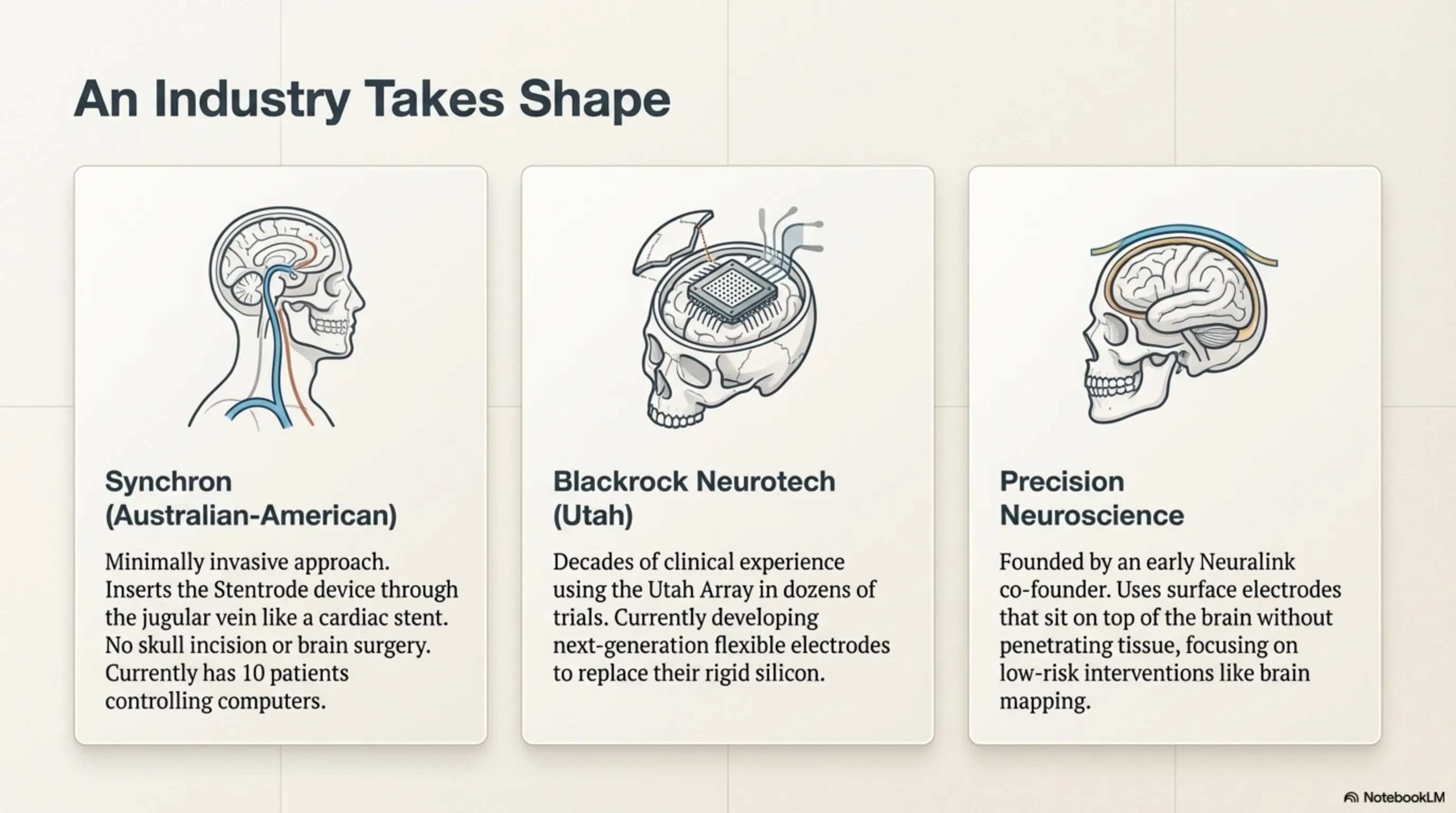
But Neuralink isn't alone. Competitors like Synchron and Blackrock Neurotech are also making progress. Synchron, with its minimally invasive approach (through the jugular vein), already has 10 patients. Blackrock, with its Utah Array, has decades of experience. And new companies like Precision Neuroscience with surface electrodes are emerging.
This is no longer a race — it's an industry taking shape. And with the mass production announcement, Neuralink is betting it can lead the way.
The Technology: 1,024 Electrodes and Robotic Surgery
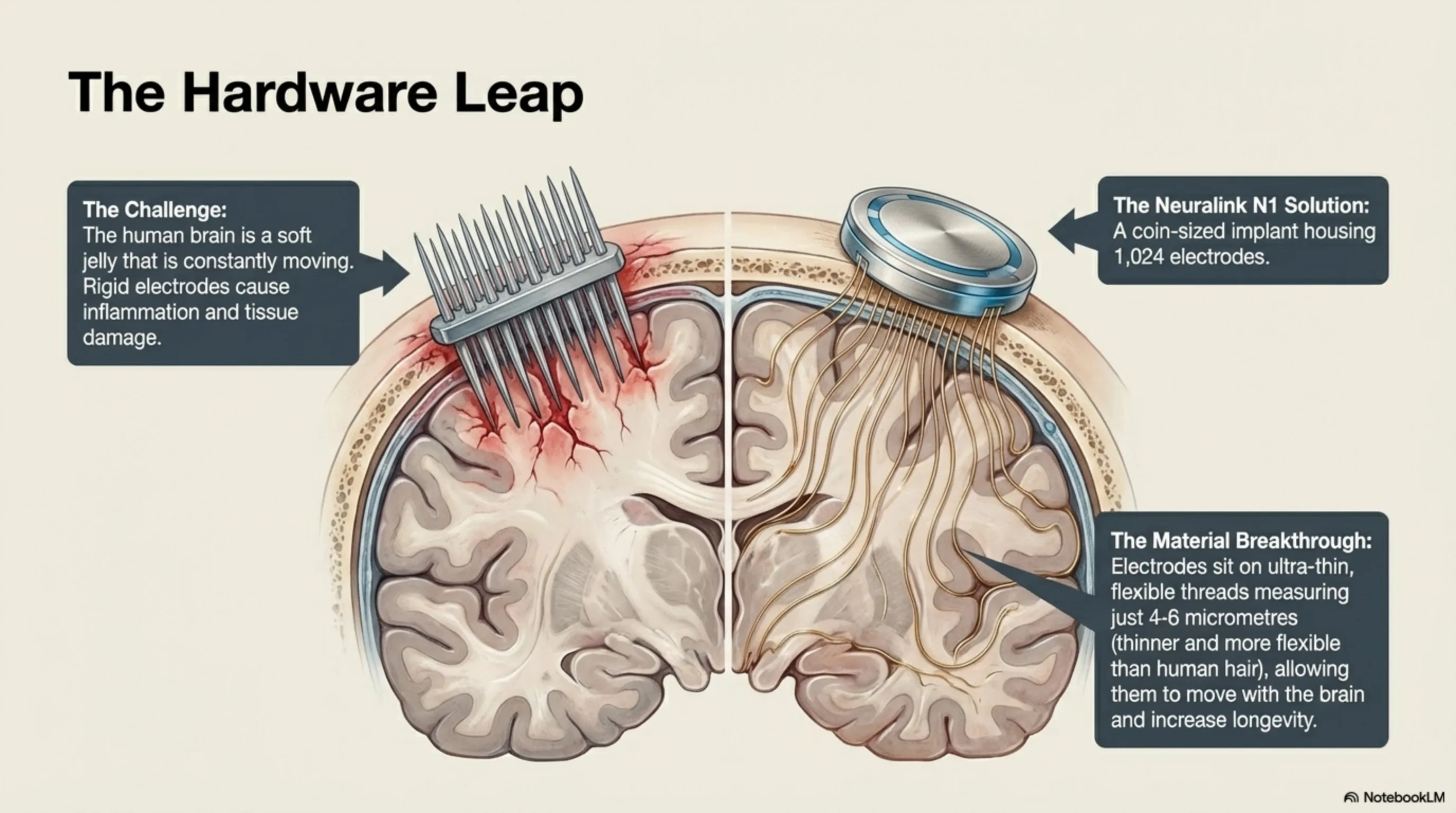
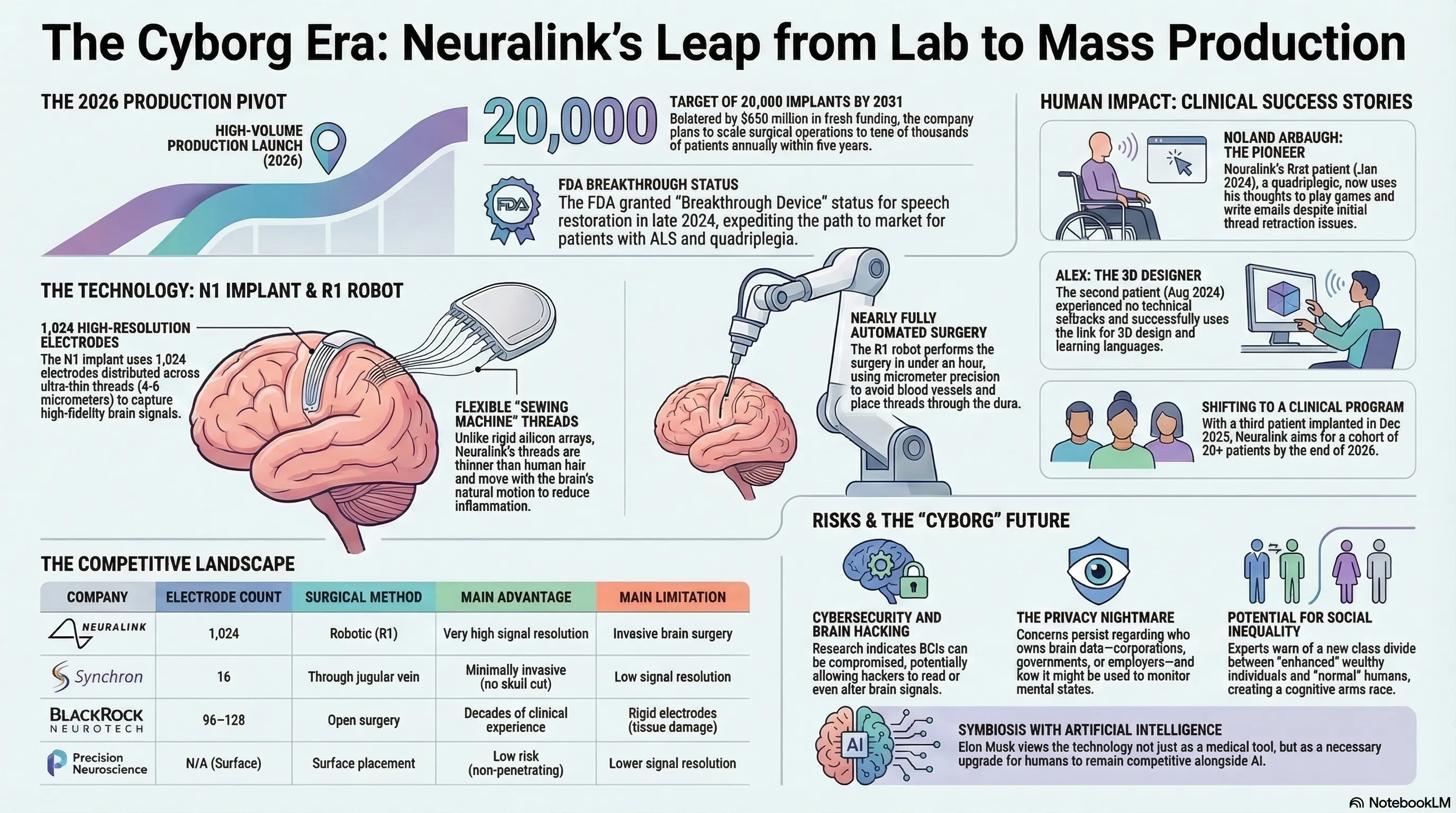
Let's talk about the technology. The Neuralink N1 — the company's current device — is a coin-sized implant with 1,024 electrodes. These electrodes sit on ultra-thin threads (4-6 micrometers) that are more flexible than human hair.
Why does this matter? Because the brain is a soft jelly that's constantly moving. Rigid electrodes (like the Utah Array) can damage brain tissue. But Neuralink's flexible threads can move with the brain, reducing inflammation and increasing longevity.
But how do you insert these ultra-thin threads into the brain? It's impossible by human hand. That's why Neuralink built the R1 robot — a robotic surgical system that can:
1. Place threads with micrometer precision: The robot can position each thread exactly, avoid blood vessels, and control depth.
2. Speed up surgery: What might take hours now takes less than one hour.
3. Reduce risk: The robot never gets tired, never trembles, and never makes mistakes.
4. Scale: One robot can perform multiple surgeries per day. A human surgeon? Maybe one or two.
| Feature | Neuralink N1 | Synchron Stentrode | Blackrock Utah Array |
|---|---|---|---|
| Electrode Count | 1,024 | 16 | 96-128 |
| Surgical Method | Robotic (R1) | Through vein | Open surgery |
| Flexibility | Soft threads | Metal stent | Rigid silicon |
| Signal Resolution | Very High | Medium | High |
| Invasiveness | Medium | Low | High |
| Clinical Experience | ~12 patients | 10 patients | Decades |
But technology is only half the story. The other half? FDA approval and the path to market.
FDA Approval and Path to Market
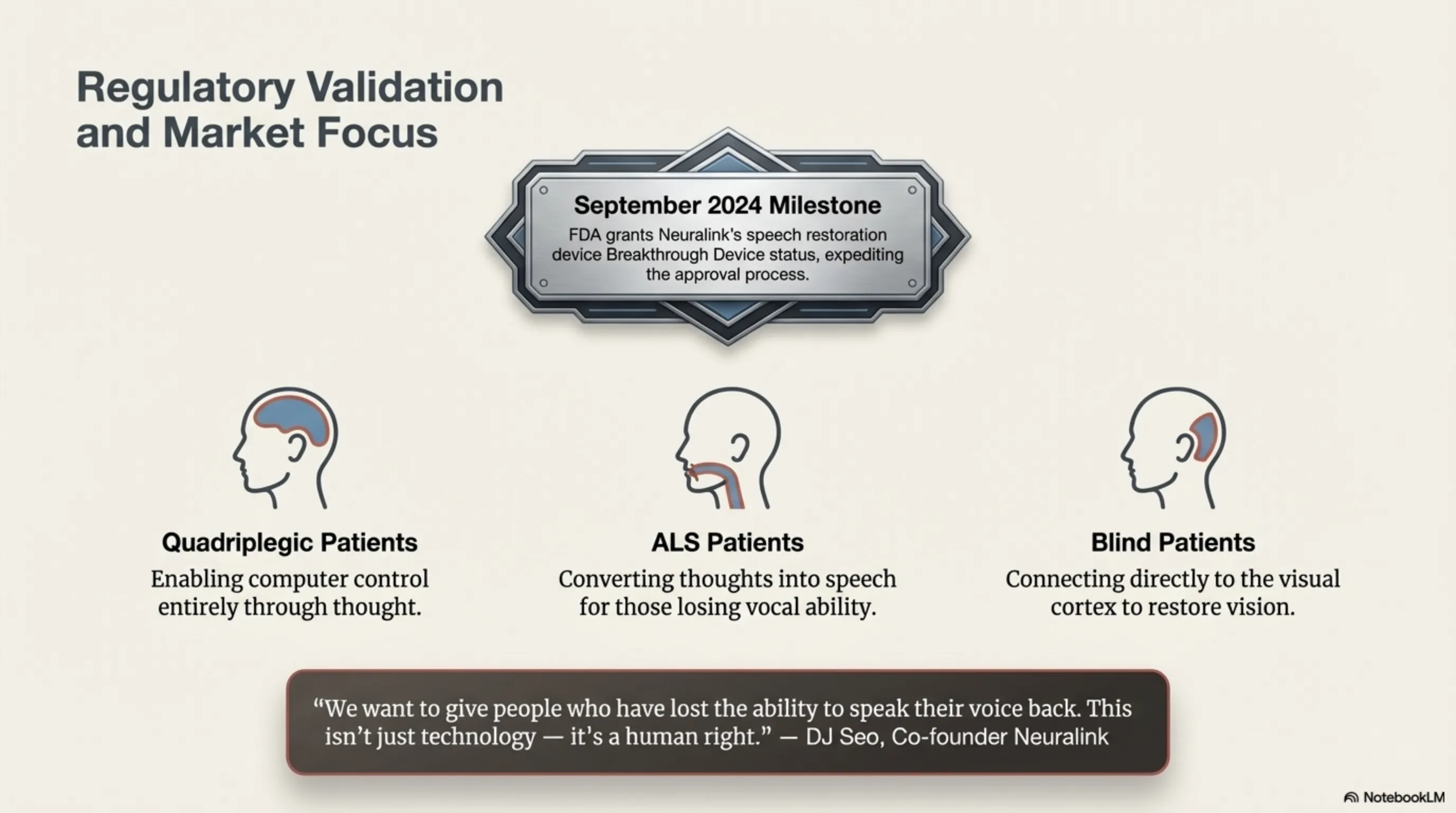
In September 2024, Neuralink passed a historic milestone: the FDA granted the company's speech restoration device "Breakthrough Device" status. What does this mean? It means the FDA believes this technology can transform patients' lives — and is ready to expedite the approval process.
But this isn't just a label. It's a signal: Neuralink is no longer a science fiction startup — it's a serious medical company approaching market.
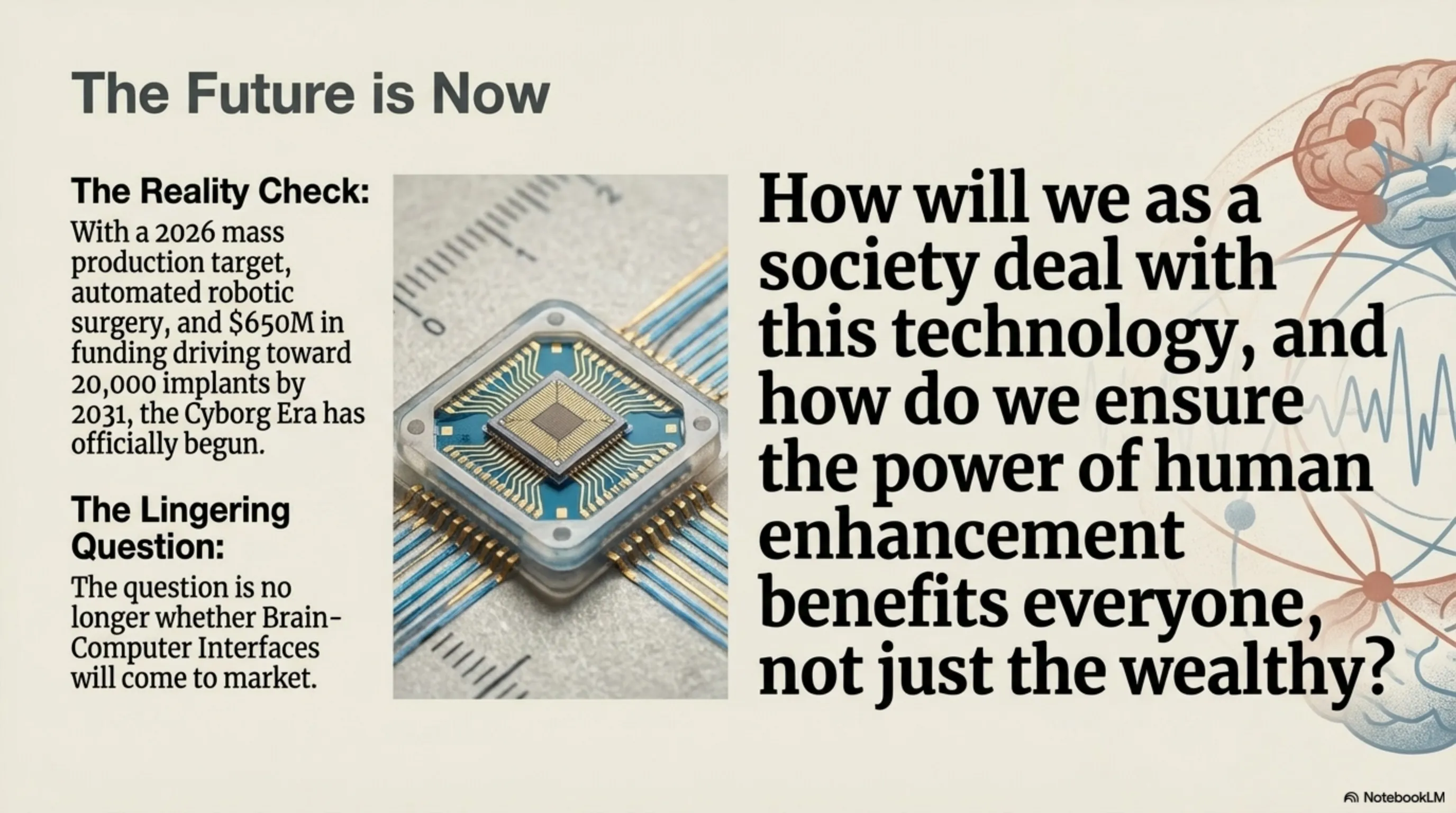
In December 2025, Neuralink raised $650 million in new funding. What's this money for? Scaling production, expanding clinical trials, and preparing for mass production. With this capital, Neuralink aims to reach 20,000 annual implants by the end of 2031.
But who will these patients be? Currently, Neuralink is focusing on three groups:
1. Quadriplegic patients: People who cannot move. Neuralink can allow them to control computers with their thoughts.
2. ALS patients: People who are losing the ability to speak. Neuralink can convert their thoughts into speech.
3. Blind patients: In the future, Neuralink wants to restore vision — by connecting directly to the visual cortex of the brain.
"We want to give people who have lost the ability to speak their voice back. This isn't just technology — it's a human right." — DJ Seo, Co-founder Neuralink
But the path to market is still long. The FDA must confirm safety and efficacy. Insurance must cover costs. The medical community must be trained. And patients must trust.
Real Stories: Noland Arbaugh and Alex
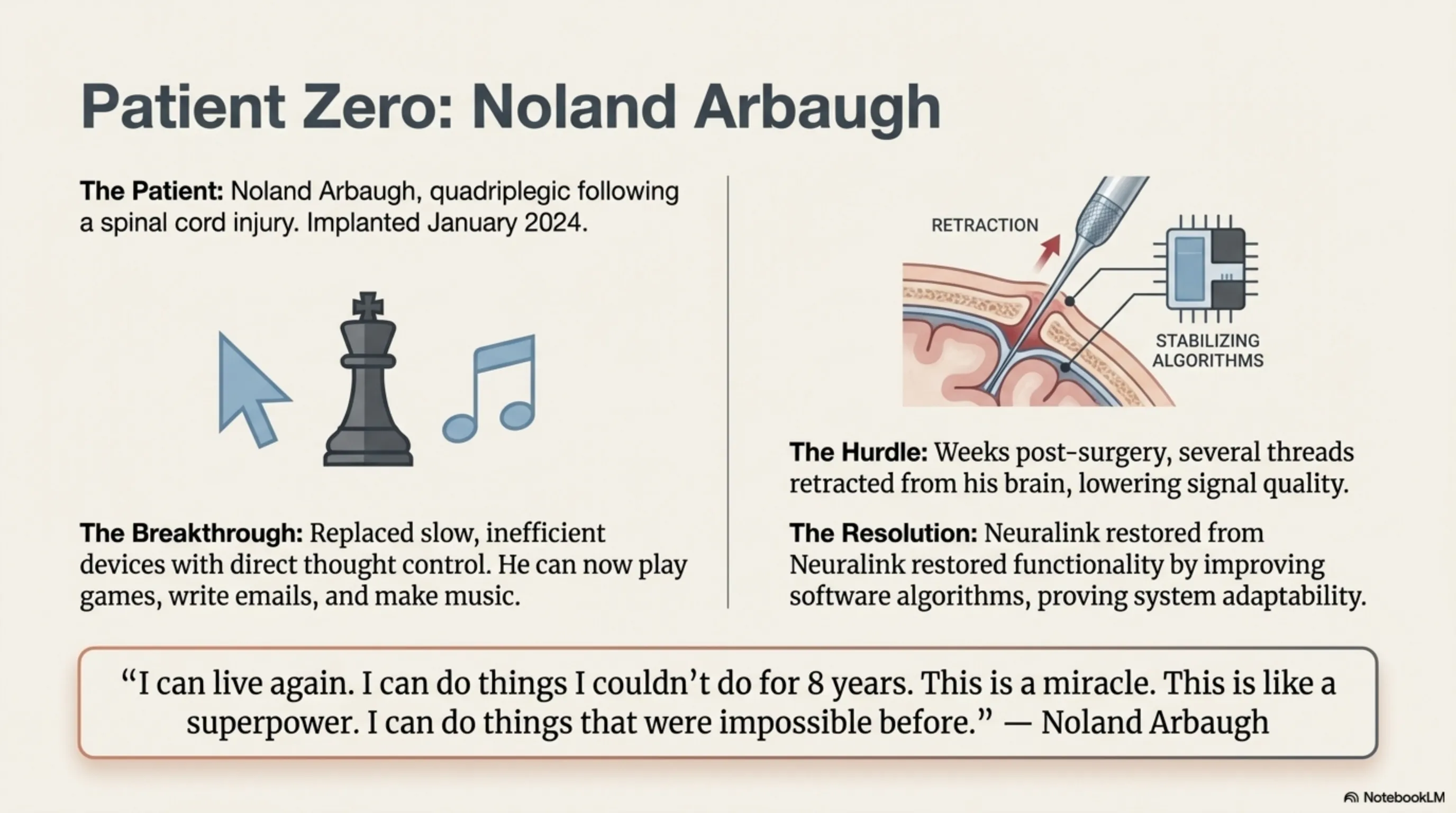
Let's move from theory to reality. Noland Arbaugh — Neuralink's first patient — received the implant in January 2024. He's a quadriplegic patient who suffered a spinal cord injury in a diving accident. Before Neuralink, he couldn't control a computer — except with slow and inefficient devices.
But after the implant? He can control a computer with his thoughts. He can play games, write emails, and even make music. In a video, he said: "This is like a superpower. I can do things that were impossible before."
But Noland's story wasn't without challenges. A few weeks after surgery, some threads retracted from his brain. This was a serious problem — because fewer electrodes mean lower signal quality. But the Neuralink team, by improving software algorithms, was able to restore functionality.
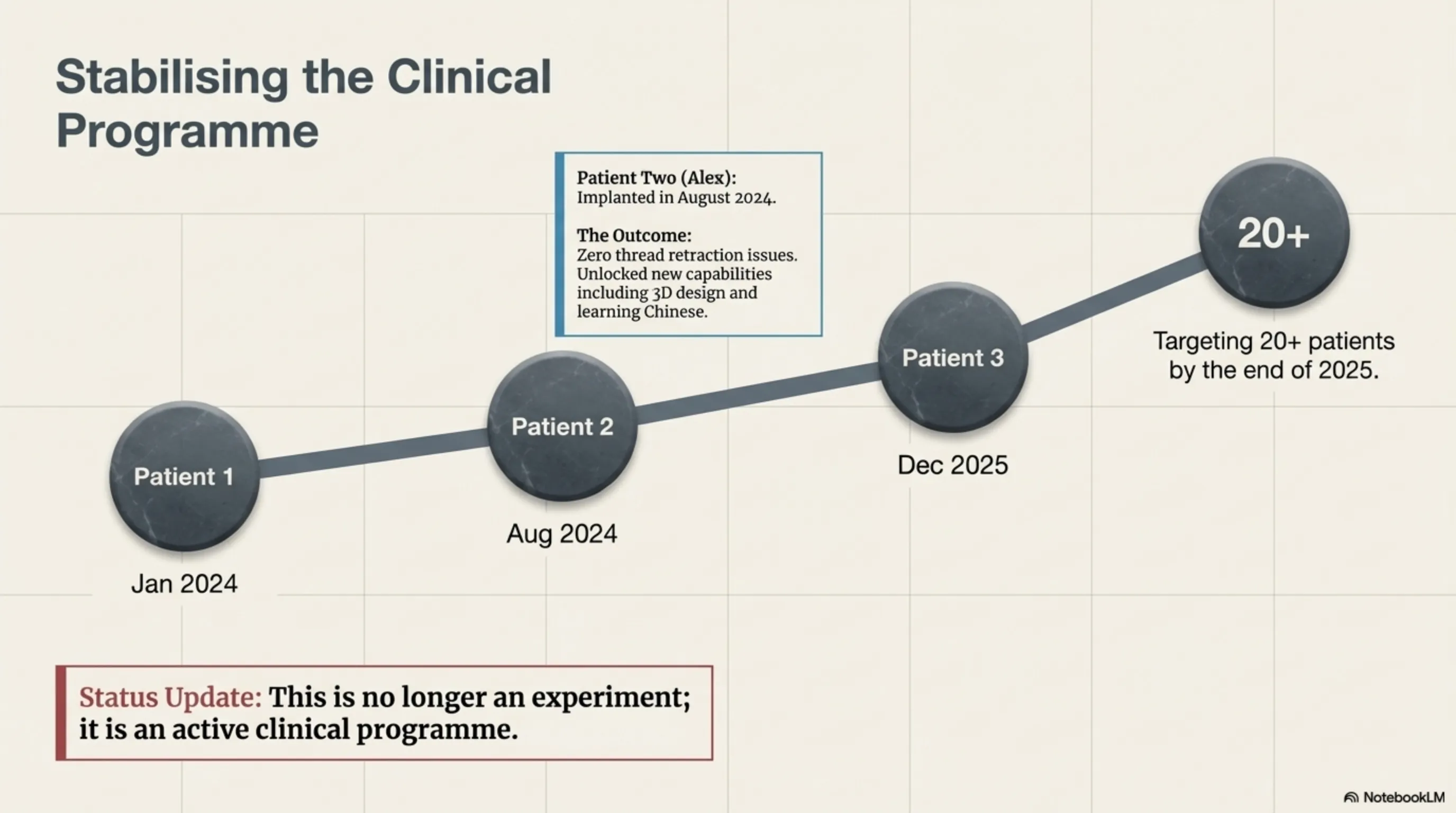
The second patient — Alex — received the implant in August 2024. He's also a quadriplegic patient. But unlike Noland, he had no issues with threads. He can now play video games, do 3D design, and even learn Chinese.
In December 2025, Neuralink announced it had implanted a third patient. And by the end of 2025, the company wants to have 20+ patients. This is no longer an experiment — it's a clinical program.
"I can live again. I can do things I couldn't do for 8 years. This is a miracle." — Noland Arbaugh, Neuralink's first patient
But this is just the beginning. Neuralink wants to move from computer control to speech restoration, vision restoration, and even movement restoration. The future? Humans who can change the world with their thoughts.
The Competition: Synchron, Blackrock, and Precision Neuroscience
Neuralink isn't the only player. The Brain-Computer Interface industry is growing — and competitors are moving fast.
Synchron: This Australian-American company is attracting attention with its minimally invasive approach. Instead of open brain surgery, Synchron inserts its Stentrode device through the jugular vein — like a cardiac stent. This means no skull incision, no brain surgery, and no major risks.
Currently, Synchron has 10 patients — and all of them can control computers with their thoughts. But the limitation? Only 16 electrodes. This means lower signal resolution — and more limited applications.
Blackrock Neurotech: This Utah company has decades of experience. Their Utah Array — a 96-128 electrode array — has been used in dozens of clinical trials. But the problem? Rigid electrodes that can damage brain tissue.
However, Blackrock is working on a new generation of flexible electrodes — and may soon become a serious Neuralink competitor.
Precision Neuroscience: This company was founded by one of Neuralink's early co-founders. Their approach? Surface electrodes that sit on the brain's surface — without penetrating tissue. This means lower risk, but also lower signal resolution.
Precision is conducting clinical trials — and may be useful for specific applications (such as brain mapping before surgery).
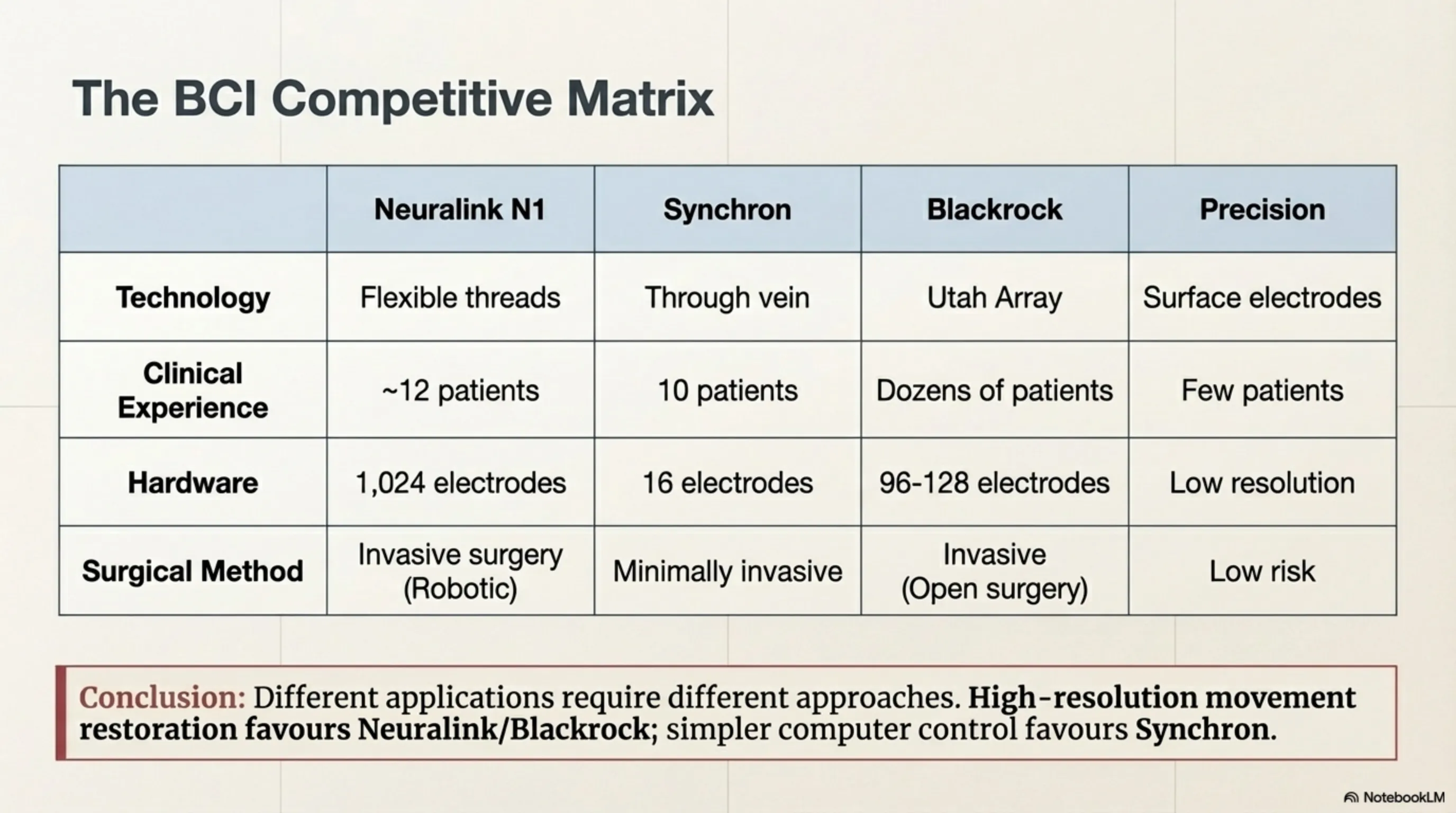
| Company | Approach | Patient Count | Main Advantage | Main Limitation |
|---|---|---|---|---|
| Neuralink | Flexible threads | ~12 | 1,024 electrodes | Invasive surgery |
| Synchron | Through vein | 10 | Minimally invasive | Only 16 electrodes |
| Blackrock | Utah Array | Dozens | Long experience | Rigid electrodes |
| Precision | Surface electrodes | Few | Low risk | Low resolution |
So who will win? Probably everyone. Because different applications require different approaches. For precise control (like movement restoration), you need high resolution — Neuralink or Blackrock. For simpler applications (like computer control), Synchron may be sufficient.
Risks and Challenges: Security, Privacy, and Brain Hacking
But let's be honest: connecting brains to the internet has serious risks. And these risks aren't just technical — they're ethical, social, and even existential.
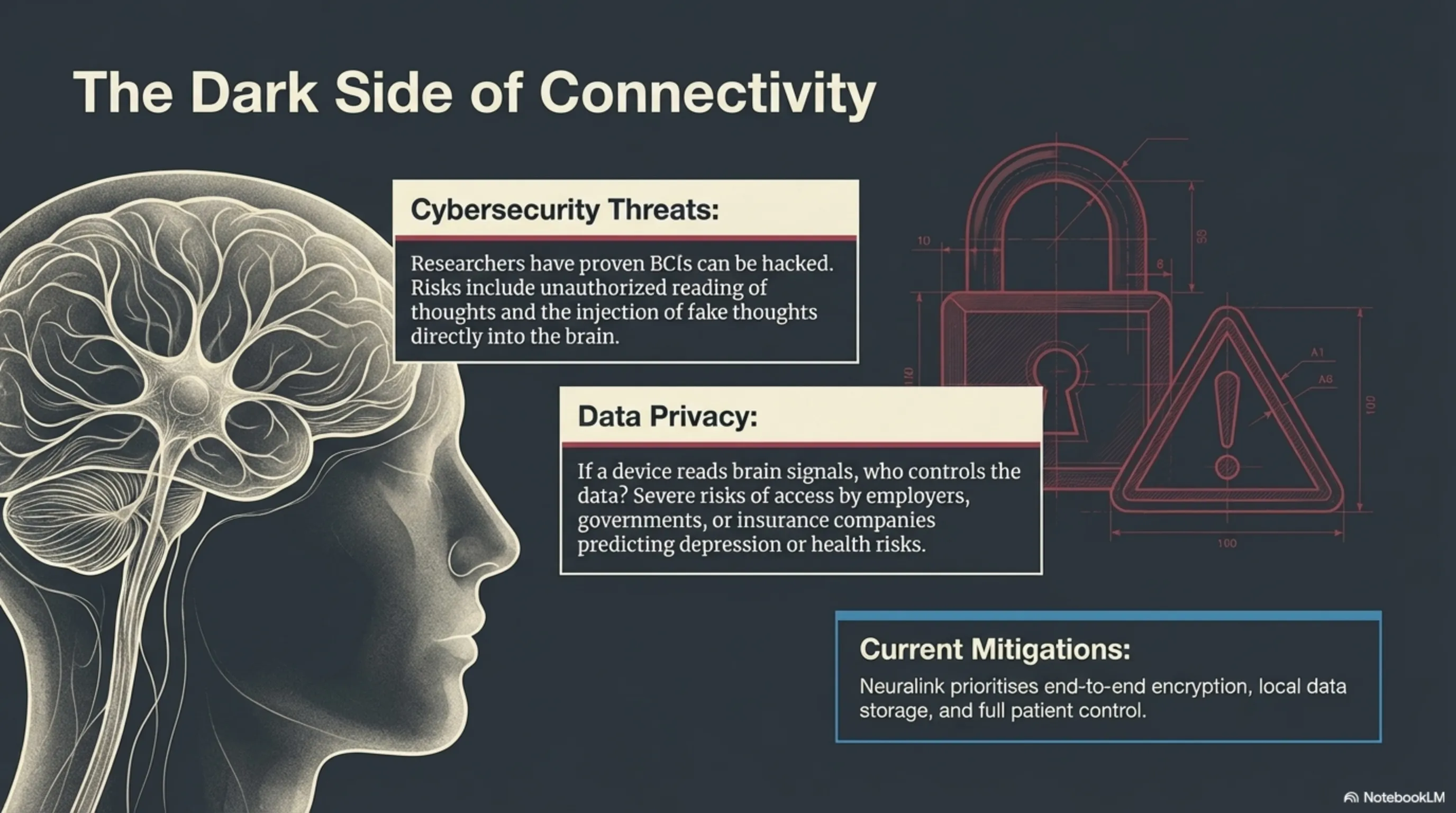
1. Cybersecurity: If your brain is connected to the internet, can it be hacked? Answer: Yes. Researchers have already shown that Brain-Computer Interfaces can be hacked — and hackers can read or even alter brain signals.
Imagine a hacker could read your thoughts. Or worse — could send fake thoughts to your brain. This is no longer a science fiction movie — it's a real risk.
2. Privacy: If Neuralink can read your brain signals, who has access to that data? The company? The government? Insurance companies? Employers?
Imagine your employer could know what you're thinking about. Or your insurance could know you're at risk for depression. This is a privacy nightmare.
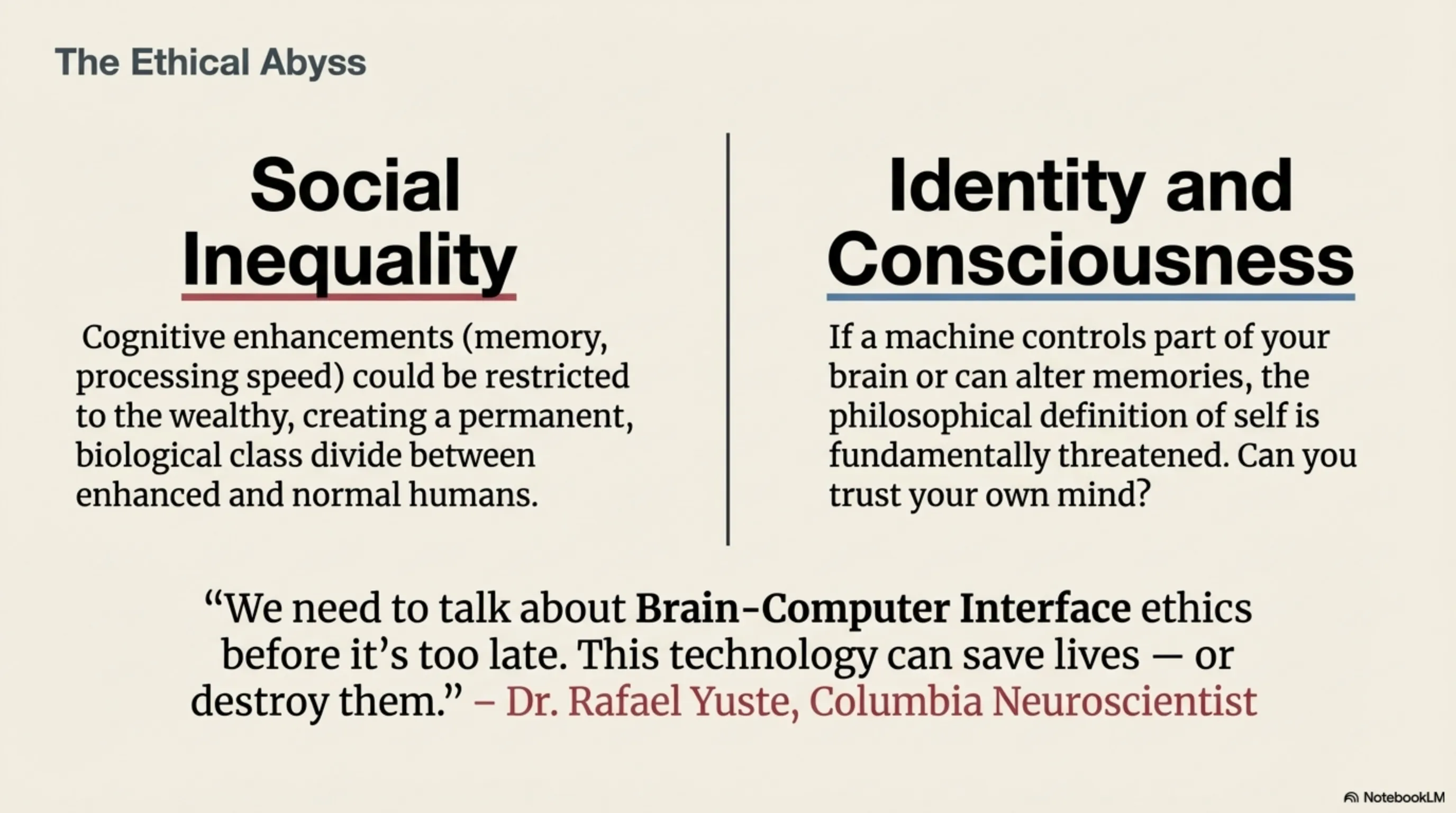
3. Social Inequality: If Neuralink can enhance cognitive abilities (like memory, intelligence, or processing speed), who will have access? Only the wealthy?
This could lead to a new class divide: "enhanced" humans versus "normal" humans. And this could fundamentally change society.
4. Identity and Consciousness: If part of your brain is a machine, are you still "you"? If Neuralink can create fake memories, can you trust your own memories?
These are philosophical questions — but they'll soon become practical.
"We need to talk about Brain-Computer Interface ethics before it's too late. This technology can save lives — or destroy them." — Dr. Rafael Yuste, Columbia Neuroscientist
Neuralink says security and privacy are top priorities. The company uses end-to-end encryption, stores data locally, and gives patients full control. But is this enough? Time will tell.
The Future: From Treatment to Enhancement
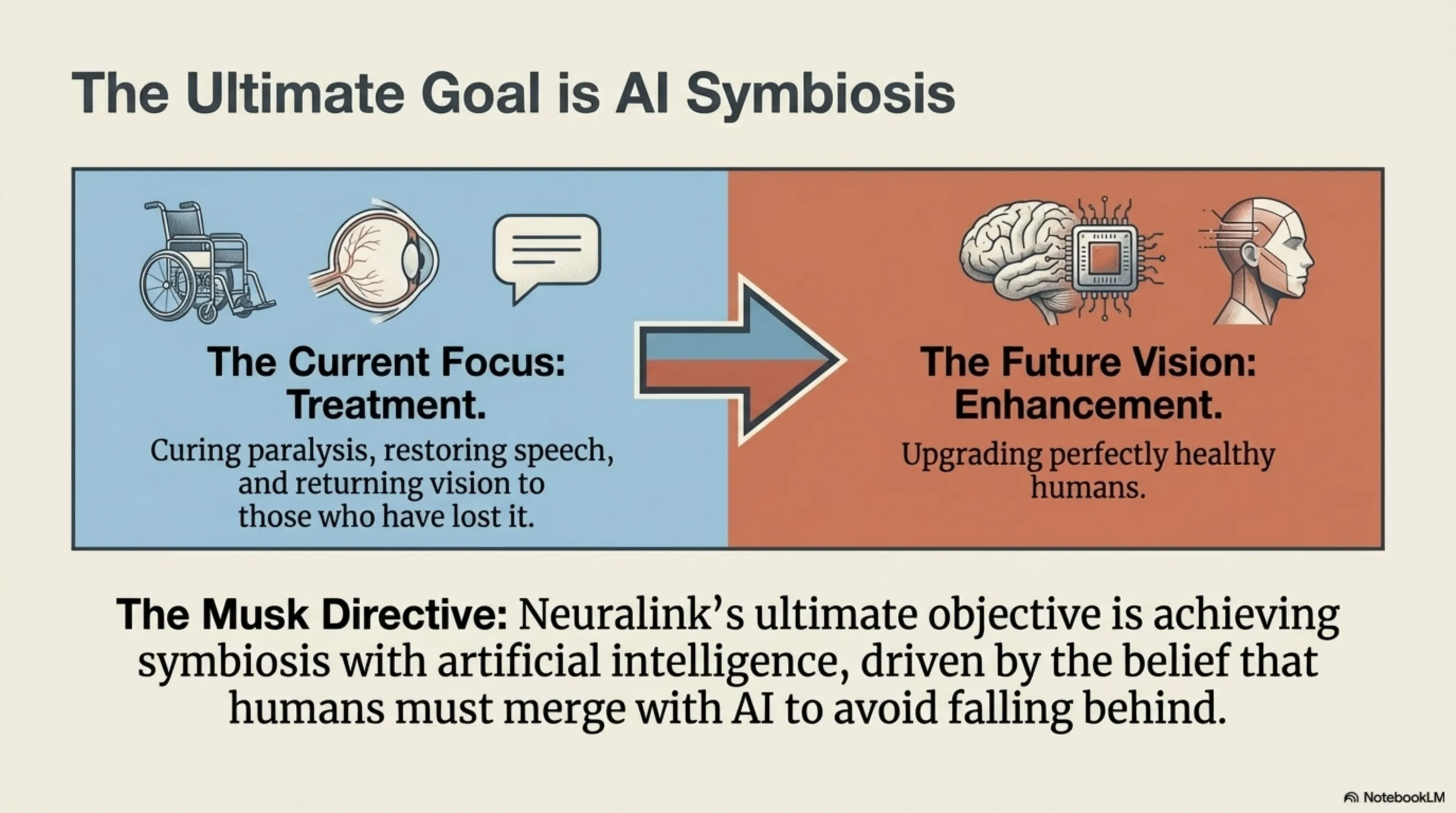
Currently, Neuralink focuses on treatment: helping paralyzed people, restoring speech, restoring vision. But the future? Enhancement — upgrading healthy humans.
Elon Musk has repeatedly said that Neuralink's ultimate goal is "symbiosis with artificial intelligence." He believes humans must merge with AI — or fall behind.
Imagine you could:
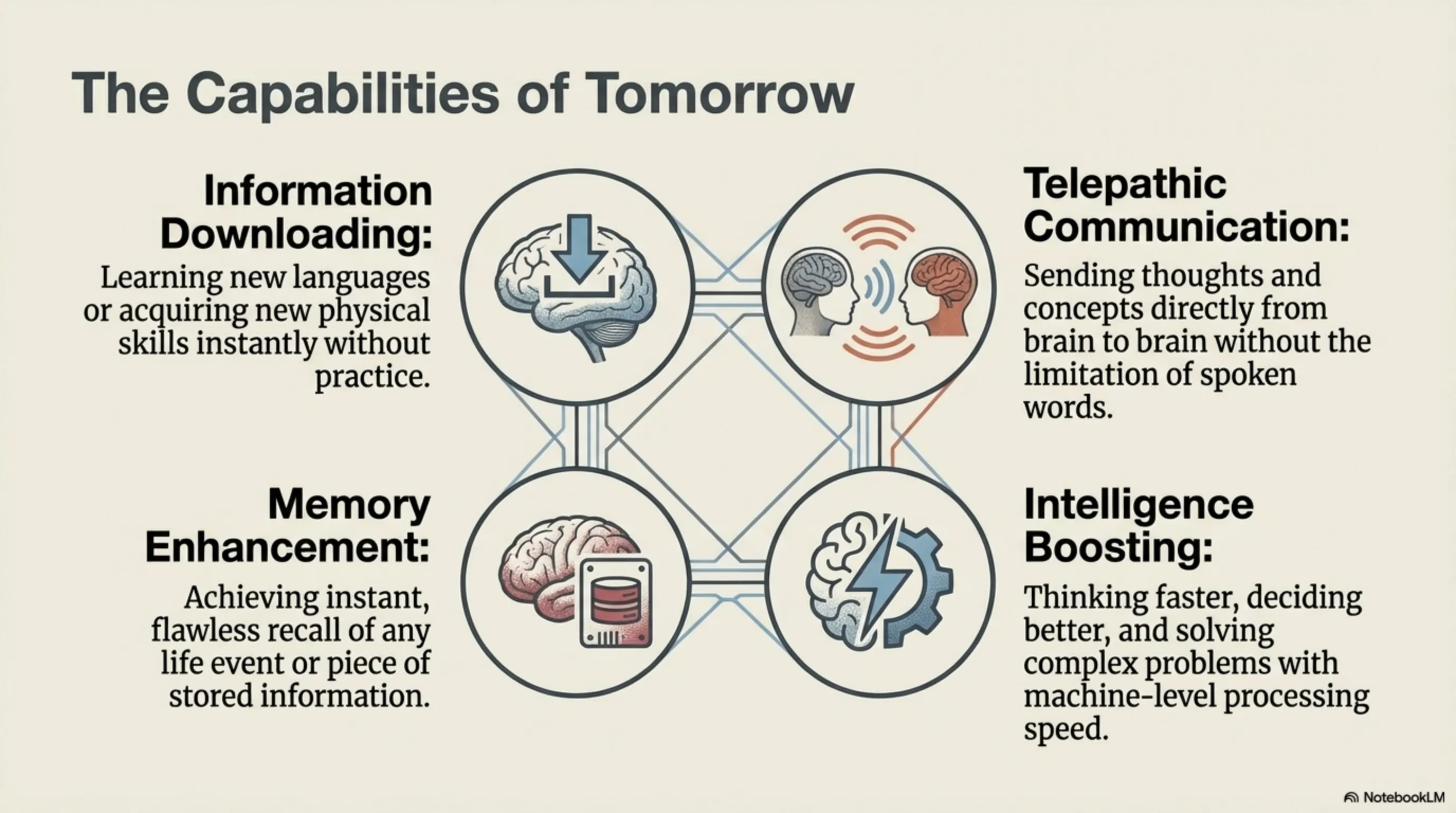
• Download information directly: Learn a new language in seconds? Download a new skill without practice?
• Communicate telepathically with others: Send thoughts directly from brain to brain, without words?
• Enhance your memory: Never forget anything, have instant access to any memory?
• Boost your intelligence: Think faster, decide better, solve complex problems?
This is no longer science fiction — it's the future Neuralink is building. But is society ready?
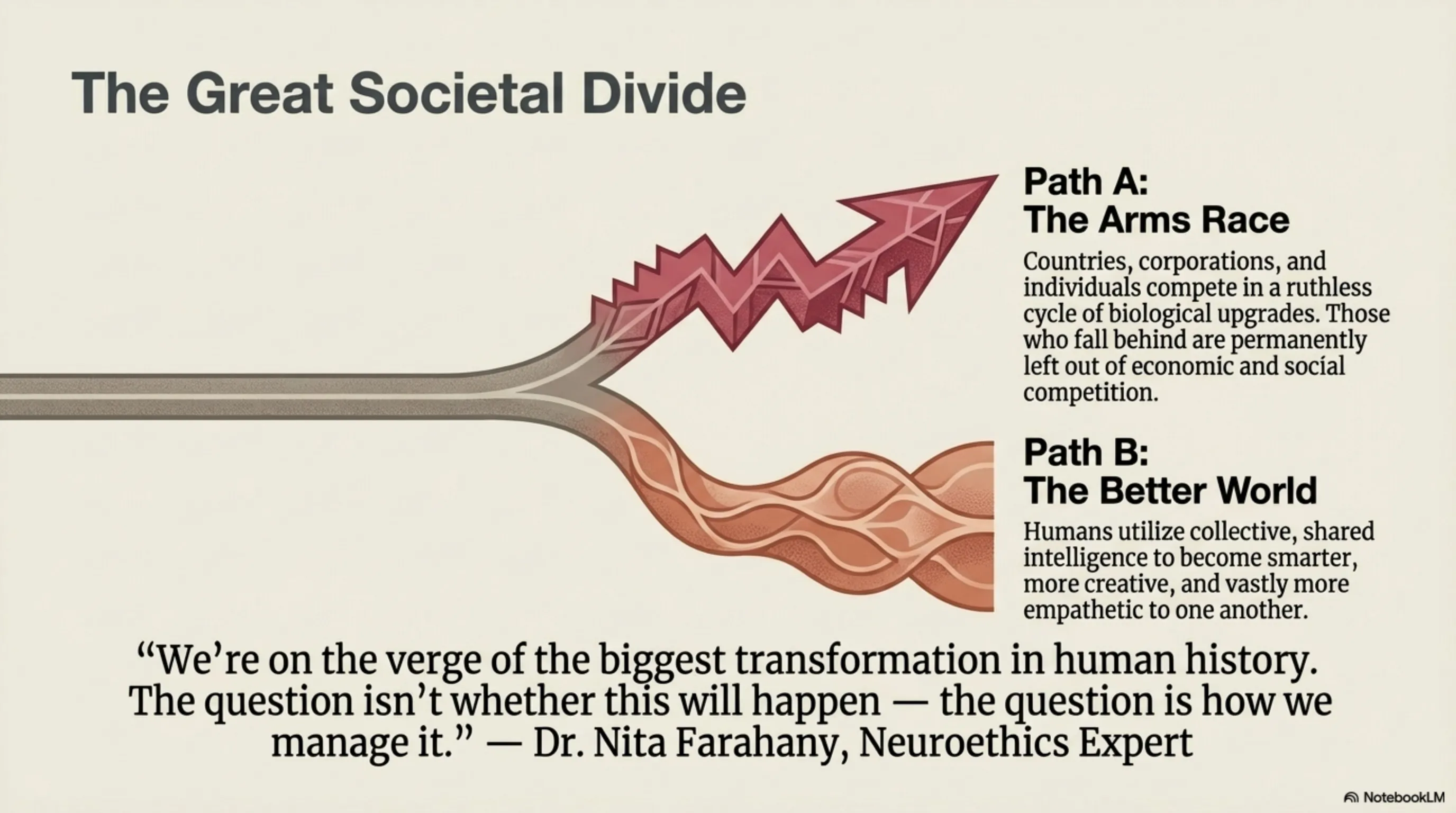
Some experts believe Enhancement could lead to an arms race: countries, companies, and individuals striving to upgrade themselves — and those who fall behind get left out of competition.
Others believe Enhancement could lead to a better world: humans who are smarter, more creative, and more empathetic.
The reality? Probably somewhere in between. But one thing is certain: the future is coming — and we need to be ready.
"We're on the verge of the biggest transformation in human history. The question isn't whether this will happen — the question is how we manage it." — Dr. Nita Farahany, Neuroethics Expert
Neuralink says Enhancement is still years away. But at the current pace of progress, it may happen sooner than we think.
Conclusion: The Cyborg Era Has Begun
Neuralink is no longer an experiment — it's a reality. With the announcement of mass production in 2026, nearly fully automated surgery, $650 million in new funding, and a target of 20,000 annual implants by 2031, the company is moving from lab to market.
But this isn't just about Neuralink. It's about an emerging industry: Synchron with its minimally invasive approach, Blackrock with its long experience, Precision with its surface electrodes. All are moving toward a future where brains connect to machines.
The risks are real: cybersecurity, privacy, social inequality, and existential questions about identity. But the opportunities are also real: restoring speech, restoring vision, restoring movement — and perhaps one day, enhancing humanity itself.
The question is no longer whether Brain-Computer Interfaces will come to market. The question is: How will we as a society deal with this technology? How will we use it? And how will we ensure it benefits everyone — not just the wealthy?
Welcome to the Cyborg Era. The line between human and machine is blurring — and the future is now.
Special Cyborg Era Gallery