In an unprecedented transformation, Agentic AI adoption in enterprise companies has surged from 11% in 2024 to 79% in 2026 — a 7x growth in just 24 months, marking the fastest enterprise technology adoption in history. This revolution isn't just about numbers; it's about a fundamental shift from Copilot (reactive assistant) to Agent (autonomous coworker) that's reshaping how organizations operate. The Agentic AI market has grown from $7.9 billion in 2024 to $9.89 billion in 2026 and is projected to reach $195 billion by 2034. But beyond the numbers, it's the real ROI that's convinced CFOs: 40-70% operational cost reduction, 3-5x productivity improvements, and an average 192% ROI in 18 months. 74% of executives report positive ROI in the first year — some in just 4-6 weeks. The key difference between Copilot and Agentic AI lies in autonomy, persistence, and scope. Copilot is reactive, stateless, and human-driven — it just helps you work faster. Agent is proactive, with persistent memory and goal-driven — it executes entire workflows for you. This is the shift from "How can I help?" to "I'll handle it." The OpenClaw phenomenon demonstrates the power of this transformation. This open-source project launched in November 2025 now has over 180,000 GitHub stars, 100,000+ active installations, and 30% enterprise adoption — the fastest growth in open-source project history. OpenClaw manages emails, browses the web, executes code, and integrates with Slack, Teams, and other platforms — all running locally on your hardware. Real use cases show the impact: In customer support, agents resolve 65% of queries without human intervention at $0.25-$0.50 per interaction (vs $3-6 for humans) with 70% higher satisfaction. In lead qualification, 4-7x better conversion rates. In IT, automated ticket resolution and predictive maintenance. In DevOps, automated code review, testing, and deployment. But challenges are real: Shadow IT is spreading faster than security can manage. A one-click RCE vulnerability in OpenClaw exposed over 30,000 instances. 386 malicious extensions on the ClawHub marketplace. Integration is complex. Change management is difficult. And pricing models are evolving (67% moving to usage-based by 2027). Predictions are bold: By 2028, 33% of enterprise software will have agentic AI and 15% of work decisions will be autonomous. By 2029, 50% of knowledge workers will create and manage agents. By 2030, agents will be the default interface for enterprise software and the agentic economy will reach $3-5 trillion. The question is no longer whether you should adopt Agentic AI — it's how fast you can do it before your competitors leave you behind. With proven ROI, real use cases, and mass adoption, Agentic AI has moved from experiment to business necessity.
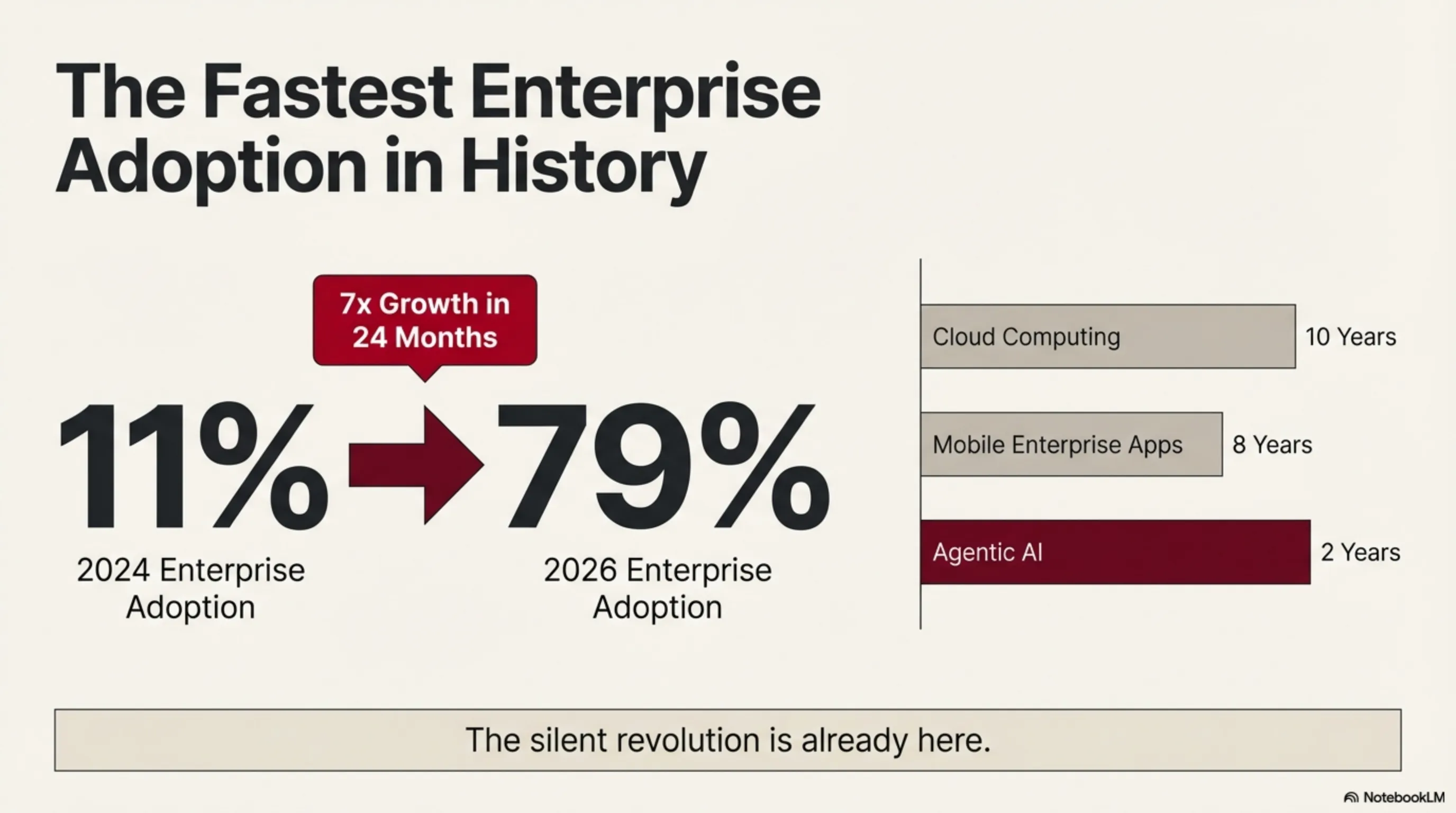
In 2024, only 11% of enterprises used AI agents. In 2026, that number hit 79% — a 7x growth in just two years. This is the fastest enterprise technology adoption in history. But this isn't just about numbers — it's about a fundamental shift: from Copilot that helps you work, to Agent that works for you. From AI assistant to AI coworker. From optimizing how humans work to changing what humans work on. Welcome to the Agentic AI era — where a $195 billion market is taking shape.
The Silent Revolution: From 11% to 79% in Two Years
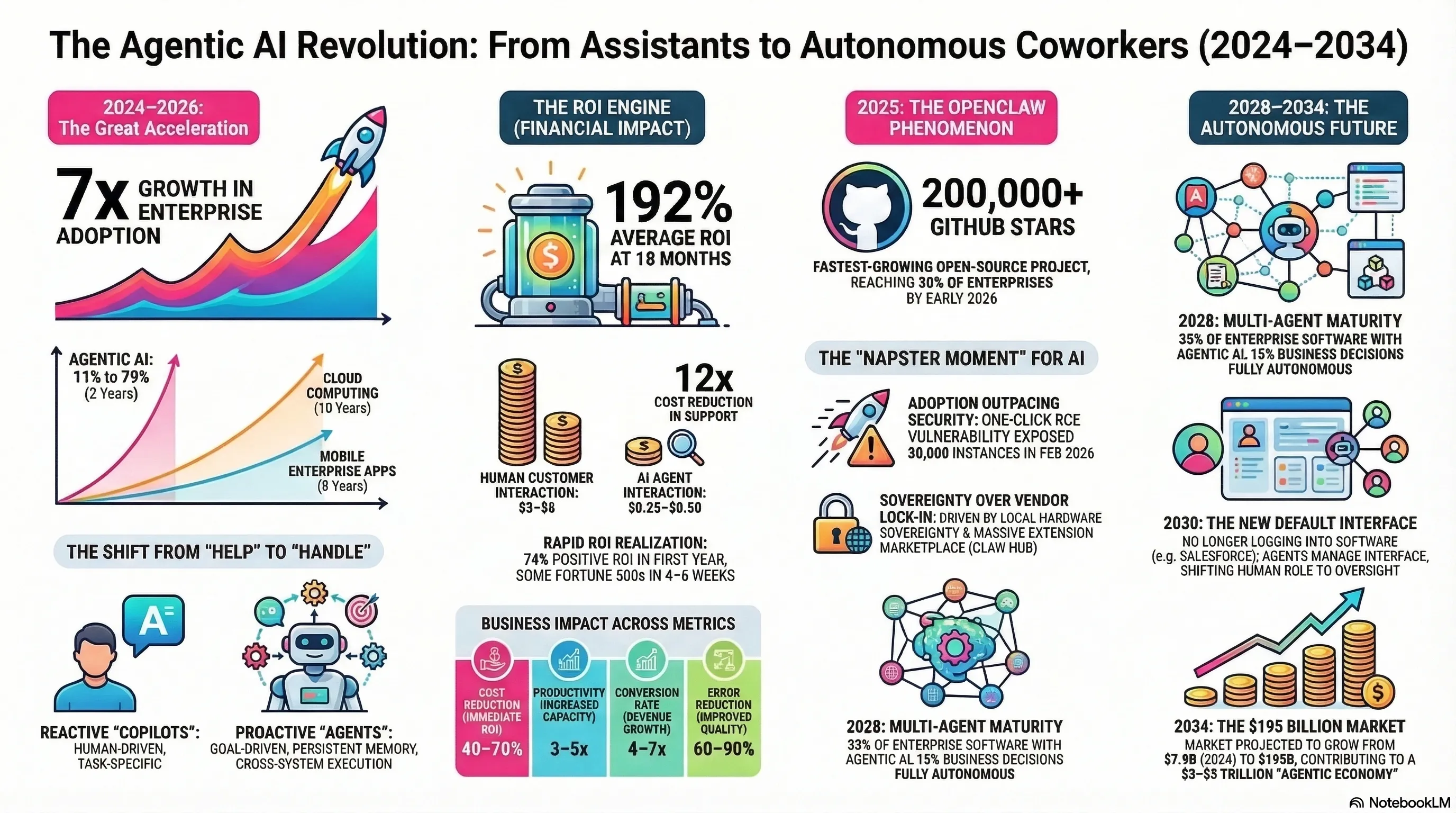
Let's start with numbers that are truly staggering. According to PwC's 2026 survey, 79% of enterprise companies now use AI agents. This is up from just 11% in 2024. A 7x growth in just 24 months.
To understand how fast this is, let's compare with other technology adoptions: Cloud Computing took about 10 years to reach 70% adoption. Mobile Enterprise Apps took about 8 years. But Agentic AI? Just 2 years. This is the fastest enterprise technology adoption in history.
But why did this happen? What made companies rush to Agentic AI at this speed? The answer is simple: ROI. Real, measurable, and fast return on investment.
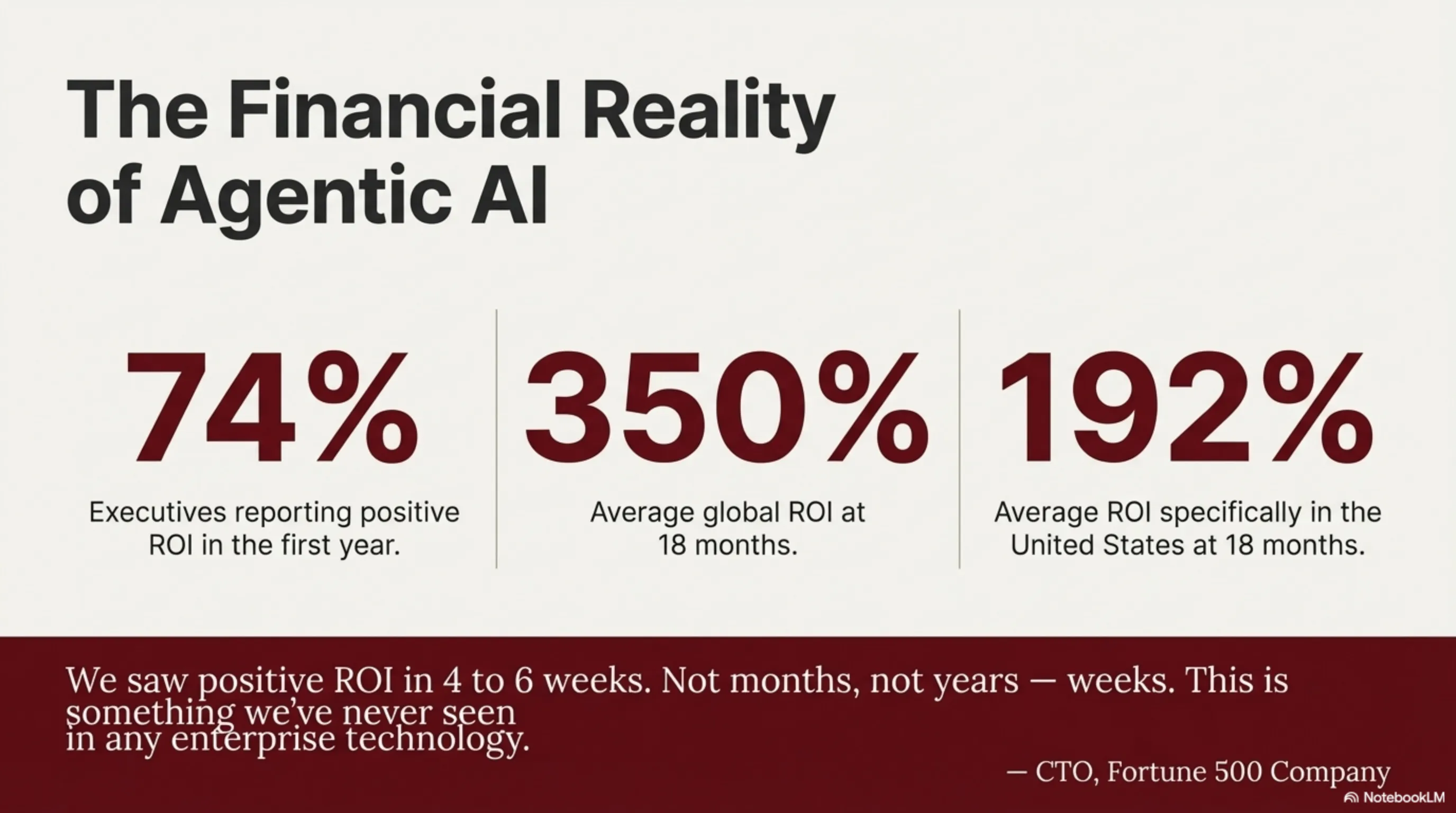
"We saw positive ROI in 4 to 6 weeks. Not months, not years — weeks. This is something we've never seen in any enterprise technology." — CTO of a Fortune 500 company
According to research, 74% of executives report ROI in the first year. Average ROI at 18 months? 350%. In the United States, this number reaches 192%. These numbers are no longer hype — this is reality.
| Year | Enterprise Adoption | Market Size | Key Milestone |
|---|---|---|---|
| 2024 | 11% | $7.9B | Early adopters |
| 2026 | 79% | $9.89B | Mass adoption |
| 2028 | 85%+ | $30B+ | Standard practice |
| 2030 | 95%+ | $52B | Default interface |
From Copilot to Agent: The Fundamental Shift
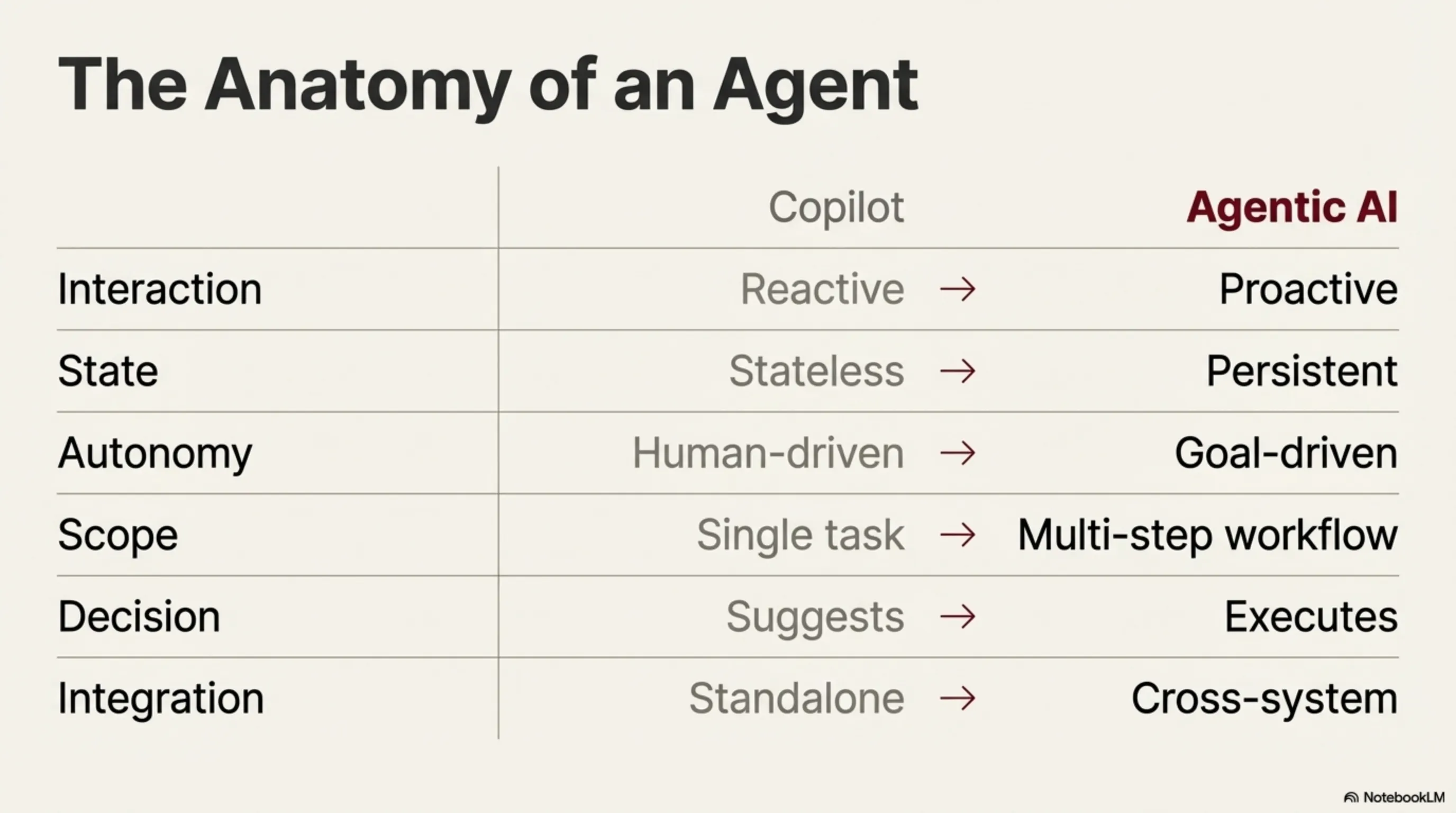
To understand why Agentic AI is so transformative, we need to understand the difference between Copilot and Agent. This isn't just a technical difference — it's a paradigm shift.
Copilot (2023-2025): A reactive assistant. You give it a prompt, it responds. No memory between sessions. No autonomy. No multi-step planning capability. Just a smart tool that helps you work faster.
Agent (2026+): An autonomous coworker. You give it a goal, it plans, executes, and reports. With persistent memory. With decision-making capability. With multi-system coordination ability. This is no longer just a tool — it's a team member.
| Aspect | Copilot | Agentic AI |
|---|---|---|
| Interaction | Reactive | Proactive |
| State | Stateless | Persistent |
| Autonomy | Human-driven | Goal-driven |
| Scope | Single task | Multi-step workflow |
| Decision | Suggests | Executes |
| Integration | Standalone | Cross-system |
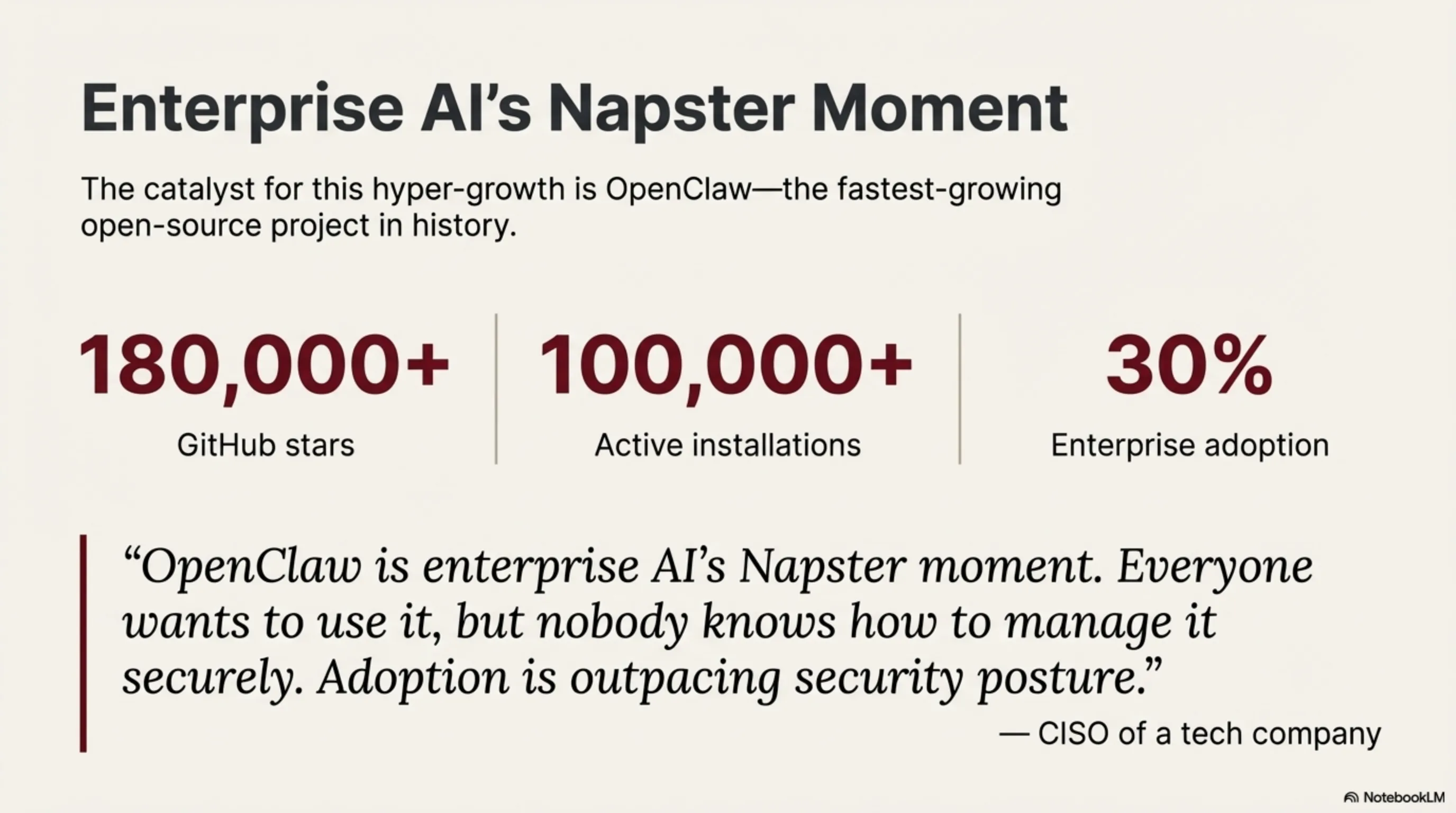
This is the shift from "How can I help?" to "I'll handle it." From assistance to delegation. From optimizing how humans work to changing what humans work on. From Copilot to Autopilot.
"Copilot helped me write emails faster. Agent reads emails, prioritizes them, responds to routine ones, and only escalates important ones to me. That's the difference between assistance and delegation." — Product Manager at a SaaS company
The OpenClaw Phenomenon: Enterprise AI's Napster Moment
If you want to understand why Agentic AI was adopted so quickly, we need to talk about OpenClaw. This open-source project launched in November 2025 has had the fastest growth in open-source project history.
Staggering numbers: As of February 2026, OpenClaw has between 180,000 to 215,000 GitHub stars. Over 100,000 active installations. 2 million visitors within days of going viral. And most importantly: 30% of enterprise companies have adopted it.
What does OpenClaw do? Everything. Email management. Web browsing. Code execution. Task scheduling. Writing extensions. Coordinating sub-agents. Connecting to Slack, Teams, WhatsApp, Telegram, Discord. And all of this runs locally on your hardware.
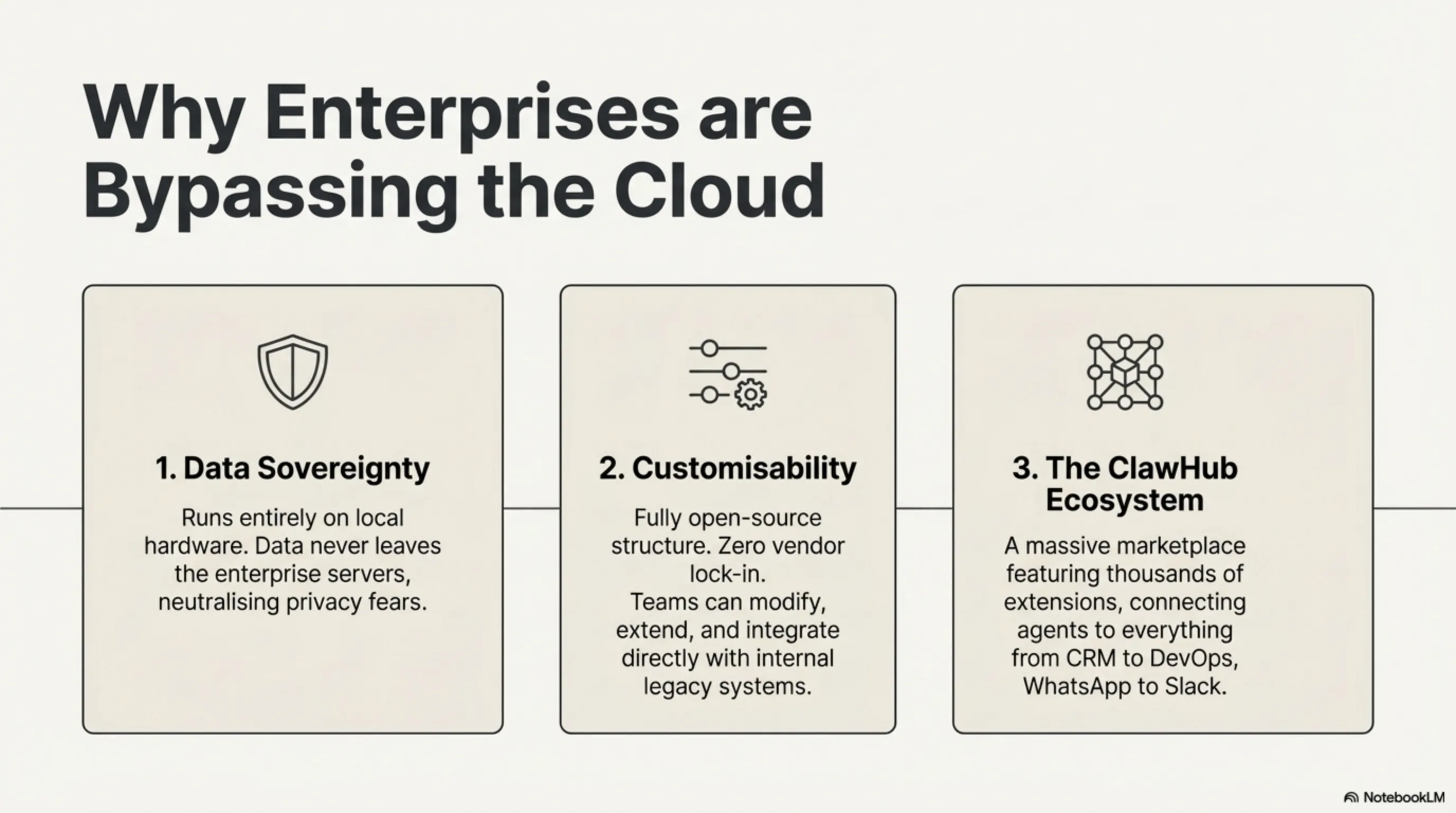
But why did OpenClaw become so popular? Three reasons:
1. Data sovereignty: Unlike cloud solutions, OpenClaw runs on your hardware. Your data never leaves your servers. For companies worried about privacy and security, this is a game-changer.
2. Customizability: OpenClaw is fully open-source. You can modify it, extend it, and integrate it with your internal systems. No vendor lock-in.
3. Ecosystem: ClawHub, OpenClaw's extension marketplace, has thousands of extensions. From CRM integrations to DevOps automation. If you need it, there's probably an extension for it.
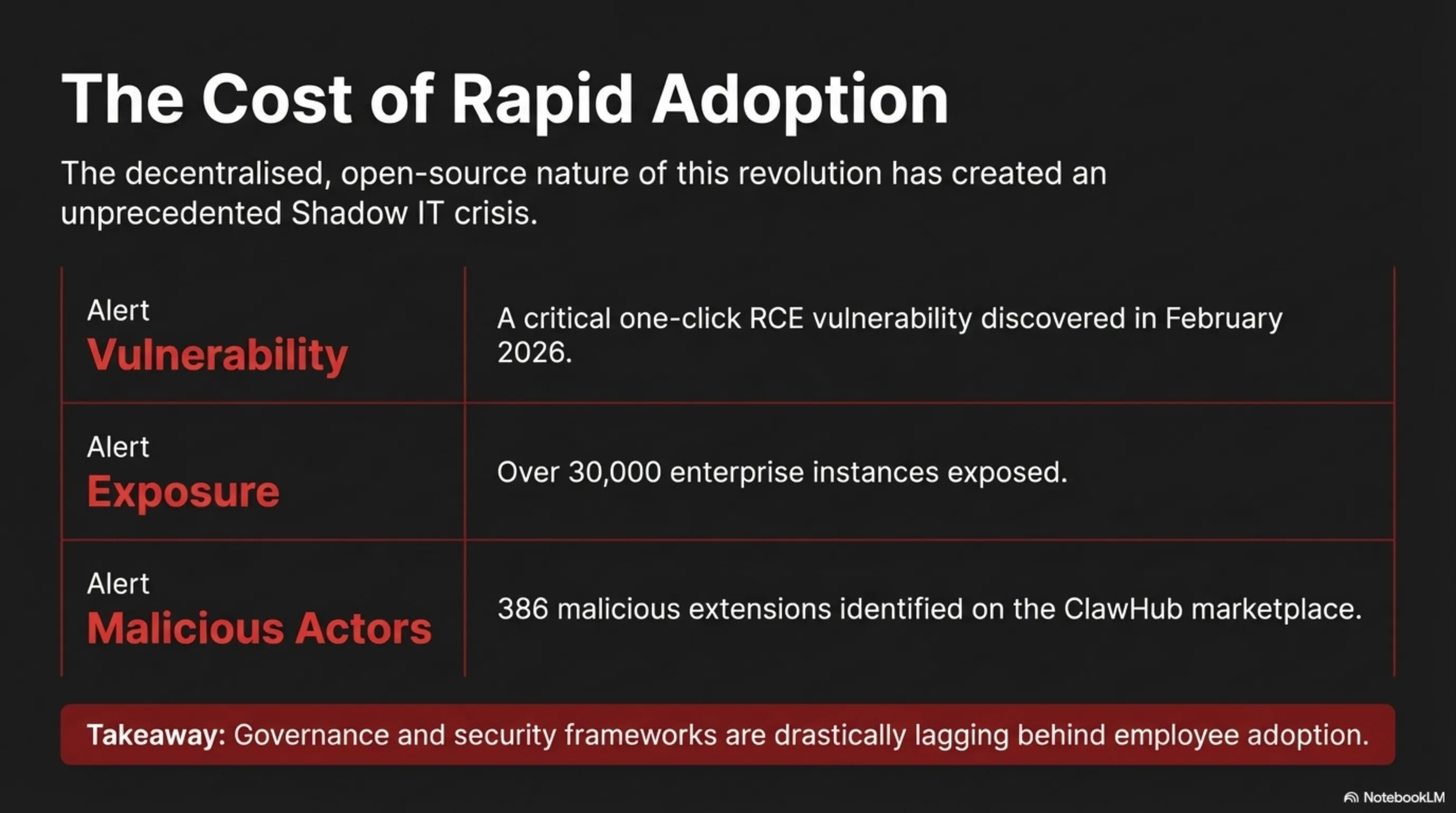
But this rapid growth comes at a cost: security. In February 2026, a one-click RCE vulnerability was discovered. Over 30,000 instances exposed. 386 malicious extensions on ClawHub. Shadow IT spreading faster than security can manage.
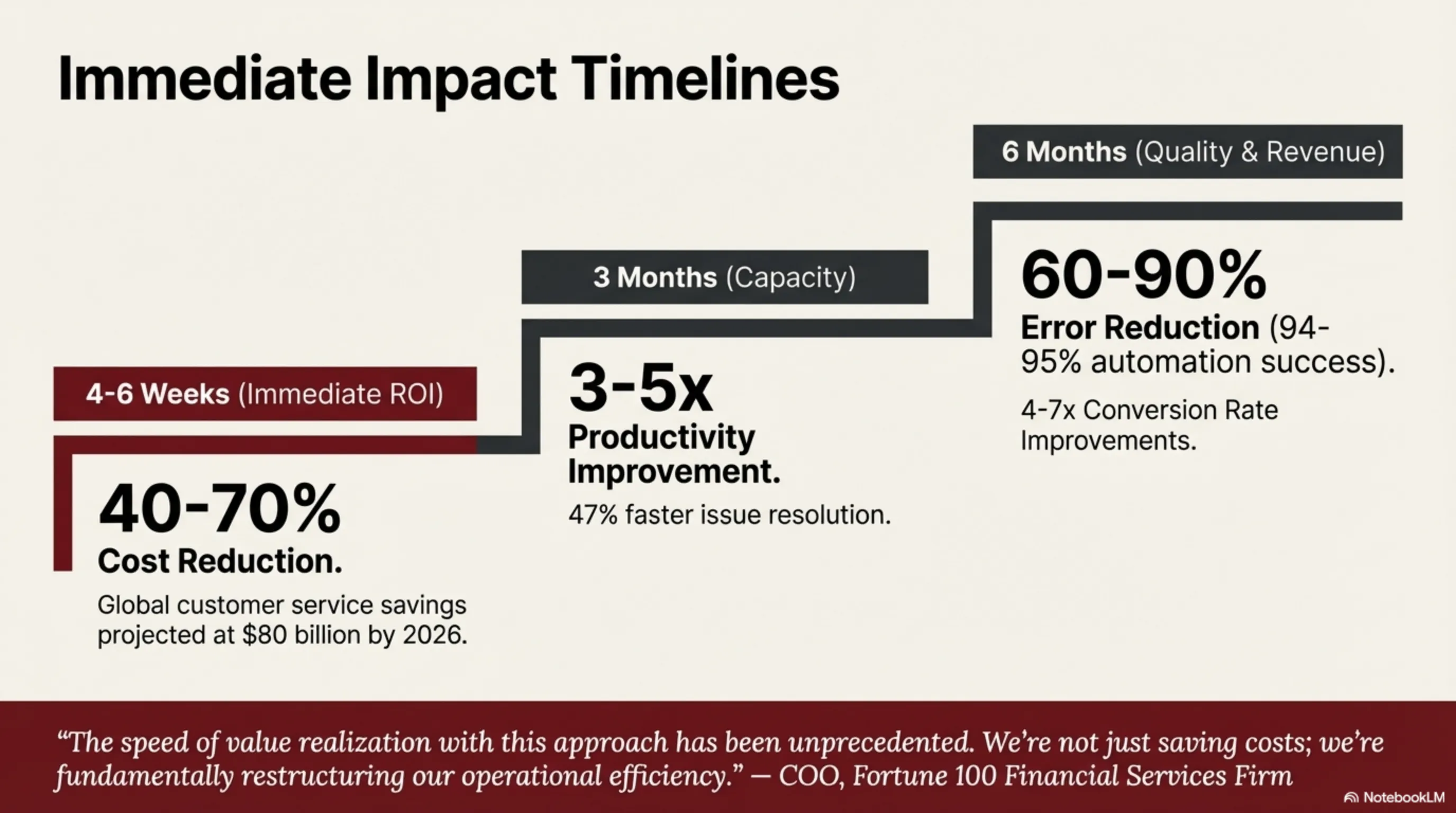
"OpenClaw is enterprise AI's Napster moment. Everyone wants to use it, but nobody knows how to manage it securely. Adoption is outpacing security posture." — CISO of a tech company
Real ROI: Why CFOs Love Agentic AI
Let's talk about what really matters: money. How much does Agentic AI save? How much does it increase productivity? And most importantly, what's the real ROI?
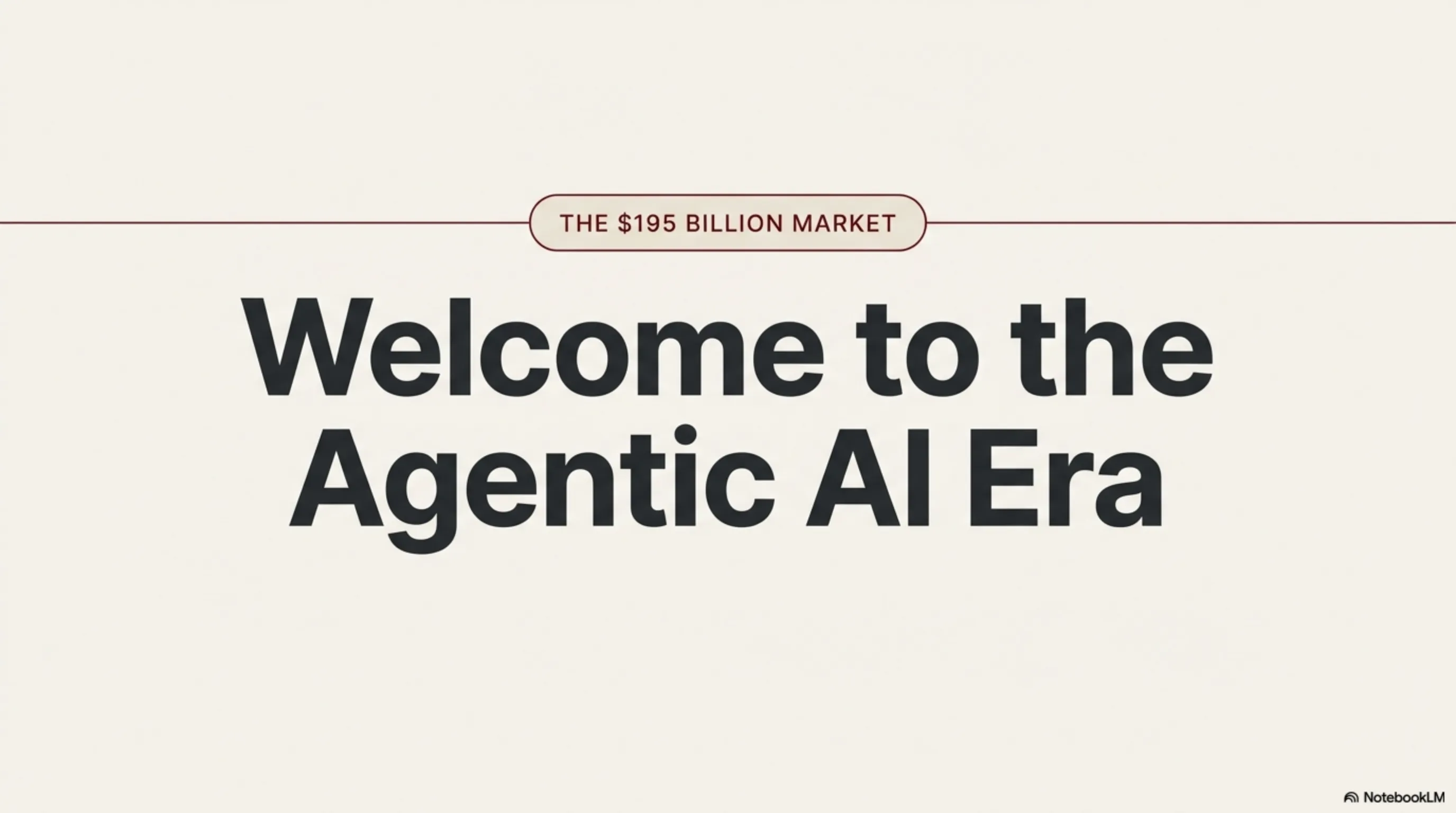
Cost reductions: Companies report 40-70% operational cost reduction. 60-80% labor cost reduction. 85-90% cost per interaction reduction. By 2026, global savings in customer service reach $80 billion.
Productivity gains: 3-5x productivity improvements. 4-7x conversion rate improvements. 47% faster issue resolution. 65% of queries resolved without human intervention.
Error reduction: 60-90% error reduction. 94-95% automation success rates. This is no longer an experiment — this is production.
| Metric | Improvement | Timeline | Business Impact |
|---|---|---|---|
| Cost reduction | 40-70% | 4-6 weeks | Immediate ROI |
| Productivity | 3-5x | 3 months | More capacity |
| Conversion rate | 4-7x | 6 months | Revenue growth |
| Error reduction | 60-90% | 6 months | Better quality |
| Overall ROI | 192% | 18 months | Competitive advantage |
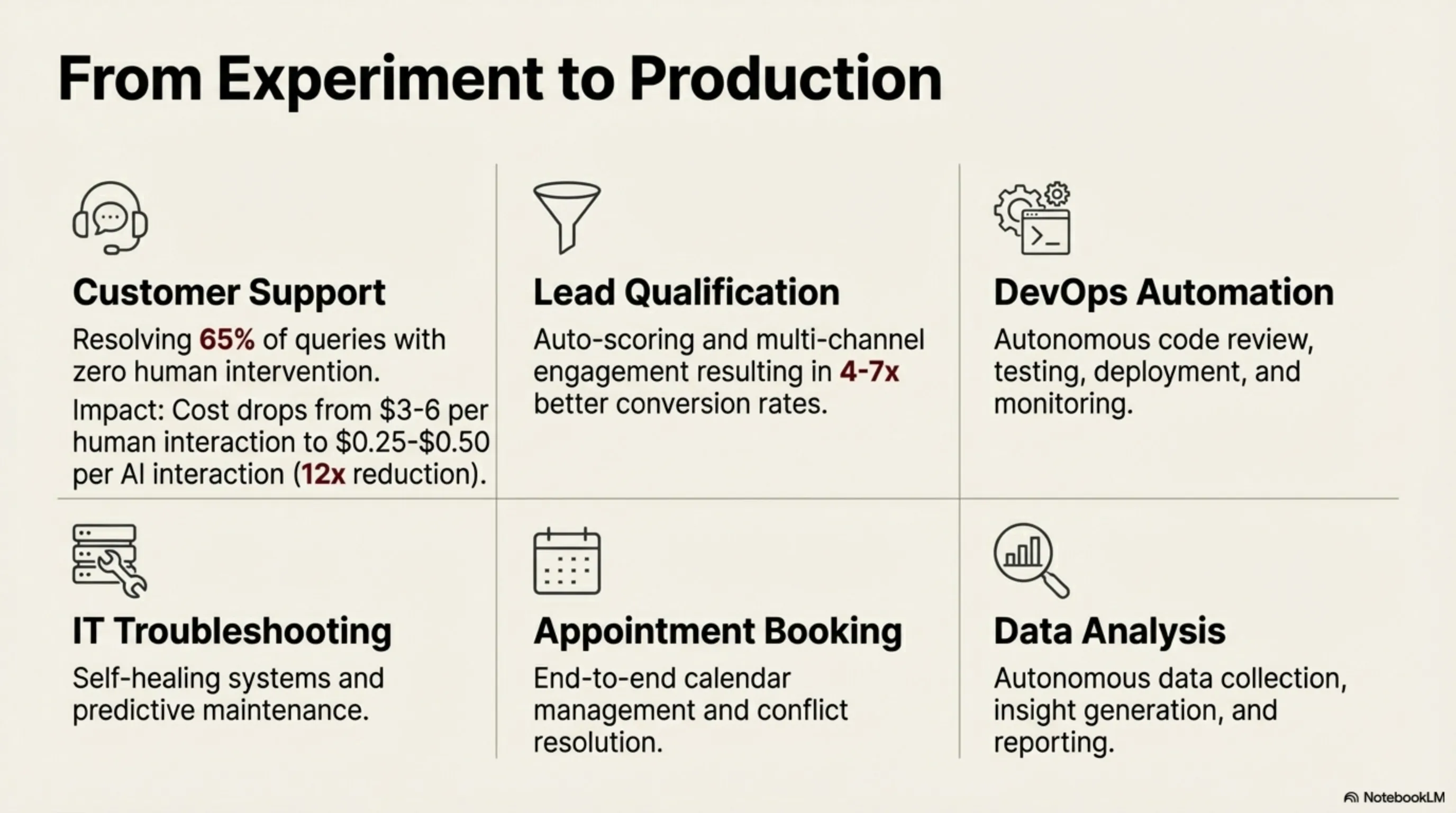
Let's look at a real example: Customer support. A human interaction costs $3-6. An AI agent interaction? $0.25-$0.50. That's a 12x cost reduction. And quality? 70% higher customer satisfaction. 65% of queries resolved without human intervention.
Or Lead qualification. Agents can automatically score and route leads. Multi-channel engagement. Real-time prioritization. Result? 4-7x better conversion rates.
"We saw 74% ROI in the first year. At 18 months, our ROI reached 350%. This is no longer an experiment — it's a business necessity." — CFO of a retail company
Use Cases: From Customer Support to DevOps
Agentic AI isn't just for one industry or one task. It's changing every part of business. Let's look at some real use cases:
1. Customer Support: Agents can resolve 65% of queries without human intervention. They can respond in multiple languages. They can maintain context across interactions. And they never get tired, never get sick, and never take vacations.
2. Lead Qualification: Agents can automatically score leads. They can engage across multiple channels (email, chat, phone). They can route high-priority leads to sales. Result? Better conversion rates and shorter sales cycles.
3. IT Troubleshooting: Agents can automatically resolve tickets. They can run self-healing systems. They can perform predictive maintenance. This means fewer outages, less downtime, and happier IT teams.
4. Appointment Booking: Agents can manage calendars. They can automate scheduling. They can send reminders. And they can resolve conflicts. No more email back-and-forth.
5. DevOps Automation: Agents can review code. They can run tests. They can deploy. They can monitor. And they can respond to issues. This means faster deployments and more reliable systems.
6. Data Analysis: Agents can collect data. They can analyze. They can generate insights. And they can create reports. All without human intervention.
"We use agents for everything — from customer support to DevOps. They're no longer an experiment. They're part of our team." — VP of Engineering at a startup
Challenges and Risks: The Dark Side of Rapid Growth
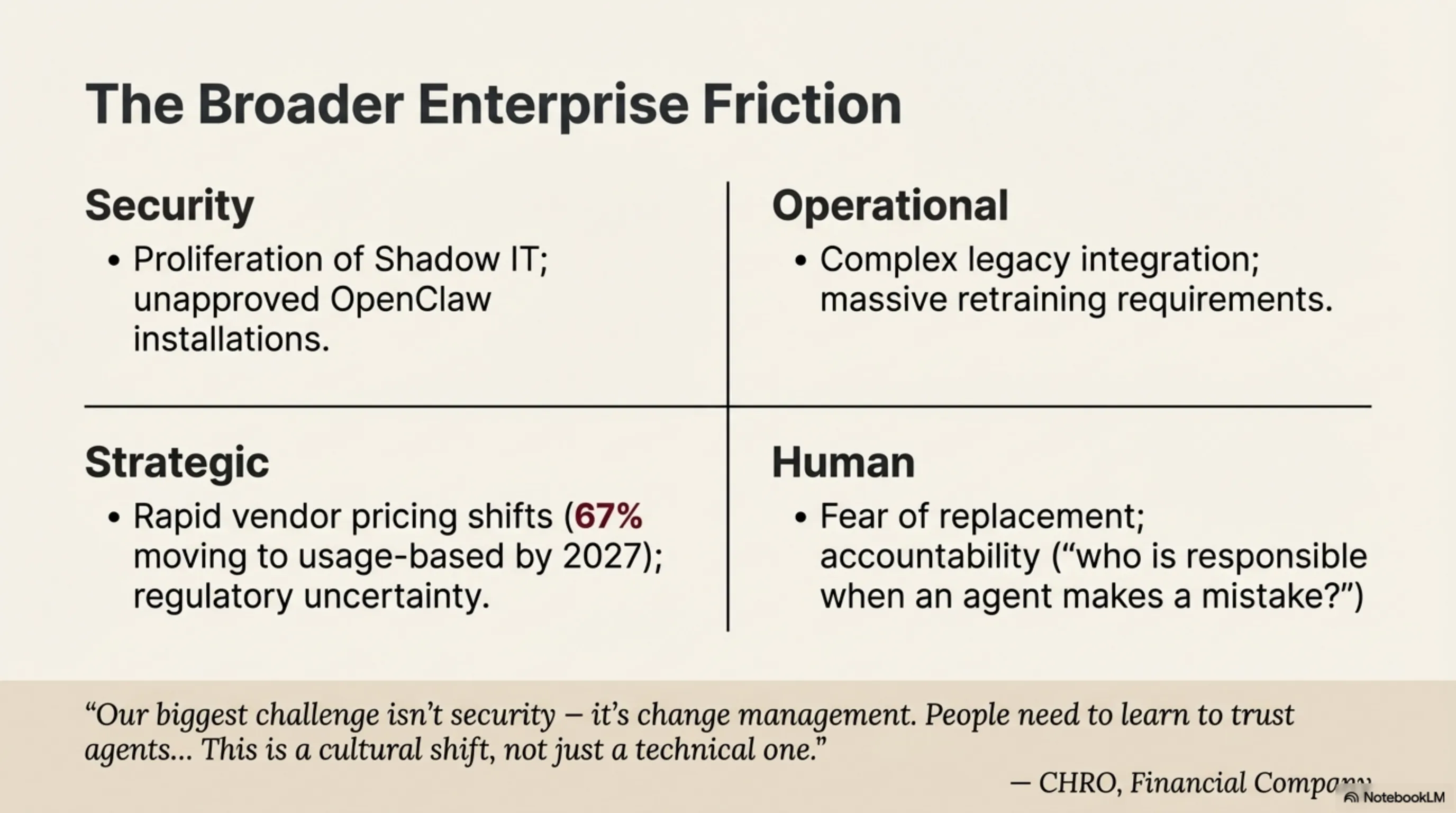
But it's not all sunshine and rainbows. The rapid growth of Agentic AI brings serious challenges and risks.
Security: Shadow IT is proliferating. Employees install OpenClaw and similar tools without IT approval. Malicious extensions are published in marketplaces. Data is at risk. And governance frameworks are still being developed.
Operational: Integration is complex. Change management is difficult. Training requirements are significant. Processes need to be redesigned. And legacy systems may not be compatible.
Strategic: Pricing models are changing (67% moving to usage-based by 2027). Vendor lock-in risks. Skill gap in workforce. Regulatory uncertainty. And ethical considerations.
Human: Fear of job replacement. Resistance to change. Need for new skills. And the big question: who's responsible when an agent makes a mistake?
"Our biggest challenge isn't security — it's change management. People need to learn to trust agents, manage them, and collaborate with them. This is a cultural shift, not just a technical one." — CHRO of a financial company
The Future: The $195 Billion Market and Beyond
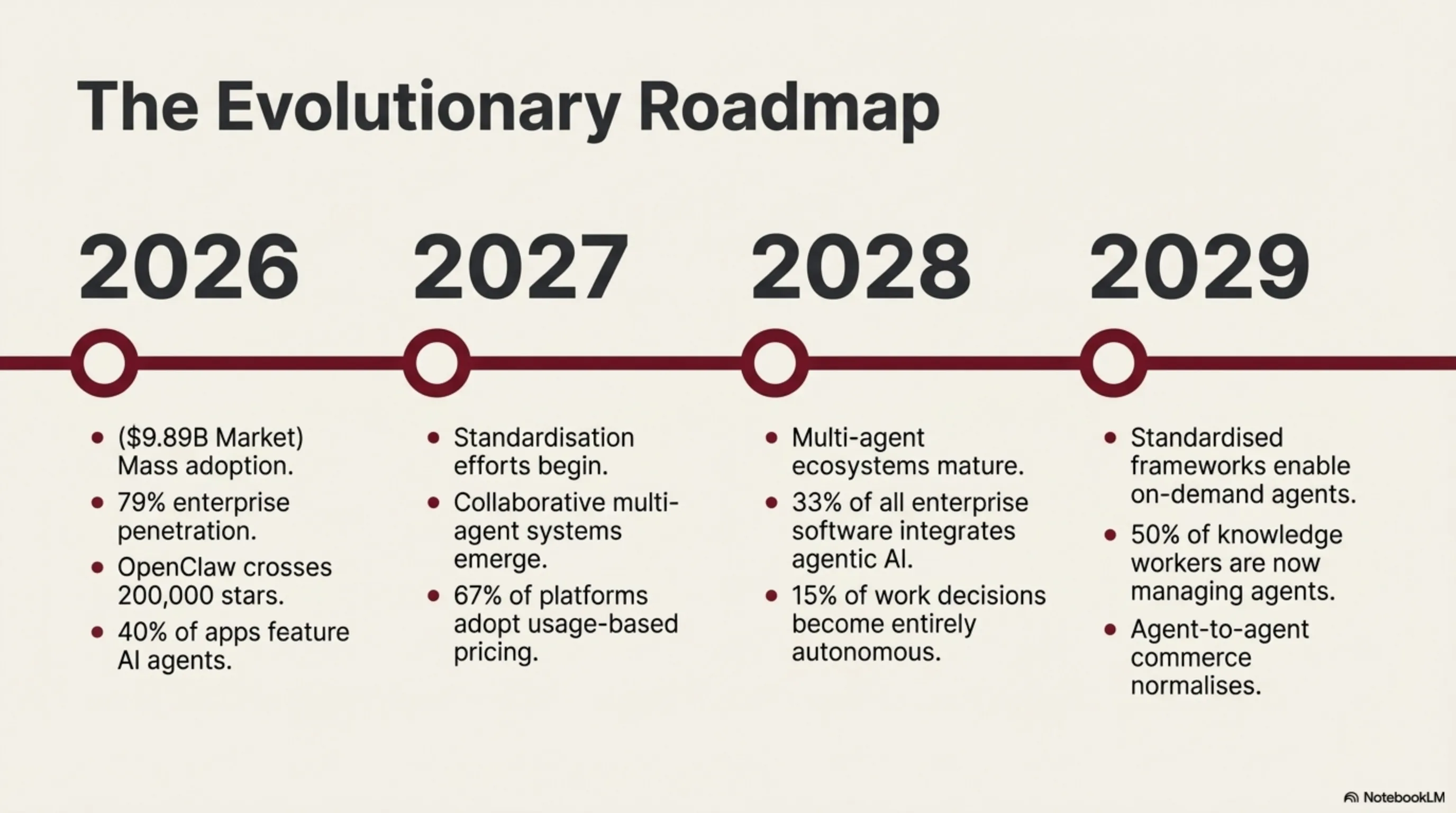
So what's the future? Where is all this going? Let's look at the predictions:
2026: 79% enterprise adoption. 40% of apps with AI agents. $9.89B market size. OpenClaw crosses 200,000 stars.
2027: Collaborative multi-agent systems emerge. 67% adopt usage-based pricing. Standardization efforts begin.
2028: 33% of enterprise software has agentic AI. 15% of work decisions autonomous. Multi-agent ecosystems mature.
2029: 50% of knowledge workers create/manage agents. Standardized frameworks enable on-demand agents. Agent-to-agent commerce becomes normal.
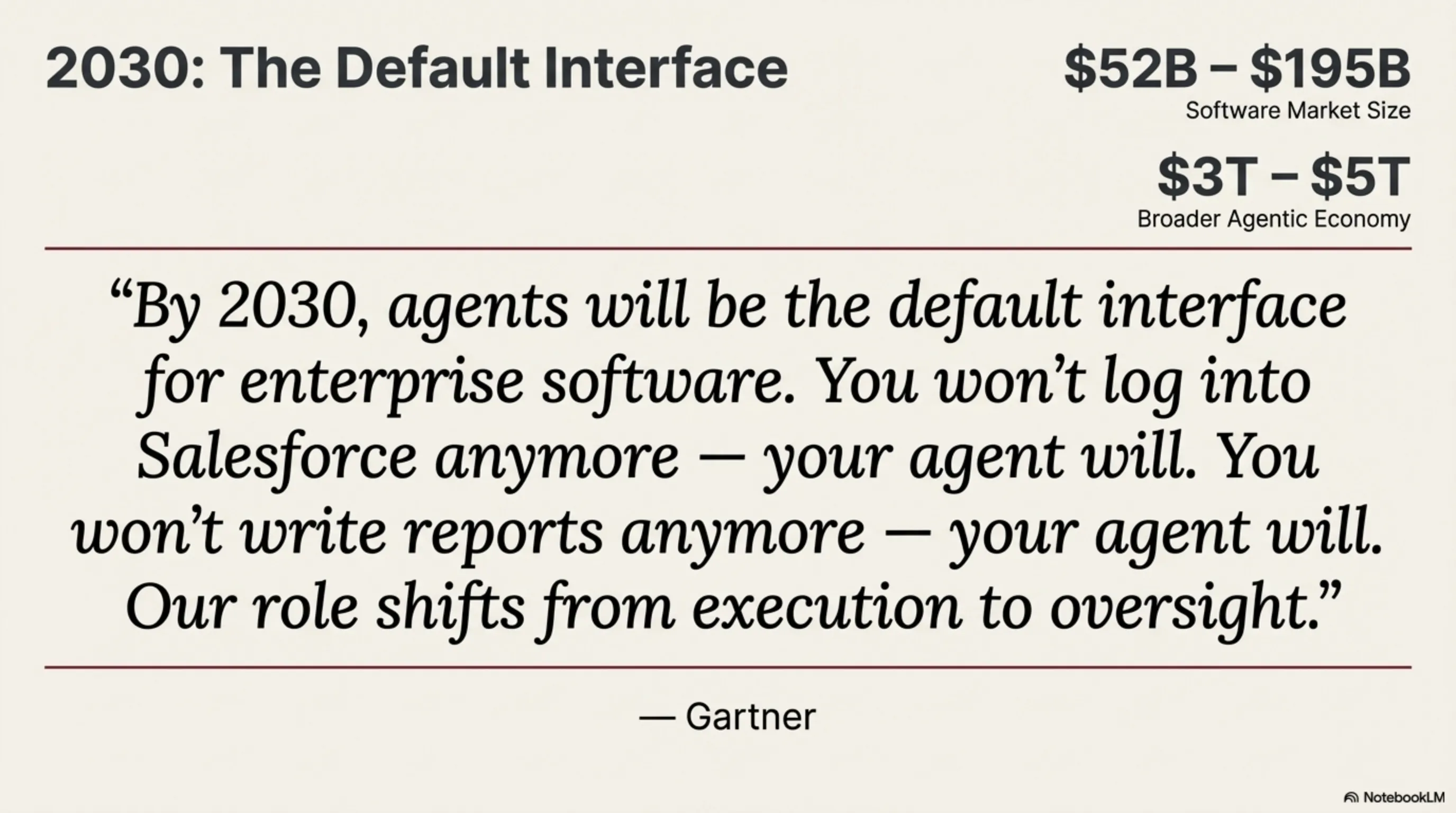
2030-2034: $52-195B market size. $3-5T agentic economy. Agents become default interface for enterprise software.
But beyond the numbers, a fundamental shift is happening. We're moving from an era where humans work with software to an era where agents work with software and humans manage agents. This is a paradigm shift — and we're only at the beginning.
Conclusion: The $195 Billion Revolution
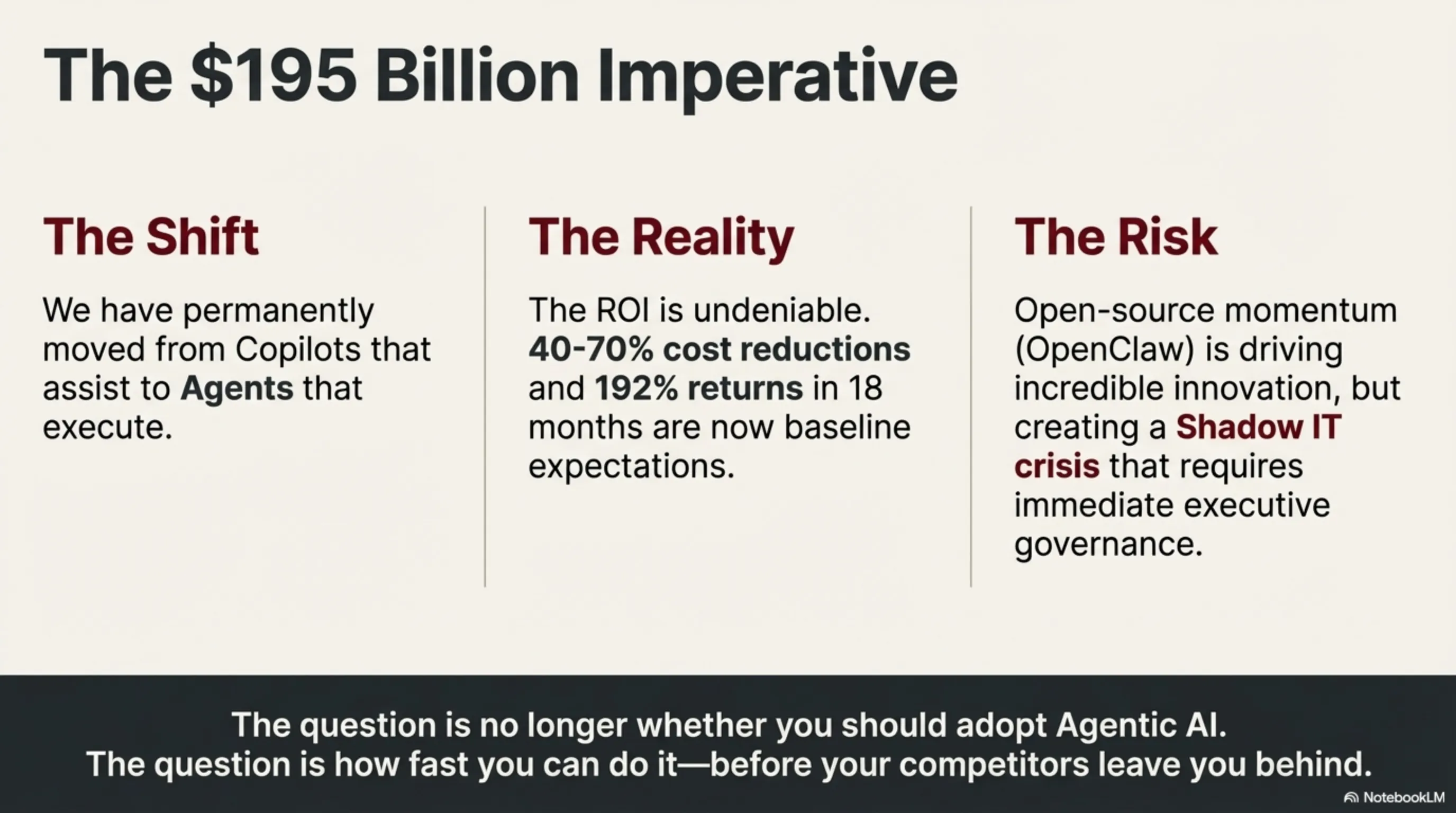
Agentic AI is no longer an experiment — it's a business necessity. From 11% to 79% in just two years. From $7.9 billion to $195 billion by 2034. From Copilot that assists to Agent that executes.
The ROI is real: 40-70% cost reduction. 3-5x productivity. 192% ROI in 18 months. This is no longer hype — this is reality.
OpenClaw shows: Open source can transform enterprise. 100,000+ installations. 30% enterprise adoption. Fastest growth in history.
Challenges are real: Security. Shadow IT. Change management. But the benefits outweigh the risks.
The future is clear: By 2029, 50% of knowledge workers will manage agents. By 2030, agents will be the default interface.
The question is no longer whether you should adopt Agentic AI. The question is how fast you can do it — before your competitors leave you behind.
Agentic AI Revolution Gallery