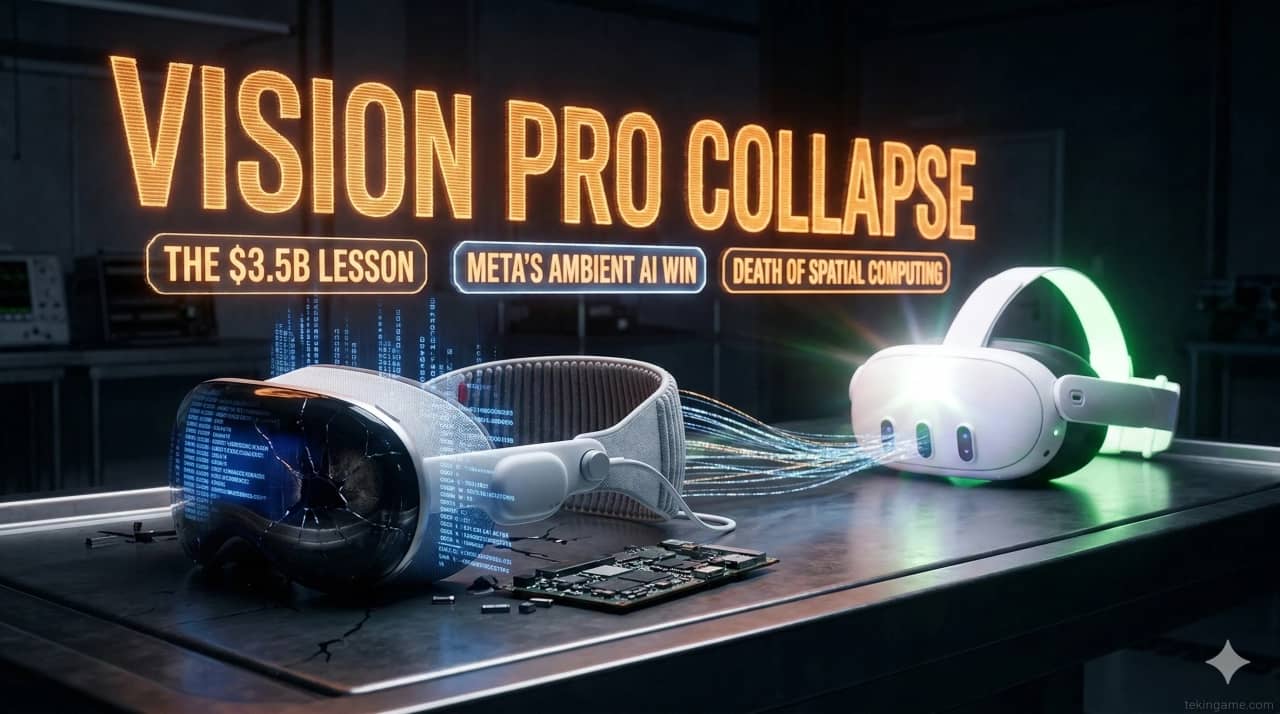
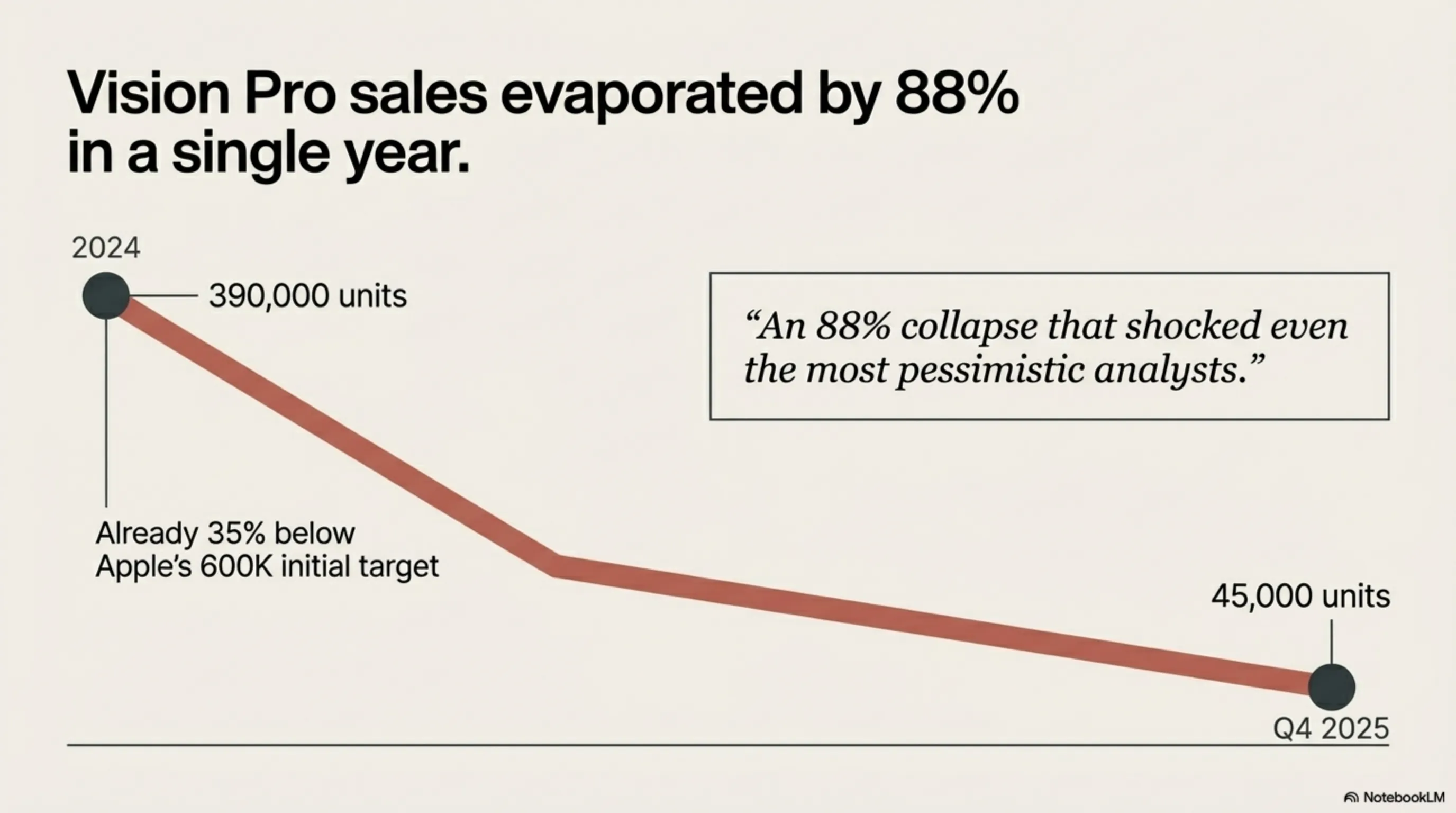
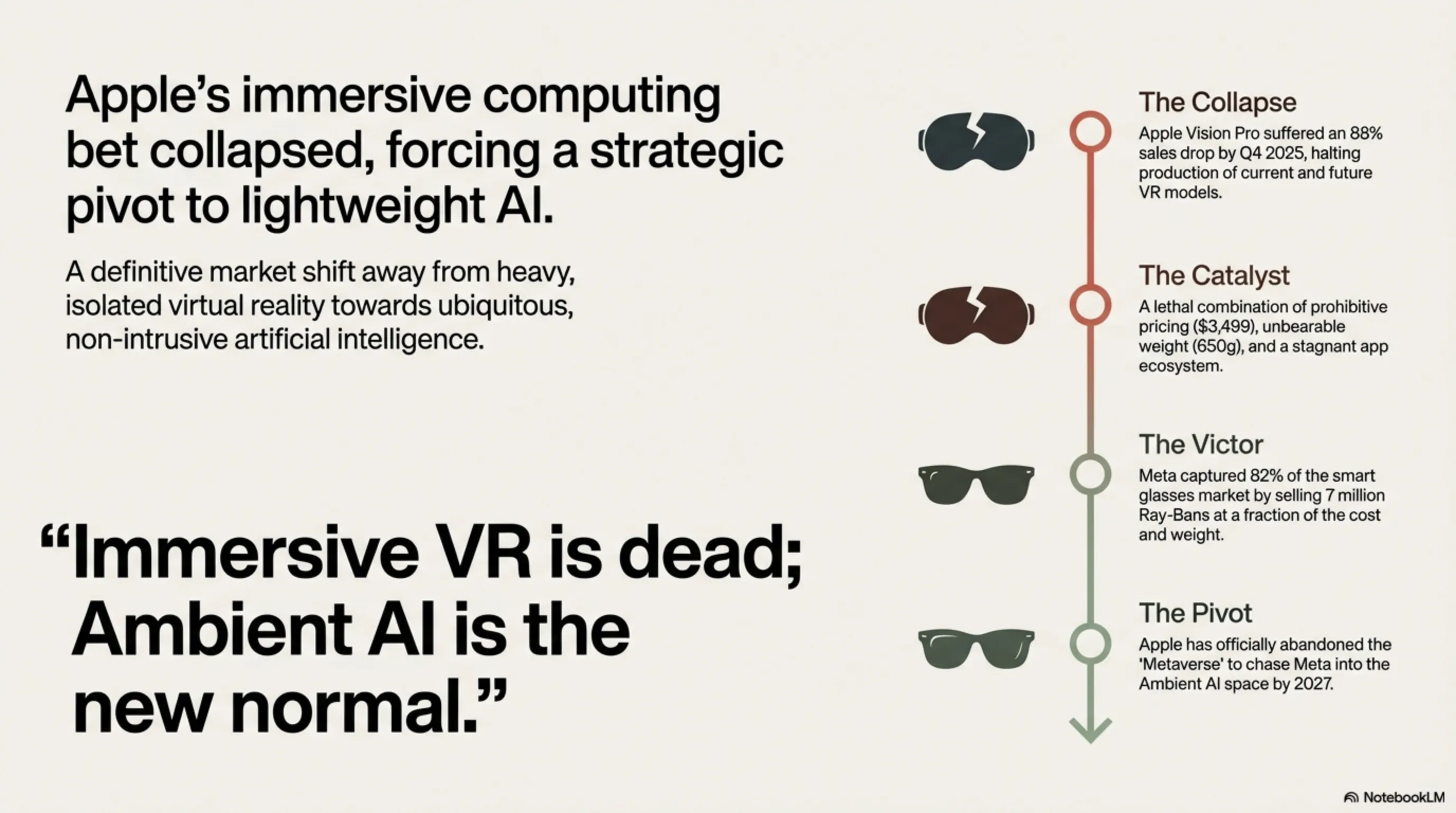
Apple's Vision Pro became one of the company's biggest failures in history. Sales plummeted from 390,000 units in 2024 to just 45,000 units in Q4 2025 — an 88% collapse showing the market rejected the product. Apple not only halted Vision Pro production but also canceled the cheaper version and redirected all resources toward AI smart glasses.
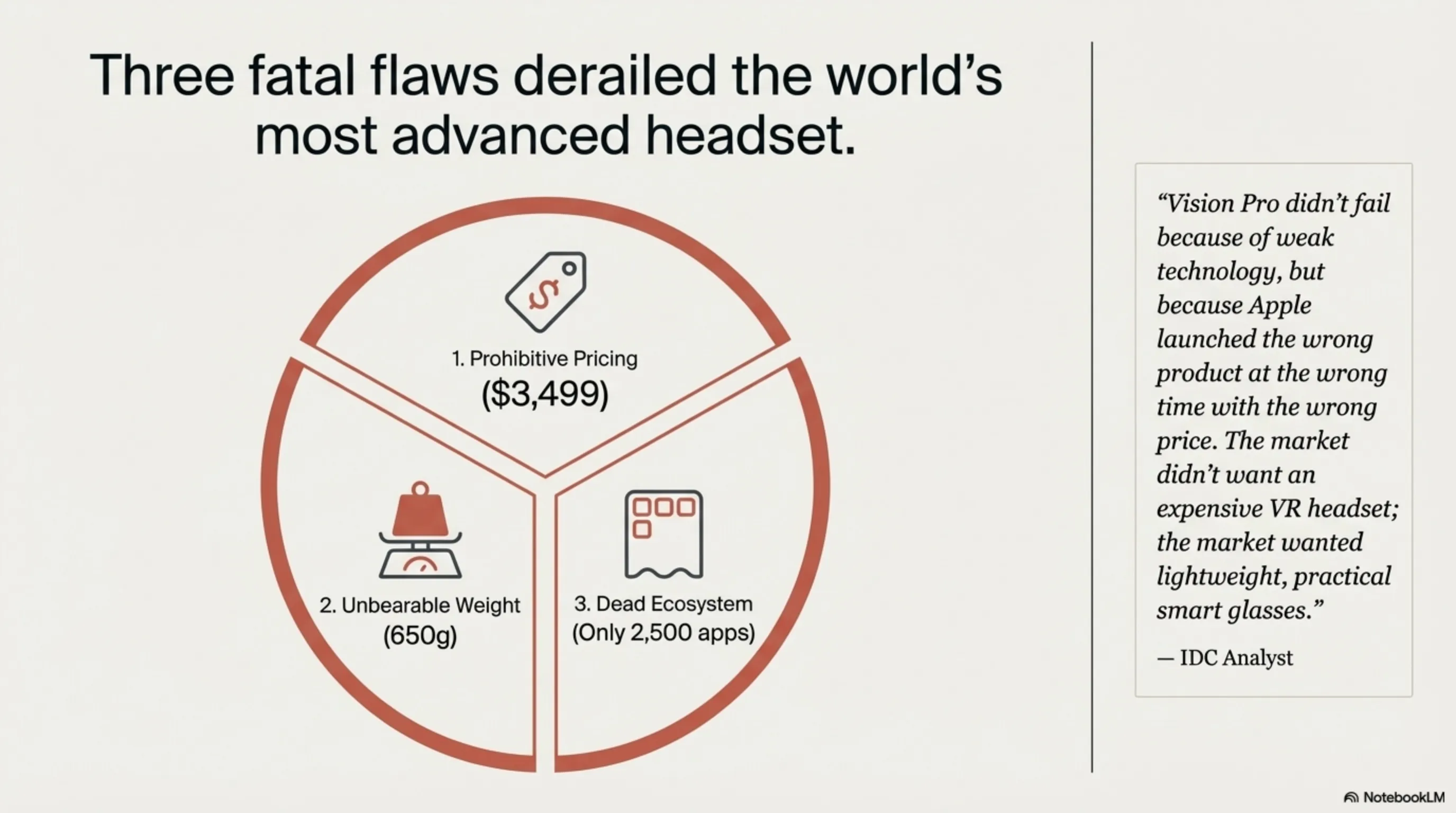
Three main reasons for Vision Pro's failure: unrealistic $3,499 price tag (10x Meta Quest 3), 650-gram weight causing neck pain and headaches after 30-60 minutes, and lack of app ecosystem with only 2,500 apps where even many of Apple's own apps don't have native versions.
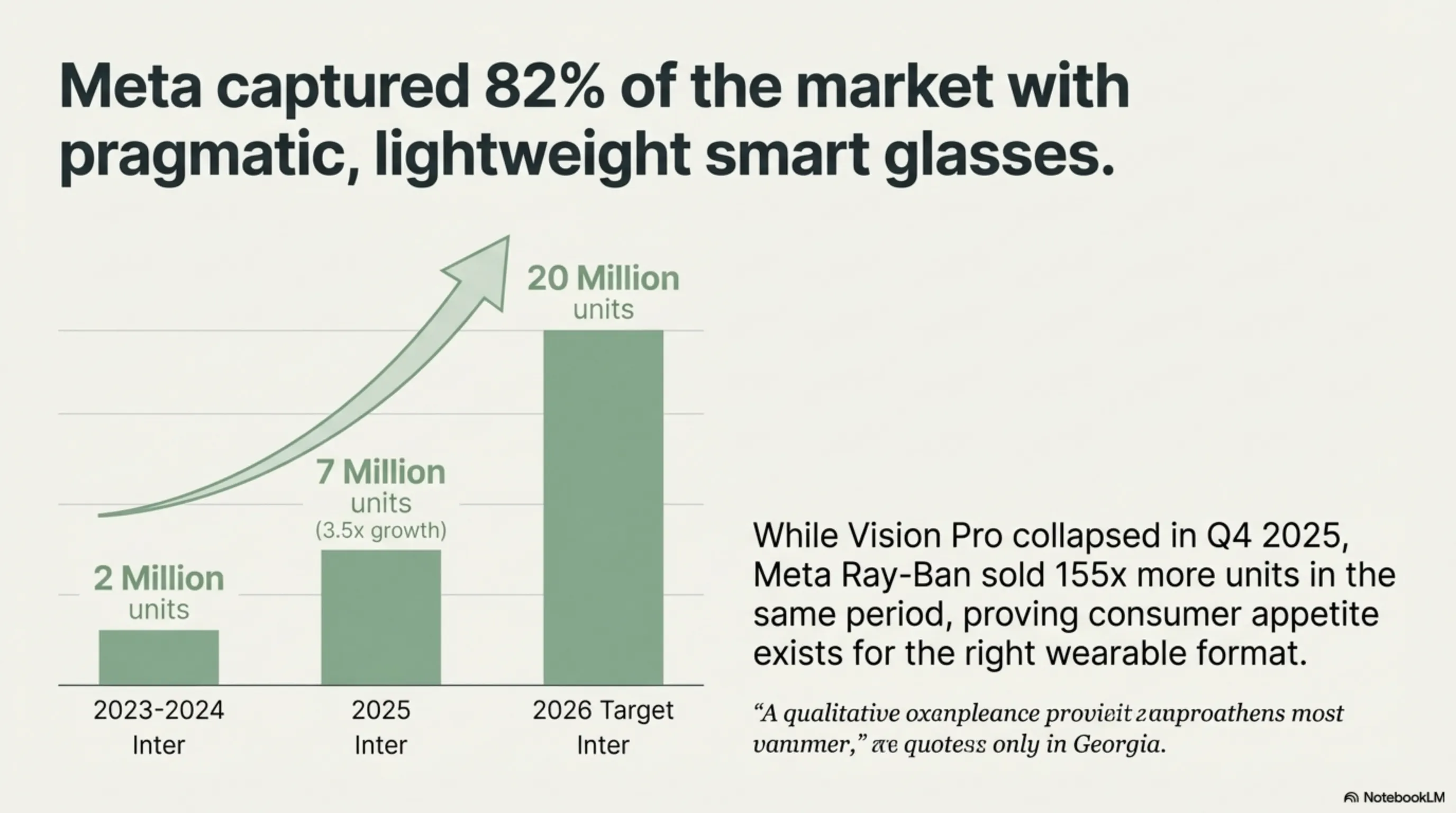
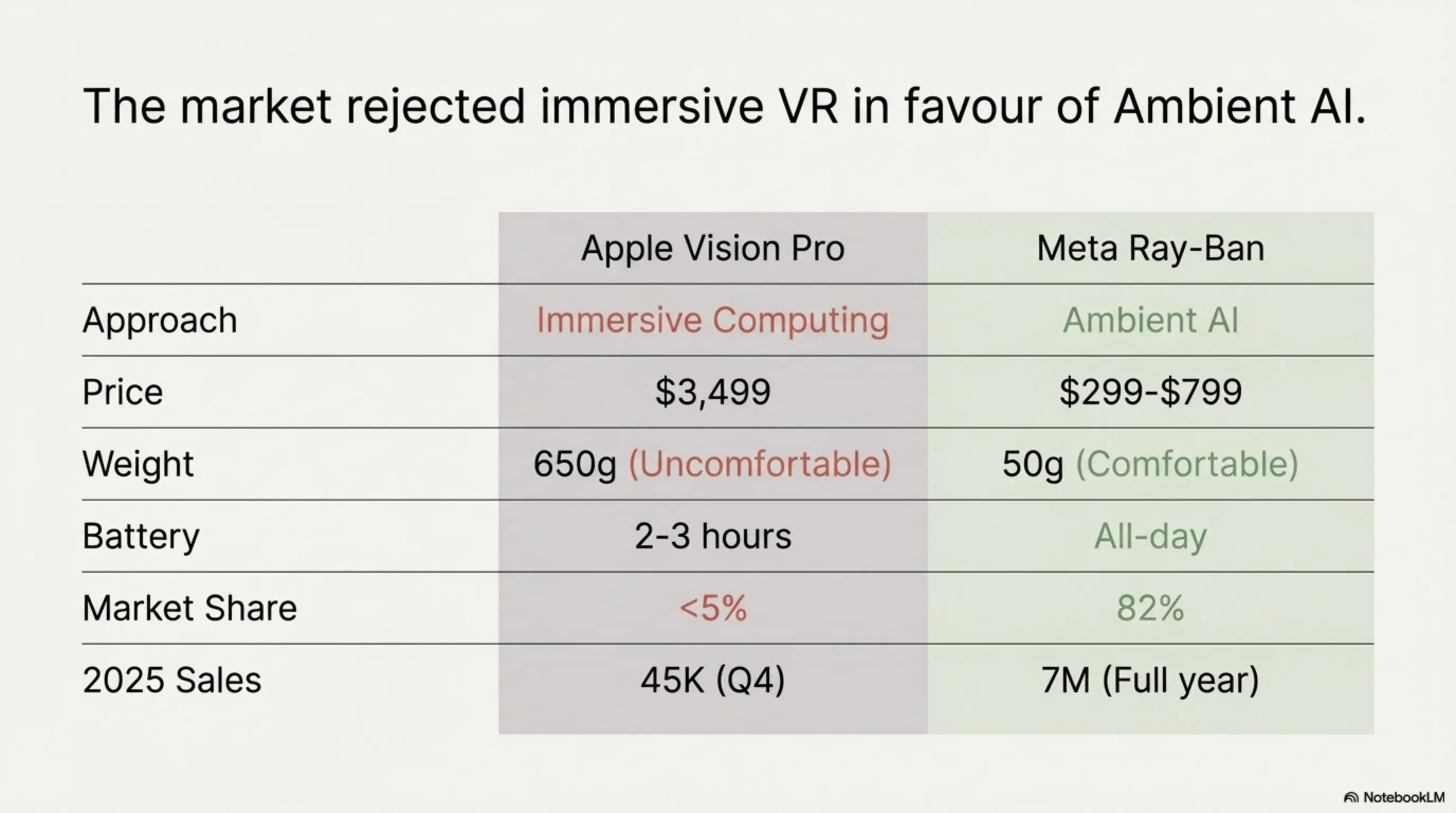
In contrast, Meta achieved remarkable success with Ray-Ban. Sales grew from 2 million units in 2023-2024 to 7 million units in 2025, capturing 82% of the smart glasses market. Ray-Ban's success formula is simple: affordable price ($299-$799), lightweight (50g), all-day battery, and normal glasses form factor people can wear without feeling weird.
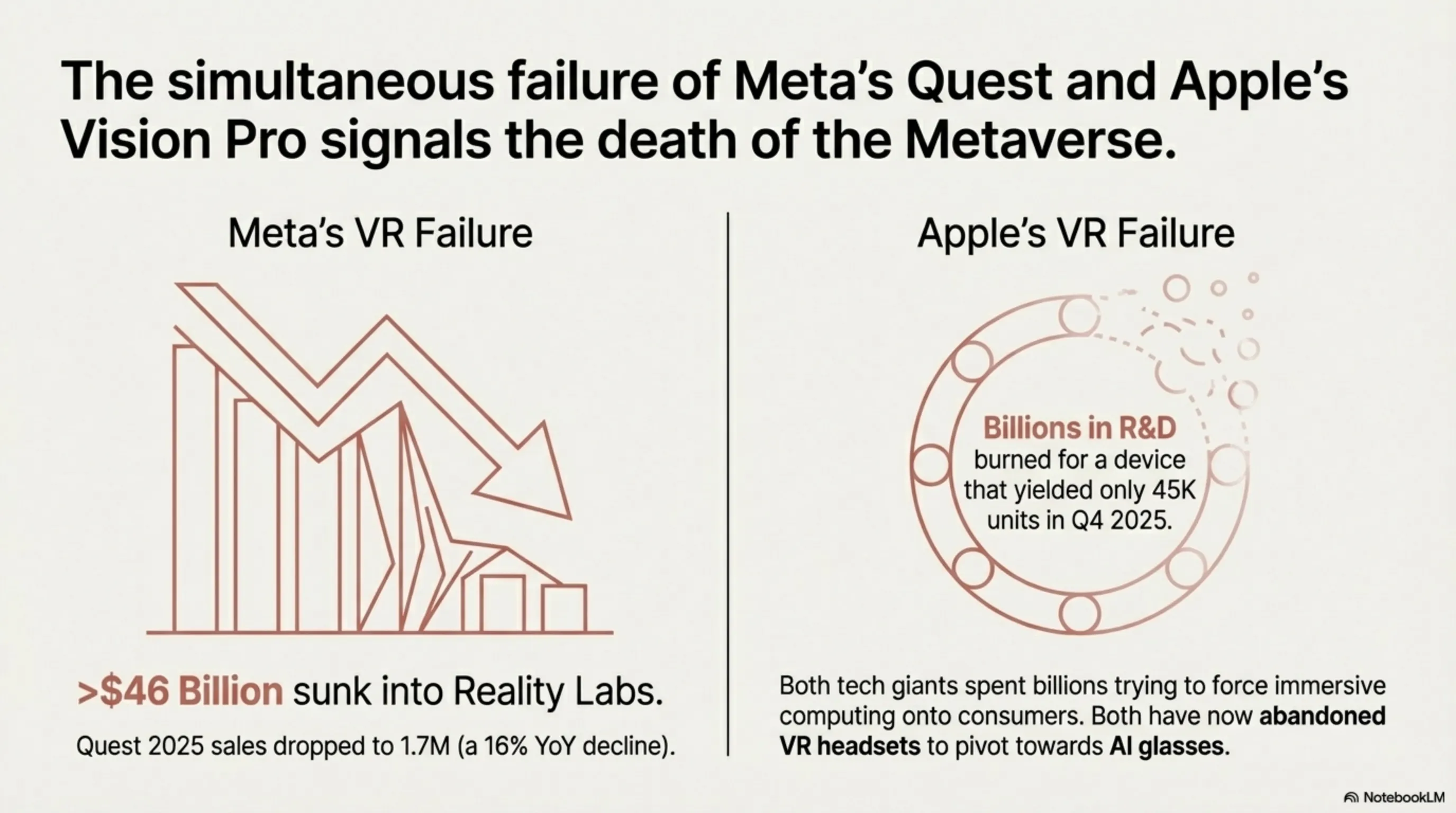
Vision Pro's failure represents the death of the Metaverse. Both Meta with $46 billion invested in Reality Labs and Apple with billions in R&D couldn't make immersive computing a reality. Why? Wrong form factor (heavy headsets), lack of clear use case, high price, and social rejection.
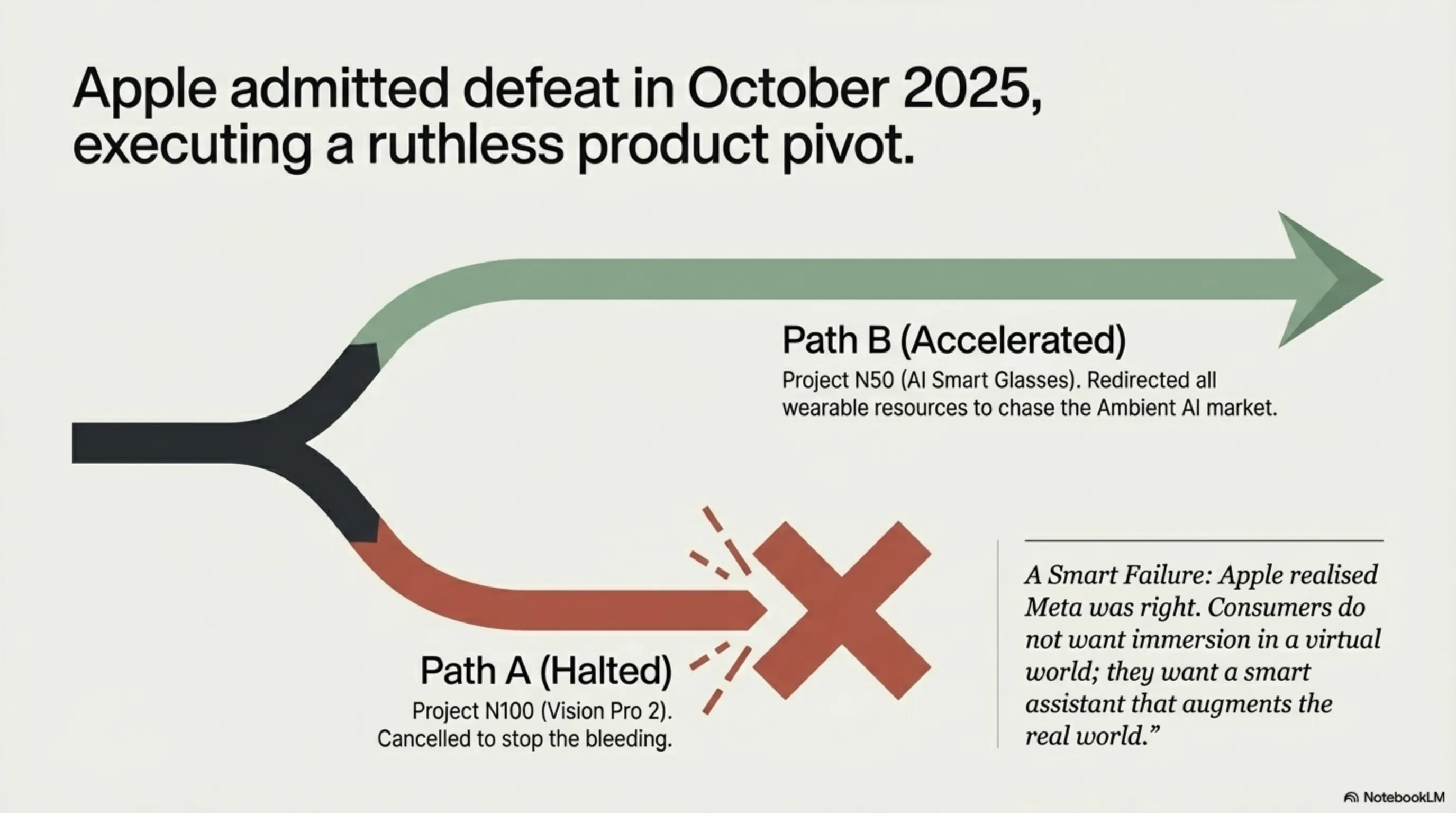
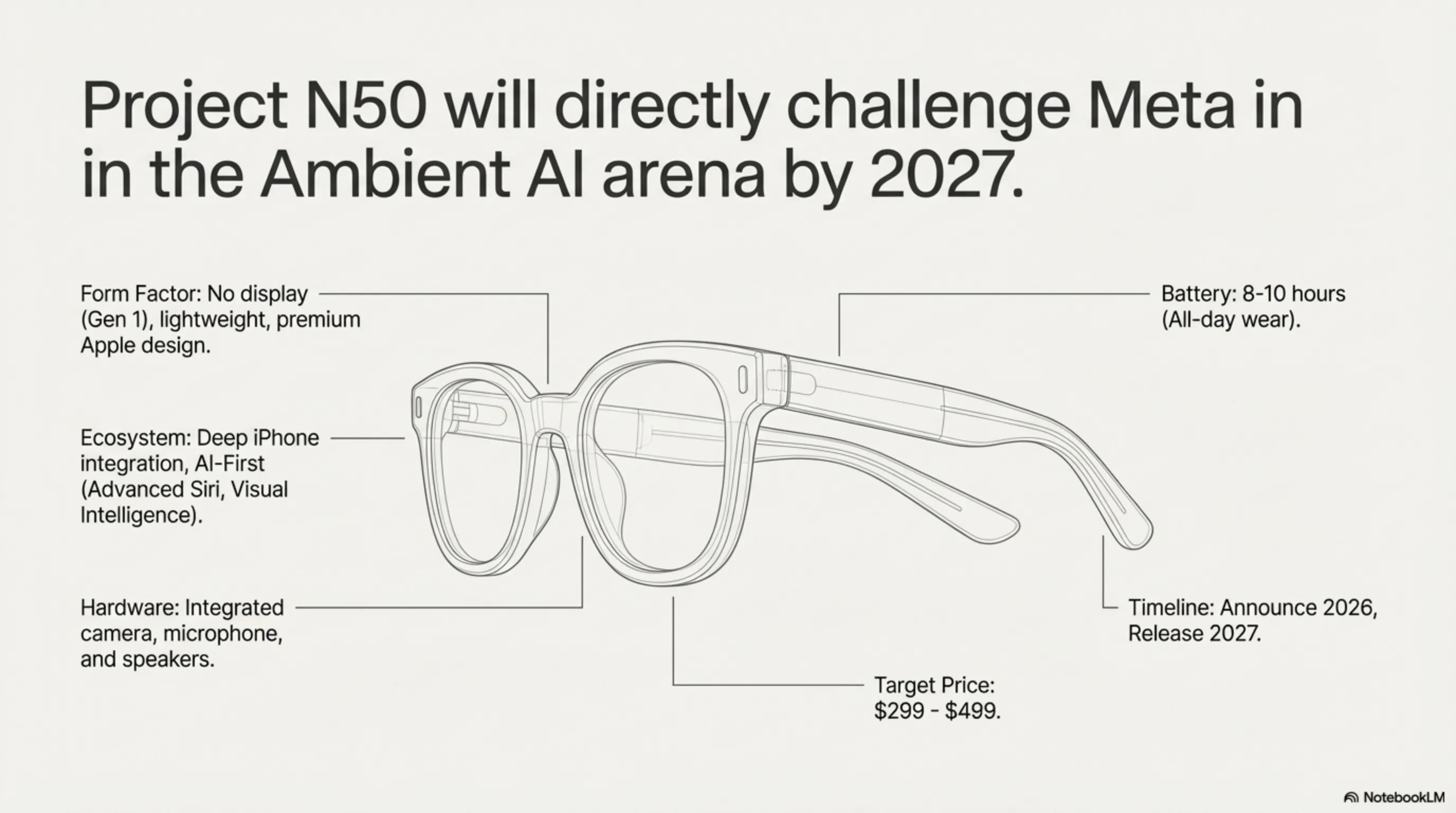
Now Apple is changing strategy. In October 2025, it halted Vision Pro 2 and redirected all resources to AI smart glasses (codename N50) launching in 2027. These glasses won't have a display, will connect to iPhone, focus on AI and Visual Intelligence, and will be priced at $299-$499 — exactly Meta's strategy with Ray-Ban.
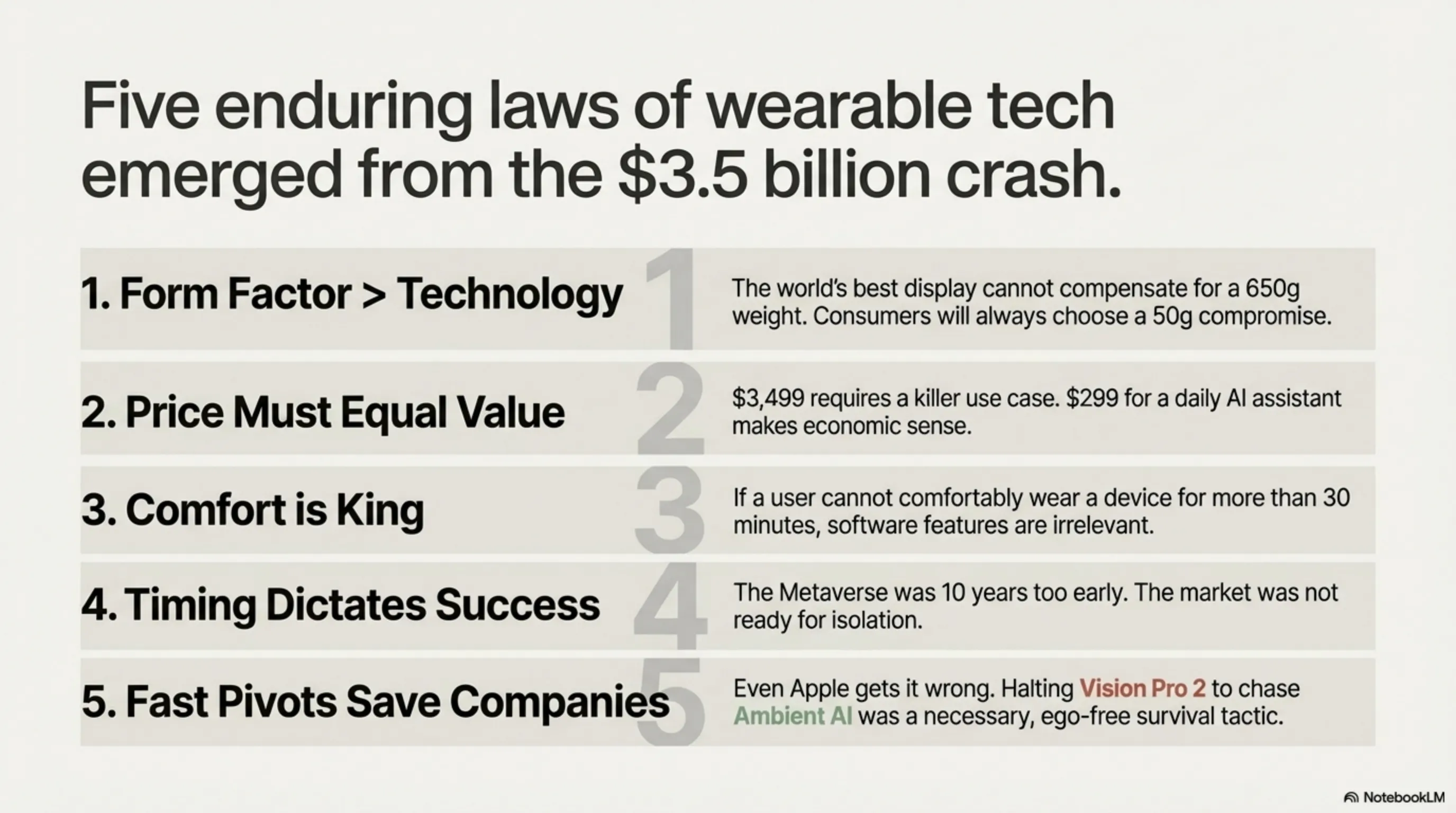
Five key lessons from Vision Pro's failure: (1) Form factor matters more than technology — people chose 50g glasses over 650g headset, (2) Price must match value — $3,499 for a product without killer use case is too much, (3) Comfort matters more than features — if users can't use it for more than 30 minutes, no features matter, (4) Market must be ready — Metaverse came too early, (5) Even Apple can be wrong — but at least it was smart enough to pivot quickly.
This $3.5 billion failure shows the era of Metaverse is over and the era of Ambient AI has begun. Meta with Ray-Ban is ahead of Apple, but Apple with AI glasses in 2027 can take the market back — if it learned from Vision Pro's mistakes.
Share Brief:
When Apple unveiled the Vision Pro at $3,499 in June 2023, Tim Cook called it "the beginning of the era of Spatial Computing." Less than three years later, the device has become one of Apple's biggest failures in history. Sales plummeted from 390,000 units in 2024 to just 45,000 units in Q4 2025 — an 88% collapse that shocked even the most pessimistic analysts. Apple has not only halted Vision Pro production but also canceled the cheaper version and redirected all resources toward lightweight AI smart glasses — the same product Meta successfully launched with Ray-Ban, capturing 82% of the market.
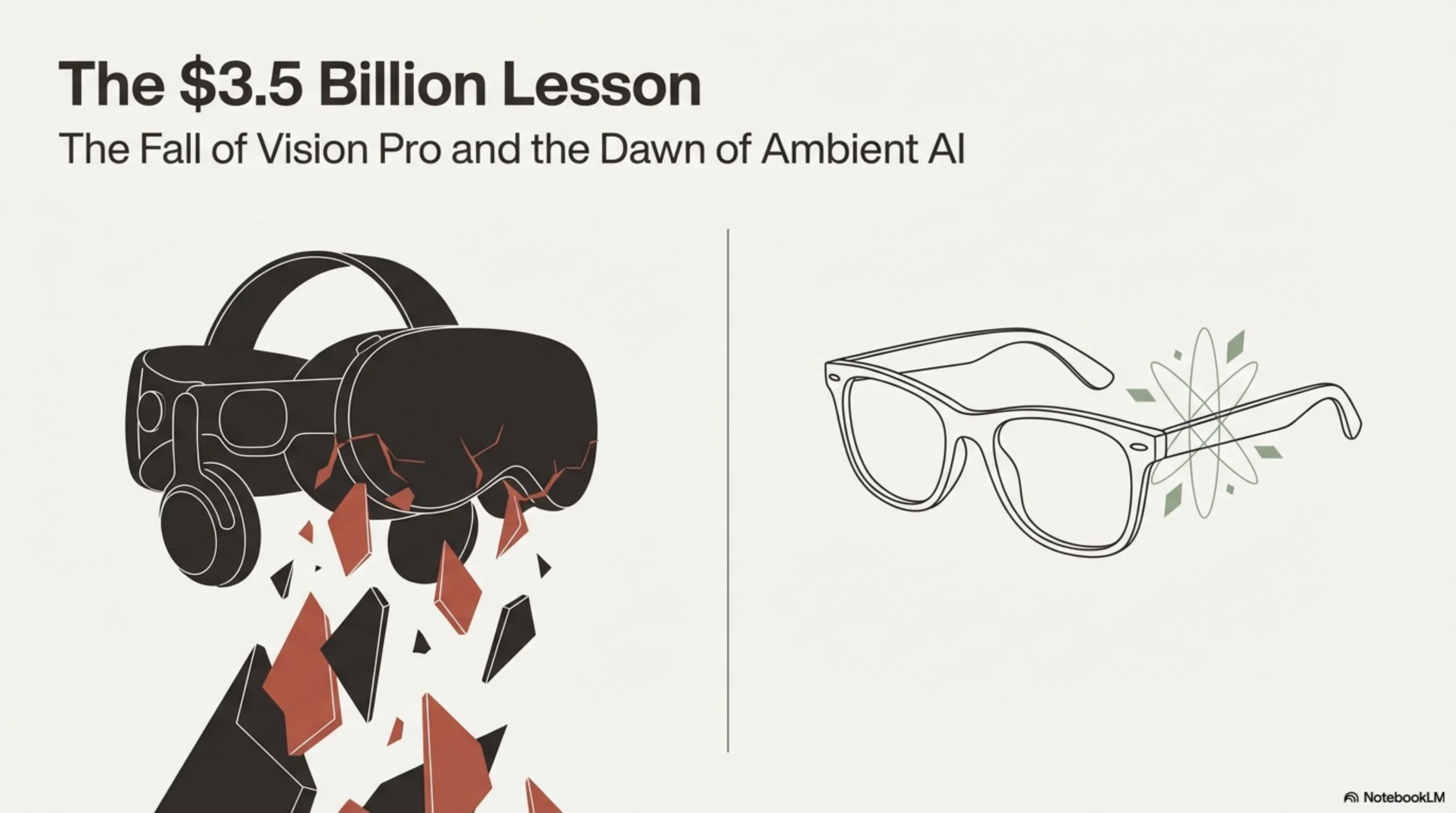
This isn't just the story of Vision Pro's failure; it's the story of the death of the Metaverse, the end of the immersive computing dream, and a $3.5 billion lesson Apple learned from Meta. Let's examine how the world's largest tech company failed at one of the decade's most important bets.
The Free Fall: When 390K Becomes 45K
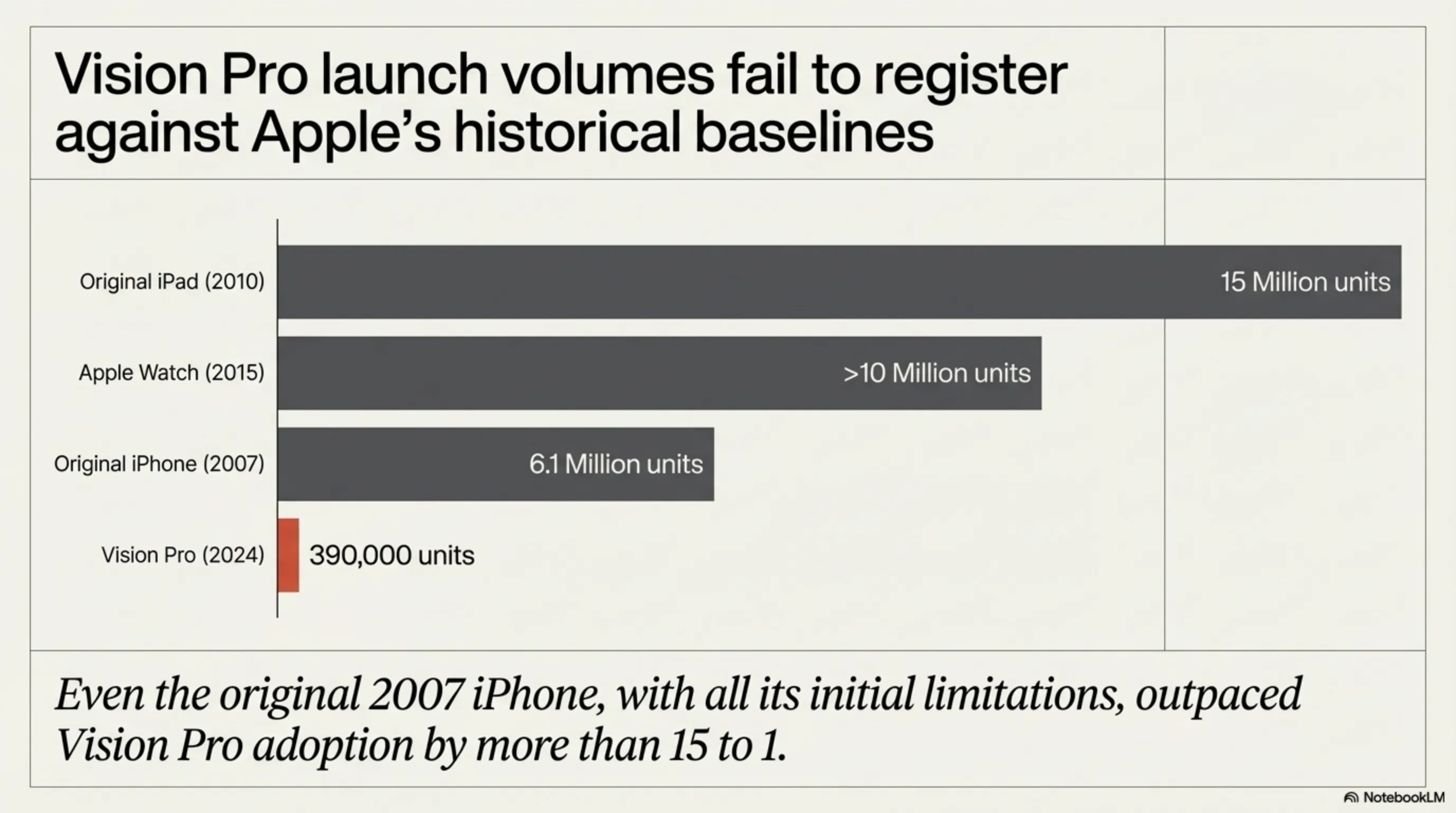
The numbers are brutal. Vision Pro sold 390,000 units in 2024 — already 35% below the initial target of 600,000 units. But the real catastrophe hit in Q4 2025: only 45,000 units sold. In just one year, Vision Pro sales collapsed by 88%.
To understand this disaster, let's compare with other Apple products. The original iPhone in 2007 — with all its limitations — sold 6.1 million units. The original iPad in 2010 sold about 15 million units. Even the original Apple Watch in 2015 sold over 10 million units. Vision Pro, with 390K units in year one and 45K units in Q4, doesn't even come close to Apple's weakest launches.
But why? Why did a product Apple worked on for years, with the world's best display technology, the most powerful mobile chips, and the rich iOS ecosystem, fail so catastrophically?
IDC Analyst: "Vision Pro didn't fail because of weak technology, but because Apple launched the wrong product at the wrong time with the wrong price. The market didn't want an expensive VR headset; the market wanted lightweight, practical smart glasses."
The answer lies in three key factors: unrealistic pricing, unbearable weight, and lack of app ecosystem. Let's examine each.
The $3,499 Price Tag: When Premium Becomes Prohibitive
Apple has always had a premium pricing strategy. iPhones cost more than Android competitors. MacBooks cost more than Windows laptops. But Apple customers are willing to pay the premium because they receive value: better design, integrated ecosystem, excellent support.
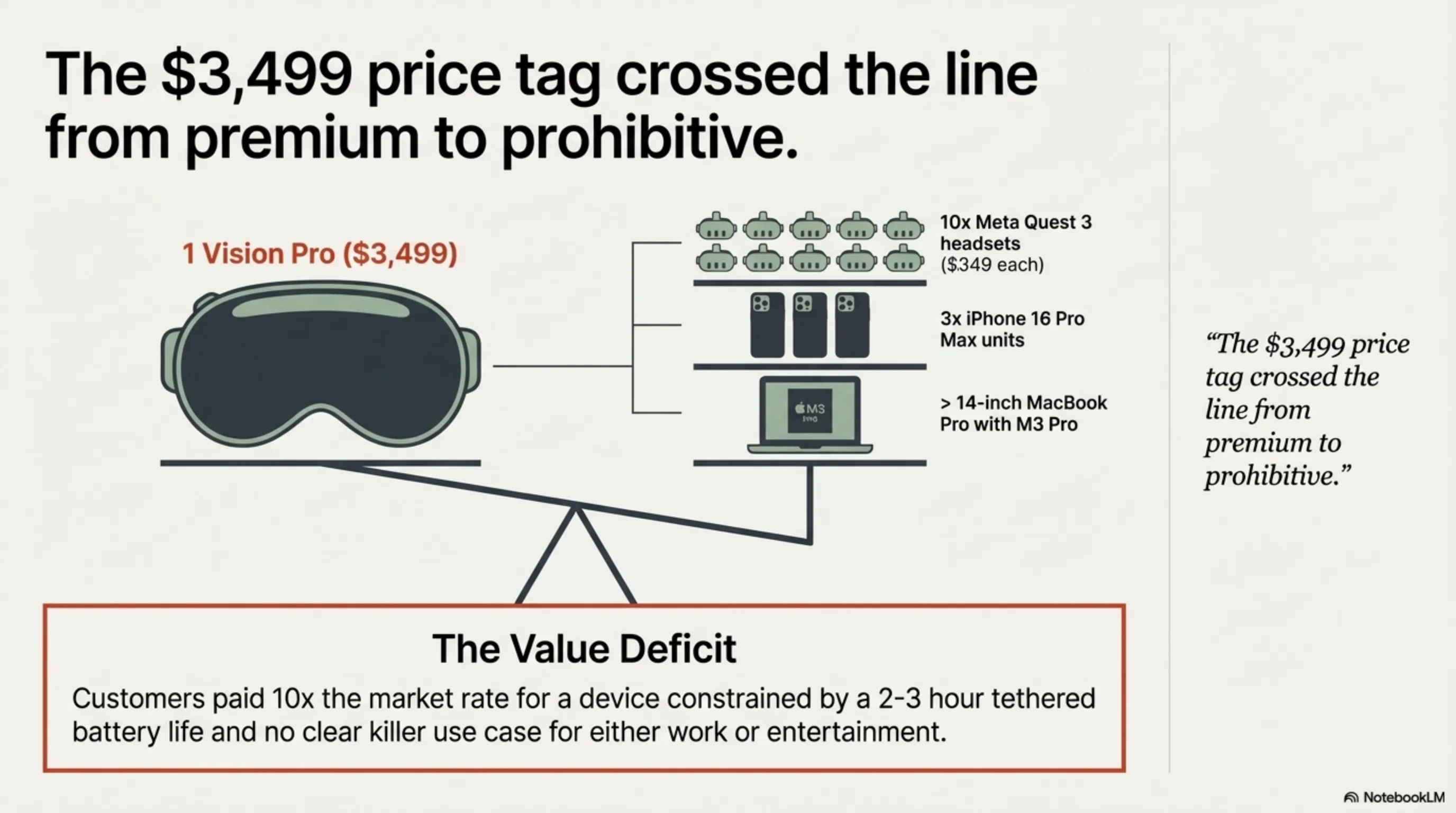
But Vision Pro at $3,499 crossed the line from premium to prohibitive. This price is 10x the Meta Quest 3 ($349). This price exceeds a 14-inch MacBook Pro with M3 Pro. This price equals three iPhone 16 Pro Max units.
And for what? For a device that:
Only has 2-3 hours of battery (while tethered to power)
Only has 2,500 apps (compared to millions of iOS apps)
Causes discomfort after 30-60 minutes (due to weight)
Has no killer use case (neither for work nor entertainment)
Compare this with Meta Ray-Ban at $299-$799, with all-day battery, looking like normal glasses, and selling 7 million units in 2025 — 155x more than Vision Pro in Q4.
Feature
Vision Pro
Meta Ray-Ban
Meta Quest 3
Price
$3,499
$299-$799
$349
Weight
650g
~50g
515g
Battery
2-3 hours
All day
2-3 hours
2025 Sales
45K (Q4)
7M (full year)
1.7M (full year)
Market Share
<5%
82%
~15%
Form Factor
Bulky headset
Normal glasses
VR headset
Use Case
Immersive Computing
Ambient AI
Gaming/VR
Apple thought customers would pay for "the world's best display technology." But customers didn't want the best display; they wanted a practical product they could use every day. And Vision Pro wasn't that product.
650 Grams of Weight: When Technology Becomes Torture
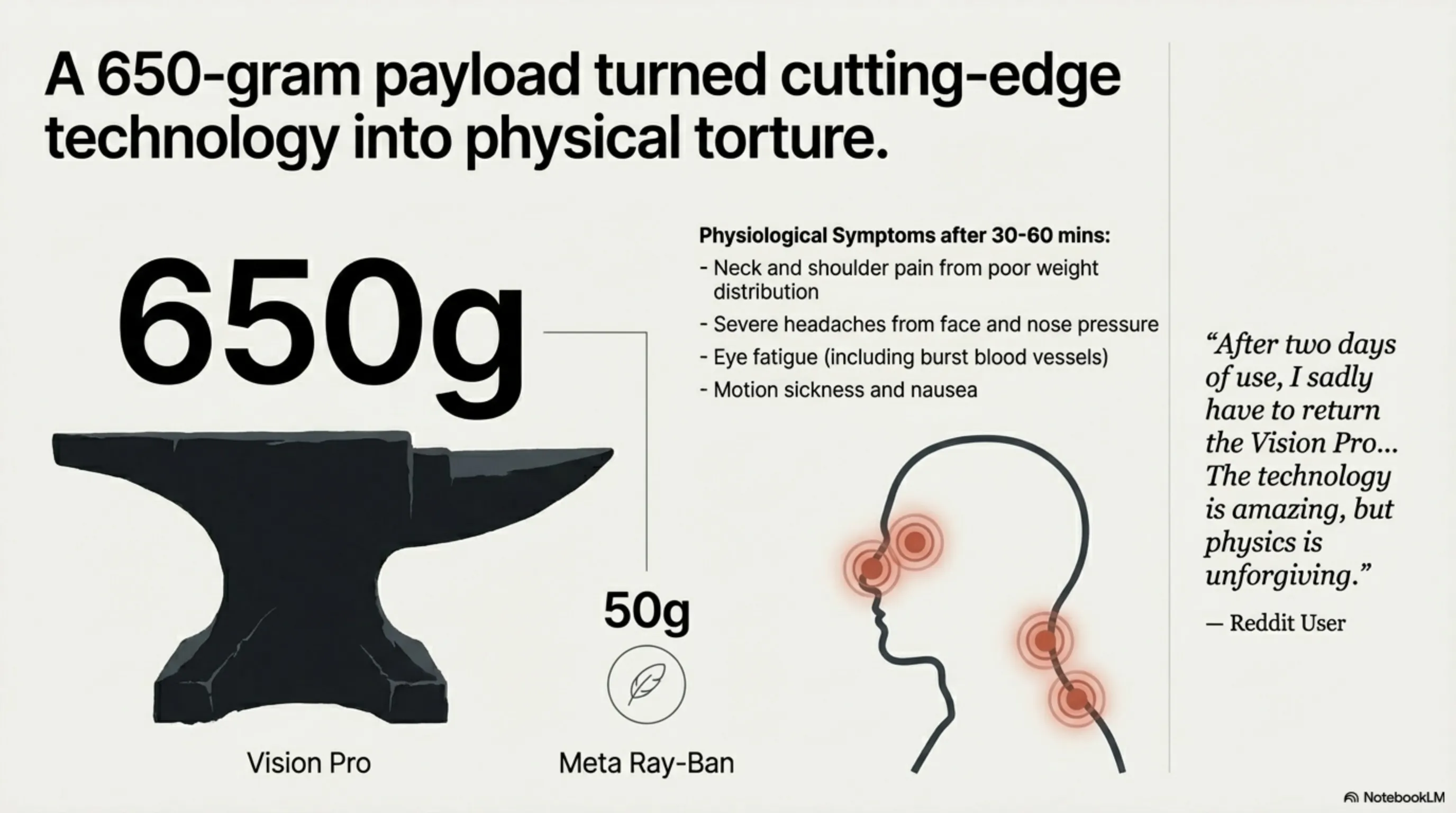
If price was Vision Pro's first barrier, weight was the second — and perhaps more critical. At 650 grams (1.3-1.4 pounds), Vision Pro is one of the heaviest VR headsets on the market. The weight alone isn't enough; the main problem is poor weight distribution that puts all pressure on the user's face and nose.
The result? Users experiencing after 30-60 minutes:
Neck and shoulder pain: Headset weight strains neck muscles
Severe headaches: Pressure on face and nose causes headaches
Eye fatigue: Some users even reported burst blood vessels
Nausea symptoms: Motion sickness in some users
Reddit User: "After two days of use, I sadly have to return the Vision Pro. The device is very heavy and uncomfortable, and I can't imagine using it for extended periods. The technology is amazing, but physics is unforgiving."
This problem was so serious that Vision Pro's return rate within the first 14 days — Apple's return window — was very high. Users who excitedly purchased the device realized after a few days they couldn't use it for more than an hour.
Compare this with Meta Ray-Ban at just 50 grams — 13x lighter than Vision Pro. You can wear Ray-Ban all day without even noticing. But Vision Pro? After 30 minutes, you're just waiting to take it off.
Apple tried to solve this with different band designs: Solo Knit Band, Dual Loop Band. None worked. The fundamental problem was that 650 grams couldn't be comfortably distributed on the head and face.
Dead Ecosystem: When Even Apple Doesn't Build Apps
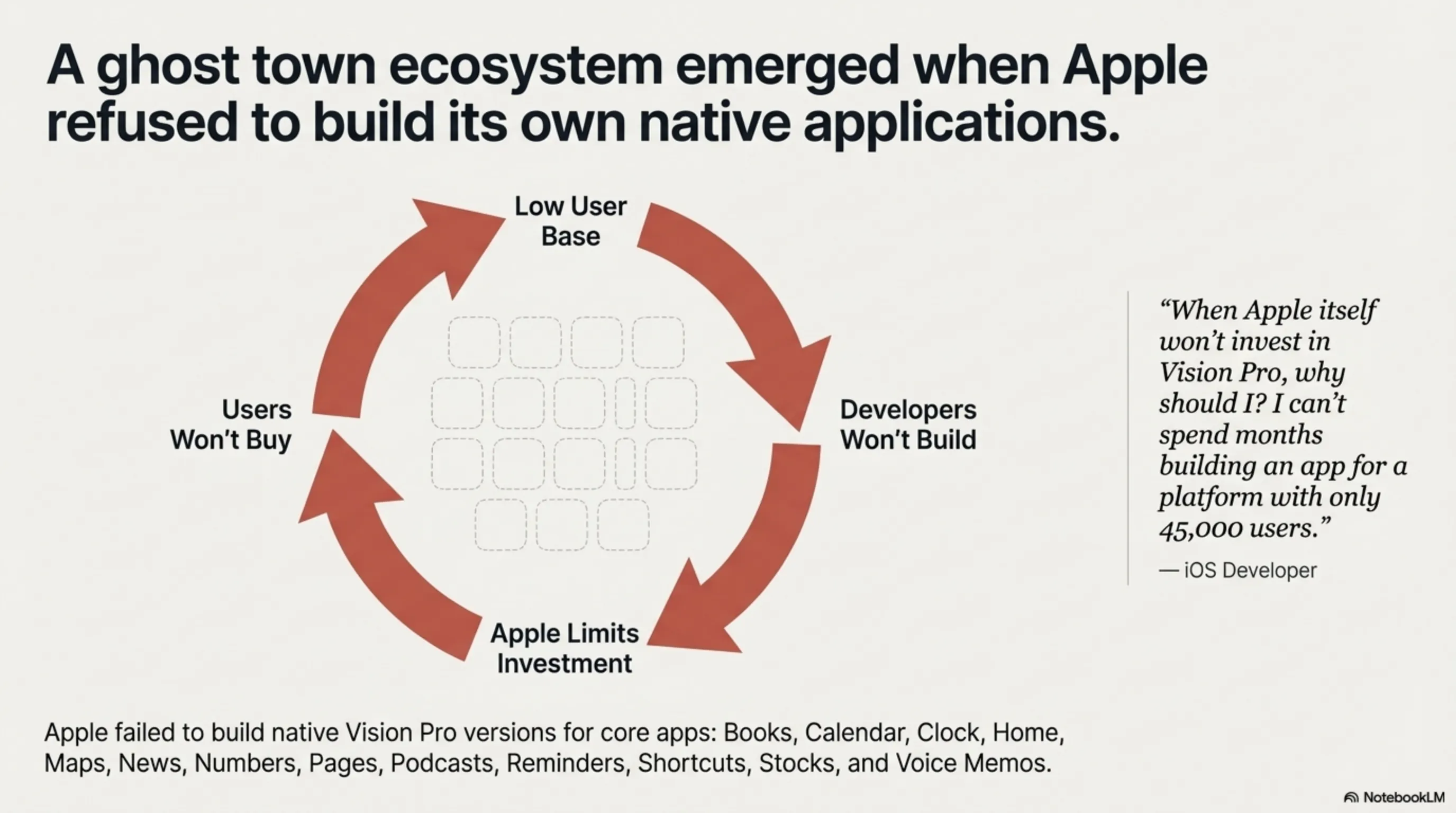
One of the strangest aspects of Vision Pro's failure was that even Apple didn't believe in its own platform. By mid-2024, Vision Pro had only about 2,500 apps — a very low number for an Apple platform. But the main problem wasn't this; the problem was that many of Apple's own apps didn't have native Vision Pro versions.
List of Apple apps without native Vision Pro versions:
Books
Calendar
Clock
Home
Maps
News
Numbers
Pages
Podcasts
Reminders
Shortcuts
Stocks
Voice Memos
Think about it: Apple, claiming Vision Pro was "the future of computing," wasn't even willing to build basic apps like Calendar and Maps for it. What message did this send to third-party developers?
iOS Developer: "When Apple itself won't invest in Vision Pro, why should I? I'm a small studio. I can't spend months building an app for a platform with only 45,000 users."
This was a classic chicken-and-egg problem:
Users won't buy because there aren't enough apps
Developers won't build apps because there aren't enough users
Apple won't invest because there aren't enough sales
And this negative cycle continued until Apple decided to halt the entire project.
Meta's Revenge: When Ray-Ban Defeats Apple
While Vision Pro was collapsing, Meta was making history with Ray-Ban. The numbers are brutal:
Why did Ray-Ban succeed where Vision Pro failed? The answer is simple: Meta launched the right product at the right time with the right price.
Aspect
Apple Vision Pro
Meta Ray-Ban
Approach
Immersive Computing
Ambient AI
Display
High-res VR/AR
No display (Gen 1)
Price Strategy
Premium ($3,499)
Accessible ($299-$799)
Target Market
Wealthy Early Adopters
Mainstream
Weight
650g (uncomfortable)
50g (comfortable)
Battery
2-3 hours
All day
Social Acceptance
Weird/Isolating
Natural/Normal
Use Case
Unclear
Clear (AI assistant)
Result
Failure
Success
Meta understood that people don't want to be immersed in a virtual world; they want a smart assistant that helps them in the real world. Ray-Ban does this:
Camera: Take photos and videos without pulling out your phone
AI Assistant: Ask questions, translate, identify objects
Music: Listen without wearing headphones
Calls: Answer without touching your phone
And all this in normal glasses you can wear all day. This is what the market wanted — not a $3,500 headset that gives you a headache after 30 minutes.
Death of the Metaverse: When Both Meta and Apple Fail
Vision Pro's failure isn't just a product failure; it's the death of a dream — the Metaverse dream. Both Meta and Apple spent billions trying to make immersive computing a reality. Both failed.
Meta's Failure:
Investment: Over $46 billion in Reality Labs
Quest Sales 2025: 1.7 million units (16% decline YoY)
Pivot: Meta also shifting to AI glasses
Lesson: Immersive VR not ready yet
Apple's Failure:
Investment: Billions in R&D
Sales: 390K in 2024, 45K in Q4 2025
Pivot: Apple also shifting to AI glasses
Lesson: Same as Meta — too early, wrong form factor
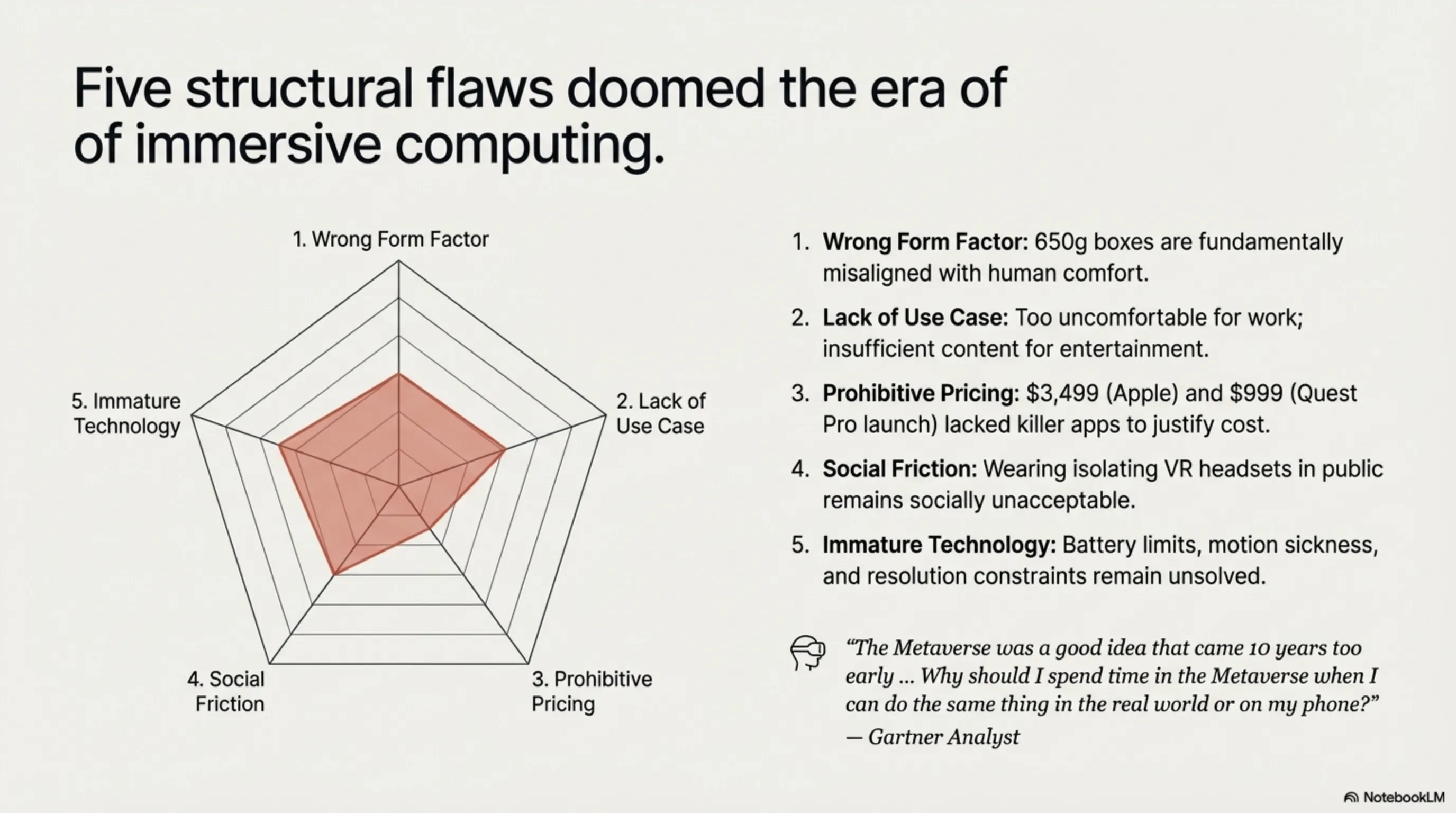
Why did the Metaverse fail? Several fundamental reasons:
1. Wrong Form Factor: VR headsets are too bulky, heavy, and uncomfortable. People don't want a 650-gram box on their face.
2. Lack of Use Case: What is the Metaverse good for? Work? No, too uncomfortable. Entertainment? No, not enough content. Social? No, it's isolating.
3. High Price: Both Vision Pro ($3,499) and Quest Pro ($999 at launch) were too expensive for a product without a killer app.
4. Social Acceptance: Wearing a VR headset in public looks weird. People stare at you like you're an alien.
5. Technology Not Ready: Short battery, heavy weight, motion sickness, low resolution (Quest), high price (Vision Pro).
Gartner Analyst: "The Metaverse was a good idea that came 10 years too early. The technology isn't ready, the market isn't ready, and most importantly, no one could provide a convincing use case. Why should I spend time in the Metaverse when I can do the same thing in the real world or on my phone?"
And now both Meta and Apple are pivoting to AI smart glasses — a product that's lightweight, affordable, and practical. The Metaverse is dead; the era of Ambient AI has begun.
Apple's Pivot: AI Glasses by 2027
In October 2025, Apple made a historic decision: halt Vision Pro 2 (codename N100) and redirect all resources to AI smart glasses (codename N50). This was an admission of failure — but a smart failure.
Apple's New Strategy:
No Display: First-gen Apple glasses won't have a display
iPhone Integration: Must connect to iPhone
AI-First: Focus on voice assistant and Visual Intelligence
This is exactly Meta's strategy with Ray-Ban. Apple realized Meta was right: people don't want to be immersed in a virtual world; they want a smart assistant that helps them in the real world.
Likely Features of Apple Glasses:
Camera: For Visual Intelligence (object recognition, translation, search)
Microphone: For advanced Siri
Speaker: For music and calls
AI Assistant: Answer questions, navigation, reminders
All-day Battery: At least 8-10 hours
Apple Design: Beautiful, minimal, premium
If Apple does this right, it can take the market back from Meta. Apple is stronger than Meta in design, ecosystem, and brand. But if it makes the same mistakes again — price too high, weight too heavy, features too few — it might lose this market forever.
Conclusion: The $3.5 Billion Lesson
Vision Pro's failure is one of the most expensive lessons in tech history. Apple — the company that built iPhone, iPad, and Apple Watch — couldn't build a successful VR headset. Why?
Five Key Lessons:
1. Form Factor Matters More Than Technology: Vision Pro had the world's best display, but weighed 650 grams. People chose 50-gram glasses.
2. Price Must Match Value: $3,499 for a product without a killer use case is too much. $299 for a practical AI assistant makes sense.
3. Comfort Matters More Than Features: If users can't use the product for more than 30 minutes, no features matter.
4. Market Must Be Ready: The Metaverse was a good idea, but came too early. The market isn't ready for immersive computing yet.
5. Even Apple Can Be Wrong: Apple thought it could succeed where Meta failed. It was wrong. But at least it was smart enough to pivot quickly.
Now Apple is starting over — this time with lightweight AI glasses. Will it succeed this time? Or has Meta with Ray-Ban captured this market forever? We'll find out in 2027.
But one thing is certain: the era of the Metaverse is over. The era of Ambient AI has begun. And this time, Meta is ahead of Apple.
Majid Ghorbaninazhad, designer and analyst of technology and gaming world at TekinGame. Passionate about combining creativity with technology and simplifying complex experiences for users. His main focus is on hardware reviews, practical tutorials, and creating distinctive user experiences.