
The 23-year history of Xbox - from Microsoft's bold entry into the console market to the $68 billion Activision Blizzard acquisition. The story of failures, successes, and strategic transformation from selling consoles to building a global gaming ecosystem with Game Pass and Cloud Gaming.
Layer 1: The Anchor - When Microsoft Decided to Take Down Sony
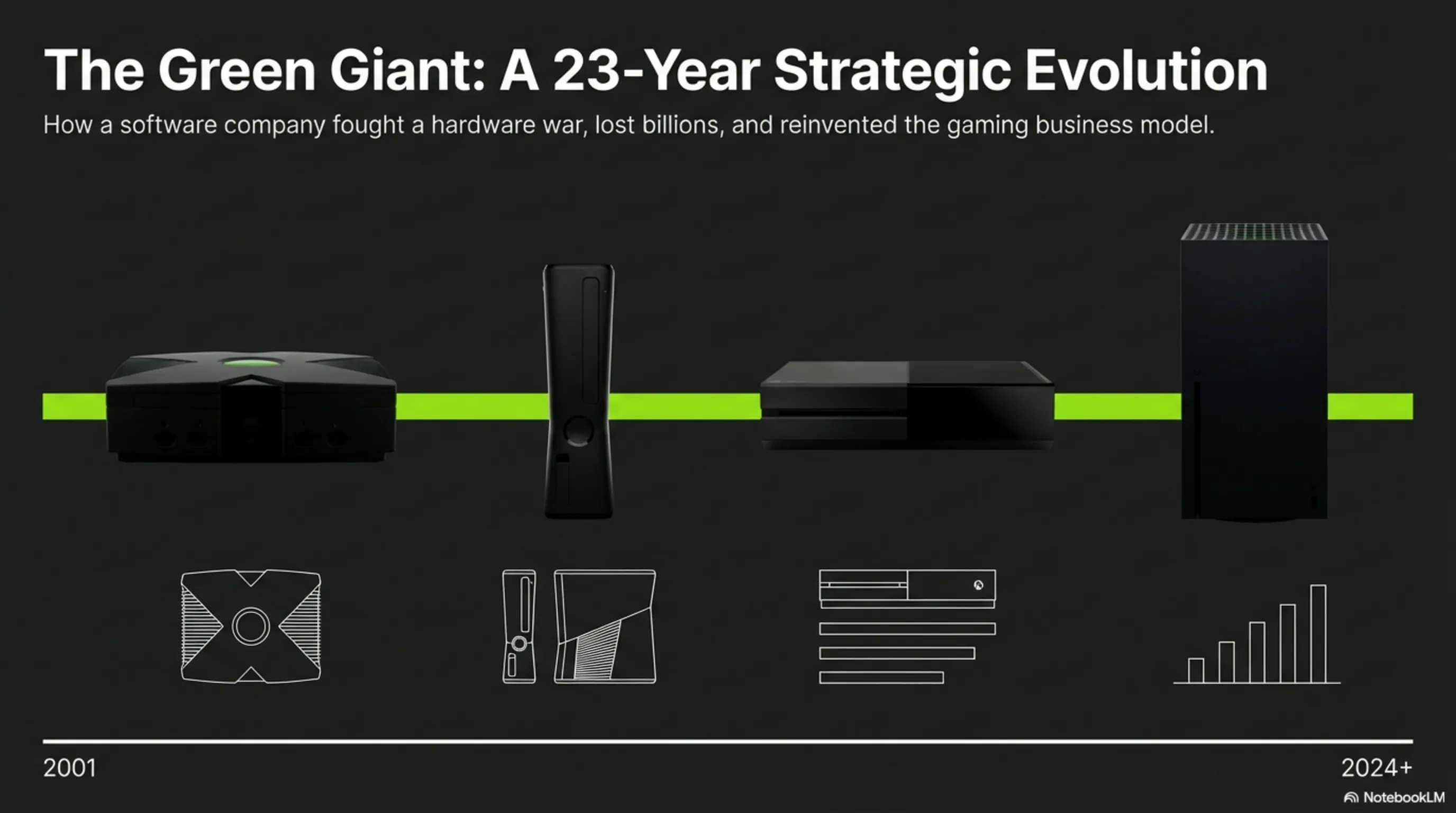
Hello Tekin Army! Today I want to take you on a 23-year journey - a journey into one of the boldest gambles in tech history. The story of how a software giant specializing in Windows and Office decided to enter the gaming console jungle and fight Sony and Nintendo - two giants who had dominated this market for decades.
This is the story of Xbox. The story of a brand that started from scratch, failed multiple times, lost billions of dollars, but never gave up. Today Xbox is one of the three major powers in the gaming industry, but its path has been full of catastrophic mistakes, controversial decisions, and 180-degree pivots.
Why did Microsoft even enter this market? The answer is simple: fear. Bill Gates and Microsoft's senior executives saw Sony with PlayStation 2 conquering living rooms. They feared gaming consoles would replace PCs and eliminate Microsoft from the home entertainment market. So they decided to make a preemptive strike.
Layer 2: Original Xbox - The Green Giant's Entry (2001-2005)
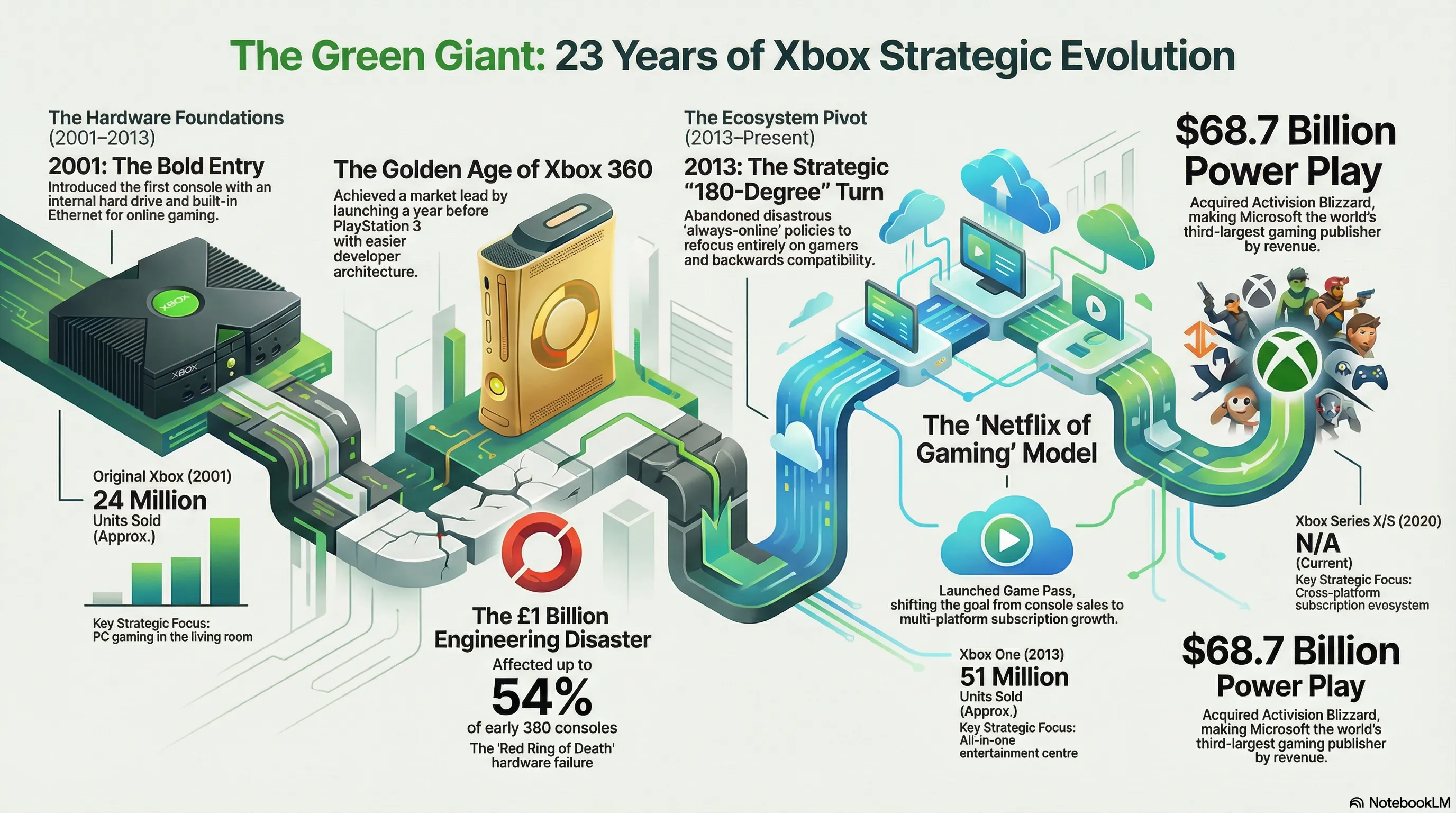
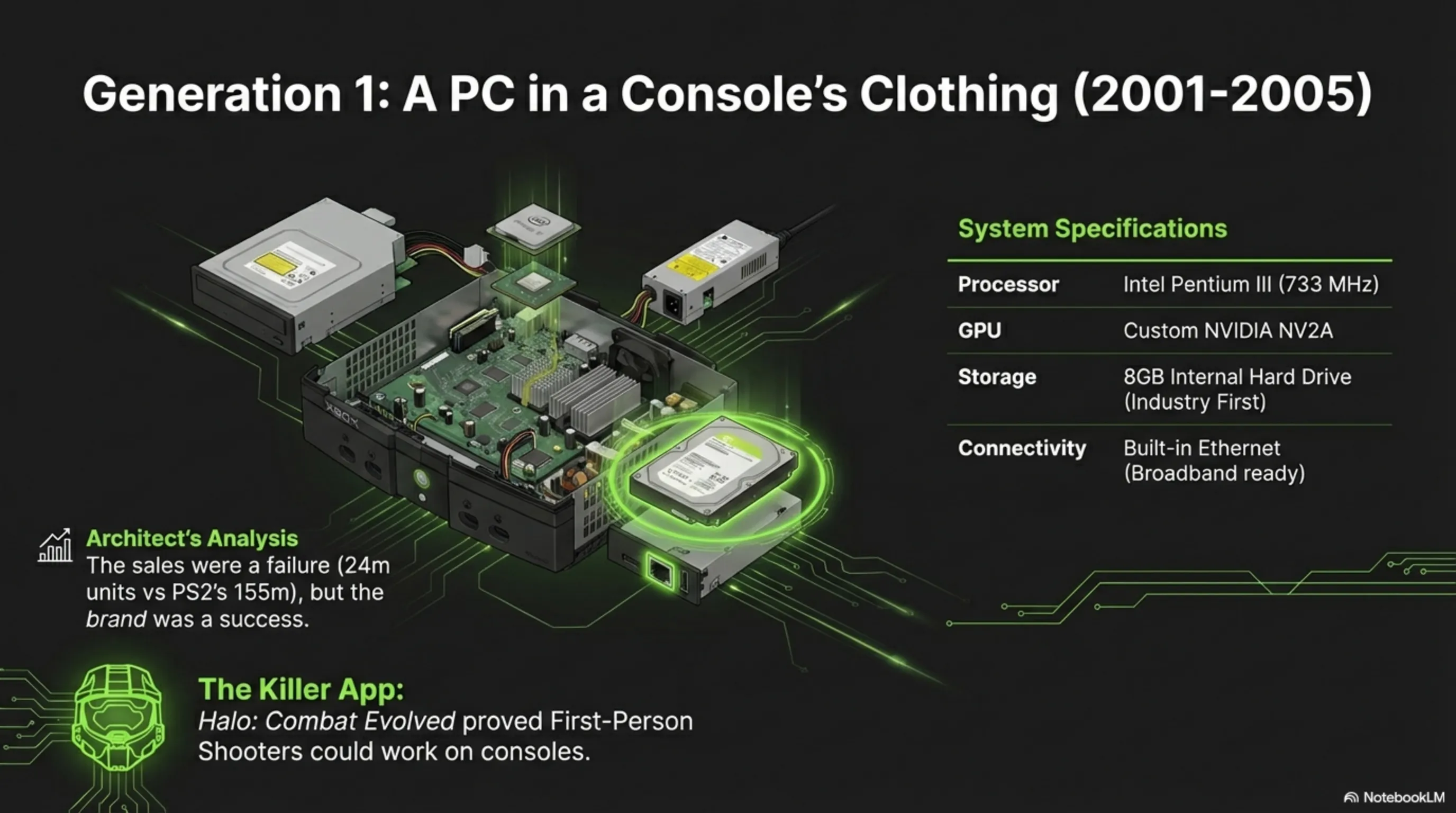
November 2001, Microsoft introduced its first gaming console: Xbox. It was a massive black and green box that looked like a miniaturized PC - and that's exactly what it was! Xbox used an Intel Pentium III processor and NVIDIA GPU. This was a fundamental difference from competitors who had custom architectures.
Xbox's technical specs were revolutionary for that time: 733 MHz CPU, 64 MB RAM, and an internal 8 GB hard drive. This was the first console with an internal hard drive - a huge advantage for game saves and content downloads. PlayStation 2 still used memory cards!
But more important than hardware was Microsoft's strategy: they wanted to bring PC gaming to the living room. Xbox supported built-in Ethernet for online gaming - something PlayStation 2 didn't have. And most importantly, they introduced Xbox Live - the first unified online service for consoles.
📊 Architect's Analysis: Why Didn't Original Xbox Fail?
Original Xbox failed in sales - only 24 million units versus 155 million PlayStation 2. But Microsoft got one thing right: building a loyal fanbase. Halo, Xbox Live, and the excellent controller made hardcore gamers interested in Xbox. This fanbase later saved Xbox.
Halo: Xbox's Savior
If there was one game that saved Xbox, it was Halo: Combat Evolved. This game was made by Bungie studio and was a sci-fi first-person shooter that changed everything. Halo showed that FPS could work great on consoles - before that, everyone thought FPS was only for PC.
Master Chief, Halo's hero, became Xbox's icon. This game had incredible sales and made many people buy Xbox just for Halo. This proved the "killer app" concept - one exclusive game that can sell a console by itself.
Xbox Live: Online Gaming Revolution
November 2002, Microsoft launched Xbox Live. This was a subscription service ($50 per year) that offered online gaming, voice chat, and friends list. This was the first time a console had a unified and professional online experience.
Halo 2 (2004) was the first blockbuster game fully focused on Xbox Live. Millions played online, formed teams, and talked together. This was the beginning of console online gaming - something that's normal for us now, but was revolutionary then.
Layer 3: Xbox 360 - The Golden Age (2005-2013)
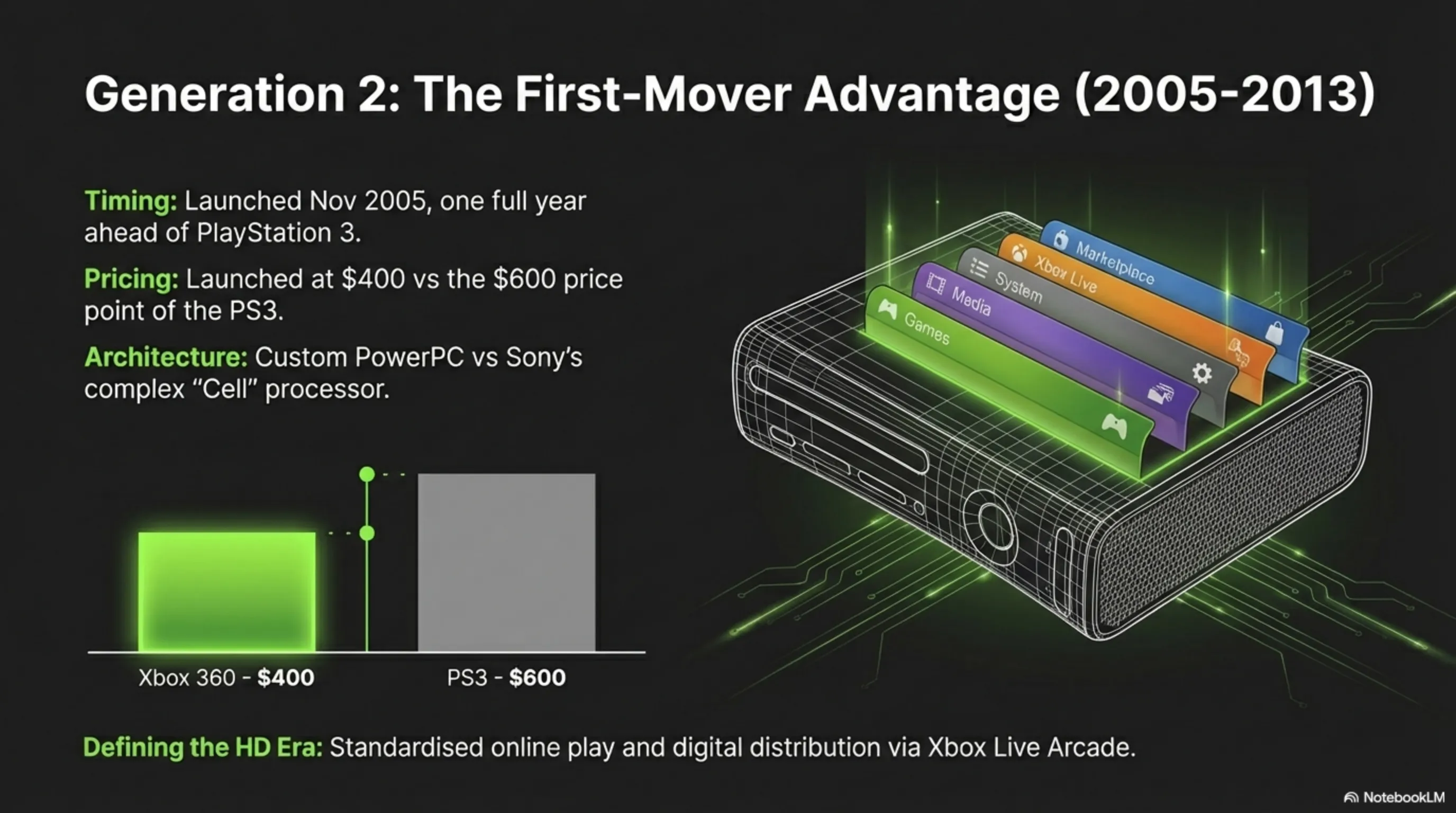
November 2005, Microsoft introduced Xbox 360 and this time everything was different. Xbox 360 came one year before PlayStation 3 - a huge strategic advantage. Microsoft learned that being first to market matters a lot.
Xbox 360's design was much better than original Xbox: smaller, prettier, and with a modern UI. The new dashboard with sliding blades, Xbox Live Arcade for indie games, and ability to download movies and music made Xbox 360 a complete entertainment center.
Hardware was powerful too: triple-core PowerPC processor at 3.2 GHz, custom ATI GPU, and 512 MB RAM. Xbox 360 was the first console to run games natively in HD resolution (720p and 1080p).
Console War: Xbox 360 vs PS3
Xbox 360 came one year earlier than PS3 and started at $400 (versus $600 for PS3). This was a huge advantage. By the time PS3 arrived, Xbox 360 already had millions of users and a stronger game library.
Xbox 360's exclusive games were legendary: Halo 3, Gears of War, Forza Motorsport, Fable, and Alan Wake. But more importantly, multiplatform games usually ran better on Xbox 360 because its architecture was easier for developers.
🔧 Technical Insight: Why Was Xbox 360 Development Easier?
PS3 used Cell architecture - a complex processor with 8 cores that was very hard to program. Xbox 360 used PowerPC architecture similar to PC. Result? Developers could more easily make games for Xbox 360 and usually the Xbox version worked better.
Red Ring of Death Disaster
But Xbox 360 had one catastrophic problem: Red Ring of Death (RROD). This was a hardware failure that made the console completely stop working and three red lights around the power button would light up. It's estimated that 23-54% of early Xbox 360s had this problem!
This was an engineering disaster. Microsoft had to extend warranty to 3 years and spend billions on free console repairs. It's estimated this problem cost Microsoft over $1 billion.
RROD's cause was poor cooling system design. Xbox 360 got very hot and this made the motherboard solder break apart. Microsoft later released redesigned versions (Xbox 360 S and E) that didn't have this problem, but brand damage was done.
Kinect: The Big Gamble
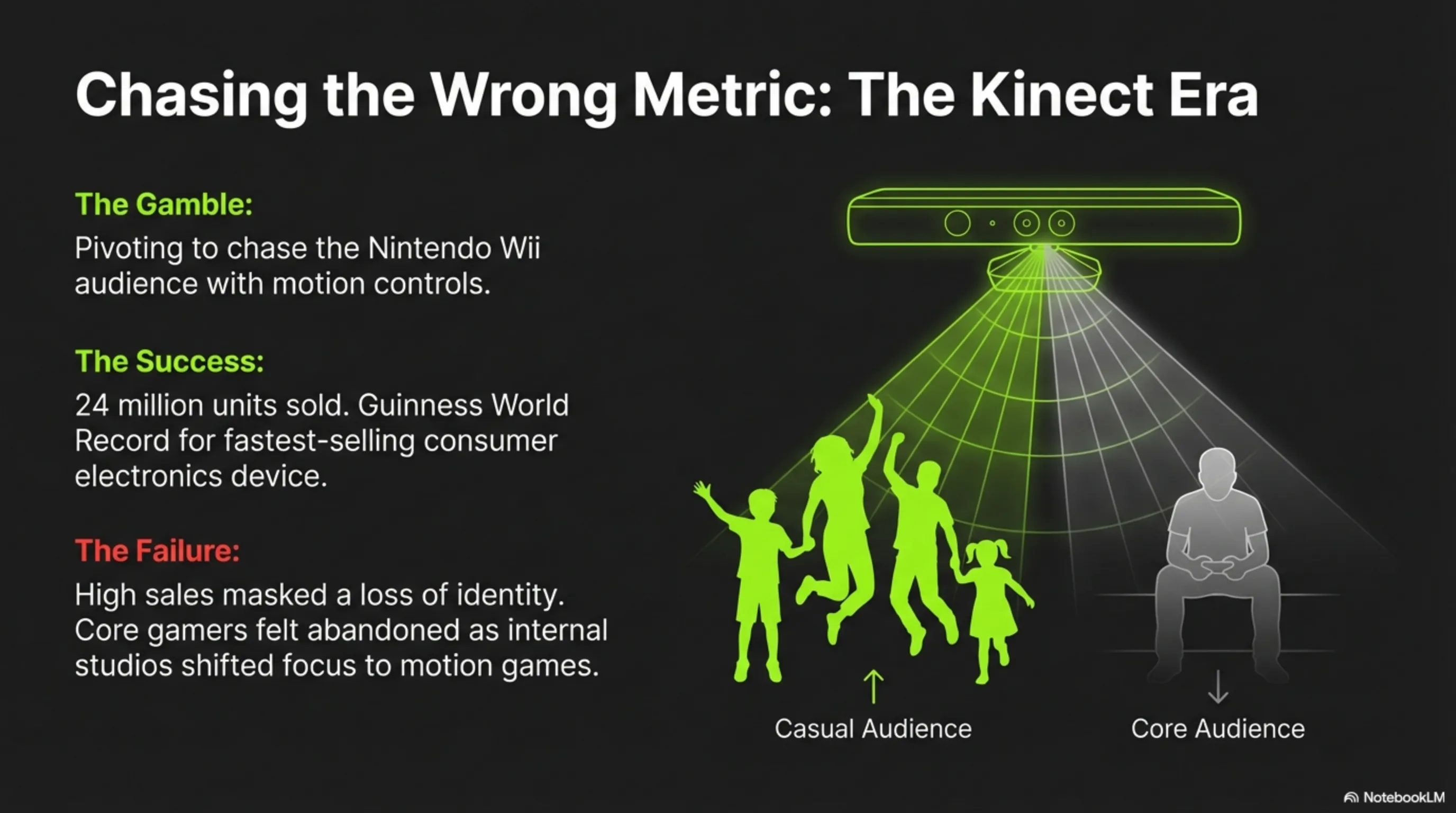
November 2010, Microsoft introduced Kinect - a motion sensor camera that could track your body and let you control games without a controller. This was a response to Wii's success with its motion controller that conquered the casual gaming market.
Kinect was successful in sales - sold 24 million units and entered Guinness Book as fastest-selling consumer electronics device. But in gaming terms, it failed. Kinect games were usually weak and hardcore gamers showed no interest. This experience was later repeated with Xbox One - with more catastrophic results.
Layer 4: Xbox One - Strategic Disaster (2013-2020)
May 2013, Microsoft introduced Xbox One and had one of the worst reveals in gaming history. Instead of focusing on games, Microsoft presented Xbox One as an "all-in-one entertainment center" that could watch TV, play movies, and... maybe play games too!
Don Mattrick, head of Xbox division, talked more about TV and sports than games in the reveal. His famous phrase "Xbox, watch TV" became a meme and symbol that Microsoft didn't understand what gamers wanted.
Catastrophic Policies
But worse than the reveal were the policies Microsoft announced:
1. Always-Online: Xbox One had to connect to internet every 24 hours, or games wouldn't work. This was a disaster for those without stable internet or who wanted to play in remote areas.
2. No Used Games: You couldn't buy used games or lend your games to friends. Each disc was locked to one account. This caused severe gamer anger.
3. Mandatory Kinect: Xbox One came with Kinect and couldn't be bought without it. This raised the price to $500 - $100 more than PS4.
4. Weaker Hardware: Xbox One was graphically weaker than PS4. Its GPU was 1.31 teraflops versus PS4's 1.84 teraflops. This difference was visible in games - multiplatform games usually ran at higher resolution on PS4.
⚠️ Architect's Warning: Community Reaction
The internet exploded. Gamers were angry, media criticized Microsoft, and Sony took advantage. At E3 2013, Sony released a simple video showing how to lend PS4 games to friends: just hand them the disc! This video went viral with millions of views. Microsoft was completely defeated.
180-Degree Turn
Community pressure was so high that Microsoft had to retreat. In June 2013, Don Mattrick announced Always-Online policy and used game restrictions were cancelled. Later they made Kinect optional and reduced price to $400.
But it was too late. Brand damage was done. PS4 with an excellent reveal completely focused on gamers conquered the market. Result? PS4 sold over 117 million units, while Xbox One sold only about 51 million.
Phil Spencer: Xbox's Savior
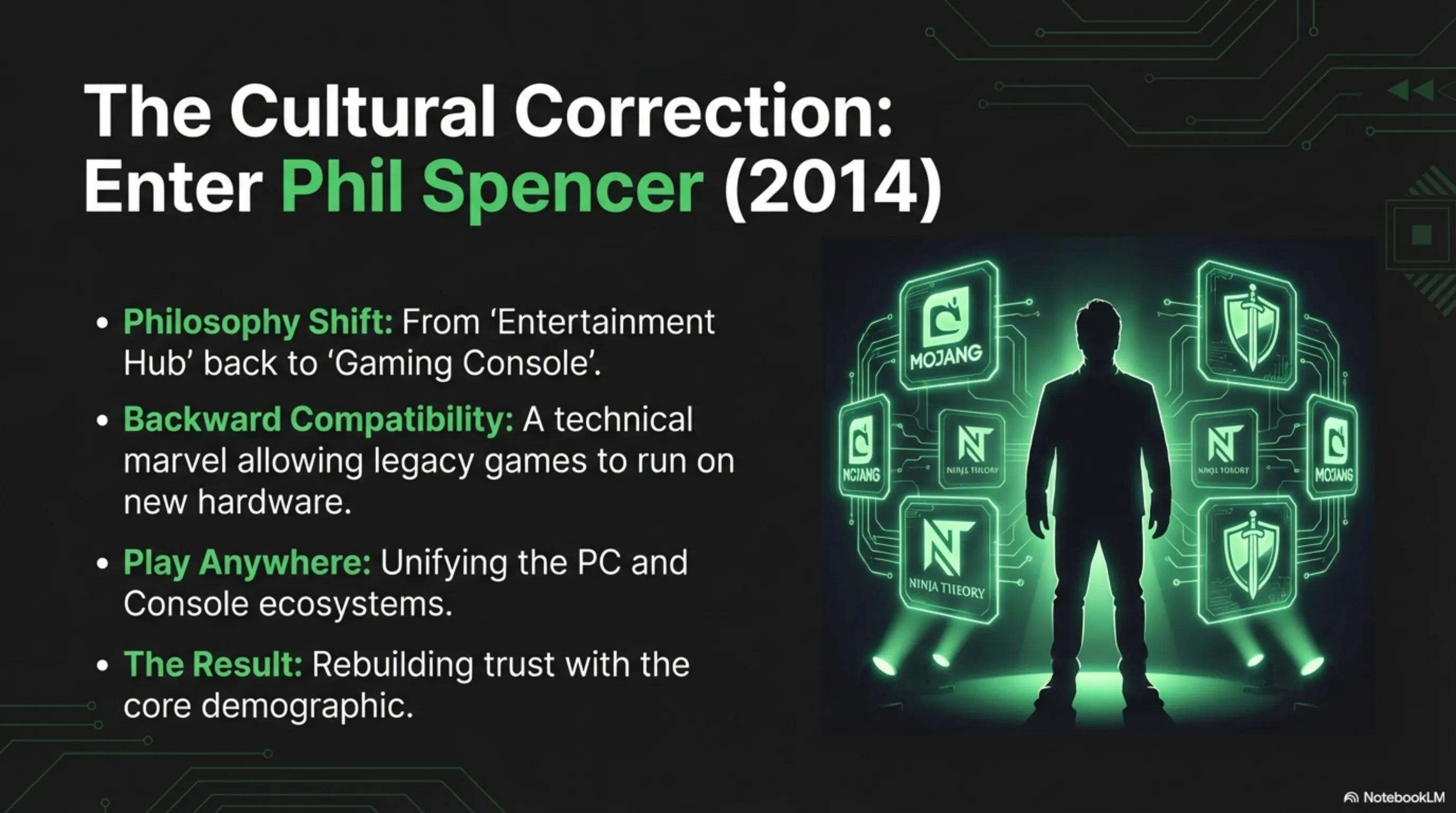
2014, Phil Spencer was appointed as new head of Xbox division and everything changed. Spencer was a real gamer who understood what the community wanted. He started listening to feedback, investing in game development studios, and focusing on what really matters: games.
Under Spencer's leadership, Microsoft made several strategic decisions:
1. Studio Acquisitions: Microsoft started buying game development studios. Ninja Theory, Obsidian Entertainment, inXile Entertainment, Playground Games, and later Bethesda ($7.5 billion) and Activision Blizzard ($68.7 billion - biggest acquisition in gaming history).
2. Game Pass: Launching Xbox Game Pass - a subscription service that for $10-15 per month gives access to hundreds of games. This was a game-changer and became "Netflix of gaming".
3. Play Anywhere: You could play Xbox games on both Xbox and PC with one purchase. This was a huge advantage for those who had both console and PC.
4. Backward Compatibility: Xbox One could run Xbox 360 and even original Xbox games. This was an amazing feature that PS4 didn't have.
Layer 5: Xbox Series X/S - New Generation (2020-Now)
November 2020, Microsoft introduced two ninth-generation consoles: Xbox Series X (powerful console) and Xbox Series S (cheaper and smaller console). This was a smart strategy - two options for two different markets.
Xbox Series X: Most Powerful Console
Xbox Series X came with stunning technical specs:
- CPU: AMD Zen 2 with 8 cores at 3.8 GHz
- GPU: AMD RDNA 2 with 12 teraflops (more powerful than PS5)
- RAM: 16 GB GDDR6
- Storage: Fast 1 TB SSD at 2.4 GB/s
- Support for 4K at 120 fps and Ray Tracing
Xbox Series X was on paper the most powerful console on market. Its design was interesting too - a black cube standing vertically that looked like a mini-fridge (which itself became a meme!).
Xbox Series S: Budget Option
Xbox Series S was a smaller and cheaper console ($300 versus $500 for Series X) designed for 1440p gaming, not 4K. This was a great option for those without 4K TVs or with limited budgets.
Series S used the same CPU, but weaker GPU (4 teraflops), less RAM (10 GB), and smaller SSD (512 GB). But its price was very attractive and great for casual gaming market.
🔧 Technical Insight: Two-Console Strategy
Microsoft's strategy was smart: Series X for hardcore gamers who want the best experience, and Series S for general market who want to enter next-gen cheaply. This allowed Microsoft to cover both premium and budget markets.
Big Problem: Lack of Exclusive Games
Xbox Series X/S had powerful hardware, but one big problem: lack of ninth-gen exclusive games. For years after launch, Xbox had no major AAA exclusive. Halo Infinite came late with mixed reception. Starfield and Forza Motorsport also released late.
In contrast, PS5 had strong exclusives like Demon's Souls Remake, Ratchet & Clank: Rift Apart, Returnal, Horizon Forbidden West, and God of War Ragnarök. This was a big difference that made PS5 ahead in sales.
Layer 6: Game Pass - Future Strategy
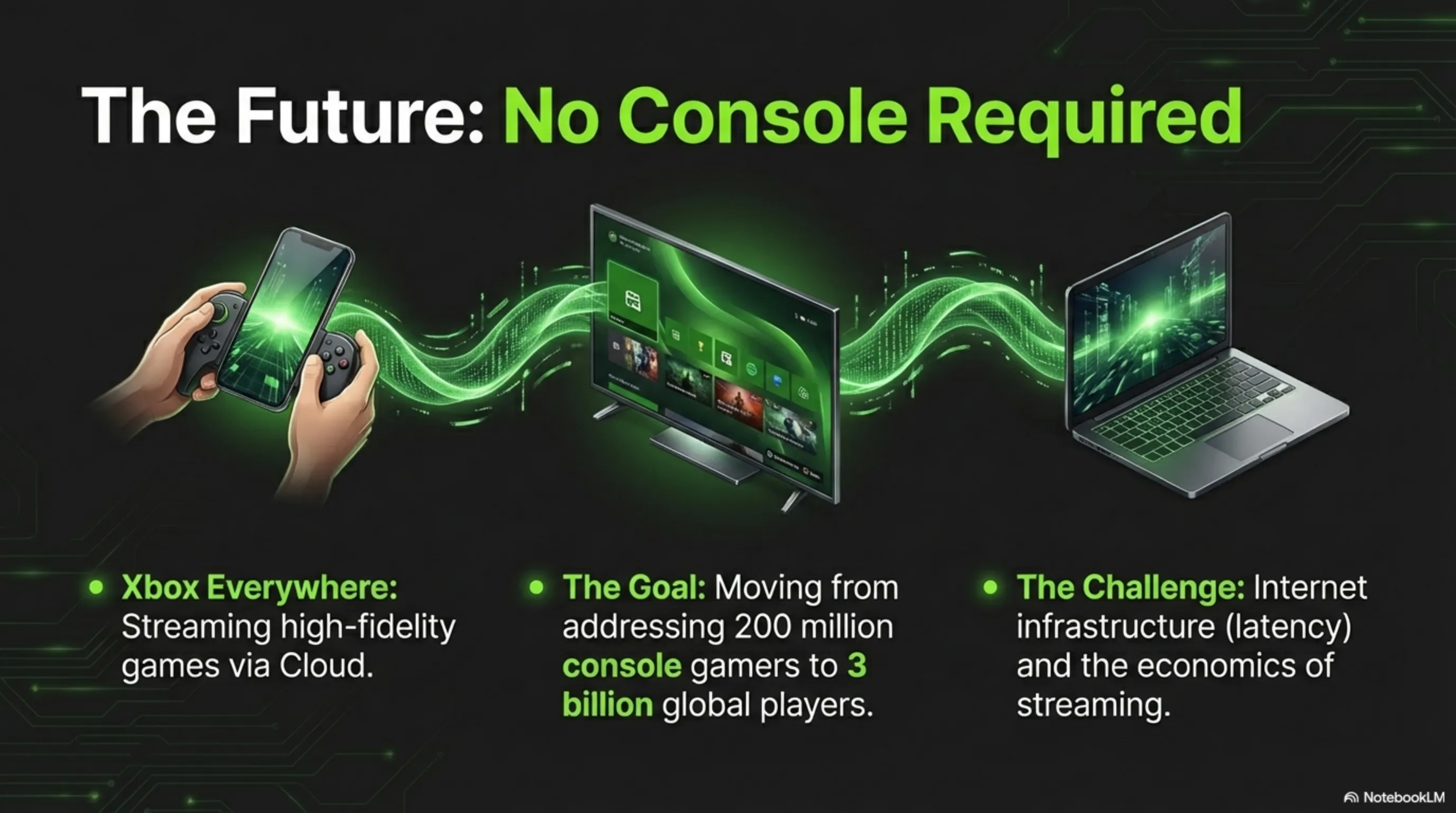
If there's one thing that differentiates Xbox from PS5, it's Xbox Game Pass. This service for about $15 per month (Ultimate version) gives access to over 400 games - including all Xbox exclusives on day one.
Game Pass is a paradigm shift in gaming industry. Instead of buying each game for $70, with a monthly subscription you have access to hundreds of games. This business model is like Netflix, Spotify, and other streaming services.
Why Is Game Pass Important for Microsoft?
Microsoft is no longer chasing console sales - they're building a subscription ecosystem. Phil Spencer has repeatedly said their goal is "bringing games to everyone, everywhere, on any device". Game Pass makes this possible:
- You can play on Xbox Series X/S
- You can play on PC
- You can play with Cloud Gaming on mobile, tablet, or even smart TV
This means you don't even need an Xbox to access Xbox games. This is a long-term strategy that might define gaming's future.
Layer 7: Activision Blizzard Acquisition - Biggest Deal Ever
January 2022, Microsoft announced it would buy Activision Blizzard for $68.7 billion. This was the biggest acquisition in gaming industry history and shocked everyone. Activision Blizzard owned massive franchises like Call of Duty, World of Warcraft, Overwatch, Diablo, and Candy Crush.
This deal took a year and a half to complete because various regulatory bodies (FTC in America, CMA in UK, and European Commission) were concerned this purchase would cause monopoly. Finally in October 2023, the deal completed and Activision Blizzard officially became part of Microsoft.
Why Is This Purchase Important?
This purchase made Xbox the world's largest game publisher (after Tencent and Sony). Now Microsoft has over 30 game development studios and can release dozens of AAA games every year.
Most importantly, Call of Duty - world's biggest FPS franchise - now belongs to Microsoft. This is a huge trump card for Game Pass. Imagine every year, the latest Call of Duty comes to Game Pass on day one. This could attract millions.
🚨 Critical Analysis: Risks of This Strategy
Activision Blizzard acquisition is a huge gamble. Microsoft spent $68.7 billion and must return this money. If Game Pass can't reach desired subscriber numbers, this could be a financial disaster. Also, Activision Blizzard has struggled with cultural issues and sexual harassment scandals in recent years. Microsoft must fix this culture.
Layer 8: Future - Where Are We Going? (2026 and Beyond)
It's now 2026 and Xbox is at a turning point. With Activision Blizzard acquisition, Microsoft has become world's largest game publisher (after Tencent and Sony). Game Pass is becoming a giant platform. Cloud Gaming is improving. But the question is: is this enough?
Challenges Ahead
1. Lack of Exclusives: Xbox still hasn't produced enough strong exclusive games. Halo Infinite was weak, Starfield was mixed, and Fable and Perfect Dark haven't released yet. Microsoft must prove it can make quality AAA games.
2. Competition with PlayStation: PS5 is ahead in sales and has stronger exclusives. Sony is still console king and Xbox must work much harder.
3. Game Pass Profitability: It's still unclear if Game Pass is actually profitable. If this business model fails, Microsoft must change its strategy.
4. Cloud Gaming: Cloud Gaming technology isn't perfect yet. Lag, image quality, and need for high-speed internet are still problems to solve.
Opportunities Ahead
1. Call of Duty on Game Pass: If Microsoft can put Call of Duty on Game Pass day one, this could attract millions of new subscribers.
2. New Studios: With 30+ studios, Microsoft can release dozens of AAA games every year. If quality is high, this could be a game-changer.
3. Mobile Market: With Activision Blizzard acquisition, Microsoft gained access to mobile market (Candy Crush, Call of Duty Mobile). This is a huge market that could generate massive revenue.
4. Metaverse and AI: Microsoft is investing in future technologies like metaverse (with Minecraft and HoloLens) and artificial intelligence (with Copilot). These could define gaming's future.
Conclusion: 23 Years of War, Persistence, and Transformation
Xbox's story is a story of failure and success. From a bold entry in 2001, to Xbox 360's golden age, to Xbox One disaster, and now strategic transformation with Game Pass and Activision Blizzard acquisition. Xbox never gave up, even when everyone thought it should quit.
What differentiates Xbox from others is its long-term vision. Microsoft is no longer chasing console war victory - they're building a gaming ecosystem accessible everywhere, on any device. This is a paradigm shift that might define the industry's future.
Can Xbox beat PlayStation? Maybe not - at least not in console sales. But maybe that's not the right question. Maybe the right question is: Can Xbox bring gaming to everyone? And the answer to that question seems positive.
🎯 Xbox History Summary
2001-2005 (Original Xbox): Microsoft's bold entry with Halo and Xbox Live - establishing a brand
2005-2013 (Xbox 360): Golden age - close competition with PS3, legendary games, but RROD disaster
2013-2020 (Xbox One): Strategic disaster with bad reveal, but salvation with Phil Spencer and Game Pass
2020-Now (Series X/S): New generation with powerful hardware, Game Pass, and Activision Blizzard acquisition
Future: Focus on ecosystem, Cloud Gaming, and bringing games to everyone - not just console sales
For those of us who've seen these 23 years, Xbox isn't just a console - it's part of gaming history. From nights playing Halo 2 online with friends, to the moment we first tried Game Pass and realized gaming's future was changing. Xbox proved that even a software giant can succeed in hardware and gaming - you just have to persist.
Here's to the next 23 years filled with amazing games, technological innovations, and memorable moments. Long live Xbox!