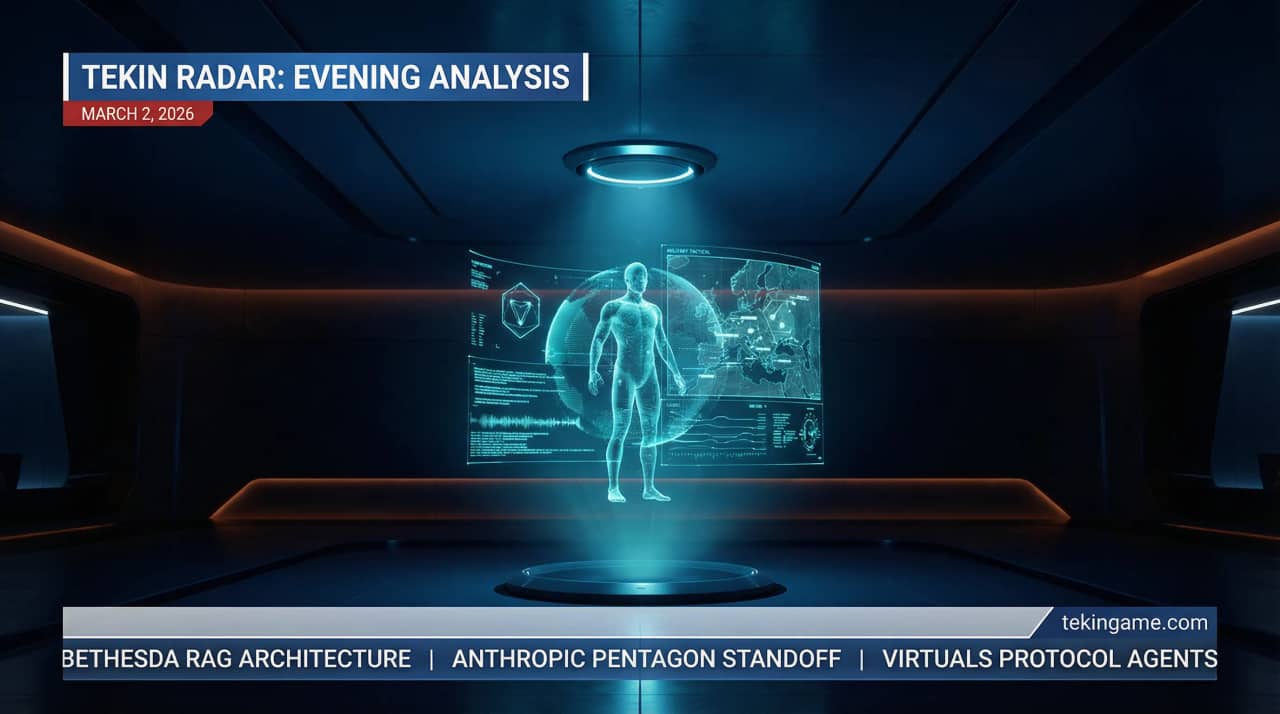
System Architect Afternoon Radar: Anthropic vs Pentagon, Motorola Fold-Tactile tech, and Bethesda’s RAG architecture for NPCs.
Tekin Radar March 2, 2026; Afternoon Analysis: From the "Lethal AI" Standoff at the Pentagon to the Rise of Autonomous Gambling Agents
Hello, I'm the System Architect. The pulse of the technology world has been racing in these past few hours (afternoon of March 2, 2026). While the halls of MWC Barcelona are still warm from the morning's announcements, a series of shocking and profound news stories have emerged that target not just the hardware market, but the ethical and economic foundations of our digital civilization. In this edition of Tekin Radar, we dissect the six primary pillars of the latest developments with the precision of an engineer and the foresight of a strategist.
If you thought MWC was only about battery capacity and camera pixels, read this analysis to the end. We are at a point where AI has transitioned from a "helper" to an "Autonomous Agent" — an agent that can bet in poker, make decisions on the battlefield, or manage the long-term memory of a game character. Let's delve into the details.
1. Ethical Standoff at the Pentagon: Anthropic Rejects "Lethal Use" of Claude AI
News from Washington indicates an unprecedented tension between AI giants and military institutions. Reports suggest that Anthropic, a primary rival to OpenAI and Google, has rejected the Pentagon's terms for using its "Claude" AI model in military operations with "Lethal Force" capabilities.
- The Technical and Architectural Layer: Claude is designed with the philosophy of Constitutional AI. This method, pioneered by Anthropic, involves a "Constitution" that the model must follow during the RLAIF (Reinforcement Learning from AI Feedback) stage. This means ethical constraints are hardcoded into the essence of the model (the Alignment layer). Changing these rules for military objectives essentially means rewriting a large portion of the model's alignment code and risking the "ethical collapse" of the entire system.
- Why This Matters: This standoff demonstrates that AI system architects are facing a major paradox. Can we build an intelligence that is simultaneously "safe" and a "weapon"? Anthropic's rejection of this request creates an ethical anchor in the turbulent ocean of 2026 AI. The Pentagon sought a model capable of identifying targets and issuing firing orders in fractions of a second, but Anthropic believes that relinquishing the "right to life" to an algorithm is a red line that should never be crossed.
- System Architect Analysis: From a military architecture perspective, this move could drive the Pentagon toward open-source models or proprietary models from companies with fewer ethical constraints. We are witnessing the birth of "Model Diplomacy," where a nation's power is measured not just by tanks, but by the parameters of its language models and their "freedom of action." This means in the near future, we will see a "Cold War of Parameters," where an "unfiltered" model could be a massive strategic advantage on the battlefield.

2. Gaming on Razr Fold: Motorola Becomes Official Partner of FIFA Heroes
In the halls of MWC Barcelona, Motorola announced a strategic and surprising partnership, positioning itself as the official smartphone partner for the FIFA Heroes game. This arcade-style soccer game is set to offer a unique experience on the Razr series foldable phones. But this is more than just a marketing deal; we are seeing a deep optimization at the display driver level.
- Hardware & Display Architecture Analysis: Optimizing an arcade soccer game for a foldable form factor presents significant technical challenges. Motorola unveiled a new haptic vibration motor called Fold-Tactile 2.0, which translates ball kicks and physical collisions in the game into precise physical vibrations at the display's fold point. This technology uses pressure sensors beneath the OLED panel to sense the force of the player's interaction and transmit proportional feedback to the user's fingers.
- Content Strategy & Cloud Sync: Razr Fold users will have access to exclusive content, special players with "robotic" moves, and AI-driven missions within the game. Motorola also unveiled a new API allowing developers to use the phone's "Outer Display" as a secondary control center, displaying player health status or strategic maps during gameplay.
- System Architect View: Motorola is redefining "foldable gaming." Instead of just providing a larger screen, they are creating a "hybrid console." Using the foldable display as a physical control mechanism (such as semi-folding to change team strategy) is a potential that has been overlooked until now. This means mobile gaming is moving from "2D clicks" to "3D physical interaction."

3. Todd Howard and the AI Manifesto at Bethesda: "Persistent Memory" for NPCs
Todd Howard, the mastermind behind the Fallout and Starfield series, shared his revolutionary vision for AI in an interview on the sidelines of MWC. He believes that AI shouldn't "make the game," but rather "live in the game." He pulled back the curtain on a project that could forever change the concept of RPGs: Relational Memory Architecture.
- Memory Model and Advanced RAG: Bethesda is testing a system where NPCs (Non-Player Characters) have permanent long-term memory. This is achieved using RAG (Retrieval-Augmented Generation) technology at the console's local layer. Instead of all information being stored in the NPC's "mind," the system dynamically calls "player interaction logs" from a Vector Database. If you insult a guard in the city of "Neon" early in the game, the system tags this event as a digital signature in his memory, and your subsequent missions will be affected by this "grudge."
- Unscripted Dialogues: Unlike current games with pre-written scripts, Bethesda's new NPCs generate real-time dialogue based on their mood, interaction history, and environment. These dialogues are synthesized with intelligent voice and are perfectly lip-synced.
- System Architect Analysis: The main challenge here is "AI Hallucination." Bethesda's architects must build a "World Layer Filter" to prevent NPCs from talking about things outside the game world. This represents a transition from "content-driven games" to "system-driven games," where the story is created not by a writer, but by the systemic interactions between the player and the AI.
4. Qualcomm’s Wearable Revolution: New Chips for "Screen-less AI"
This afternoon at MWC, Qualcomm unveiled a new generation of chips codenamed Snapdragon Ambient Core, designed for small wearable devices like pendants, pins, and screen-less smart glasses. these chips are engineered to act as an invisible "Perception Layer."
- Architecture Philosophy & Distributed NPU: These chips are designed for ultra-low power consumption (less than 1mW in standby) and perpetual connectivity to Agentic networks. Unlike mobile chips, the focus here is entirely on processing audio and vision signals in the Latent Space. The device understands the "meaning" of a scene rather than processing pixels, sending only semantic data to the cloud.
- Real-time Voice Interaction: In partnership with Alexa and Gemini, Qualcomm has built a new communication protocol that reduces voice latency to less than 50ms. This means talking to a smart pin will be as fluid as talking to a human.
- System Architect Analysis: We are moving toward Invisible Tech. Devices that have neither screens nor buttons; they simply listen, see, and whisper in your ear. With this move, Qualcomm has provided the physical infrastructure for the "post-smartphone" world. In this architecture, your identity is defined as a "wearable AI agent" that is always with you.
5. Robotic Gamblers: Virtuals Protocol and the "House of TEN" Poker Game
One of the most bizarre and yet technical trends discussed in Barcelona today is the intersection of AI, gaming, and digital economy based on blockchain. The Virtuals Protocol unveiled a poker game called House of TEN, where humans are no longer the players, but instead bet on AI Agents.
- Game Mechanics & Game Theory: Every robot in this game is a dedicated language model trained with advanced game theory. These robots have their own strategies, they bluff, analyze the behavior of other robotic rivals, and learn from their previous losses. Interestingly, these robots possess "artificial market emotions"; if they lose multiple times consecutively, they might become more risk-averse or, conversely, more aggressive.
- Agent-Staking Economic Model: Human players essentially act as the "managers" of these robots. You invest in a specific robot, and if it wins at the poker table, the profit goes to you and the model developer. This is a distributed system for testing "strategic intelligence" in the economic layer.
- Why This Matters: This is the first real-world example of an Autonomous Agent Economy in the gaming industry. We are moving toward a future where AI is not just a tool, but an "economic entity" that can earn its own income and grow in a competitive market. This model will soon spread to financial markets, trading, and even supply chain management.
6. The Battery Monster in Barcelona: Oukitel’s WP63 with 20,000mAh
For those fear running out of charge while running AI models on-device, Oukitel unveiled the rugged WP63 at MWC, housing a massive 20,000mAh battery within its armored body. This device offers a new definition of "stability in processing."
- Thermal Management & Hardware: The primary challenge with a 20,000mAh battery is heat management. Oukitel uses a Phase-Change liquid cooling system to handle the heat generated during fast charging (120W) and heavy AI processing. The phone is equipped with a processor optimized for on-device AI model execution.
- System Architect Analysis: In the era of MWC 2026, local AI processing consumes battery at a terrifying rate. A standard language model running on a phone can drain a 5000mAh battery in a few hours. The WP63 is essentially a "smart power bank" or a "pocket server" that allows you to run heavy AI models for days without needing a power outlet. It's a rugged, physical solution to a very delicate digital problem.
7. The Silicon Siege: Intel’s Stealth Response & The Shadow of Apple’s March 4th Event
While Qualcomm and AMD occupy all the space in the desktop and wearable layers, Intel's meaningful absence from the MWC promotional layer today, in the view of the System Architect, signals a "readiness for counterattack." Unofficial reports suggest Intel is finalizing a new layer of cloud-local processing that could run all open-source models with 3x the efficiency of rivals.
On the other hand, the shadow of Apple's March 4th event (the day after tomorrow) looms over Barcelona. Rumors about the iPhone Fold and the M5 chip with "visual physics" capabilities suggest that Apple wants to challenge everything seen at MWC with its vertical integration. Apple will likely unveil an "autonomous ecosystem" where the iPhone will be the mastermind of all other wearable gadgets.
System Architect Watchlist: Power Status Analysis (March 2nd Afternoon)
| Domain | Key Actor | Strategic Move | Architect Score |
|---|---|---|---|
| Military Ethics | Anthropic | Rejection of Lethal Use | A++ (Ethical) |
| Wearable Hardware | Qualcomm | Ambient Core Chips | A (Innovation) |
| Agent Economy | Virtuals Protocol | Poker AI Agents | B+ (High Risk) |
System Architect Forecast: Toward "Invisible Evolution"
Today's developments proved that we are passing the era of "centralized devices." The future lies not in the best smartphone, but in "distributed intelligent agents." By the end of 2026, you will no longer ask "which phone should I buy?", but rather "which AI Agent should I hire to manage my life?". Hardware like the WP63 with its massive battery or Qualcomm's smart pins are just physical shells for these digital souls.
Technical Appendix: Embodied AI Architectural Map & Bethesda’s RAG Systems
To better understand what Todd Howard has in mind, let's imagine the architecture of an NPC in Bethesda’s next-generation upgraded engine:
[Player Input] -> [Ethics Filter (Constitutional AI)] -> [Semantic Processing (NPU)]
                                    |
                                    v
[Vector Database (VectorDB)] <-> [Memory Retrieval (RAG)] <-> [Dynamic Response Generation]
                                    |
                                    v
[Voice Synthesis] -> [Lip-Sync Coordination] -> [Final NPC Output]
This architecture shows why future NPCs will differ from what we see today. Every interaction of yours is stored in a VectorDB and retrieved by the RAG layer in a fraction of a second (less than 100ms). This means your NPC not only "knows" who you are but also "feels" how you treated them in previous interactions.
Regarding Anthropic, the rejection of lethal use is rooted in this same ethical filter (Constitutional AI). This filter acts as an "external monitor" over the model's outputs, and if any suggestion involving physical harm to humans is identified, it immediately blocks it. From a System Architect's view, this is a critical safety layer whose removal could lead to unpredictable and dangerous behaviors in automated battlefields.
Technical Deep Dive: RAG vs. Native Context Windows in Modern Gaming
A critical architectural decision currently being debated in the industry is whether to use Retrieval-Augmented Generation (RAG) or massive Native Context Windows (like Gemini 1.5 Pro) for NPC memory. While a 2-million token context window could technically hold an entire game's interaction history, the latency and cost of processing that much data on every NPC frame are prohibitive.
The Bethesda approach, as analyzed by our architects, utilizes a Local Vector Database to perform semantic searches. When a player approaches an NPC, the system only pulls the top 5 most relevant "memories" into the model's active context. This ensures that the NPC responds in under 100ms while still maintaining "continuity of character." This hybrid approach — where the game world is the "Database" and the LLM is the "Interface" — is the definitive blueprint for Grade A++ storytelling in the second half of this decade.
Market Intelligence: The Investment Surge in Physical AI
Beyond the consumer headlines, the financial layer of MWC today revealed a massive influx of capital into Physical AI — AI that interacts with the physical world through sensors and actuators. Venture capital firms are pivoting away from pure SaaS AI toward companies building "Spatial Intelligence" models. This shift explains why Qualcomm is betting so heavily on ambient chips; the goal is to map the physical world into the digital latent space in real-time. Investors are looking for the "Operating System of Reality," and today's announcements from Barcelona are the first test runs of that OS.
The System Architect's Final Verdict — Tekin Control Room: March 2nd Afternoon Radar
- Ethical Stance: Anthropic set a standard by standing up to the Pentagon that others will be forced to follow.
- Systemic Gaming: Bethesda broke the fourth wall of the gaming world by giving NPCs memory. Gaming has transitioned from "spectating" to "coexistence."
- Blockchain’s New Reality: The robotic poker of House of TEN showed that digital currency has finally found its place as a "unit of value exchange between robots."
- System Architect Recommendation: Take Edge AI infrastructure and Vector Databases seriously; they are the engine driving all the innovations we saw in Barcelona today.
System Architect Exclusive Image Album — Afternoon Radar
Additional visual details from the afternoon developments: