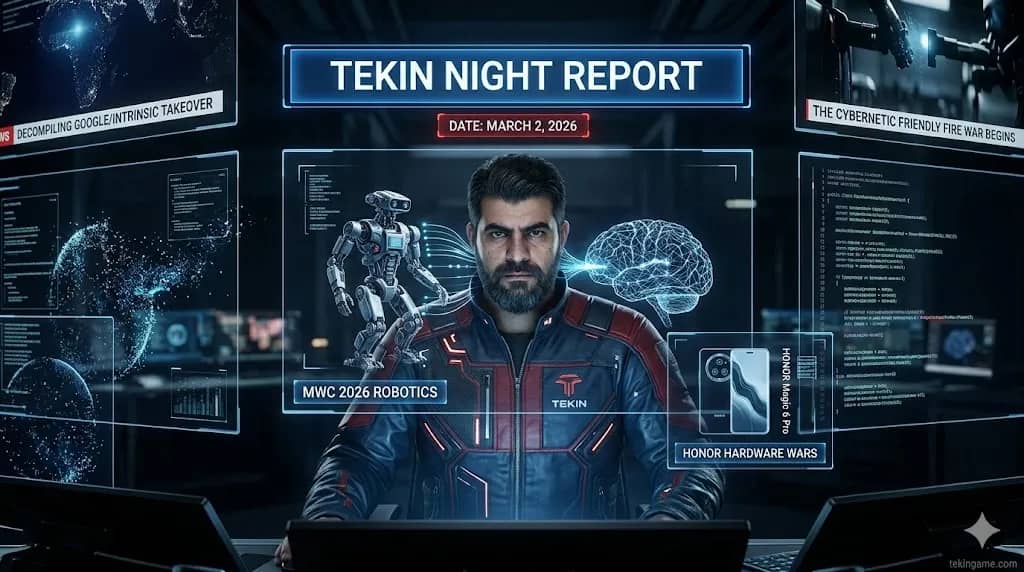
Tekin Night March 2nd: Analyzing MWC 2026 robotics highlights, Intrinsic integration, and the geopolitical chip race.
Tekin Night — March 2, 2026: Robotics Night — From Honor's Humanoid Robot to Singapore's $800M Semiconductor Bet; System Architect Evening Bulletin
Hello, I'm the System Architect, and tonight I'm analyzing the hottest news from the heart of MWC 2026 in Barcelona — the world's largest mobile and tech event. Tonight is Robotics Night — the night when the boundary between smartphone and humanoid robot was erased, Google finalized its biggest robotics acquisition, and Asian powers poured billions into the chip war. Let's dissect six breaking stories with the precision of an engineer and the passion of a strategist.
MWC 2026 has transformed Barcelona's Fira Gran Via into a battlefield of emerging technologies like never before. Over 100,000 attendees from 200 countries are witnessing tech giants — from Samsung and Lenovo to Honor and ZTE — unveil their latest innovations. But the common thread across every booth is unmistakable: AI is no longer just software — it has become physical, tangible, and is entering our real lives. From humanoid robots dancing on stage to processors running AI models on your desktop — MWC 2026 is the inflection point of Physical AI.
1. Honor Unveils Its First Humanoid Robot + "Robot Phone" with Embodied AI!
Chinese tech company Honor, the brand that spun off from Huawei, detonated a robotics bomb at MWC 2026 Barcelona. They didn't just introduce their first humanoid robot with an autonomous dance performance on stage — they also unveiled the revolutionary concept of the "Robot Phone" — a smartphone that combines a motorized flip camera, embodied AI, and cinematic imaging capabilities.
- Honor's Humanoid Robot: Introduced with an autonomous dance performance at MWC, this robot signals Honor's serious entry into the humanoid robotics market. While full technical specifications haven't been released yet, its alignment with China's broader humanoid robot strategy is unmistakable.
- "Robot Phone" — Where Smartphones Meet Robotics: Expected to launch in the second half of 2026, this device features a Motorized Flip Camera — a concept Honor describes as "embodied AI interaction combined with robot-grade kinematic imaging." In simpler terms, the phone's camera moves like a miniature robot to find optimal angles.
- Strategic Analysis: Honor's move demonstrates that smartphone companies are no longer just selling screens — they're producing "intelligent physical entities." The DNA of Huawei's engineering flows through Honor, suggesting that HarmonyOS could soon become the operating system for Chinese consumer robots.
2. Google Integrates Robotics Company Intrinsic into Its Core — Attacking "Physical AI"
In a major strategic move, Google has pulled robotics software company Intrinsic Innovation LLC out of its independent Alphabet subsidiary status and integrated it directly into Google's core operations. The objective? Accelerating the development of "Physical AI."
- What Does Intrinsic Do? The company built a robotics software platform aimed at simplifying industrial robot deployment. Instead of months of custom programming, Intrinsic makes robot programming as straightforward as mobile app development.
- The Google Synergy: With Intrinsic now inside Google's core, the platform gains direct access to Gemini models, Google Cloud, and vast sensor data. This exponentially accelerates "Google-powered intelligent robots."
- Market Forecast: Google is preparing to do for industrial robotics what it did with Android in the mobile world: build a standard operating system for robots. This is a direct challenge to Tesla's Optimus and emerging Chinese giants.

3. AMD Launches Ryzen AI 400 Desktop Processors — World's First Desktop AI PC with Copilot+ Support
AMD unveiled its new Ryzen AI 400 and Ryzen AI PRO 400 Series desktop processors at MWC 2026. These are the world's first desktop processors to support the Microsoft Copilot+ PC experience locally.
- NPU with 50 TOPS Power: The embedded Neural Processing Unit delivers up to 50 Trillion Operations Per Second of AI compute. This allows users to run Large Language Models (LLMs) locally on their computers without cloud latency or costs.
- Competing with Intel: AMD has created a key competitive advantage by focusing on a stronger NPU for local LLM execution. The desktop "AI PC" war has officially moved to the NPU battleground.
- Gaming & Productivity: The NPU power enables AI-based Super Resolution in games and 4K video editing assistance without burdening the main CPU and GPU.

4. Lenovo Unveils Next-Gen Foldable Gaming Handheld with Adaptive AI
Lenovo announced a next-generation Foldable Gaming Handheld at MWC 2026 under the banner "Smarter AI for All."
- Foldable Design: This device offers a massive display when open and portability when folded. Lenovo also introduced Qira — a Personal Ambient Intelligence system that syncs settings across all Lenovo devices.
- System Architect View: Lenovo is pursuing an Apple-like ecosystem strategy, syncronizing game settings across handhelds, laptops, and tablets seamlessly.

5. Chinese Galbot Raises $350 Million — The Humanoid Robot Funding Surge
Chinese startup Galbot, specializing in Embodied AI Models, successfully raised $350 million. Unlike hardware-focused rivals, Galbot concentrates on the "brain" — the large models that control physical robot bodies.
- Geopolitical Context: China is building an industrial "robot army." The density and diversity of Chinese robotics startups (Galbot, AGIBOT, Unitree) is creating a competitive ecosystem that is outpacing American rivals in innovation speed.

6. Singapore Invests $800 Million in Semiconductor R&D — The Asian Chip War Intensifies
The Government of Singapore announced an investment of S$800 million in semiconductor research, focusing on Advanced Packaging and Photonics.
- Strategic Hub: Instead of competing directly with TSMC in raw 3nm manufacturing, Singapore is positioning itself as the global hub for advanced packaging and photonics — areas that serve as the next bottlenecks in the AI supply chain.
- Photonics Expansion: Optical computing could increase AI speeds by 100x while reducing power consumption. Singapore's bet on light-based processing is a hedge against the limits of traditional silicon.

7. Huawei’s Agentic Core Solution — Backbone for Autonomous Networks
Huawei released its Agentic Core solution at MWC 2026. This architecture is designed to manage autonomous networks where thousands of AI agents handle data traffic and security automatically. It provides the essential connectivity layer for a future "Internet of Robots," ensuring that 5G/6G networks can handle the immense, low-latency telemetry required by humanoid armies.
Competitive Analysis: OpenAI vs. Google in Physical AI
While OpenAI dominates software with LLMs, Google is leveraging its integration with Intrinsic and its Android history to own the "Kinetic Layer." The race in 2026 isn't about chatbot answers — it's about which AI can tie its shoelaces first. Google’s advantage is its physical ecosystem, while OpenAI relies on agile hardware partnerships like Figure.
Technical Appendix: MWC 2026 Glossary
- Embodied AI: AI that interacts with the physical world through a robotic vessel.
- TOPS: Tera Operations Per Second, measuring AI processing power.
- Advanced Packaging: Interconnecting multiple chips to bypass traditional silicon limits.
The System Architect’s Forecast: Path to 2030
By 2030, humanoid robots will be as common in factories and households as smartphones are today. The massive investments in Singapore and the robotics surge in China confirm that while AI brains are trained in Silicon Valley and Shenzhen, the physical muscle of the next decade will be forged in Asia. The era of pure software dominance is over; Physical AI is the new reality.
The System Architect's Final Verdict — Tekin Control Room
- Hardware Transition: MWC 2026 proved that the next phase of AI is physical.
- Asian Dominance: China and Singapore are securing the robotics supply chain for the next decade.
- Embodied Future: Your future phone won't just talk to you; it will move and act on your behalf.
- Tekin Recommendation: For investors and developers, focus on Robotics and Semiconductor Packaging — they are the gold rush of 2026.
System Architect Exclusive Image Album — MWC 2026
In this section, you can view additional visual details of tonight's developments in Barcelona: