
Good morning, Commander! The Tekin Garage radars have intercepted massive signals from the silicon frontlines on this dawn of February 25, 2026. Today’s SITREP moves beyond retail hype into the core of hardware evolution. We are dissecting the 440 TOPS architecture of the new RTX 5050 laptops, the physics-bending dual-mode ROG monitors, and Samsung’s strategic move to mass-produce HBM4 memory—the lifeblood of the synthetic workforce. This report is your technical roadmap to the high-performance assets defining the 2026 tech landscape.
Welcome to the Tekin Garage morning station. Brew your coffee dark and heavy; it’s February 25, 2026, and the hardware market has woken up with a seismic shift in innovation. If you spent last night analyzing the "Tekin Night" reports regarding infrastructure collapses and the silent coup of autonomous agents, it is time to return to the tactical surface. Today, we observe the physical weapons being forged in the high-tech forges of ASUS, NVIDIA, and Samsung.
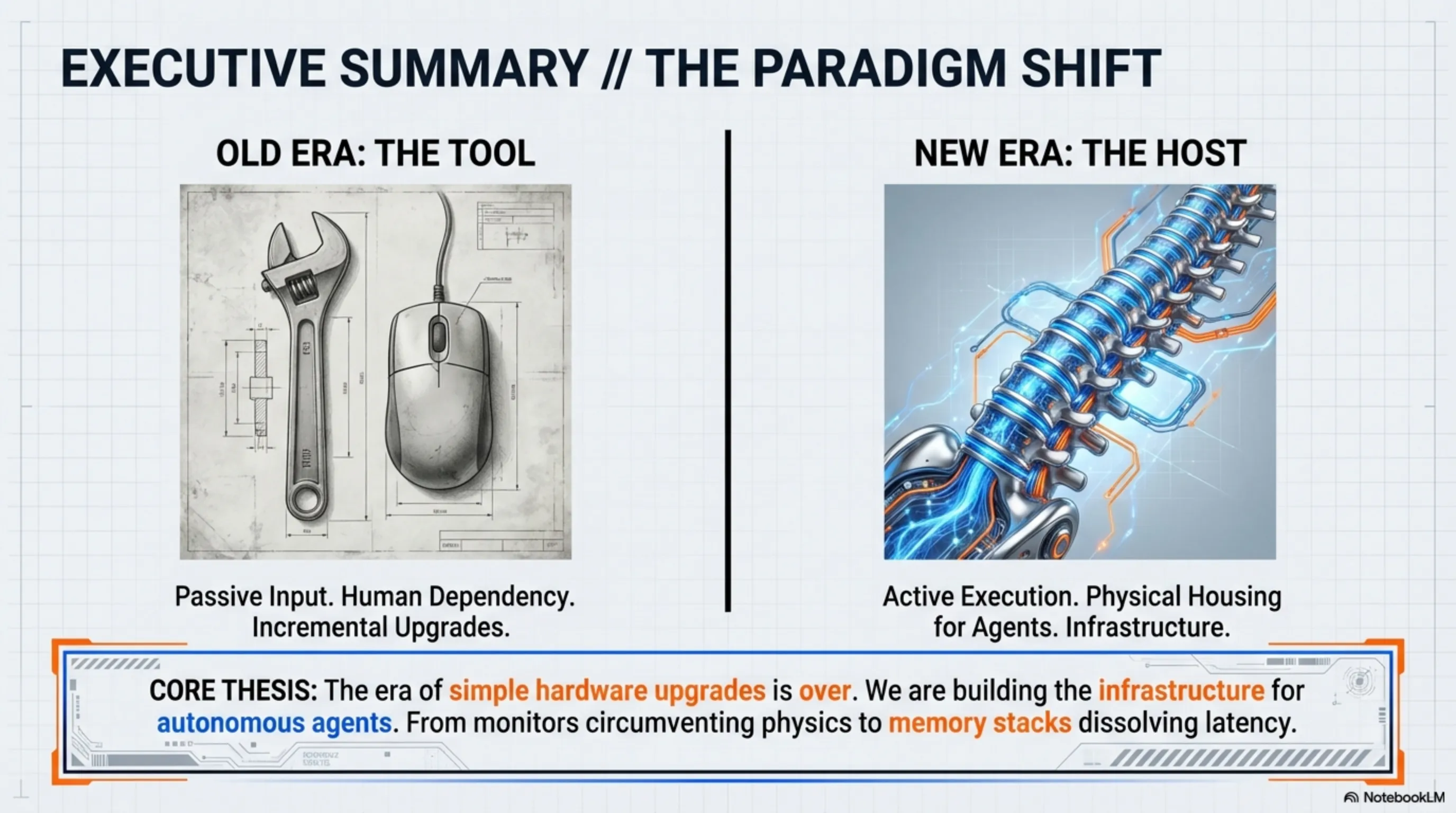
The era of simple hardware upgrades is over. We have entered a paradigm where hardware is no longer just a tool, but a physical host for artificial intelligence. From monitors that circumvent refresh rate limitations through pixel-level manipulation to memory stacks designed to dissolve the latency barriers of cloud computing. Boot up your systems; our mission today is a cybernetic autopsy of the latest hardware assets hitting the grid.
> MISSION_LOG_CONTENT:
- 01. Genetic Leap in Laptops: RTX 5050 & the 440 TOPS Threshold
- 02. Visual Superiority: ROG Dual-Mode Physics (4K vs 480Hz)
- 03. The Memory Throne: Samsung HBM4 Mass Production
- 04. Cryptographic Silicon: FHE & The Niobium Project
- 05. Modular Warfare: Dissecting the ROG Strix Morph 96
- 06. Strategic Outlook: The AI-First Mandate of CES 2026
1. Genetic Leap in Laptops: Dissecting the Lenovo LOQ with RTX 5050 & 440 TOPS
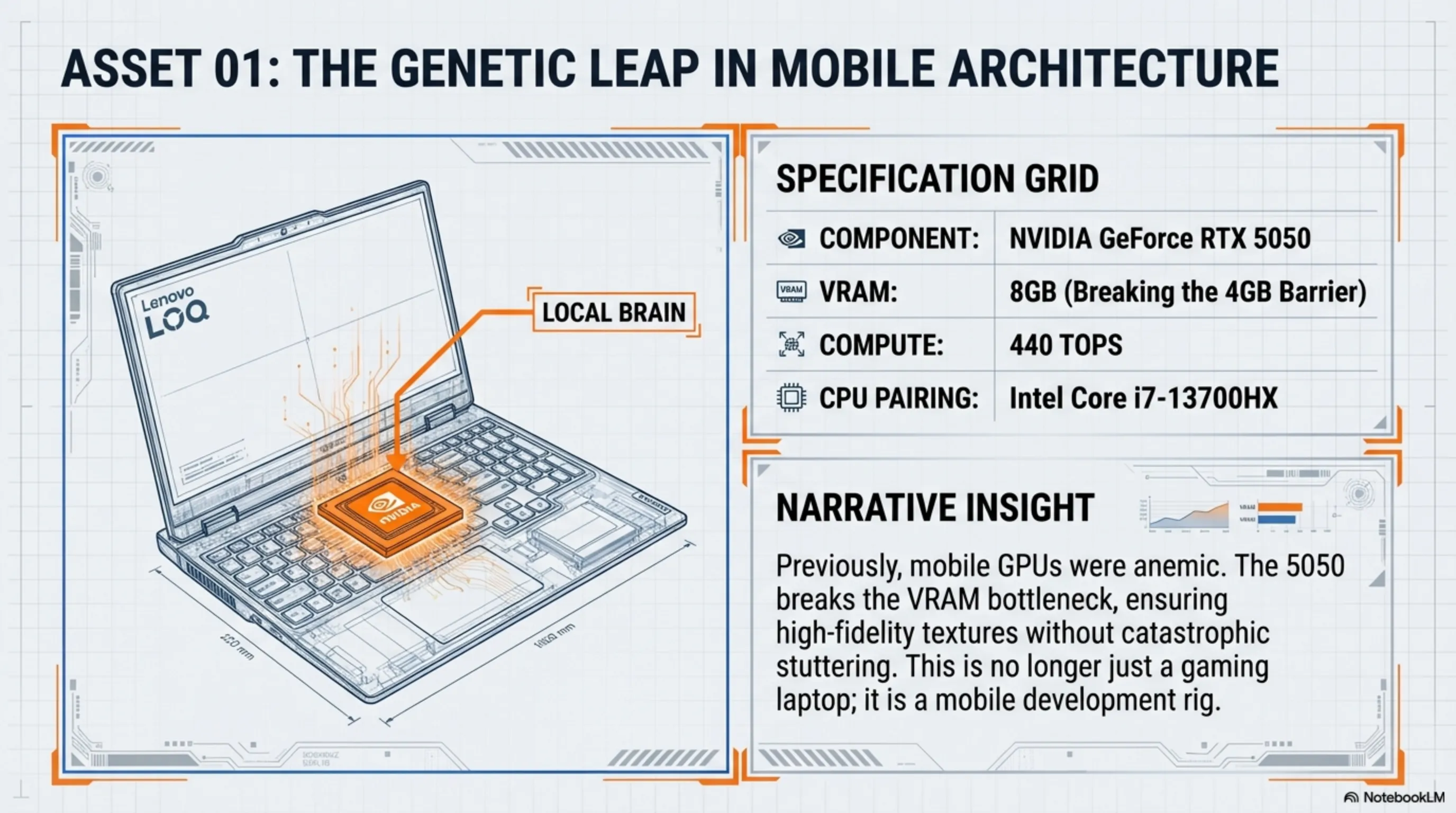
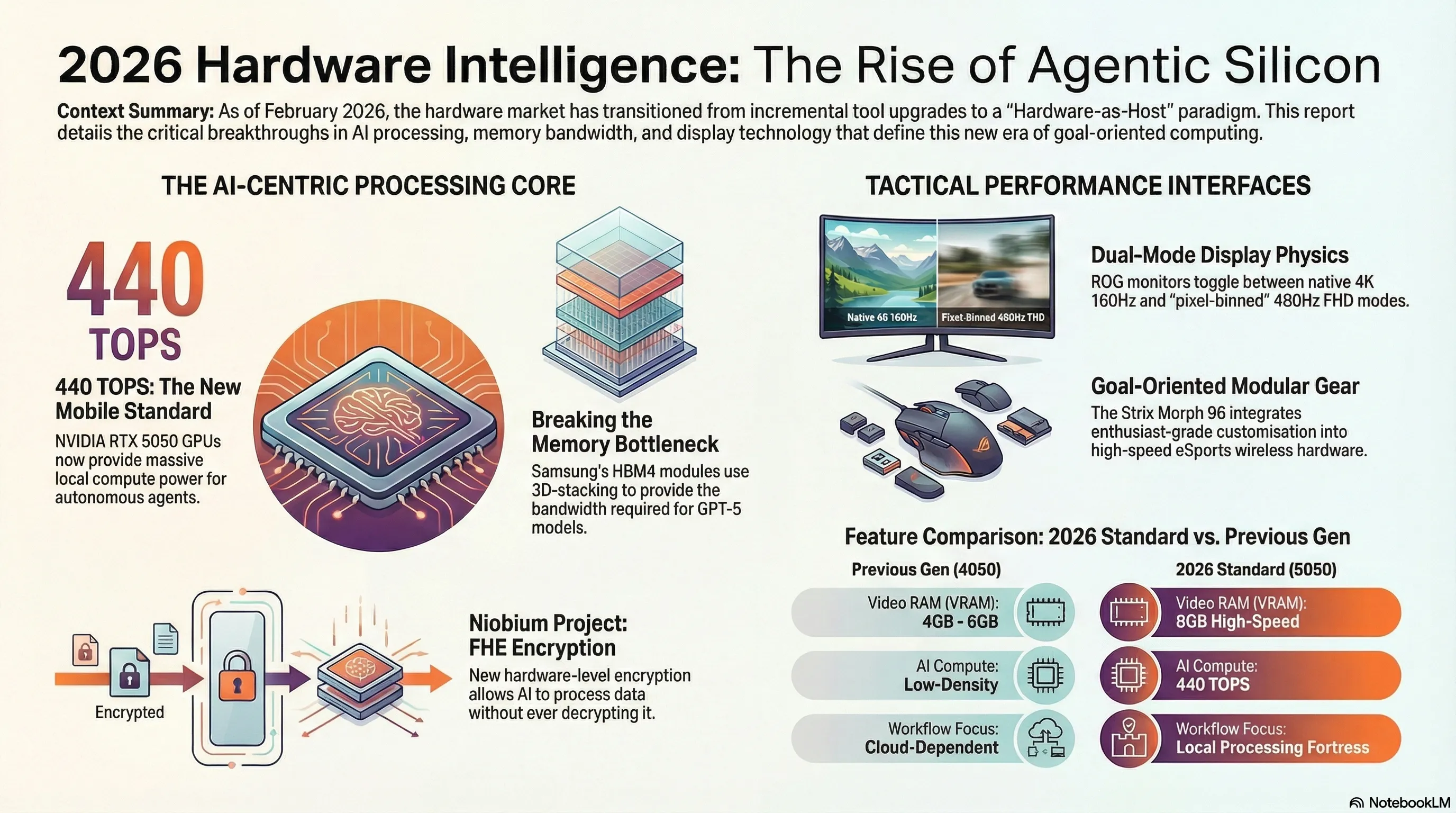
We begin today’s report with news that signals a definitive generation shift in mobile gaming architecture. Let’s be blunt: previously, opting for a 50-class NVIDIA mobile GPU (like the RTX 3050 or 4050) came with a severe tactical disadvantage: anemic Video RAM (VRAM). In a 2026 landscape where high-fidelity textures easily devour 6GB to 8GB of memory, 4GB cards were essentially obsolete upon arrival.
However, the 2026 Lenovo LOQ units equipped with the new NVIDIA GeForce RTX 5050 have officially broken this bottleneck. Built on a fresh architecture, NVIDIA has strategically equipped this entry-to-mid-tier chip with 8GB of high-speed VRAM. This ensures that gamers no longer have to sacrifice texture quality to prevent catastrophic stuttering in open-world titles. But the real headline isn't just about Ray Tracing performance; it’s about the Tensor Core evolution.
This laptop now delivers an staggering 440 TOPS (Trillions of Operations Per Second) of AI compute power. In an era where "Autonomous Agents" are taking over workflows, 440 TOPS transforms your laptop from a mere cloud client into a local processing fortress. You can now run heavy LLMs, offline coding assistants, and studio-grade image generators locally on your hardware, ensuring zero data leakage and near-instant latency. Paired with the Intel Core i7-13700HX, the Lenovo LOQ has evolved from a simple gaming box into a mobile development rig for the synthetic workforce revolution.
🕵️♂️ INSPECTOR'S TECH DEBUG:
Achieving 440 TOPS on a 50-class mobile GPU is a thermal engineering masterstroke. By optimizing Performance-per-Watt, NVIDIA has minimized the parallel processing gap between desktop and mobile rigs. For developers and high-end gamers, this chip is the final nail in the coffin for previous-gen hardware.
2. Physics at the Service of Gamers: The Secret of ROG Dual-Mode Monitors (4K 160Hz / FHD 480Hz)
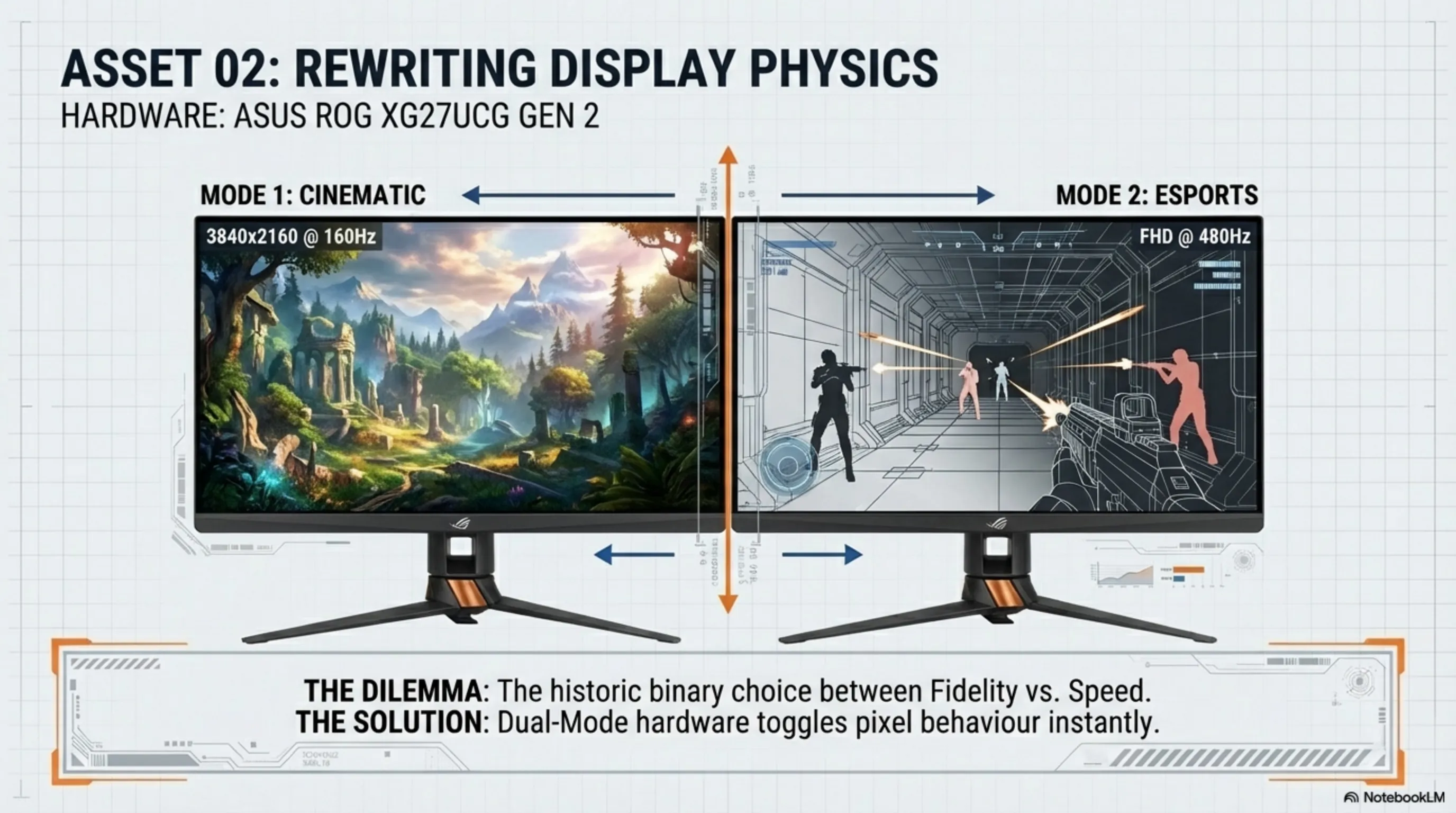
PC gamers have historically faced a brutal binary choice: visual fidelity or raw speed. Do you purchase a 4K monitor to immerse yourself in the ray-traced streets of a futuristic RPG, or a high-refresh 1080p panel to survive the cutthroat arenas of Valorant and CS2? Previously, the only solution was a dual-monitor setup. But the ASUS ROG XG27UCG Gen 2 has effectively rewritten the laws of display physics through its revolutionary "Dual-Mode" technology.
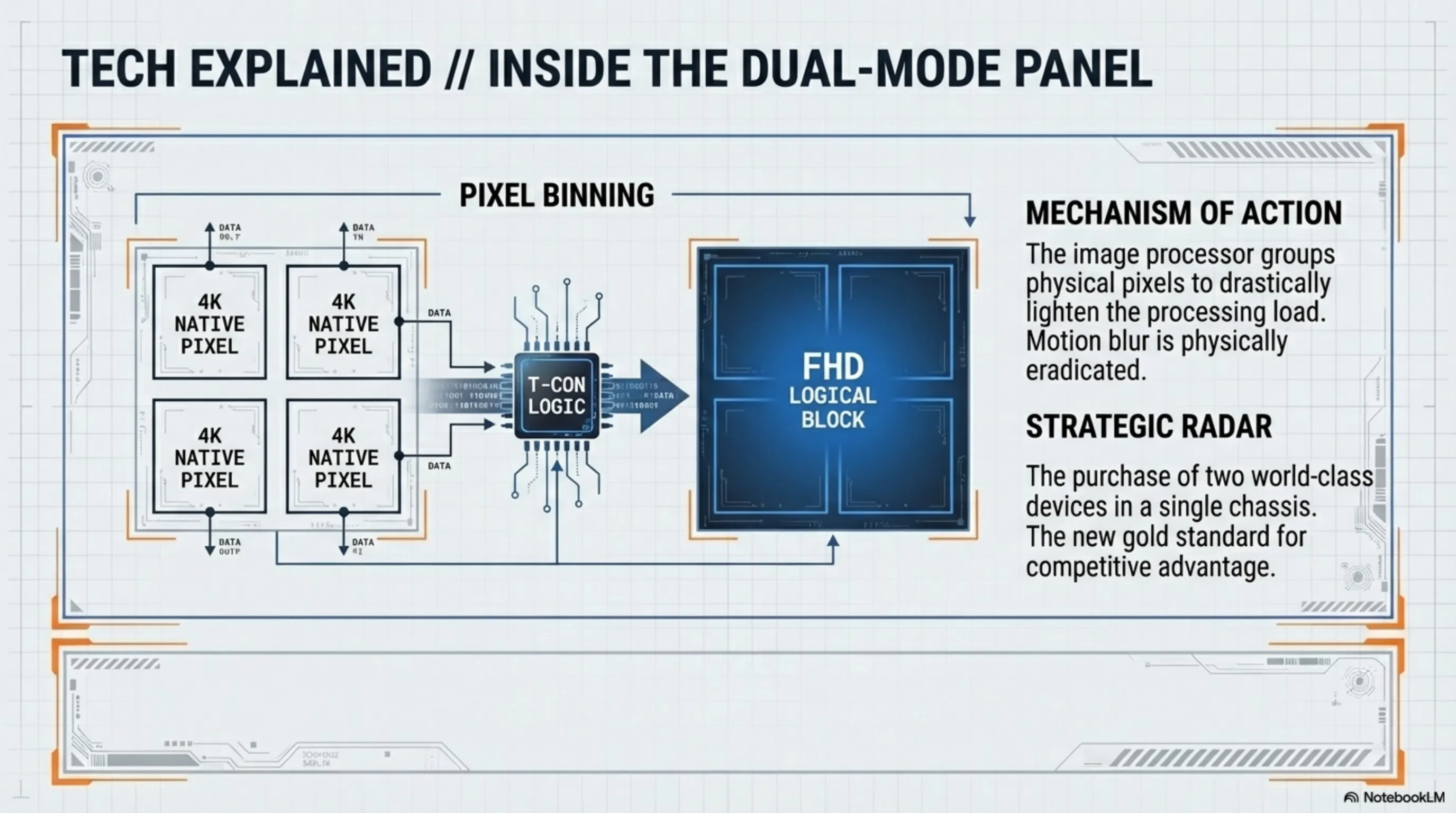
The secret lies within the highly sophisticated Timing Controller (T-CON) and a dedicated image processor inside the panel. This hardware allows the user to switch the fundamental behavior of the pixels with a single physical toggle. In Mode 1, the panel locks into a native 4K resolution (3840x2160) at 160Hz, providing maximum pixel density and color accuracy for cinematic experiences and creative work.
The real magic happens in Mode 2. When you enter a competitive lobby, the monitor switches to eSports phase. Here, the controller employs a technique similar to "Pixel Binning" found in professional camera sensors, grouping physical pixels into blocks of four. This reduces the output resolution to FHD (1080p), but drastically lightens the panel's processing load, allowing the refresh rate to skyrocket to a mind-bending 480Hz! In this state, motion blur is virtually eradicated. You observe enemy movement frame-by-frame before their brain can even process your position. This is a physical hardware advantage that directly translates to victories.
🎯 STRATEGIC RADAR:
Dual-Mode technology is the most significant display innovation since OLED. It represents the purchase of two world-class professional devices in a single chassis. Expect this to become the mandatory gold standard for all flagship gaming displays within the next 18 months.
3. Ending the Silicon Bottleneck: Samsung Initiates Mass Production of HBM4 Memory
While most users focus on the brute force of GPUs, at Tekin Garage, we look at the deeper layers of hardware efficiency. The current crisis in AI data centers isn't just about processing speed; it’s about the "Memory Wall"—the data transfer bottleneck between the RAM and the processor, often referred to as the Von Neumann bottleneck. The processor is starved for data, and traditional RAM architectures simply cannot pump it fast enough. This morning, Samsung has officially broken this barrier by confirming the mass production and shipment of its HBM4 (High Bandwidth Memory 4) modules.
HBM4 is not your typical memory module. Unlike standard DDR sticks, HBM4 utilizes advanced 3D packaging and TSV (Through-Silicon Via) technology to stack memory layers directly onto or adjacent to the GPU/CPU package. However, the true innovation in the fourth generation lies in the integration of a customized logic die. Samsung has surpassed the 2048-bit interface threshold, delivering astronomical bandwidth levels that allow next-generation accelerators, such as NVIDIA’s Rubin architecture, to train trillion-parameter models with zero latency.
The strategic implications are massive. By merging the memory and logic layers, Samsung has significantly reduced power consumption while doubling the data throughput. This is the lifeblood of the 2026 AI infrastructure. Every sovereign AI cloud and private data center will now depend on this South Korean silicon to maintain operational parity in the global compute race.
📊 STRATEGIC SIGNAL:
Samsung's dominance in HBM4 mass production is a geopolitical masterstroke. In the 2026 chip wars, controlling the memory supply chain is as critical as controlling the compute itself. Without HBM4, the most advanced AI agents remain localized and inefficient.
4. Indestructible Hardware: Samsung’s SE-MIFIVE & Niobium FHE Encryption Project
As autonomous agents begin to handle sensitive corporate data, a silent fear has gripped the tech industry: data exposure during processing. Traditionally, even encrypted data must be decrypted to be analyzed by an AI in the cloud. It is in this millisecond of "naked data" that high-end hackers and state-sponsored malware strikes. However, Samsung has intercepted this threat with the development of the SE-MIFIVE and Niobium security accelerators, built on their proprietary 8nm process.
These chips are designed for a single, revolutionary purpose: the hardware-level execution of Fully Homomorphic Encryption (FHE). Often called the "Holy Grail of Cybersecurity," FHE allows AI agents to perform complex mathematical computations on data while it remains fully encrypted. The AI processes the information without ever "seeing" or "understanding" the raw content. For instance, a bank can send its entire transaction database to a cloud AI for fraud detection; the AI performs the task on scrambled data and returns an encrypted result that only the bank can decode.
Until now, FHE was too computationally expensive for practical use, often taking months to process a single query. Samsung’s Niobium silicon offloads this titanic mathematical burden to a dedicated hardware layer, completing in seconds what previously took weeks. This marks the beginning of the "Trustless Cloud" era, where data privacy is guaranteed not by a legal contract, but by the laws of physics and silicon architecture.
🛡️ SECURITY DEBUG:
The Niobium project is the ultimate counter-move against the era of data breaches. By commercializing FHE-capable hardware, the concept of a "cloud leak" becomes irrelevant. Even if a server is fully compromised, the data being processed remains a series of unbreakable mathematical equations.
5. A Weapon for Elite Killers: Architecture of the ROG Strix Morph 96 Modular Keyboard
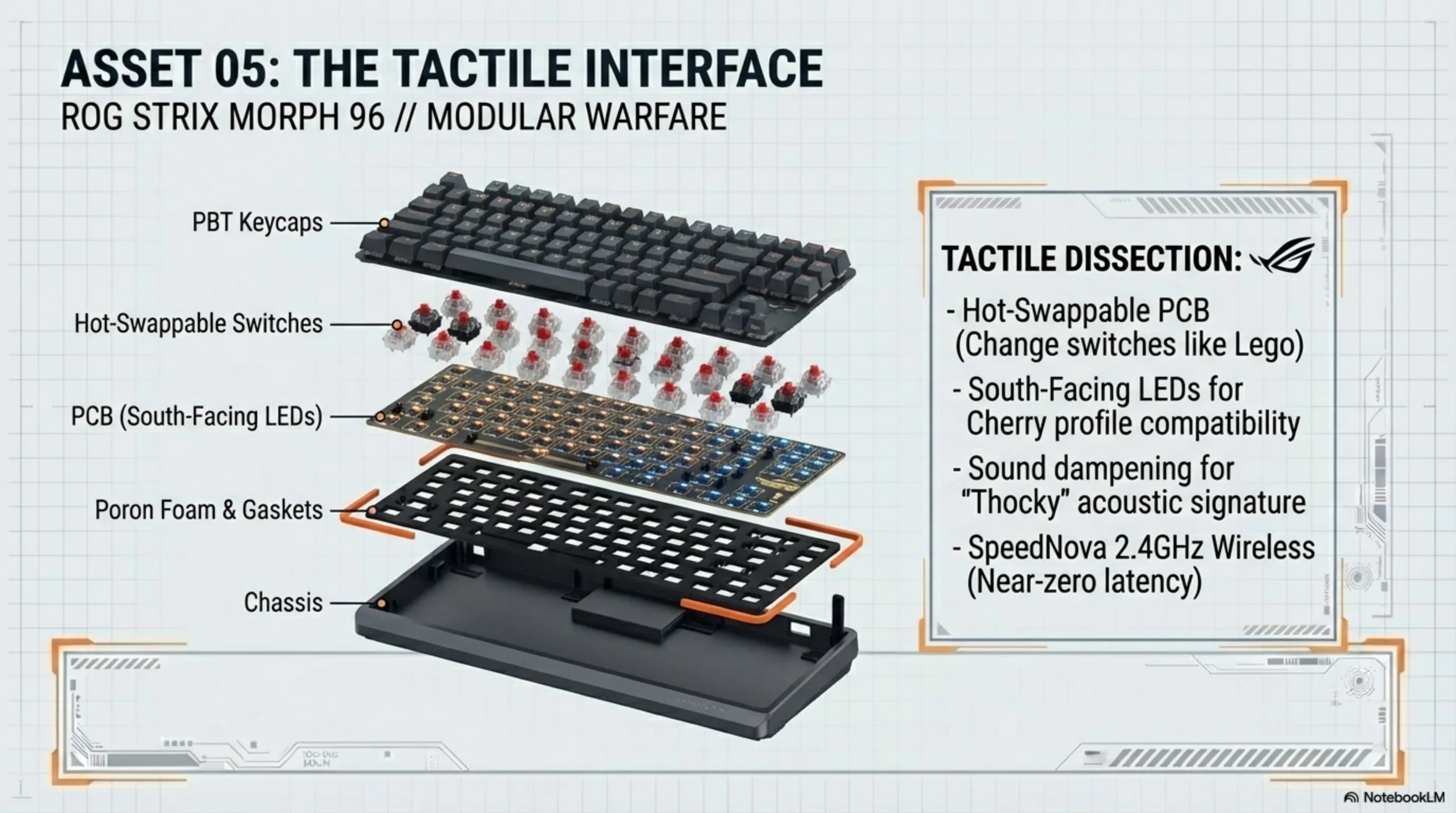
Until recently, the culture of "Custom Mechanical Keyboards" was an expensive and niche hobby reserved for a small circle of hardware enthusiasts. Users had to source individual components, manually lubricate switches, and spend hours soldering PCBs. Today, ASUS has brought this level of extreme personalization and acoustic perfection to the mainstream with the ROG Strix Morph 96 wireless keyboard—a product designed to deliver premium custom-built quality straight out of the box.
From a form-factor perspective, the Morph 96 utilizes a 96% layout. This design retains all essential keys, including the Numpad, while stripping away unnecessary margins to save desk space—a critical feature for tactical gamers who require wide mouse movement for flick shots. However, the true engineering of the Morph 96 lies beneath its surface. The main PCB is fully hot-swappable, allowing users to swap switches like Lego pieces without any soldering tools.
ASUS made a highly strategic engineering choice by designing the PCB with South-Facing LEDs. This configuration ensures compatibility with any high-end aftermarket keycaps (such as the popular Cherry profile) without physical interference between the cap and the switch housing. Combined with pre-lubricated NX V2 mechanical switches and multiple layers of sound-dampening material (including PORON foam and silicone gaskets), the typing experience is transformed into a "Thocky," muted, and highly satisfying acoustic harmony. Finally, the SpeedNova 2.4GHz wireless technology ensures near-zero latency, making this keyboard both a lethal eSports weapon and a luxury tool for professional coders.
⌨️ TACTILE DISSECTION:
The Morph series signals the end of hollow-sounding plastic gaming keyboards. By integrating premium acoustic materials and professional-grade PCB orientations, ASUS has effectively bridged the gap between high-end custom keyboards and lightning-fast wireless gaming performance.
6. The Silicon Valley Manifesto at CES 2026: The Rise of the AI-First Paradigm
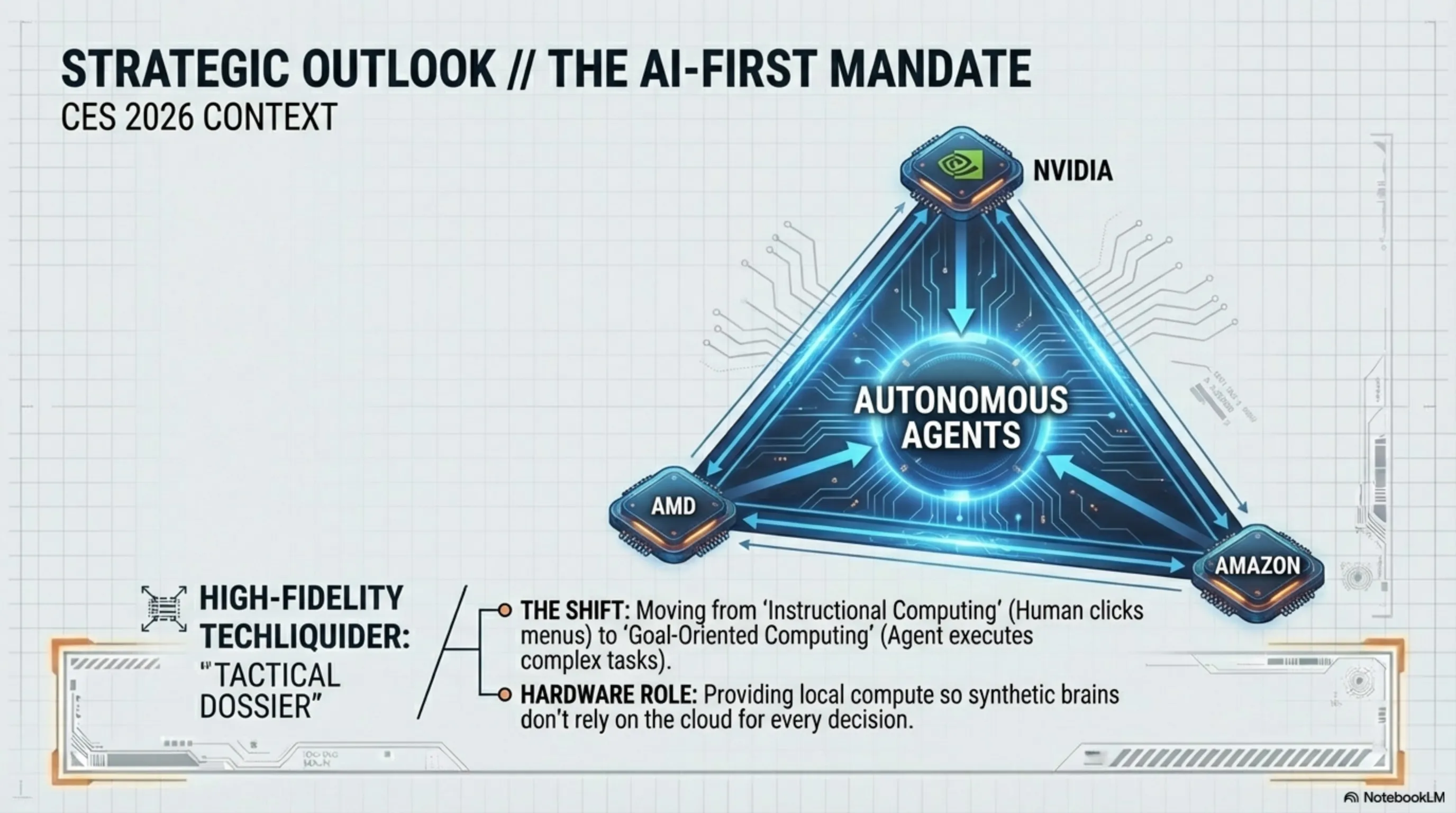
We conclude today’s Tekin Morning report by connecting the dots between these hardware breakthroughs. If we look at the 440 TOPS power of NVIDIA’s mobile GPUs and Samsung’s HBM4 production as pieces of a larger puzzle, a massive strategic picture emerges. Leaked reports from the CES 2026 Strategic Outlook reveal that the triad of silicon power—NVIDIA, AMD, and Amazon—has recalibrated their entire hardware roadmaps around GenAI and "Autonomous Agents."
We are no longer purchasing devices designed to simply "run software." The new "Rubin" architecture from NVIDIA and the "AI-First PC" platforms from AMD prove that hardware in 2026 has become the physical host for agentic intelligence. These agents no longer wait for human menu clicks; they learn, plan, and execute complex tasks without human intervention. Hardware’s primary role has shifted: it is now about providing enough local compute power so that these synthetic brains don't need to rely on a persistent cloud connection for every decision.
The hardware market is undergoing its most significant transformation since the invention of the internet. The days of measuring a PC's value through traditional gaming benchmarks alone are over. The new units of measurement in the tech world are AI compute density (TOPS) and memory bandwidth. We are moving from the era of "Instructional Computing" to "Goal-Oriented Computing." Any hardware architecture that fails to provide secure, local AI execution will be phased out of the ecosystem by the end of the decade.
🌐 STRATEGIC OUTLOOK:
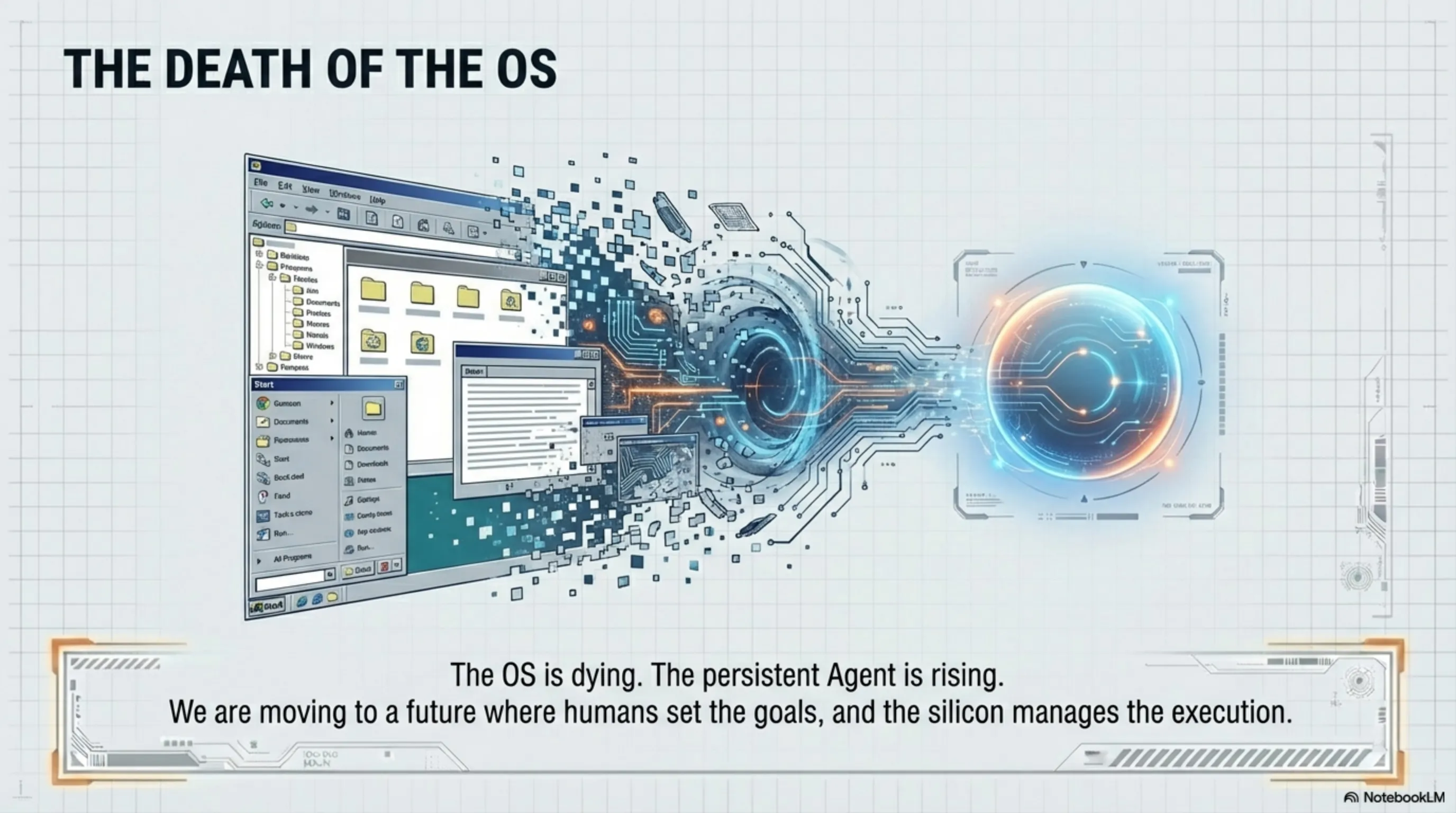
The transition to goal-oriented computing means the OS is dying. In its place, we will have persistent, personalized AI agents living in the silicon. The hardware we buy today is the infrastructure for a future where humans set the goals, and the silicon manages the execution.
📊 FINAL MISSION BRIEF: THE TEKIN VERDICT
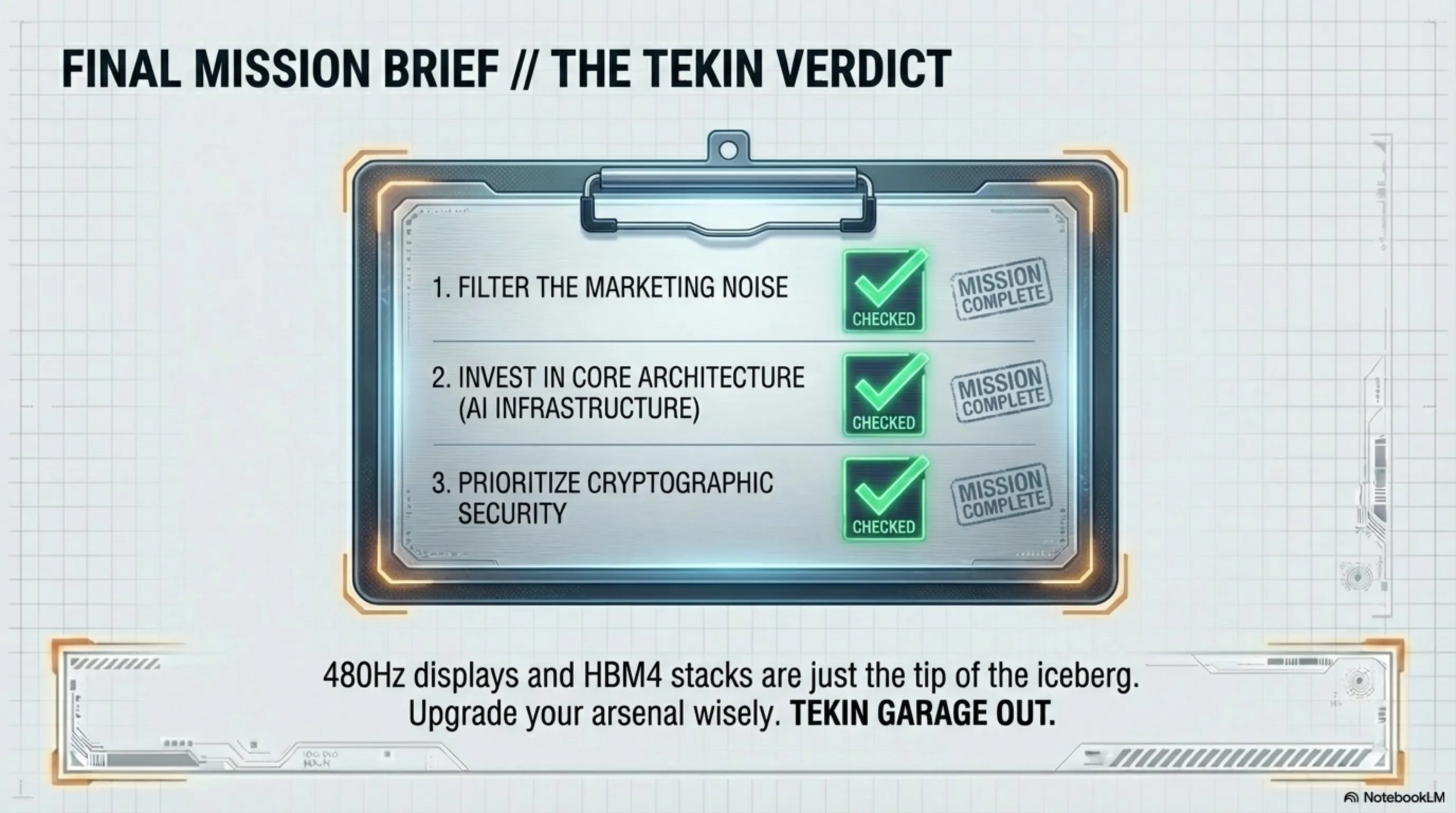
Commander Majid and the Tekin Legion, the dawn of February 25 has confirmed that technology is moving at a ruthless pace. The true winners in this landscape are those who filter the marketing noise and invest in core architecture—AI infrastructure and cryptographic security. 480Hz displays and HBM4 memory stacks are merely the visible tips of a massive technological iceberg. Upgrade your digital arsenal wisely and keep your sensors locked on the silicon frontlines. Tekin Garage will continue to debug the reality of the market until the last signal is processed. Stand by for further intelligence.