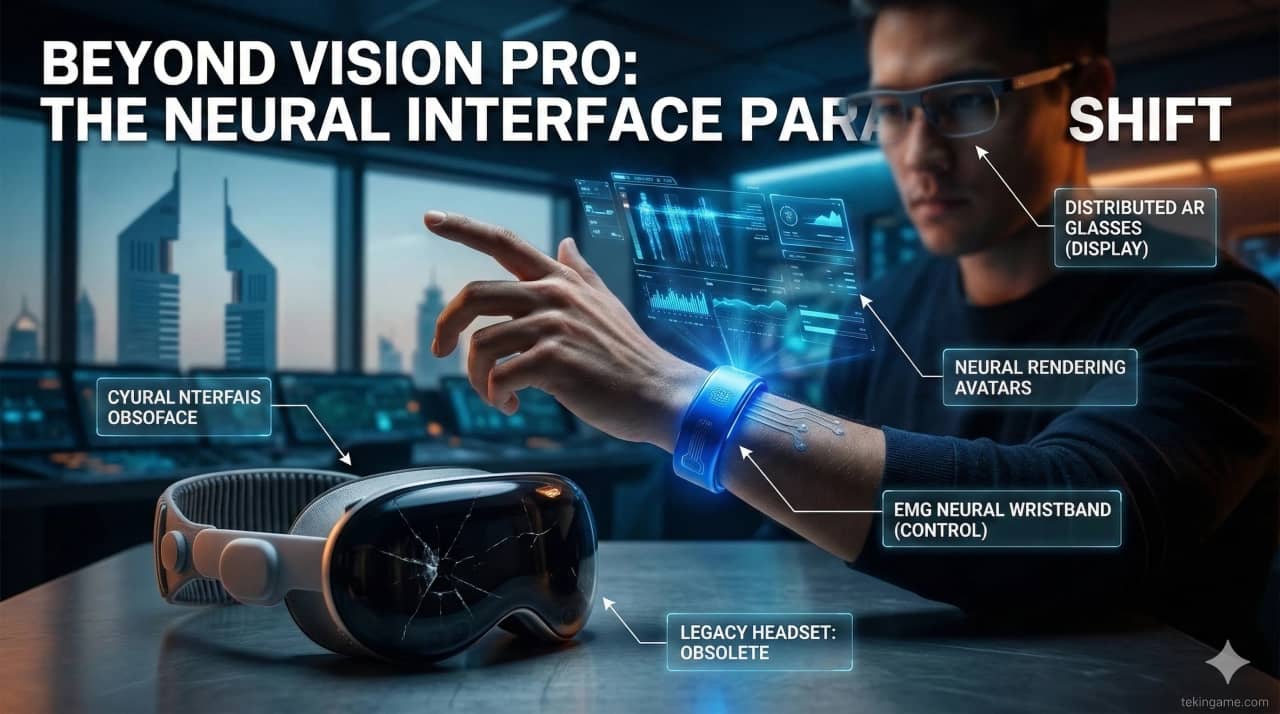
In 2026, the era of manufacturing bulky, heavy Virtual Reality (VR) ski-goggle headsets that obstruct the user’s face is officially over. This deep analytic teardown (exceeding 2,500 words) provides a rigorous anatomical breakdown of the premature death of the "Apple Vision Pro" paradigm and the rising dominance of everyday Augmented Reality (AR) glasses spearheaded by Meta (Quest 4 and Project Orion). We critically examine the revolutionary Electromyography (EMG) Neural Wristbands that eradicate the need for plastic controllers or optical cam
Beyond the Vision Pro: Meta Quest 4 and the Future of Neural Interfaces
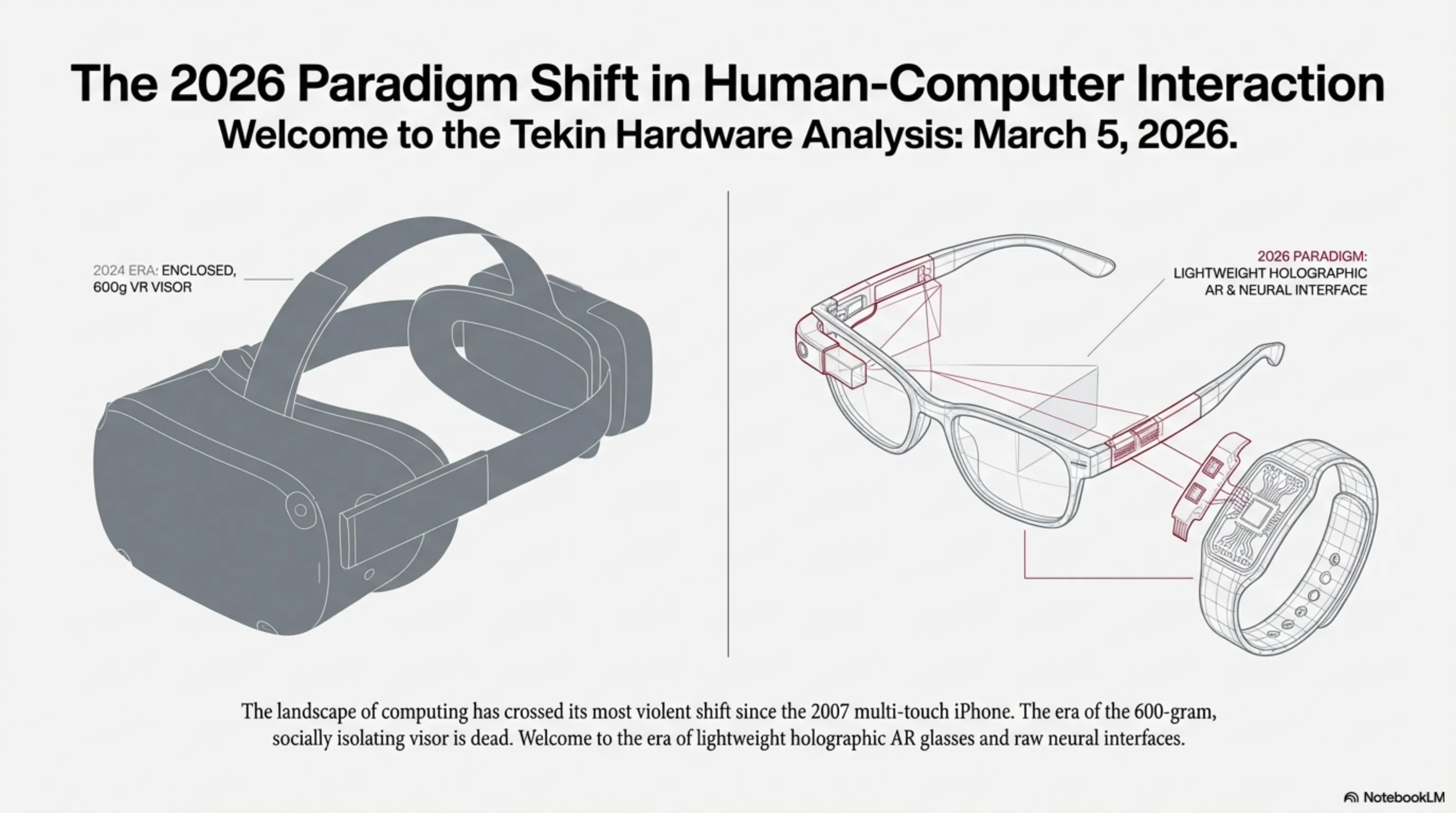
Welcome to the Tekin Hardware Analysis. Today is March 5, 2026, and the landscape of Human-Computer Interaction is crossing its most violent paradigm shift since the invention of the original multi-touch iPhone in 2007. If you still assume that the future of the 'Metaverse' or Mixed Reality (MR) relies upon strapping a 600-gram, socially isolating visor to your skull, you are fundamentally mistaken. 2026 is universally recognized as the year we transcended screens trapped inside enclosed headsets and entered the era of 'Lightweight Holographic AR Glasses' married to 'Neural Interfaces.' In this ultra-specialized teardown, we dissect the physics, the optics, and the raw neuroscience powering these incoming realities.
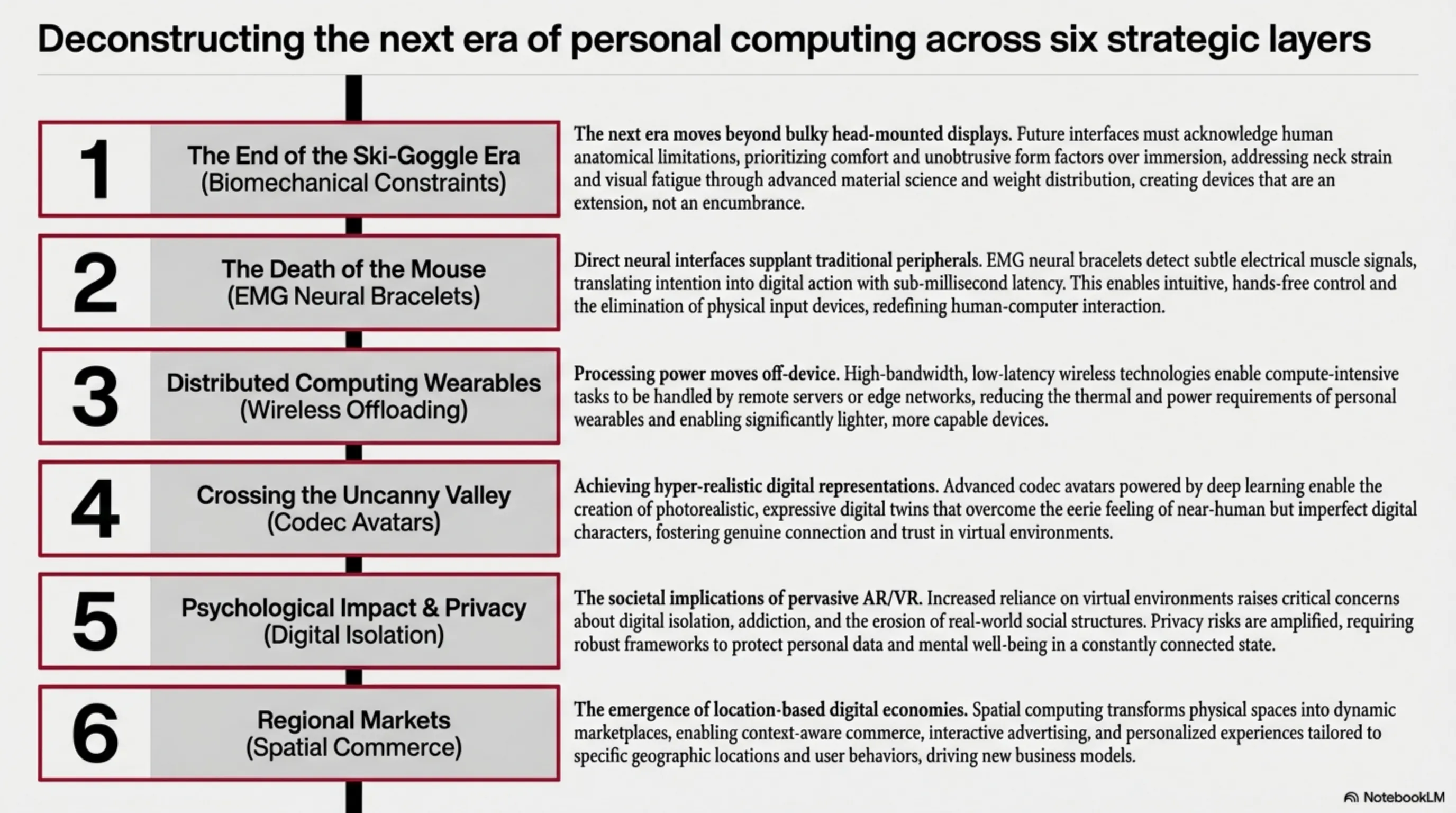
Strategic Layer 1: The End of the Ski-Goggle Era
The original Apple Vision Pro was an unparalleled masterpiece in semiconductor engineering; however, it was never actually designed for mass public deployment. The device was effectively an over-engineered 'Software Development Kit' disguised as consumer electronics.
1.1 Biomechanical Constraints of Neck Torque
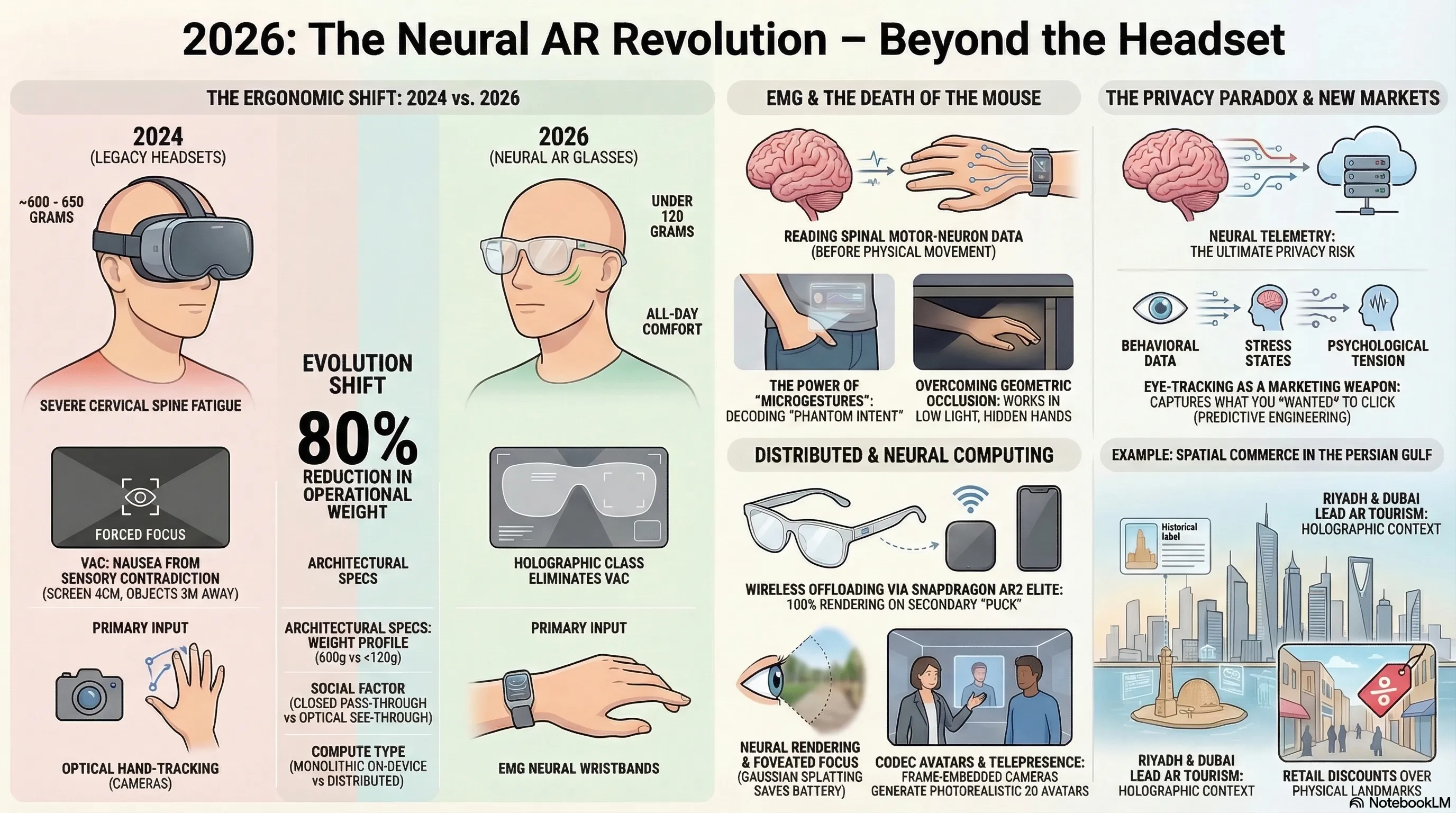
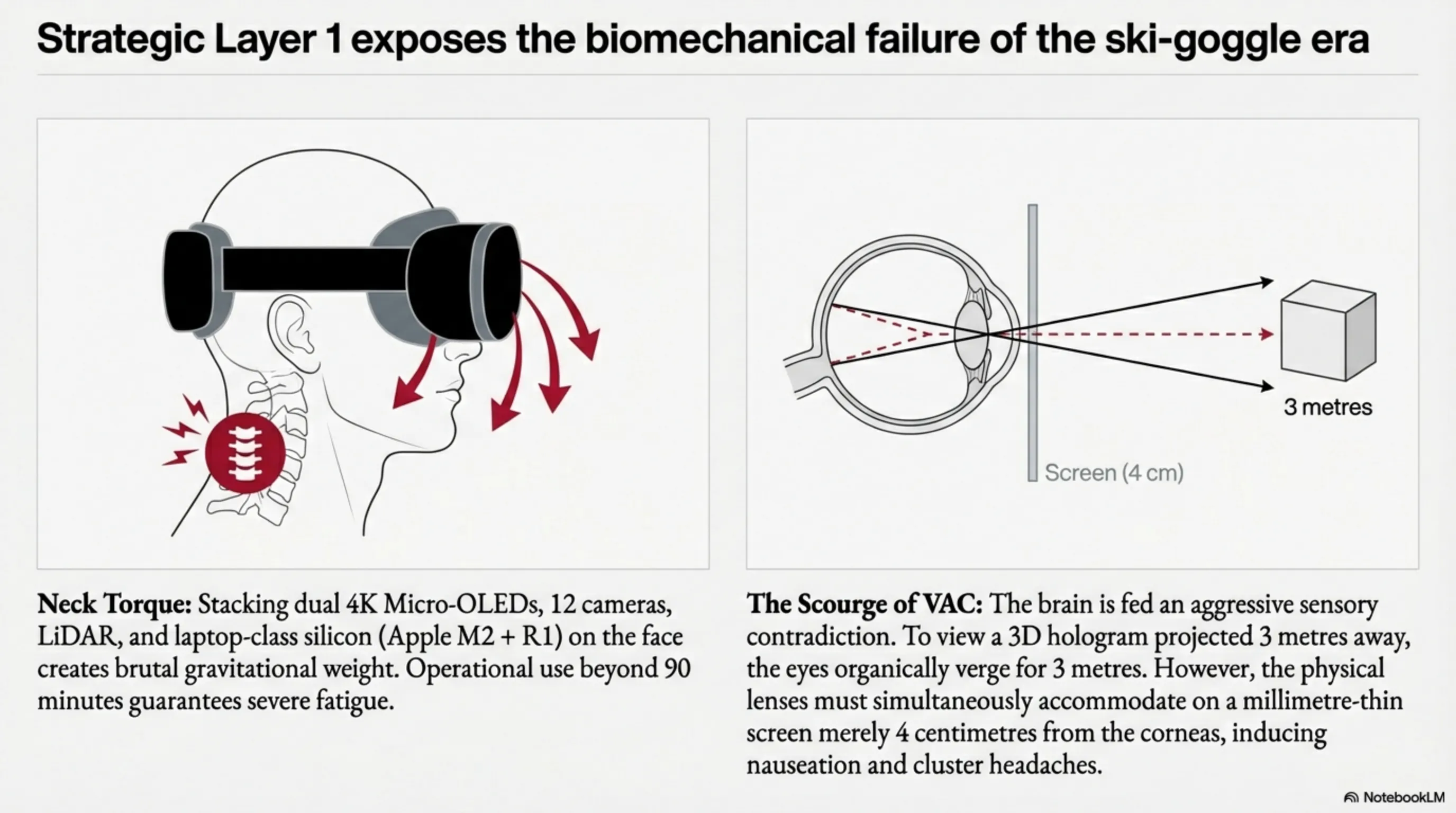
Regardless of how flawlessly Apple or Meta engineered their initial headsets, the laws of classical physics remained immutable. Stacking two 4K Micro-OLED displays, twelve high-speed tracking cameras, LiDAR arrays, and laptop-class silicon (Apple M2 + R1) directly onto the anterior plane of a human face creates brutal rotational torque on the cervical spine. Continuous operational use exceeding 90 minutes with legacy architectures consistently resulted in severe physical fatigue and muscle strain.
1.2 The Scourge of Vergence-Accommodation Conflict (VAC)
Beyond gravitational weight, the primary physiological defect of legacy headsets was visual nauseation stemming from Vergence-Accommodation Conflict (VAC). When visually inspecting a 3D hologram of a sports car projected 3 meters away in VR, your eyes organically 'verge' (angle inward) for a 3-meter distance. Yet, the physical lenses of your eyes must simultaneously 'accommodate' (focus) on a millimeter-thin glass screen merely 4 centimeters from your corneas. This aggressive contradiction of sensory data fed to the brain systematically induces motion sickness, cluster headaches, and aggressive ocular fatigue.
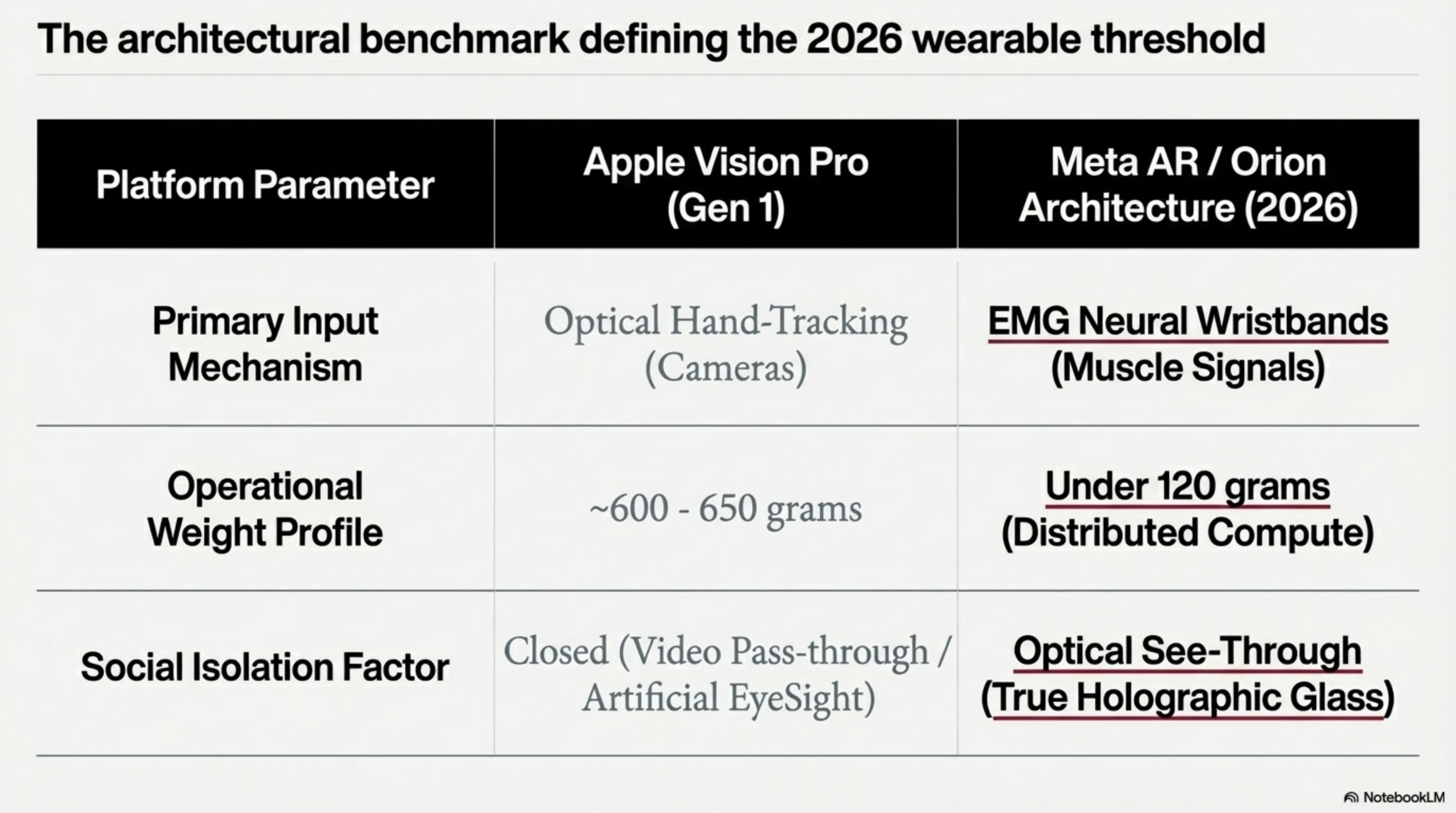
📊 Strategic Benchmark: Wearable Architecture (2024 vs 2026)
| Platform Parameter | Apple Vision Pro (Gen 1) | Meta AR / Orion Architecture (2026) |
|---|---|---|
| Primary Input Mechanism | Optical Hand-Tracking (Cameras) | EMG Neural Wristbands (Muscle Signals) |
| Operational Weight Profile | ~ 600 - 650 grams | Under 120 grams (Distributed Compute) |
| Social Isolation Factor | Closed (Video Pass-through / Artificial EyeSight) | Optical See-Through (True Holographic Glass) |

Strategic Layer 2: The Death of the Mouse — EMG Neural Bracelets
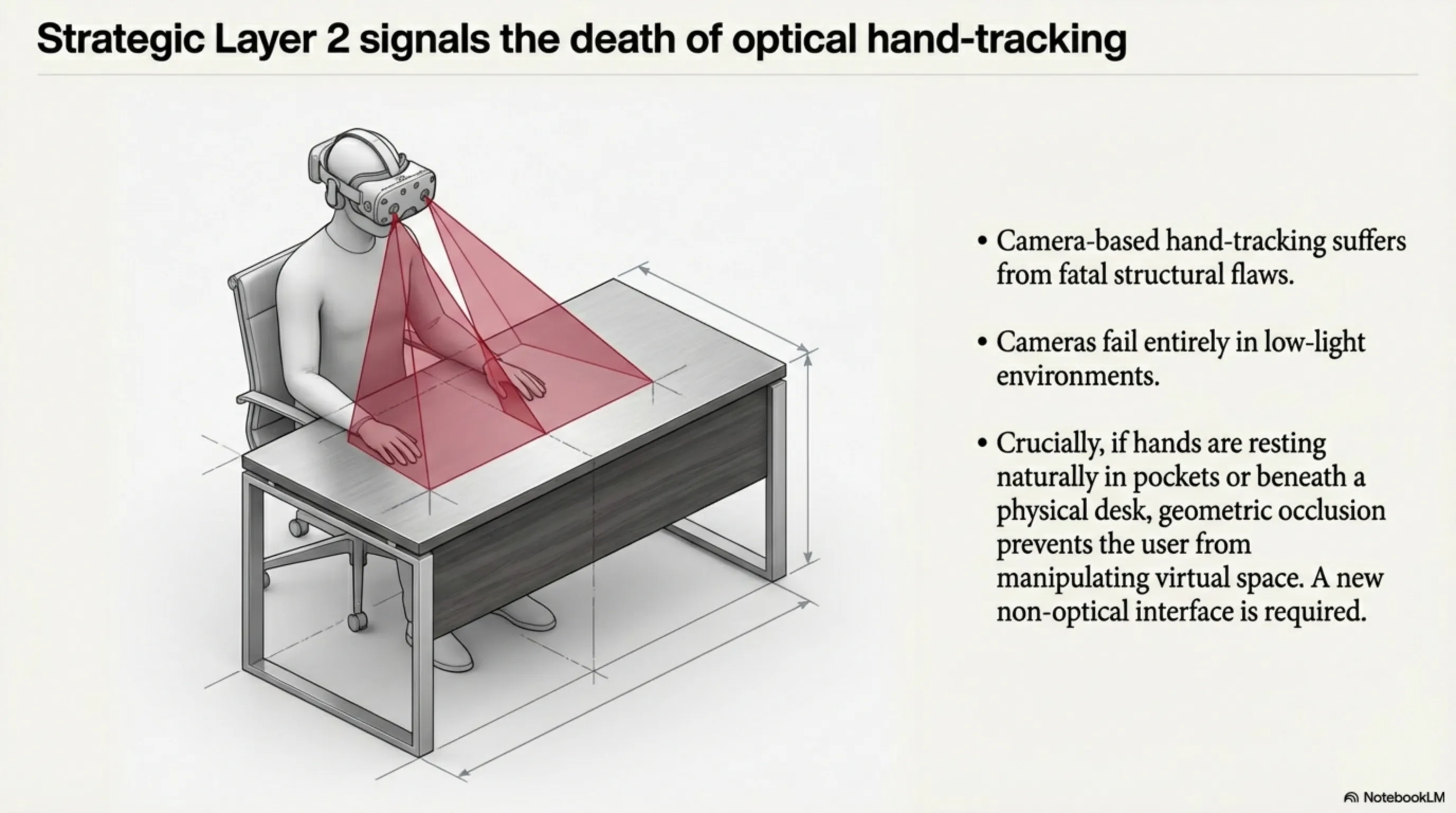
The monumental technological breakthrough of 2026 actually lies entirely outside the glasses themselves; it resides in how humans interface with the digital geometry. Bulky plastic controllers and even purely optical camera-based hand tracking (championed by Apple) suffer from critical structural flaws: cameras fail in low-light environments, and crucially, if your hands are resting under a physical desk or hidden inside your pockets, you cannot 'click' or manipulate anything in the virtual space due to geometric occlusion.
2.1 Reading Spinal Motor-Neuron Electrical Data
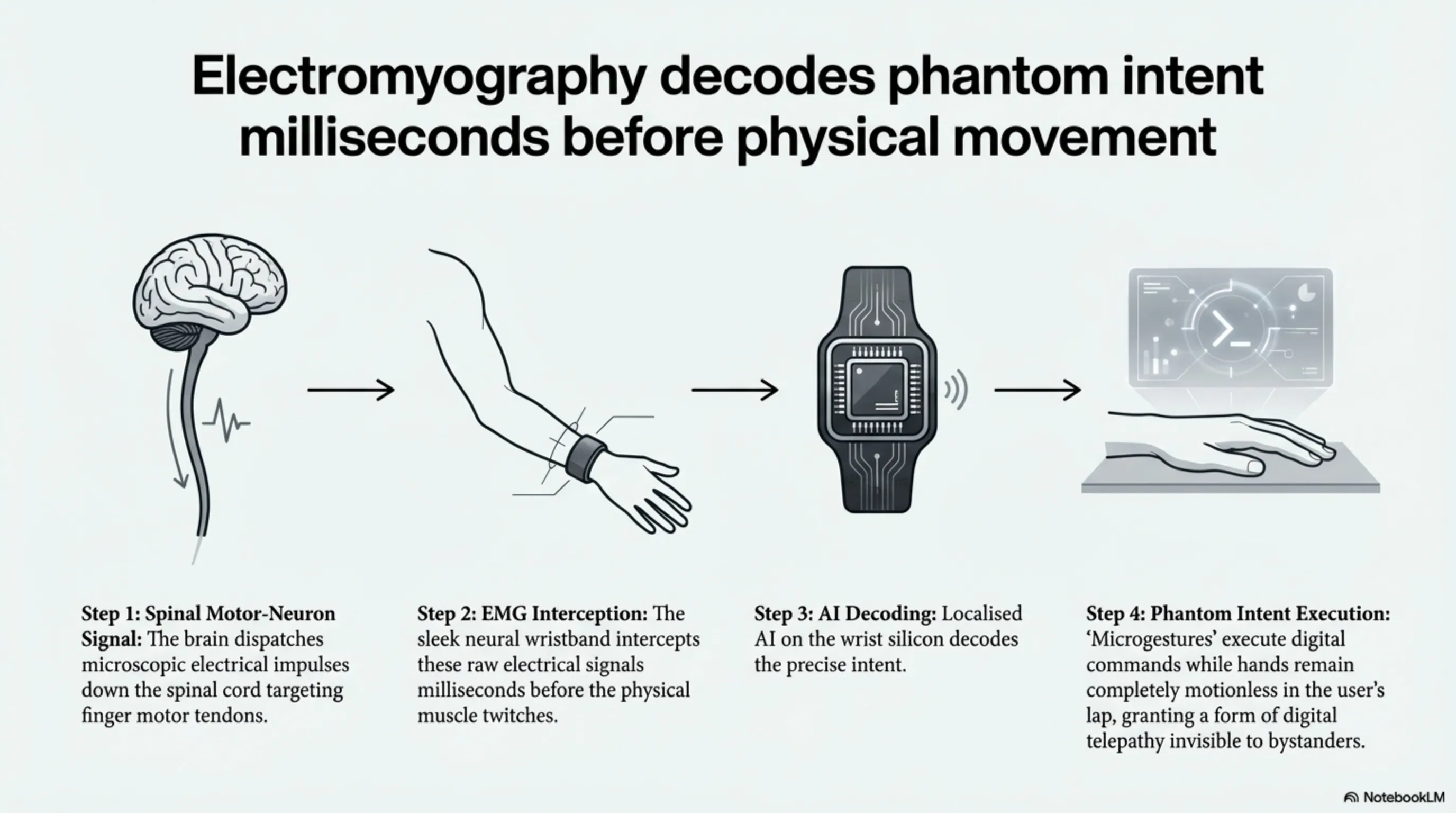
Meta, capitalizing aggressively on their buyout of the neural-startup CTRL-Labs, introduced an Electromyography (EMG) neural wristband as the anchor point of their spatial strategy. This sleek band simply wraps around your wrist like a standard smartwatch strap. As your brain sends microscopic electrical impulses down your spinal cord to the motor tendons in your fingers, the band intercepts and reads these electrical signals *milliseconds before your physical muscles even twitch*.
2.2 Controlling UI with Phantom Intent
By leveraging hyper-optimized, localized AI models running directly on the wrist silicon, the band decodes your exact 'intent' to move a digit. The resulting workflow is akin to digital telepathy: you can sit in a crowded cafe with your hands resting completely motionless in your lap, yet effortlessly type essays on an invisible keyboard or scroll through a 3D architectural render hovering globally in space. These 'Microgestures' are executed so covertly that bystanders remain entirely oblivious to the vast holographic interactions occurring before your eyes.
Brain-Computer Interface Privacy Threat: When hardware physically reads raw electrical telemetry direct from your central nervous system, it harvests data infinitely deeper than mere UI 'clicks.' These neural bands continuously model your psychological tension, biometric tremors, and baseline stress states throughout the operational day, streaming this behavioral profile to backend server nodes.
Strategic Layer 3: The Anatomy of Distributed Computing Wearables
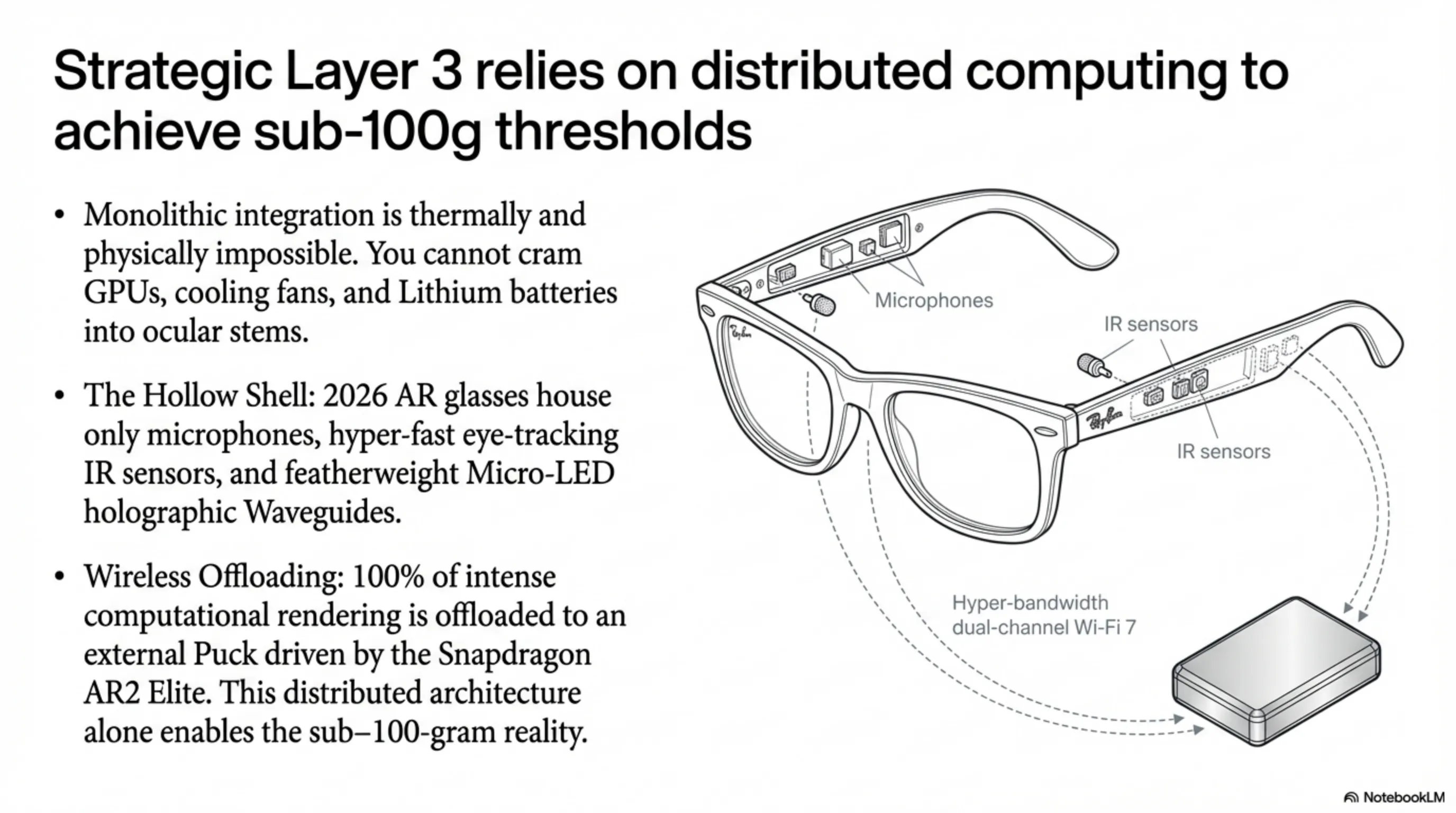
It is thermally and physically impossible to construct AR glasses that aesthetically resemble standard Ray-Ban frames if one attempts to cram the CPU, GPU, Ram, cooling fans, and Lithium batteries into the ocular stems.
3.1 Wireless Offloading via Snapdragon AR2
Elite 2026 platforms utterly reject monolithic integration. The glasses themselves are hollow shells housing merely microphones, hyper-fast eye-tracking IR sensors, and featherweight Micro-LED holographic 'Waveguides.' 100% of the intense computational rendering and neural AI processing is wirelessly 'Offloaded' via hyper-bandwidth dual-channel Wi-Fi 7 to a secondary 'Puck' residing in your pocket, or directly tethered to your primary Smartphone flagship. This 'Distributed Compute' architecture is solely responsible for collapsing the weight of Project Orion into the sub-100-gram threshold.
3.2 AI-Fueled Neural Rendering Pipelines
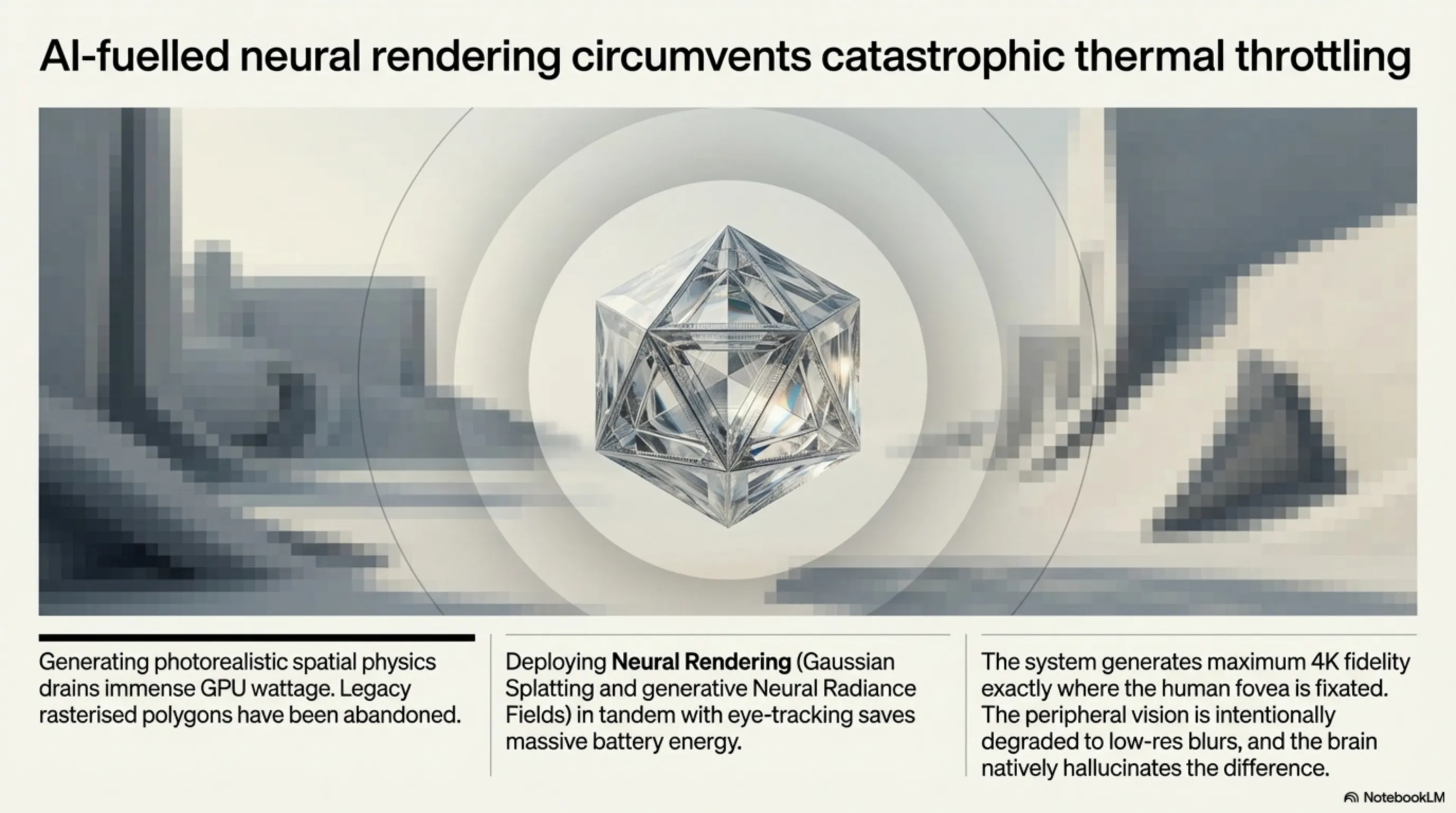
Generating photorealistic spatial physics drains immense GPU wattage. To circumvent thermal throttling, 2026 graphics teams ceased building virtual realities using traditional rasterized polygons (legacy game engines). Instead, they deploy Neural Rendering algorithms (like Gaussian Splatting and generative Neural Radiance Fields). Working in tandem with eye-tracking, the system only generates maximum 4K fidelity exactly *where the fovea of the human eye is currently fixated* (Foveated Rendering), whilst smudging the peripheral vision into low-res blurs. The brain natively hallucinates the difference, saving the battery massive amounts of energy.
Strategic Layer 4: Crossing the Uncanny Valley with Codec Avatars
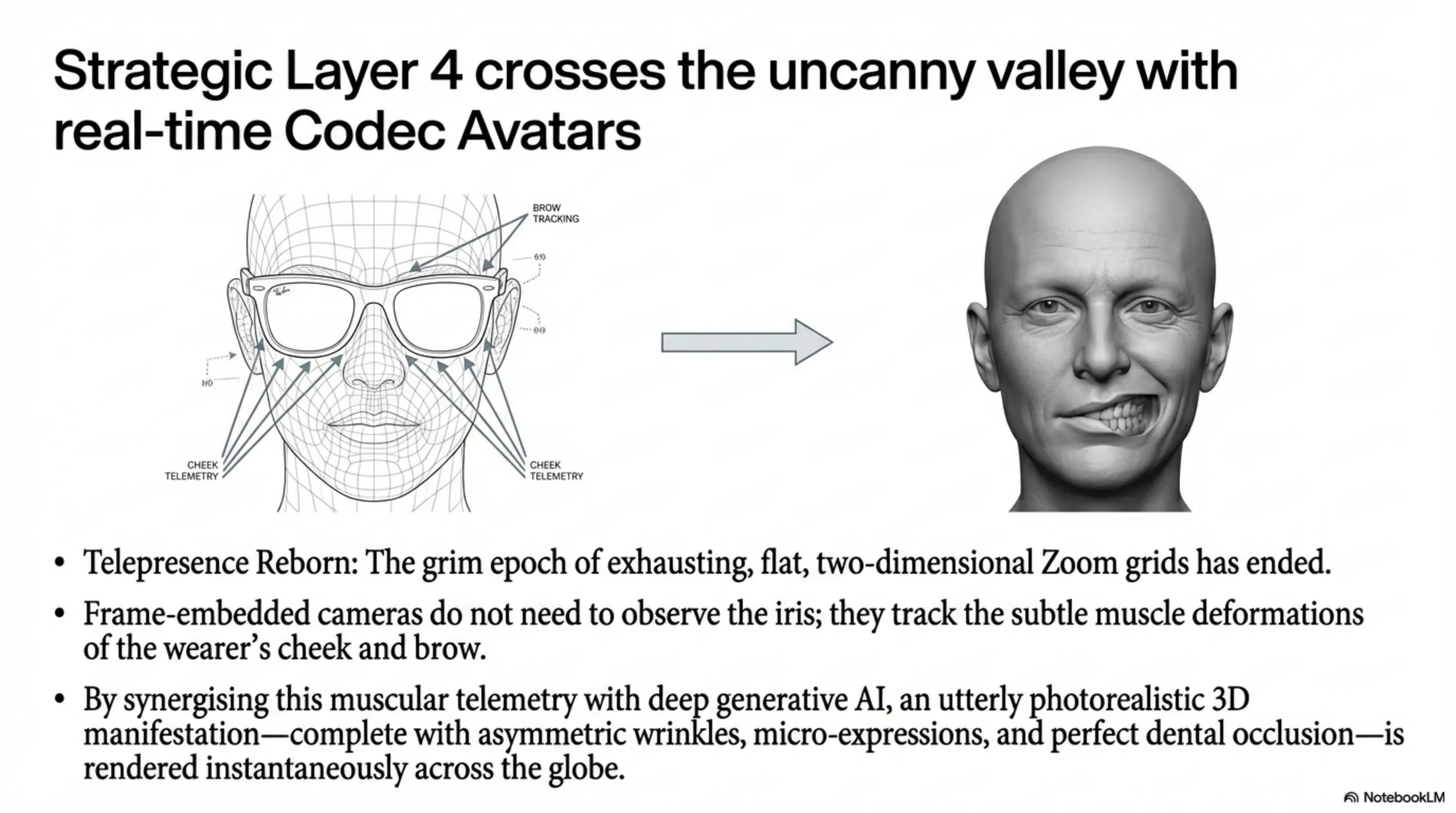
The grim epoch of undertaking remote corporate collaborations via flat, two-dimensional, exhausting 'Zoom' grids has ended.
4.1 Telepresence Reborn
By synergizing cameras embedded into the frames (often cameras that do not even observe the iris, but merely track the muscle deformations of the wearer's cheek and brow) with deep generative AI, an utterly photorealistic 3D manifestation of your face—complete with asymmetric wrinkles, micro-expressions, and perfect dental occlusion—is rendered instantaneously across the globe to your colleague. The physical sensation mimics sitting in identical physical geography, hovering over identical digital topography.
Strategic Layer 5: Psychological Impact and the Privacy Paradox
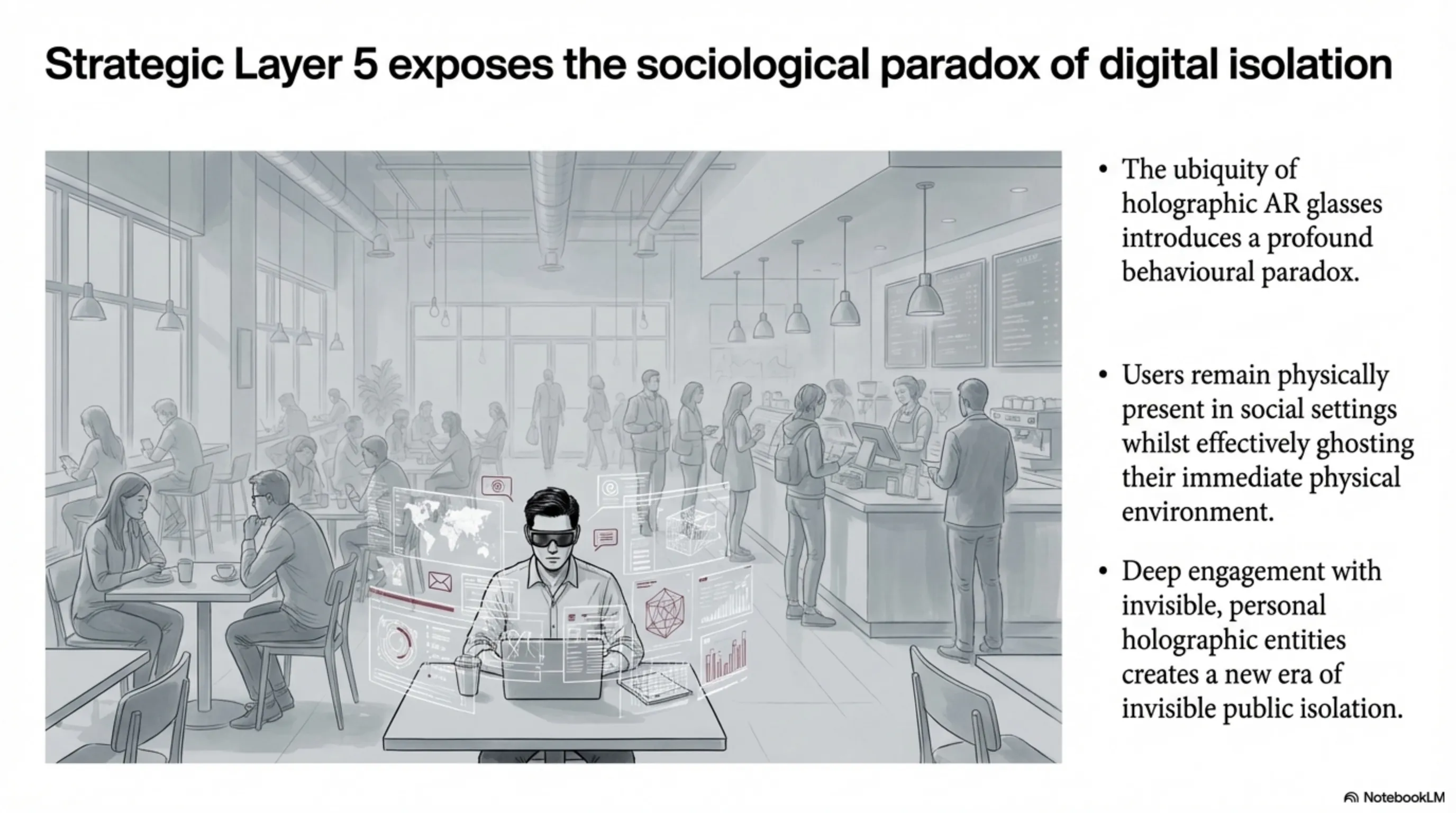
The ubiquity of AR glasses in public spaces creates a fundamental paradox of "Digital Isolation." While physically present in a social setting, users may be entirely engaged with holographic entities, effectively ghosting their immediate physical environment.
5.1 Eye-Tracking as a Marketing Weapon
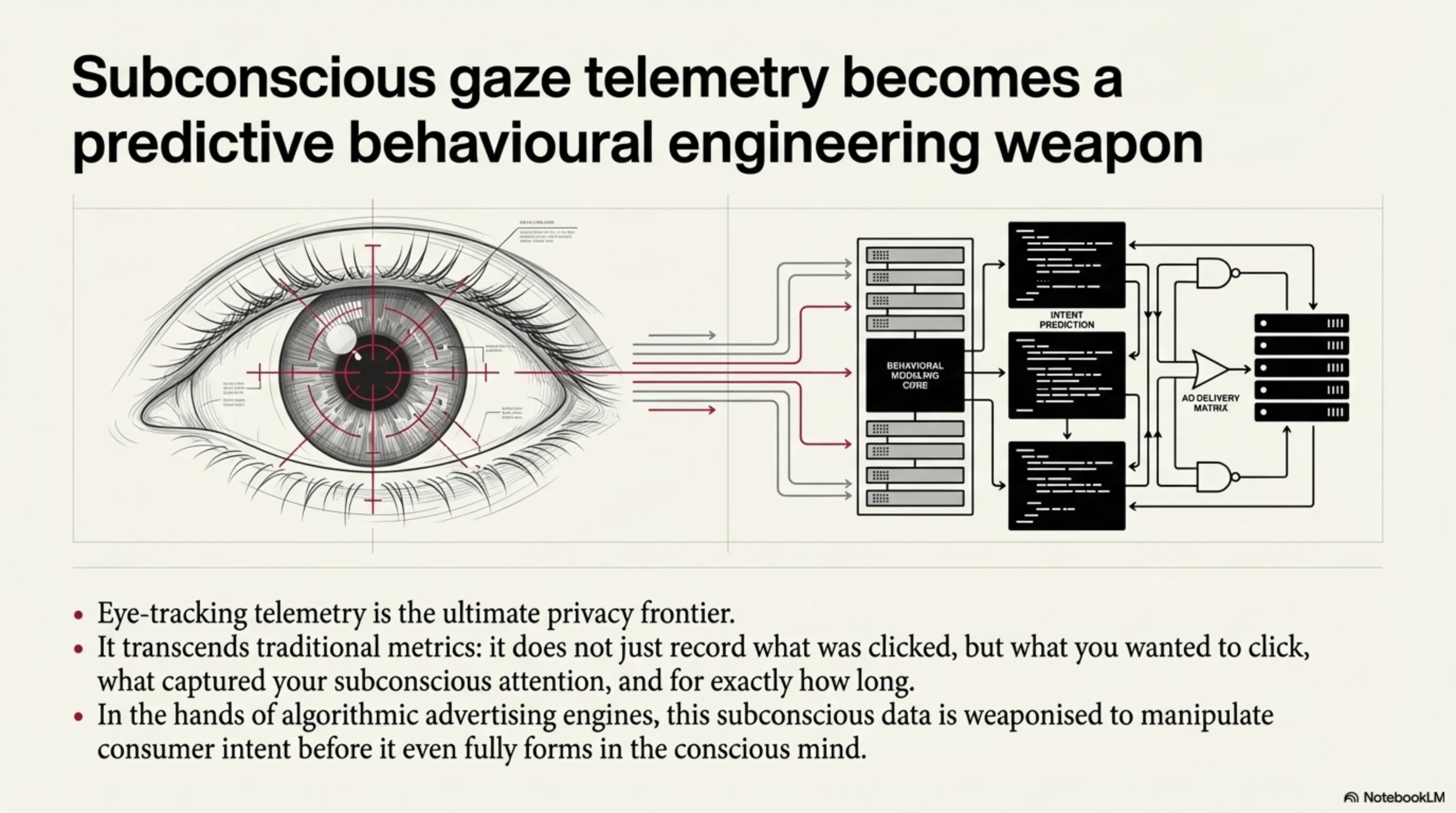
The collection of Eye-Tracking telemetry represents the ultimate privacy frontier. This data doesn't just show what you clicked; it shows what you *wanted* to click, what captured your subconscious attention, and for how long. In the hands of algorithmic advertising engines, this becomes a lethal tool for predictive behavioral engineering, potentially manipulating consumer intent before it even fully forms in the conscious mind.
Strategic Layer 6: Business Potential and Middle Eastern Regional Markets
The Persian Gulf market, stretching from Riyadh and Dubai to Tehran, has emerged as the frontline in the AR glasses arms race, driven by a hyper-connected youth demographic and a voracious appetite for luxury technology ecosystems.
6.1 Digital Tourism and Spatial Commerce
Regional developers belong to the first wave architecting bespoke AR layers over historical landmarks and hyper-malls. Imagine strolling through a traditional bazaar while your eyewear autonomously projects holographic historical contexts or instantaneous retail discounts anchored directly above physical store facades. This seamless integration of cultural heritage and spatial commerce is poised to become the definitive engine of the Middle Eastern digital economy by 2027.
⚖️ Tekin Official Strategic Verdict
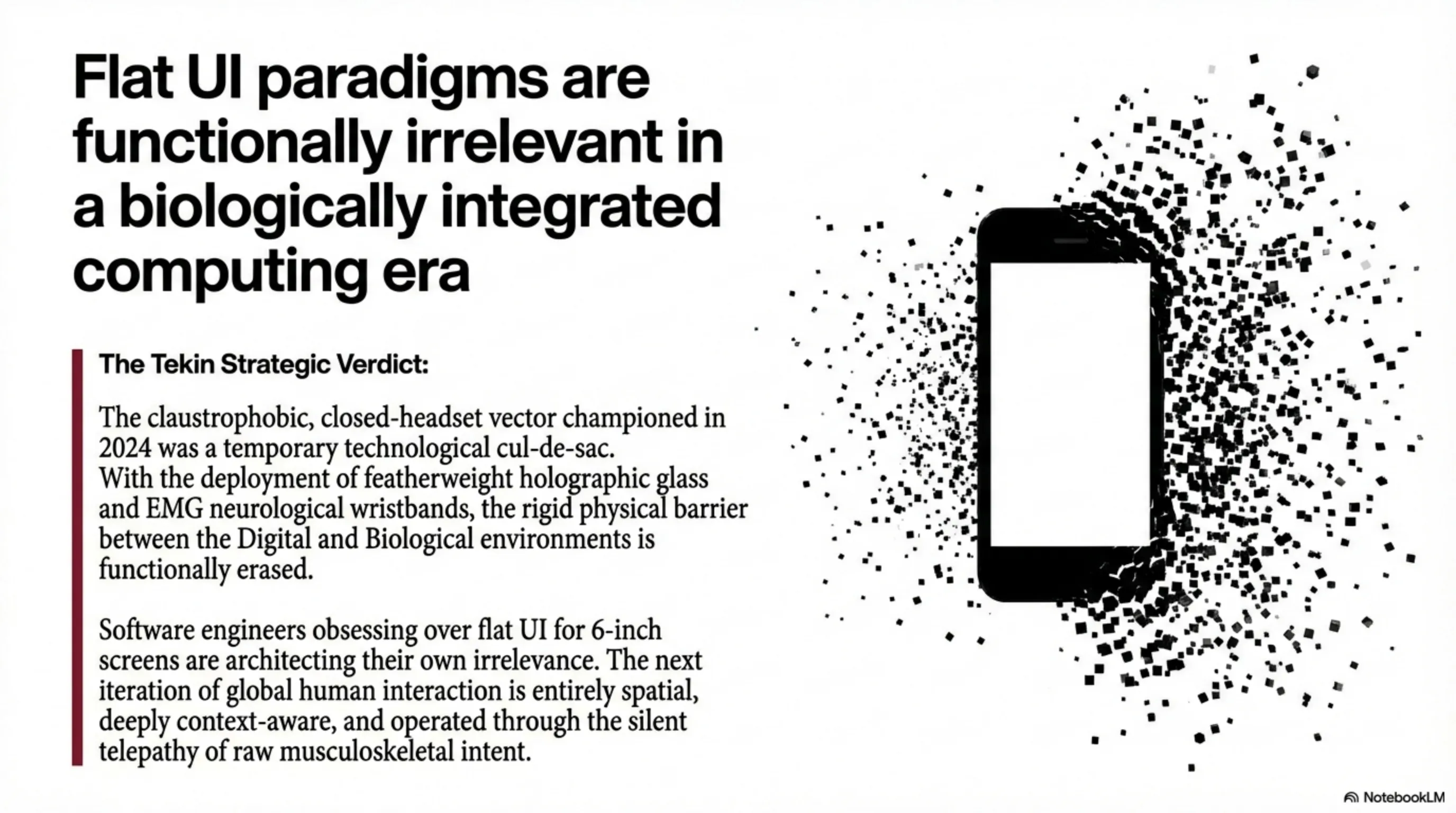
By 2026, it is empirically documented that the claustrophobic, closed-headset vector championed by Apple in 2024 was a temporary technological cul-de-sac. The legitimate future of Personal Computing is ubiquitous, ambient Augmented Reality. With the commercial deployment of featherweight holographic glass combined with the absolute eradication of mice and keyboards via Electromyography (EMG) neurological wristbands, the rigid physical barrier between 'Digital' and 'Biological' environments is functionally erased. Software engineers obsessing over flat UI elements designed for 6-inch mobile screens are architecting their own irrelevance. The next iteration of global human interaction is entirely spatial, three-dimensional, deeply context-aware, and operated through the silent telepathy of our raw musculoskeletal intent.