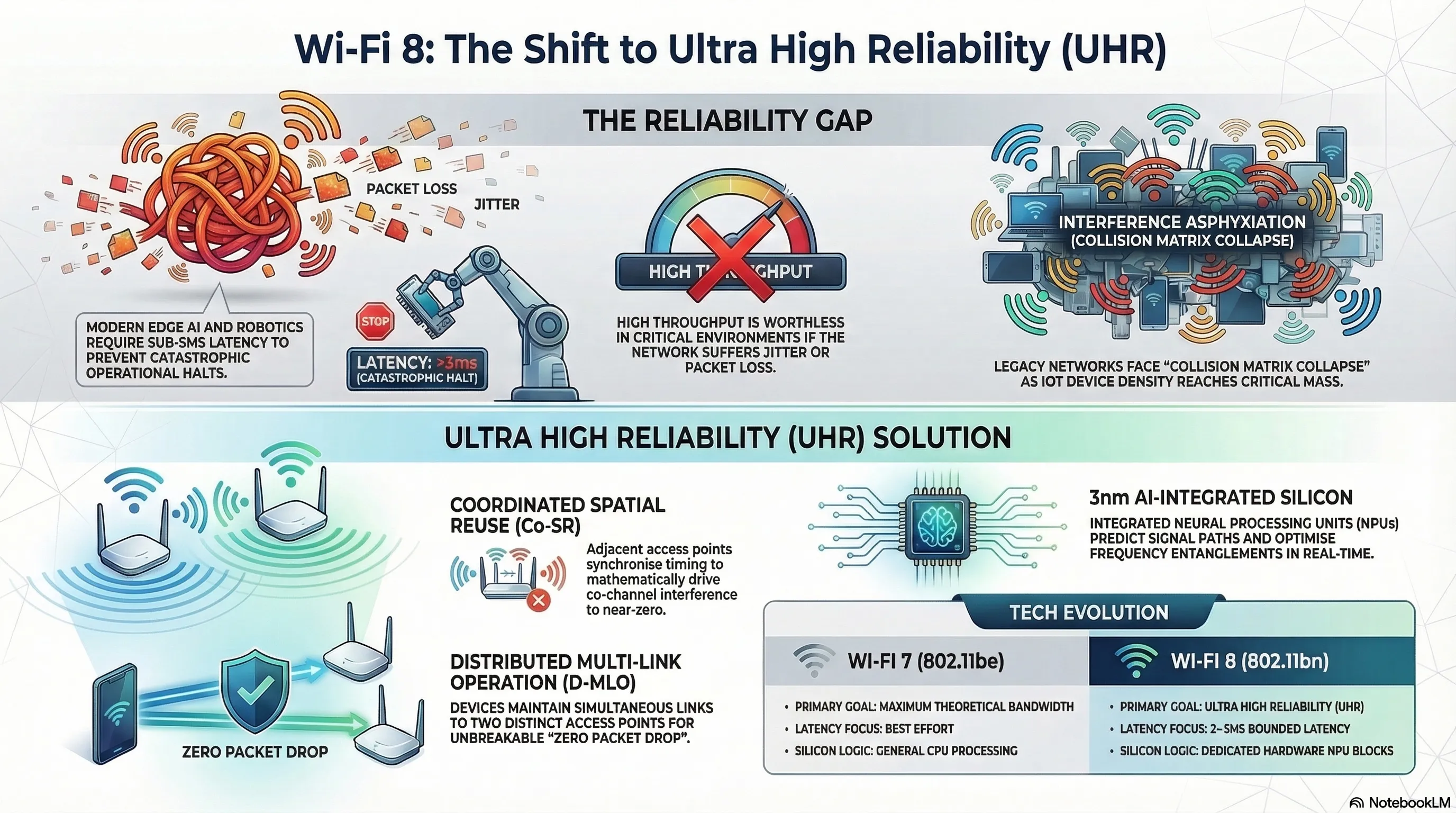
Wi-Fi 8 (802.11bn) represents a radical shift in wireless networking, moving from raw speed to 'Ultra High Reliability' (UHR). This comprehensive analysis explores the technical autopsy of the standard, focusing on 2-5ms latency for industrial and enterprise environments. We examine the 3nm silicon revolution from Broadcom and MediaTek, featuring on-die NPUs for AI-driven signal optimization. The article covers the impact on warehouse robotics (AGVs), Federated Learning for privacy-preserving AI, and the elimination of motion-to-photon latency in Mixed Reality (XR) via split-rendering. We also discuss international supply chain challenges, post-quantum cryptography (PQC), and the seamless convergence with 5G/6G cellular networks. For IT Directors (CIOs), we provide a strategic ROI analysis, positioning Wi-Fi 8 as the mandatory backbone for the automation-heavy industrial digital civilization.
Part 1: Introduction and the Death of Marketing Bandwidth (The Birth of UHR)
For the past two decades, every generation of Wireless Local Area Network (WLAN) standards—from Wi-Fi 4 through Wi-Fi 7—has revolved around a singular, easily marketable axis: the relentless pursuit of maximum theoretical bandwidth and astronomical gigabit speeds. Hardware manufacturers proudly boasted about capabilities exceeding tens of gigabits per second. However, in the first quarter of 2026, the hardware world collided with a painful, unyielding reality: in a smart factory, a robotic surgery theater, or a massive warehouse managed by a fleet of autonomous mobile robots, having 40 Gbps of raw throughput is completely worthless—and even incredibly dangerous—when the network suffers from packet loss or experiences 100-millisecond ping spikes (jitter).
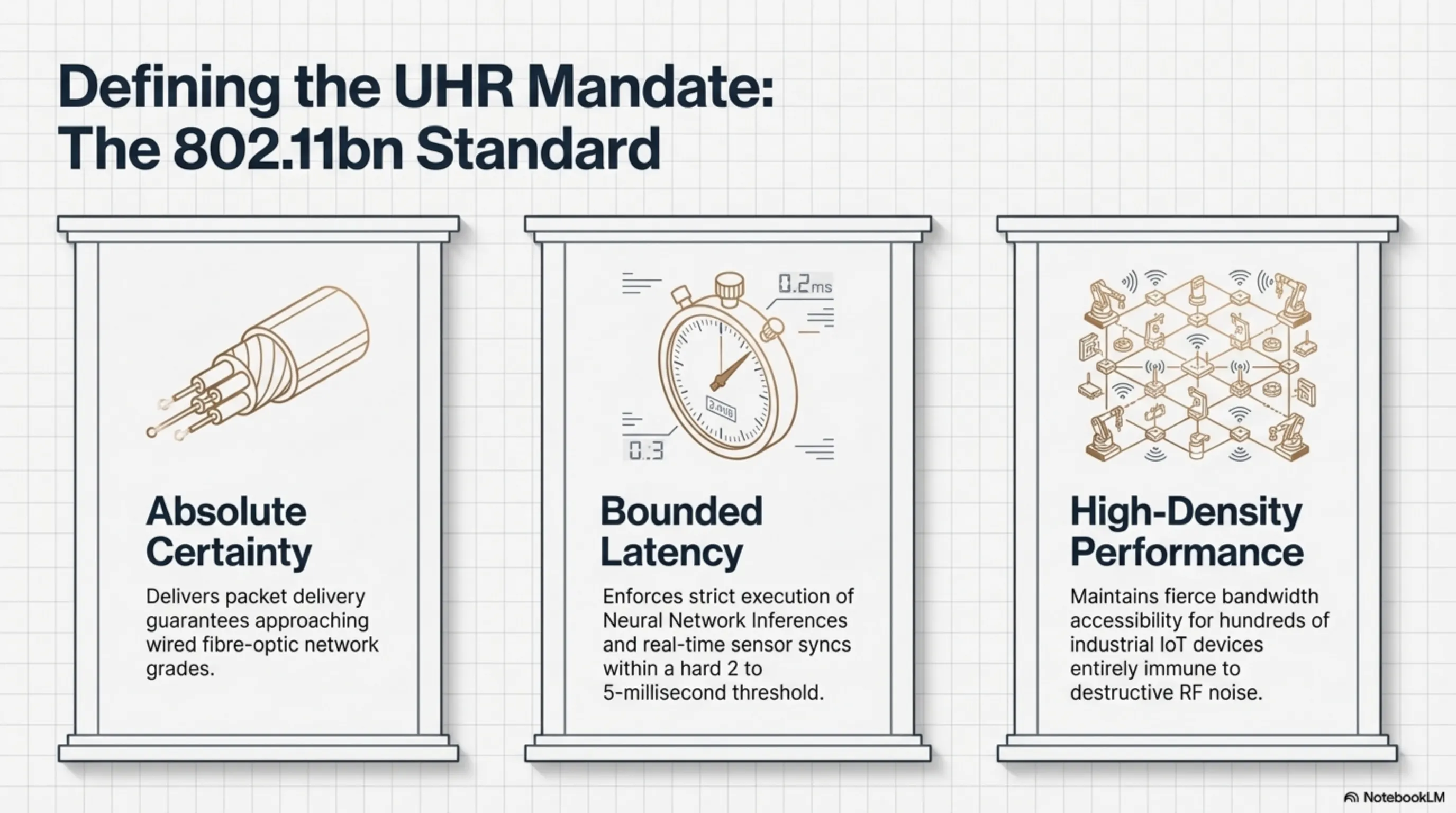
This is precisely where Wi-Fi 8, technically designated as IEEE 802.11bn, enters the hardware arena as a genuine paradigm shift. The official title of this new standard is "Ultra High Reliability" (UHR). Its primary objective is no longer simply providing more speed, but rather guaranteeing the delivery of data packets with a level of absolute certainty approaching that of wired fiber-optic networks, even in highly dense enterprise environments saturated with destructive radio frequency (RF) noise. While Wi-Fi 7 pushed raw bandwidth to its absolute limit via ultra-wide 320 MHz channels, Wi-Fi 8's critical mission is to keep that bandwidth fiercely accessible in the presence of hundreds of industrial Internet of Things (IoT) devices, entirely without interruption and with strictly Bounded Latency.
This profound philosophical pivot in network architecture occurred because modern computational models have drastically evolved. Edge AI can no longer afford to wait for responses from centralized cloud servers. Neural Network Inferences must now be executed locally (On-Device), but these independent devices require a communication network to synchronize billions of parameters and real-time sensor data—a network where, even in a worst-case operational scenario, latency never exceeds the 2 to 5-millisecond threshold. Wi-Fi 8 has completely rewritten this architecture from the absolute foundation of the physical layer (PHY) to the pinnacle of the Medium Access Control (MAC) layer to make this a reality.

Part 2: Technical Autopsy of PHY and MAC Layers in 802.11bn
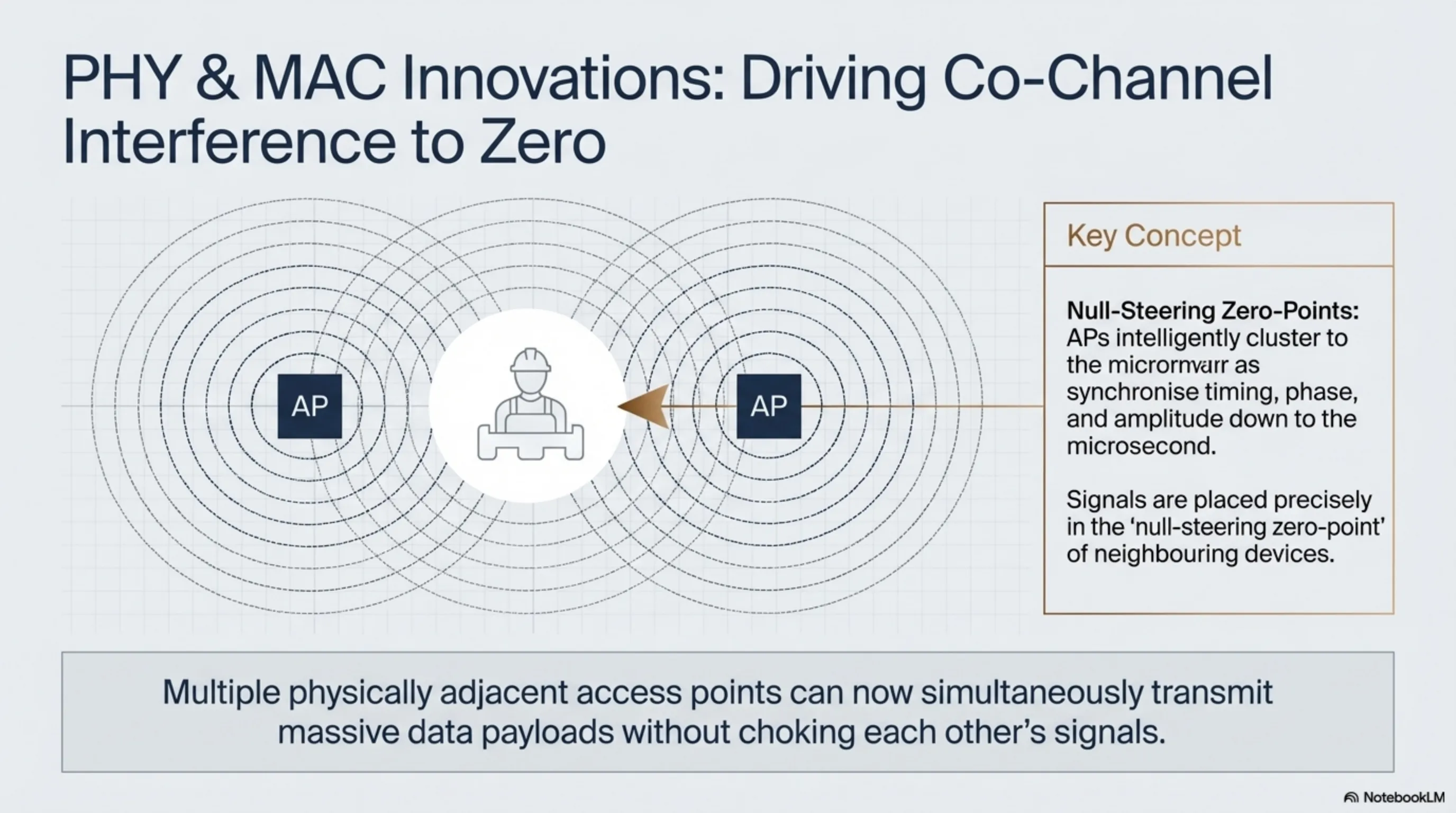
From a purely technical specification standpoint, the revolutionary features of Wi-Fi 8 are deeply rooted in highly aggressive coordination mechanisms between transmitting devices. Unlike previous iterations that typically annexed a new frequency band to boost sheer speed (such as the addition of the 6 GHz band in Wi-Fi 6E), the Wi-Fi 8 standard continues to operate across the existing 2.4, 5, and 6 GHz radio bands, and identically inherits the 4K-QAM modulation ceiling from its predecessor, Wi-Fi 7.
The core engineering innovation in this generation lies in two radical techniques: Coordinated Spatial Reuse (Co-SR) and Coordinated Beamforming (Co-BF). In contemporary dense enterprise environments, multiple Access Points (APs) operating in a large hall practically choke each other's signals due to severe Co-channel Interference. However, a network built on Wi-Fi 8 establishes an intelligent clausal cluster (either local or cloud-controlled) of APs, allowing each individual access point to synchronize its timing, phase, and signal amplitude dynamically down to the microsecond level. Consequently, two physically adjacent access points can simultaneously transmit massive data payloads on a single unified frequency block to two completely different users in varying environmental spots. They do this by placing the transmitted signal of one AP exactly in the Null-steering zero-point of the other user, driving Co-channel Interference mathematically to near-absolute zero.
Beyond this anti-interference mechanism, Distributed Multi-Link Operation (D-MLO)—the highly evolved successor to Wi-Fi 7's MLO—ensures that a client device isn't just simultaneously connected to two or three frequency bands of a single AP, but can concurrently establish active, bonded links to two physically distinct access points. This introduces a paradigm of Absolute Redundancy at the Link Layer. If an industrial robotic arm loses its direct Line of Sight (LOS) signal with the primary AP while rotating in the darkest corner of a massive distribution center, the data phase instantly transitions, experiencing "Zero Packet Drop", via the secondary AP. The aggregated signals are seamlessly combined at the router OS's Layer 2. Such a phenomenal level of unbreakable stability was previously the exclusive domain of exceedingly complex, astronomically expensive Corporate Private 5G/LTE hardware networks.
Part 3: Silicon Architecture - The 3nm Broadcom & MediaTek Revolution
Implementing the incredibly demanding algorithms required for extreme Time Coordination and dynamic Beamforming necessitates bespoke silicon packing terrifying computational power. By March 2026, the undisputed titans of semiconductor manufacturing—specifically Broadcom and MediaTek—took the helm of this revolution, delivering their first pre-production Wi-Fi 8 silicon samples to the world's largest Enterprise Original Equipment Manufacturers (OEMs).
An intensive microscopic examination of the Die Size and internal architecture of these chips reveals an unprecedented level of integration bridging analog circuitry and digital processing logic. MediaTek's next-generation flagship silicon (under the Filogic 900 taxonomy) utilizes Taiwan Semiconductor Manufacturing Company’s (TSMC) cutting-edge 3-nanometer transistors to drastically suppress Thermal Design Power (TDP) within the Wi-Fi subsystems. But why is such an impossibly advanced, exorbitant 3nm lithography deemed universally critical for a mere Wi-Fi modem package? The primary justification is the dedicated integration of hardware Neural Processing Unit (NPU) blocks directly onto the radio die—an architectural leap nonexistent in prior generations.
Empowered by these built-in AI blocks, Broadcom's newest silicon can instantaneously analyze the surrounding radio channel profile tens of thousands of times per second in authentic Real-Time using Deep Neural Networks. They apply massive Machine Learning algorithms directly onto the physical signal data (I/Q data) to accurately predict the most phenomenally optimized path for "throwing" a signal toward a rapidly moving device. These immensely powerful embedded NPUs completely Offload the burden of calculating frequency entanglements—a task that historically crushed the router's main CPU. This architectural liberation allows enterprise routers to sustain their peak ultimate throughput with radically lower energy consumption throughout extreme daily operation cycles.
This engineering triumph is a historic breakthrough for client devices specifically—flagship smartphones, smart AR glasses with miniature battery cells, and remote industrial IoT sensors—translating to a staggering, unprecedented leap in battery longevity. The receiver wake-up scheduling and the Target Wake Time (TWT) protocols within the 802.11bn standard are now timed with unbelievable microsecond precision. Clients activate their power-hungry radios for merely a fraction of a millisecond exactly when the Access Point beams isolated data uniquely to them.
Part 4: Wi-Fi 8's Impact on Warehouse Robotics (AGVs) and Industry 4.0
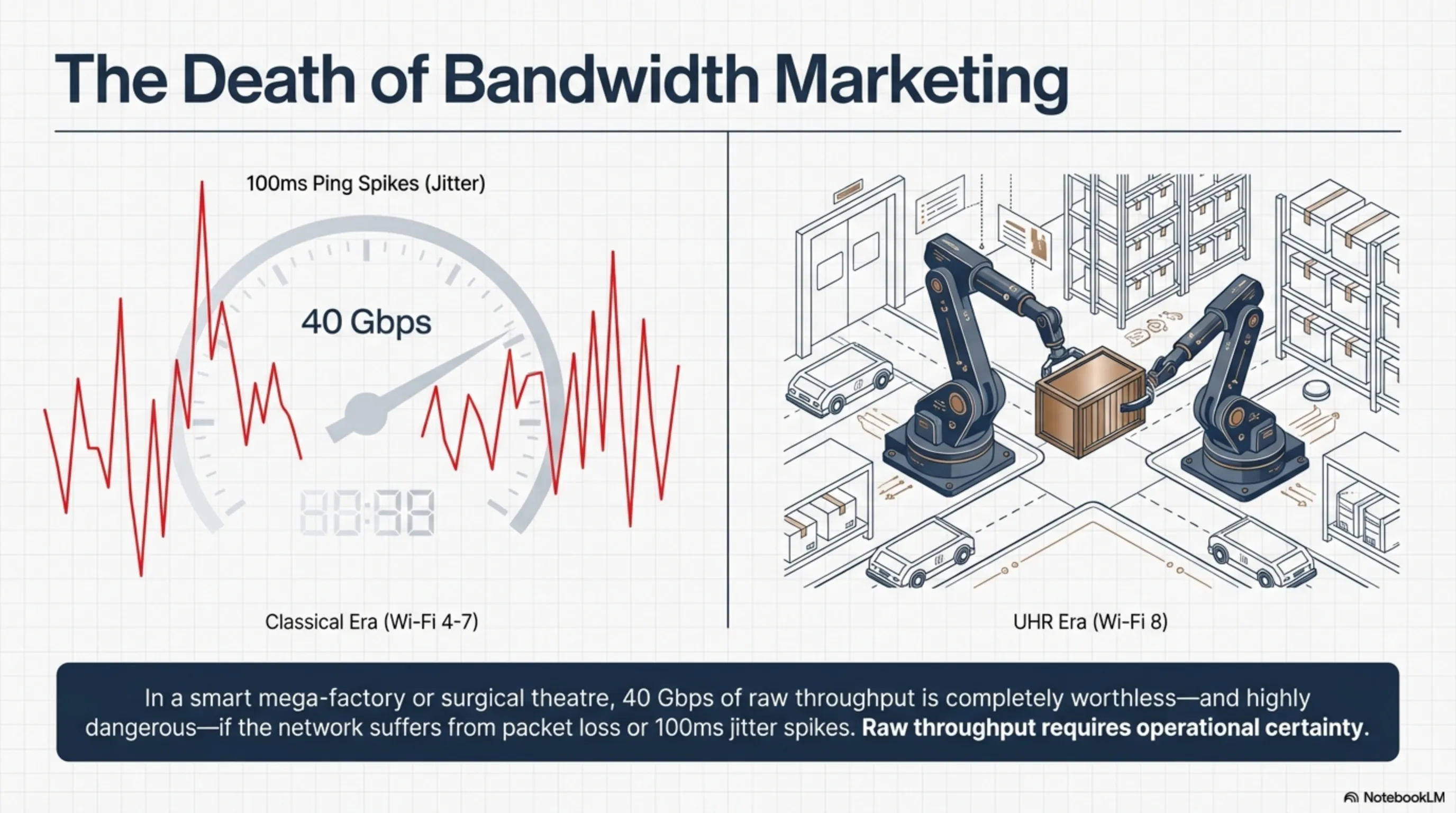
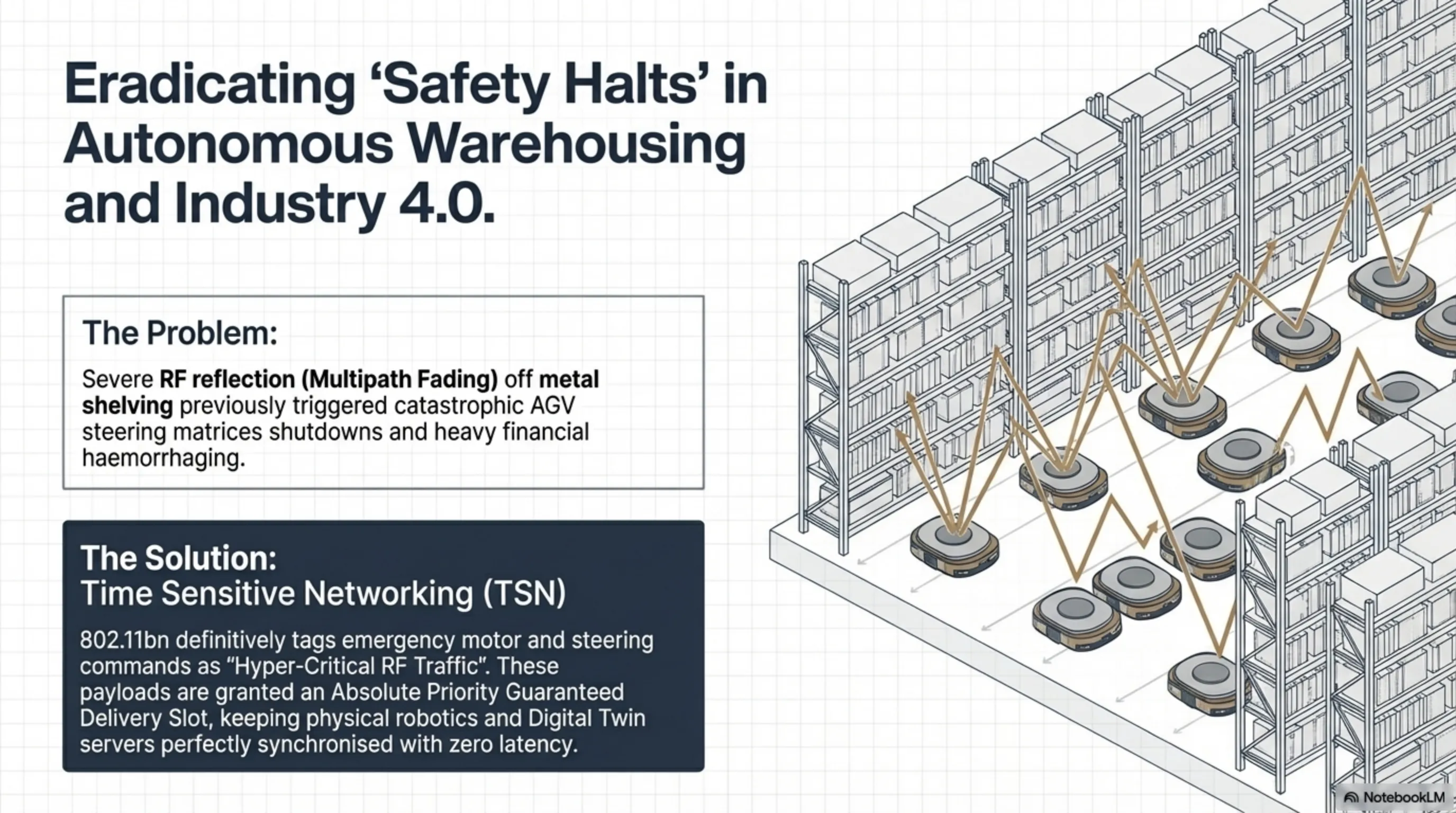
The core strategy for networking megacorporations to aggressively sell their colossal, highly lucrative Wi-Fi 8 infrastructure in the first half of 2026 specifically targets the beating heart of the global logistics industry: Amazon distribution centers, Electric Vehicle (EV) gigafactories, and gigantic industrial manufacturing plants. Inside a modern warehouse actively transitioning to the Industry 4.0 architecture, hundreds or even thousands of Autonomous Guided Vehicles (AGVs) zoom between storage racking aisles. Prior to the absolute determinism of the 802.11bn standard, brutal signal degradation caused by Multipath Fading and severe RF reflection off massive metal shelving was a highly common and deeply attritional phenomenon, predictably triggering agonizing "Safety Halts" in the robots' automated steering matrices.
Every single minute of network downtime within an advanced fleet of 500 robotics at international distribution hubs ruthlessly disrupts traffic routing algorithms, manifesting as hundreds of thousands of dollars in catastrophic financial hemorrhage due to efficiency loss. The absolute superstar feature of 802.11bn—where it viciously eclipses its cellular competitors—is Time Sensitive Networking (TSN) seamlessly executed over an entirely wireless medium. Before 2026, the vital compensatory technology of TSN was dependably viable strictly on hard-wired industrial Ethernet cables.
Now, leveraging an entirely novel Layer 2 and physical architecture, Wi-Fi 8 access points can definitively tag minute control packets (such as an emergency motor halt command or a steering angle protocol) as "Hyper-Critical RF Traffic", granting them Absolute Priority for transmission within a rigidly Guaranteed Delivery Slot. These critical payloads are never delayed or bottlenecked by dense background interference, regardless of immense network load (e.g., during peak transmission of 8K environmental security camera streams or identical widespread firmware downloads across hundreds of machines).
This stunning certainty of packet delivery amidst absolute worst-case signal disruption has wide-opened the operational floodgates for deploying Digital Twin infrastructures across mega-factories. The physical mechanics of robotic arms and their software-simulated models rendering on Edge servers remain permanently synchronized with zero latency. Consequently, for the very first time in technological history, Wi-Fi networks have crystallized into a terrifyingly economical and lethal competitor replacing the punishingly expensive, highly restrictive, and devastatingly complex deployments of Corporate Private 5G networks in the realm of deep industrial automation.
Part 5: Federated Learning: Decentralized Edge AI on Local Networks
Contemporary hardware discussions can no longer exist independently of AI workloads. As the architecture of commercial neural networks grows larger, increasingly monstrous, and more wildly complex, their processing and retraining dependencies inherently rely heavily on memory feed velocity and relentless wireless bandwidth. By early 2026, the concept of Federated Learning—or decentralized machine learning—has rapidly transitioned from a theoretical academic roadmap to a harsh commercial reality. This profound system means it is no longer systematically acceptable or secure to transmit all raw, privacy-sensitive environmental data of enterprise users (like confidential text files, biometric typing cadence patterns, or recorded voice commands) to an exposed central supercomputer or cloud datacenter to train and smarten an overarching AI model.
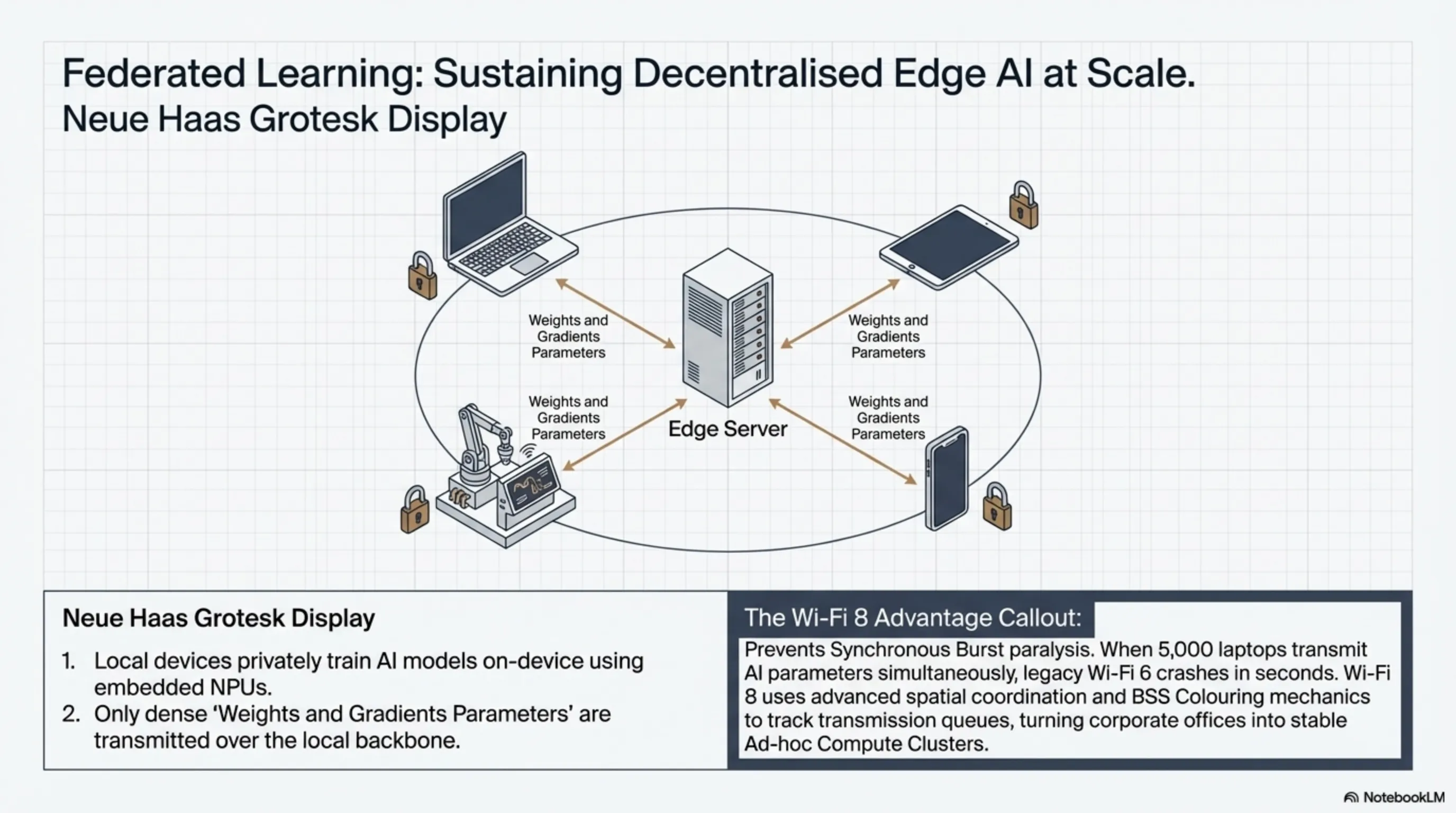
Instead, every single enterprise tablet, smartphone, or corporate laptop stationed within the company receives a miniature localized clone of the organization's AI model. Armed with its localized NPU silicon, it privately trains that algorithm on-device, highly exclusively utilizing the personal data of its specific user. Subsequently, only the "Weights and Gradients Parameters" (the highly dense output vectors of neural learning) are gathered. They are transmitted through the local Wi-Fi backbone to a local Edge Server where these millions of parameters merge flawlessly, ultimately upgrading the grand global model for the entire organization.
However, inside massive corporate skyscrapers, this tidal wave of colossal Neural Network parameters unexpectedly initiating Synchronous Bursts identically across 5,000 laptops at the close of business hours would instantly cripple and paralyze legacy Wi-Fi 6 access points infrastructure within a single second. The Wi-Fi 8 standard, via highly evolved spatial coordination and deeper BSS Coloring mechanics, powerfully dominates these Burst traffic syncs. By tracking hardware transmission queues with mind-blowing efficiency, it commands thousands of devices concurrently without causing a total network collapse. This empowers engineers to bind hundreds of localized AI-capable devices in major corporate offices together as Ad-hoc Compute Clusters directly through ultra-fast, permanently stable Wi-Fi links. This robust wireless infrastructure effectively transitions Secure Decentralized AI from a pipe dream into a definitive, irrefutable daily reality.
Part 6: Cloud Rendering and Mixed Reality (XR/AR): Eradicating Motion-to-Photon Latency
For technology analysts who have meticulously dissected the hardware architecture of leading-edge developers—such as Apple’s Vision Pro hardware or Meta's lightweight next-generation headsets—it is an acknowledged truth that the heaviest, most crushing engineering obstacle preventing total mainstream adoption is the unrelenting issue of battery volume and severe heat dissipation (Thermal Bottlenecking).
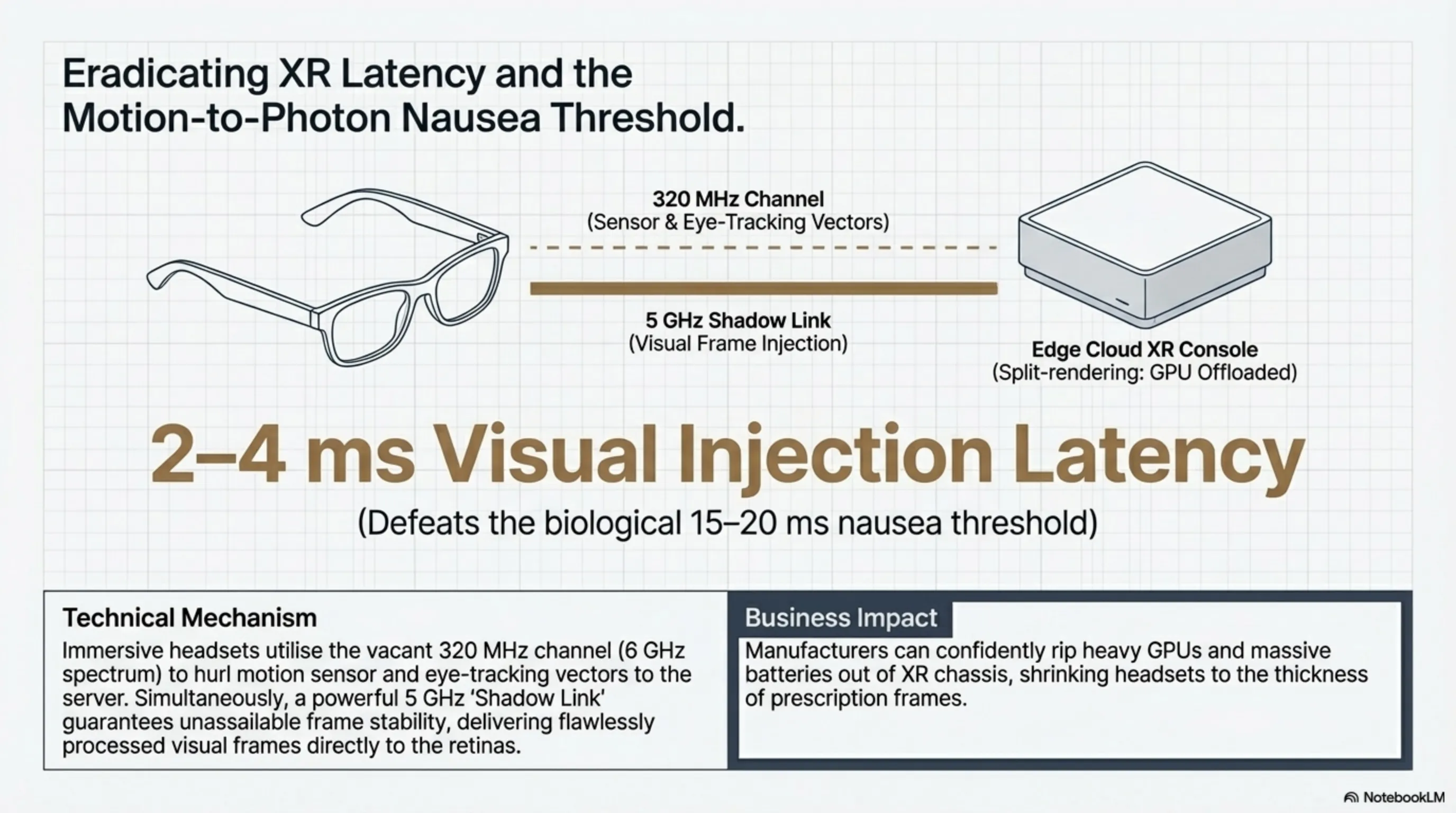
Achieving genuine visual immersion by rendering full 3D, 8K resolution scenes per eye onto MicroLED displays mandates the deployment of terrifyingly powerful, intensely hot chipsets literally strapped to the human user's skull. The ultimate macroscopic structural solution for the Extended Reality (XR) industry is forcefully decapitating the heavy graphics rendering process away from the headsets, completely offloading it to a vastly superior computer housed within the very same room, or routing it to a network-attached Edge Cloud XR console (the technique of Split-rendering). Substantively compressed, flawlessly processed visual frames are then streamed wholly wirelessly and instantaneously into the headset's blinkers. Prior to 2026, the fatal flaw in this strategy was human biology: the human brain cannot neurologically tolerate motion delays exceeding 15 to 20 milliseconds (a metric engineers rigidly refer to as Motion-to-Photon Latency). Detecting a delay between a physical head rotation and the moving virtual image commands the brain to trigger severe, immediate spatial nausea in the user.
Empowered by the spectacular D-MLO capabilities rigorously defined within Wi-Fi 8, immersive headsets now possess the unyielding capacity to simultaneously hurl continuous motion sensor data, gyroscope metrics, and precision eye-tracking vectors directly to the hosting server using an ultra-fast, highly-optimized, incredibly vacant frequency band (such as the 320 MHz channel residing on the 6 GHz spectrum). Simultaneously, identical headset hardware firmly relies on the powerful, highly penetrated 5 GHz band serving as a structural "Shadow Link" guaranteeing unassailable frame stability and receipt of individually rendered image packets. Under this new wireless benchmark, streamed visual packets are injected directly into the user’s retinas with absolute, infallible determinism in an astounding 2 to 4 milliseconds.
This extraordinary stability and the absolute infallibility of data queue management brought upon by Wi-Fi 8's frequency dominance symbolically and definitively marks the utter eradication of the thick, cumbersome, physically tethering cables previously required by high-resolution PC VR gaming headsets (like the archaic Valve Index). The standard boldly promises a spectacular reduction in the total physical mass of intelligent Augmented Reality smart glasses, bringing them terrifyingly close to the thickness profiles of ordinary prescription frames, simply because manufacturers can now confidently, unapologetically rip out the massive batteries and heavy internal Graphics Processing Units (GPUs) entirely from the glasses' chassis.
Part 7: International Supply Chains: Export Controls on Edge Network Security
The global phenomenon of transferring foundational infrastructural technologies across international borders inherently triggers massive geopolitical fault lines, severe commercial friction, and dramatic political turbulence. While highly affluent nation-states heavily invest in systematic deployment of enterprise Wi-Fi 8 frameworks—equipping entire Smart City mega-projects and massive international aviation hubs with hundreds of thousands of active devices sourced in lucrative multi-million dollar contracts from American networking juggernauts like Cisco or Aruba—the engineering reality regarding the procurement of these ultra-advanced RF equipment in heavily sanctioned markets presents a starkly divergent, high-tension narrative of survival.
The full technology stack of industrial Enterprise Wi-Fi 8 routers, purely by virtue of embedding hyper-powerful internal Neural Processing chipsets (Edge AI), deeply advanced hardware encryption modules, and highly sophisticated Radio Frequency radar and spatial mapping capabilities, immediately triggers their aggressive classification under "Dual-Use Technology Export Controls" by stringent regulatory bodies such as the U.S. Office of Foreign Assets Control (OFAC) and European trade commissions. These severe embargos prohibiting the direct legal sale of essential infrastructural hardware actively spawn massive fractures and devastating double-cost economic shocks in isolated IT markets.
First, the end-user localized pricing of powerful Wi-Fi 8 access points tumbling through the convoluted grey market of international smuggled networking hardware frequently skyrockets to two or even three times the official global MSRP found in distribution hubs like Dubai or Erbil. This viciously devours the structural IT upgrade budgets of countless private heavy-industry organizations operating under sanctions.
The second, arguably far more crushing engineering challenge, is draconian Cloud Software Locking. Dozens of paradigm-shifting modern features—such as Cloud-managed AI Spatial Analytics that rely massively on neural network processing conducted in overarching cloud ecosystems (exemplified by platforms like Ubiquiti UniFi or Cisco Meraki) to actively configure bands and neutralize interference—are systematically geoblocked locally when attempting network connections from isolated regional IPs.
To ruthlessly circumvent these vicious licensing dead-ends and cross-border connectivity blockades, elite network engineers operating inside these tense environments are actively transitioning toward rigorous "On-premise Infrastructure" architectures. They build self-hosted, extremely customized open-source local controllers securely rack-mounted internally. Furthermore, heavily modified Custom Firmware Flashing has evolved into an indispensable art form, allowing regional engineers to forcibly optimize the terrifyingly complex microwave coordination and routing algorithms directly inside the imported APs without requiring a constant, unrelenting ping and log transmission path to cloud servers housed in remote Californian datacenters.
Simultaneously, the continuous, exploding usage of cutting-edge client devices like flagship 2026 smartphones and modern laptops deeply equipped with integrated Wi-Fi 8 modules (such as Samsung Galaxy S26 Ultra terminals or powerful workstations running Apple M5 and Snapdragon X Elite Gen 2 silicone) proliferates aggressively in the hands of millions of global everyday users. This rapidly generates agonizing network strain locally on aging, crippled legacy enterprise and household access points. Failing to aggressively migrate to the massive computational capacities of 802.11bn guarantees severe bottlenecking, placing critical remote corporate workflows and vital communication matrices in imminent danger of catastrophic collapse.
Part 8: Physical Layer Security: Post-Quantum Cryptography (PQC) & WPA4
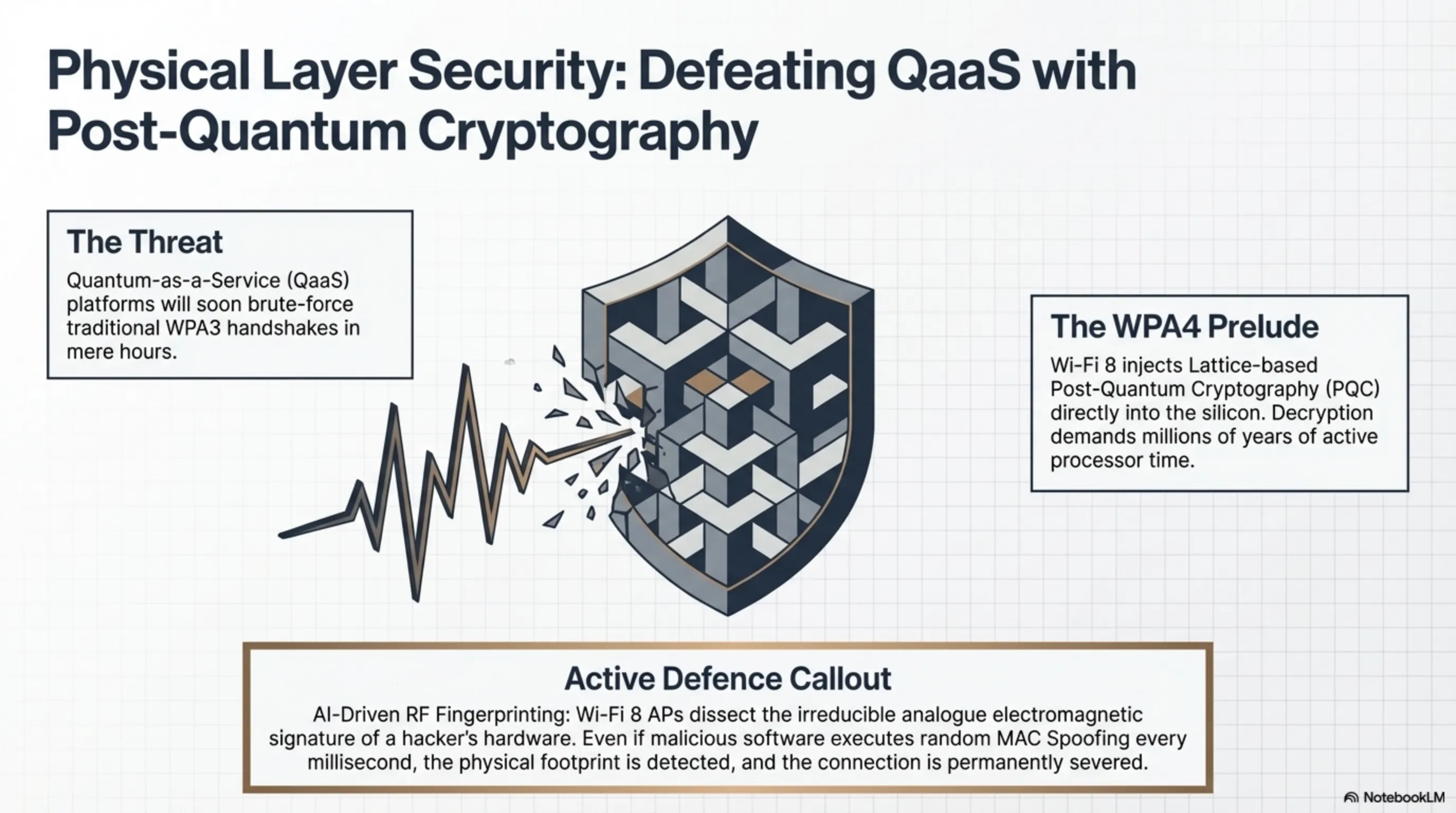
The historical evolution of network hardware security demonstrates a grim reality: it never authentically keeps pace with the blistering advancements of communication speed standards until a literal apocalyptic threat, or a looming devastating vector capable of annihilating global digital assets, forces its hand. In the modern era, that existential threat is the violent emergence of functional Quantum Computing Processors (Quantum Computing Phase). Leading global cyber defense organizations confidently predict that by the culmination of the current decade, the aggressive availability of malicious actors and hostile nation-states accessing immensely powerful Quantum-as-a-Service (QaaS) cloud platforms will empower them to utterly decimate current standard decryption algorithms. They will possess the capacity to crack the hardware passwords of Wi-Fi networks and brutally shatter the hash structures of WPA3 handshakes—tasks requiring centuries for traditional supercomputers—in a matter of mere days or violent hours via raw brute-force mechanisms.
To ruthlessly counter this highly terrifying cryptographic doomsday scenario at the foundational level, during the deep underlying engineering phases and the rigorous drafting of the 802.11bn architecture in 2026, baseline regulatory authorities (namely the Wi-Fi Alliance and the Institute of Electrical and Electronics Engineers - IEEE) radically accelerated and officially injected radically upgraded cryptosystem architectures directly into the silicon. This is formally known as "Advanced Post-Quantum Cryptography (PQC) Network Security Standards", acting as a brutal, unapologetic prelude to the inevitable, definitive WPA4 network protocol execution.
Within this deep layer of software architecture found in 2026's apex routers, constructing encryption keys and establishing secure band tunnels now leverages utterly novel mathematical protocols deeply rooted in complex multi-dimensional network geometries (Lattice-based cryptography). The uniquely potent characteristic of these specific functions is that even hyper-advanced computers armed with thousands of quantum qubits collide with a computational brick wall; theoretically, solving these dynamic equations mandates millions of years of active processor time.
Expanding beyond the sheer migration into the ultra-secure realm of quantum-resistant network cryptography, active defensive capabilities—such as the physical detection of rogue signal intruders via RF Fingerprinting—have become shockingly intelligent and profoundly Machine-learned. The physical silicone and central CPU processing cores belonging to Wi-Fi 8 routers are now structurally sentient enough to instantaneously dissect and analyze the totally unique, irreducible analog electromagnetic signature radiating from a hacker’s specific smartphone antenna or offensive system stack. Even if the attacker’s malicious software continuously and endlessly executes random MAC Spoofing Cycles every millisecond, the physical, irreducible footprint of that offending device is ripped from the ambient environmental space, and its connection is permanently severed. This entirely novel paradigm of intelligent RF surveillance cements the physical over-the-air layer as a fearsome, impenetrable frontline defensive shield protecting hyper-secure military networks, critical infrastructure refineries, datacenters, and highly sensitive banking transaction networks from a vastly expanding taxonomy of lethal, proximity-based cyber-attacks.
Part 9: The Smart City Convergence: Cellular 5G/6G Meets Wi-Fi 8
Throughout the grand historical eras of connectivity technology, a subtle yet fierce ideological war and practically invisible conflict has perpetually raged between the semiconductor titans manufacturing Wi-Fi communication chipsets and the colossal telecommunications conglomerates aggressively deploying massive 5G cellular towers (such as Verizon, T-Mobile, or AT&T). Elite mobile network operators and telecom architects have consistently prophesied that the overwhelming power of 5G Private networks and direct internet uplink infrastructure would eventually become so unstoppable that it would violently eradicate the fundamental logic and operational utility of employing Wi-Fi within localized environments. However, the indisputable frequency reality of the global radio continuum and the unyielding laws of Microwave Physics aggressively suggest otherwise.
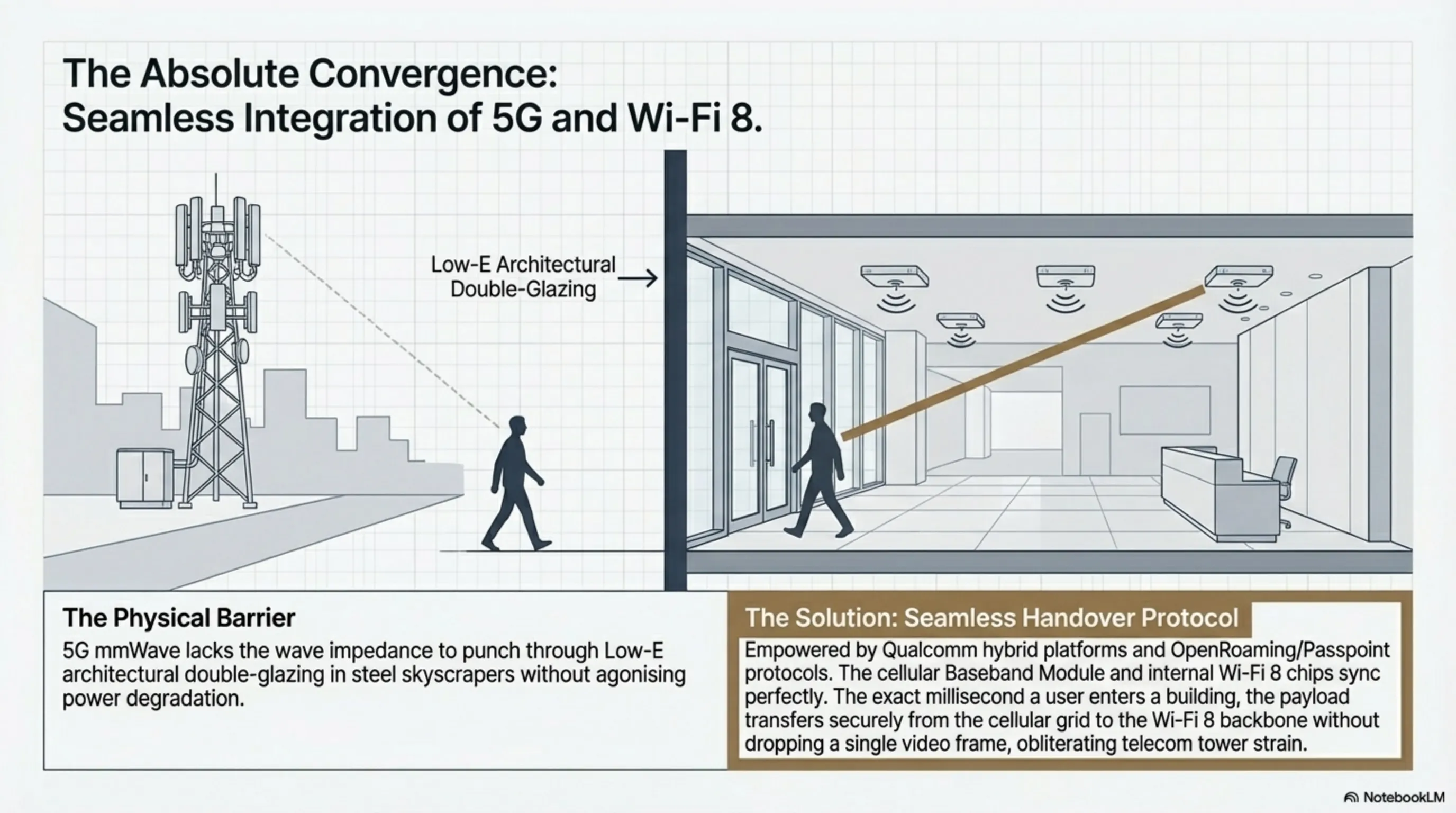
The physical wavelength frequencies dictating 5G millimeter-wave (mmWave) networks are staggeringly fragile and acutely sensitive to minute particle absorption. They completely lack the physical capacity and wave impedance required to successfully punch through a thin, noise-isolating layer of double-glazed Low-E architectural glass found in modern high-rise apartments and concrete commercial monoliths without suffering agonizing power degradation. Specifically engineered within the sweeping 2026 strategic paradigm, the previous strategy of technological hostility has been permanently, unequivocally supplanted by an immensely lucrative, seamlessly integrated joint commercial approach: the theory of Absolute Convergence.
The globe's foremost semiconductor manufacturing superpowers, brilliantly exemplified by Qualcomm's relentless successes, have successfully birthed an entirely new architecture deploying hybrid platform technologies deeply embedded within the hardware cores of both user routers and mobile phones. Thus, an employee’s device traversing the street, inside transit vehicles, or inhabiting exterior civic spaces natively maintains a hyper-powerful connection to the sprawling 5G cellular tower grid. The exact, precise millisecond that individual physically penetrates the entrance doors of a vast residential complex, corporate office bureau, or sprawling commercial shopping mall, without the user suffering a single discernible drop in quality or facing even a momentary interruption in a highly vital videoconferencing session, the connection payload protocol executes. Empowered by highly secure networking protocols like Passpoint and sophisticated roaming architectures heavily integrating OpenRoaming, the user’s live data stream transfers seamlessly, flawlessly, and securely off the macro cellular tower directly onto the highly stable, massively broadband local network operating internally on the Wi-Fi 8 backbone (Seamless Handover Protocol).
The internal RF processing chips powering Wi-Fi 8 and their distinct micro-antenna blocks now function in absolute, continuous synchronous harmony (Sync) alongside the profoundly advanced cellular Baseband Module located at the very heart of the user's silicon smartphone SoC. This boundless integration and extreme harmony residing inside the communication ecosystem radically obliterates the agonizing traffic volume and limitless load currently crushing deeply overpopulated telecom tower cells located globally across massive metropolises. Critically, it concurrently bestows upon users an enduring, incredibly tough, uniformly seamless Connectivity experience deeply enclosed within colossal modern urban hubs, towering steel skyscrapers, dense subway infrastructures, and labyrinthine commercial megamalls.
Part 10: Economic Analysis: Enterprise Infrastructure Return on Investment (ROI)
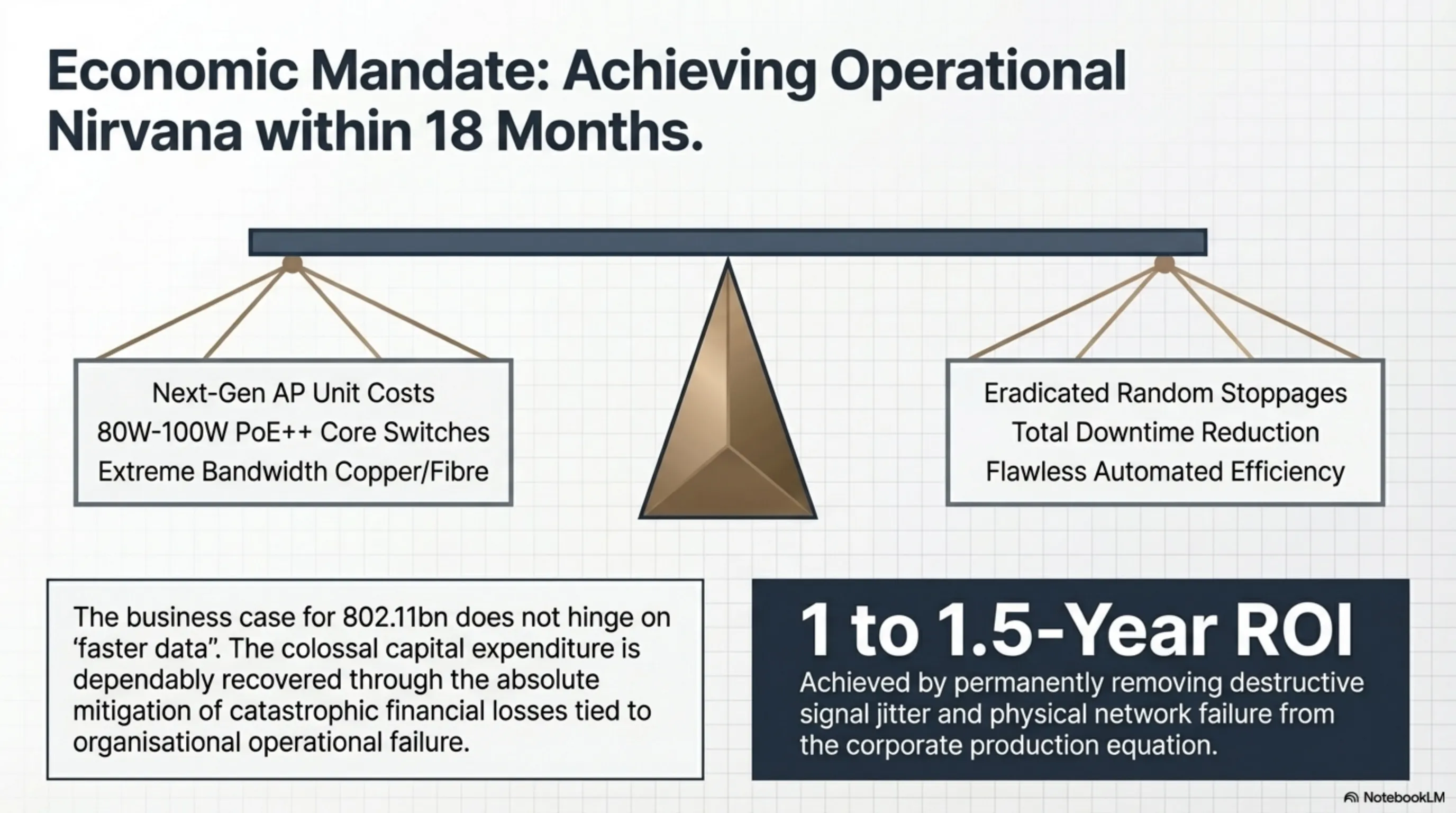
Properly allocating vast corporate budgets and executing colossal infrastructural redesign projects mandatorily requires a glaringly obvious, totally sound economic justification outlining the financial logic behind deploying hyper-complex modern hardware equipment. Executing a total migration strategy shifting completely away from obsolete legacy Wi-Fi networks toward the profoundly modern, incredibly robust Wi-Fi 8 (802.11bn) networking protocol across massive private industrial organizations, or complex mega-city transportation fleets, invariably involves exorbitant hardware capital expenditures and the expensive integration of entirely new active and passive network gear.
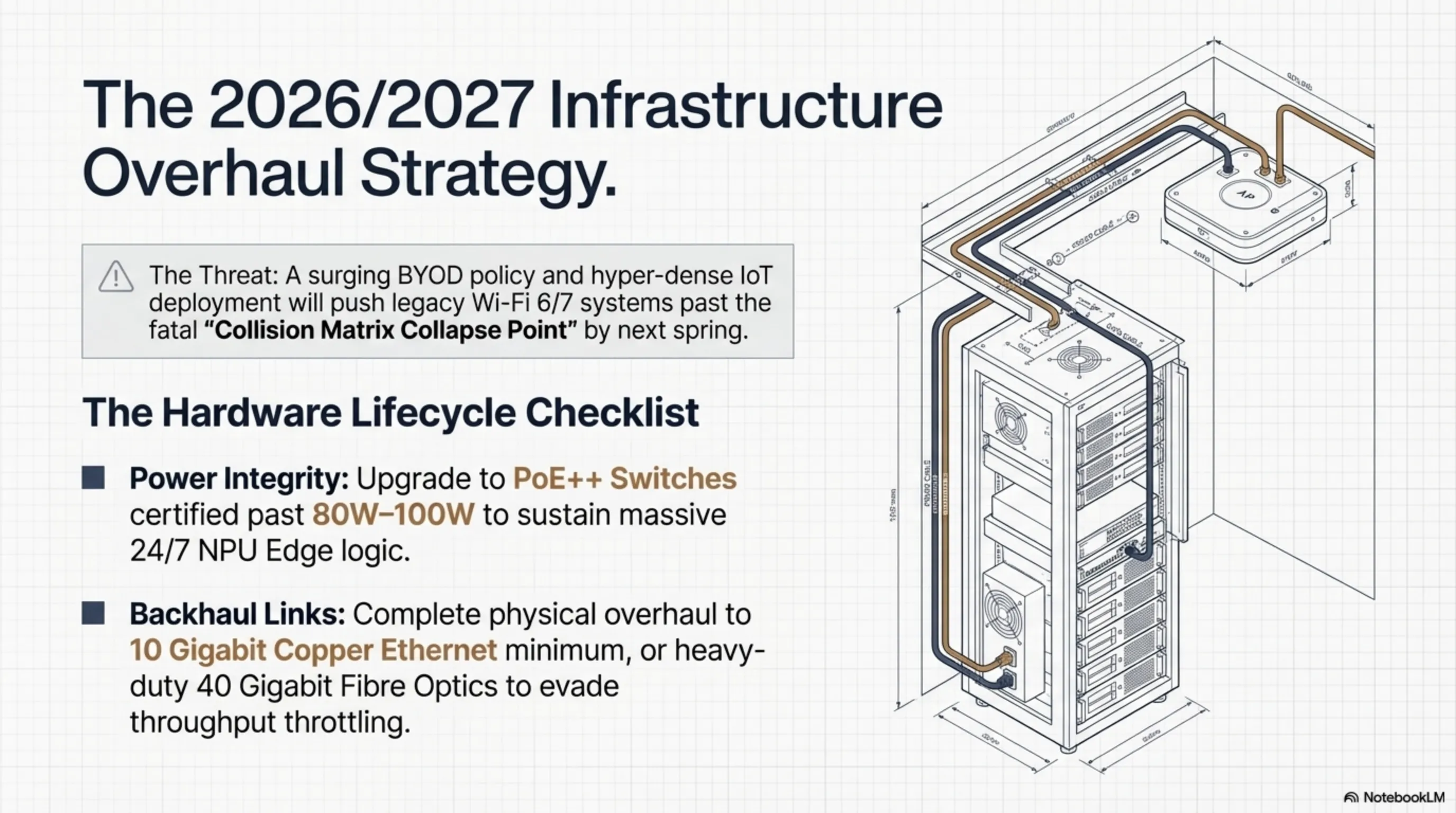
Individual Next-Generation access points possess considerably higher unit costs; they urgently demand dramatically superior copper ethernet cabling boasting extreme bandwidth tolerances, and inherently necessitate drastically more expensive networking core switches heavily compliant with massive high-power transmission standards (namely switches heavily equipped with PoE++ tech). These specific switches are wholly necessary to guarantee the delivery of aggressively high wattage and power demands required globally by Wi-Fi 8 routing hardware tasked with consistently maintaining relentless internal Neural Processing capabilities (NPU Edge logic) 24/7.
Consequently, establishing a justifiable economic case regarding the Return on Investment (ROI Analysis) linked to this critical infrastructural upgrade does not merely pivot around simplistic marketing metrics involving faster raw speeds or downloading sheer data volumes faster. The monumental financial return is instead brilliantly generated via the outright mitigation of catastrophic financial losses historically suffered during agonizing instances of organizational operational failure (Downtimes Reductions). By permanently eradicating random stoppages crippling massive robotic production lines inside automated electronics assembly plants, and by aggressively empowering relentless internal corporate financial engines that execute self-sustaining, self-teaching machine logic exclusively free from destructive signal jitter, the entire company enters an operational state of perfect, flawless efficiency. This operational Nirvana guarantees that the heavy financial costs funneled toward upgrading the entire network hardware matrix are highly dependably, comfortably recovered within a brief operating cycle of exactly one to one-and-a-half years, taking shapes as undeniably tangible, massively profitable revenue preserved exclusively because network failure was removed from the equation.
Part 11: Conclusion: The Mandatory 802.11bn Migration Strategy for IT Directors (CIOs)
Ultimately, for elite C-suite decision-makers, high-ranking Chief Information Officers (CIOs), and the senior architectural engineers actively drafting datacenters and orchestrating massive multi-million dollar enterprise mega-projects, the directive mandating a vicious upgrade of critical networking hardware to the formidable Wi-Fi 8 protocol does not merely represent a temporary network optimization trick, an unnecessarily luxurious bell or whistle, or a generously bloated annual tech budget line-item. Rather, aggressively adopting this standard undeniably provides an absolute guarantee of corporate survival and an active insurance policy safeguarding operations within a hyper-dense epoch profoundly dominated by the Internet of Things (IoT Dense Epoch).
With the inevitable, flooding deluge of hundreds of distinct secondary hardware peripherals—ranging from environmental sensors and highly intelligent 8K automated security cameras powered strictly by ferocious AI Machine Vision algorithms, to innumerable smart wearables and specialized smart headsets physically attached to present organizational personnel—operating alongside deeply mechanized assembly matrices completely devoid of physical human labor and countless heavily utilized personal computational devices (BYOD policy) surging daily into protected corporate private networks, existing constraints will reach critical mass. The painfully limited frequency container bandwidth inherently tied to older generational Wi-Fi 6 legacy hardware, spanning aggressively up to even the Wi-Fi 7 protocols, will unquestionably suffer critical asphyxiation. By the imminent arrival of next spring and summer, these crippled systems will face outright submission, disastrously violently crossing the catastrophic breaking point historically identified by engineers as the fatal Collision Matrix Collapse Point.
The successful and deeply strategic structural deployment of incredibly potent, brand-new Wi-Fi 8 generation access point hardware demands an aggressively profound, macrosystematic physical overhaul heavily targeting the firm's foundational network cabling infrastructure. To sustain the colossal power demands driving their internal monolithic silicon blocks towards maximum output, the new exceptionally robust access point terminals mandate connection via deeply fortified Power over Ethernet (PoE Switches) completely certified under extremely high-tier and highly robust transmission standards (exemplified by high-band specifications surging past 80 watts or aggressively clearing 100 watts wrapped efficiently within the PoE++ form-factor). To evade sudden network throughput throttling logic completely, these beasts mandate purely physical copper Backhaul Link connections holding absolute compliance under 10 Gigabit extreme load certifications at minimum, or depend profoundly upon elite heavy-duty 40 Gigabit Fiber Optics Ethernet infrastructure.
Chief Executives, key regulatory panel decision-makers, and lead senior network drafting engineers positioned heavily across rapidly developing global markets and the Middle East must immediately, aggressively monitor, interrogate, and microscopically assess the internal Hardware Lifecycle Engineering dynamics guiding their unique companies. Vital hard currency acquisition budgets heavily predicting IT hardware refresh cycles (Refresh Cycle 2027) must exclusively, forcefully, and strictly be modeled, completely documented, and stringently organized squarely revolving around the absolute reality of deeply integrating hyper-dependable networking architectures universally standardized within the brutal 802.11bn matrix parameters. Ultimately, we as a collective race have arrived at an absolute inflection point in raw hardware civilization occurring in March 2026. The primitive, classical epoch wherein a random Wi-Fi signal was casually viewed solely as a mere recreational convenience serving low-demand mobile users has been permanently, violently brought to its final, inexorable historical end. In its powerful modern processing layers operating today, Wi-Fi 8 functions exclusively as an impenetrable, totally decisive, extraordinarily irreplaceable backbone defining our deeply modernized, automation-heavy industrial digital civilization—a machine logic foundation configured to absolutely never yield, completely destroying the concept of operational interference, latency or devastating network failure.
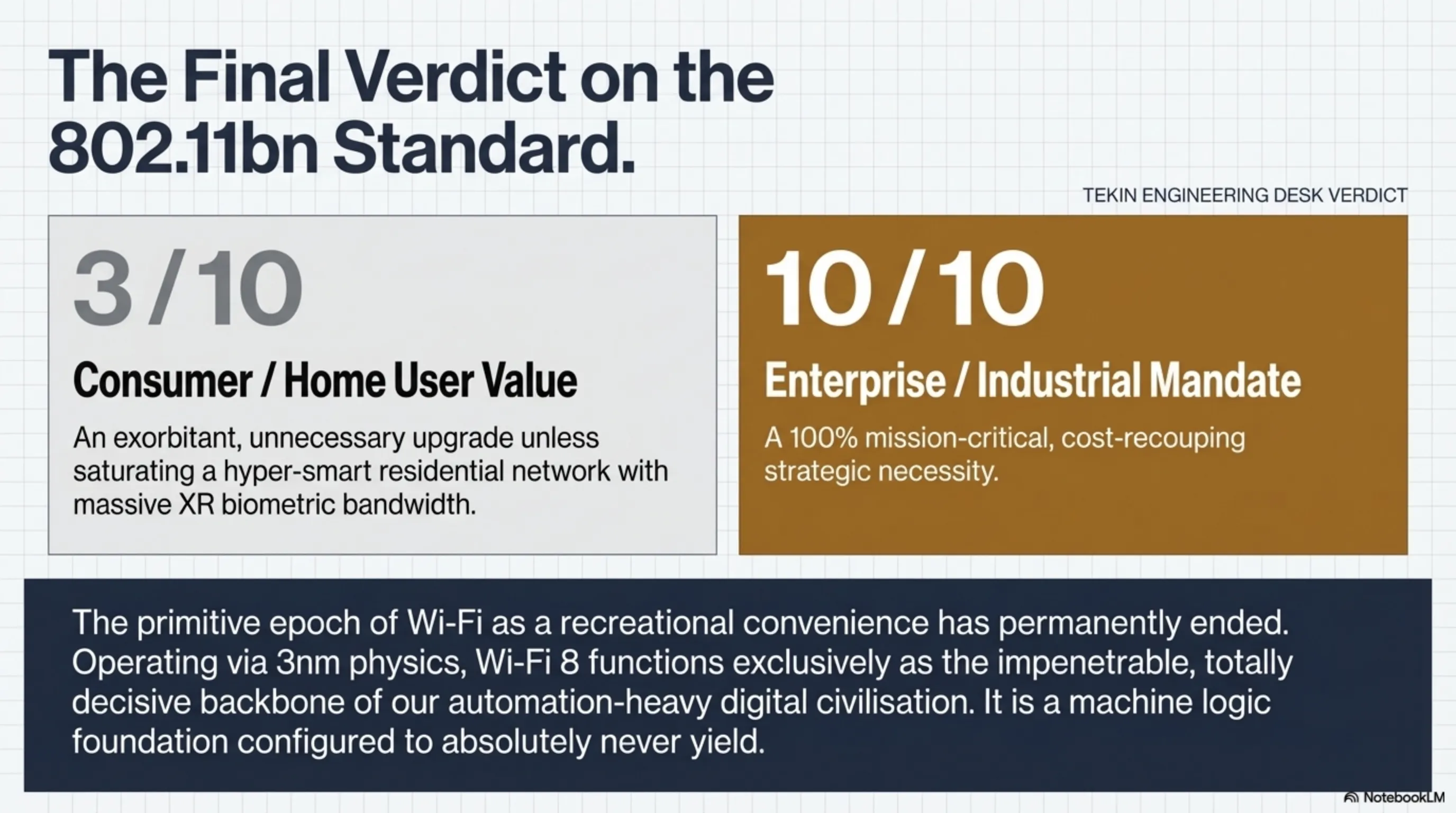
Final Editorial Verdict from the Tekin Engineering Desk: Mandatory Migration to Ultra High Reliability (UHR Standard)
Infrastructure Upgrade Value for General Consumers and Home Users: 3 out of 10 (A highly exorbitant, absolutely unnecessary hardware upgrade, firmly excluded unless specifically building incredibly extreme hyper-smart residential mansions literally saturated with hundreds of biometric wearable sensors heavily demanding massive XR visual bandwidth.)
Enterprise Value for Commercial Sectors, Hyper-Scale Datacenters, and Industrial Robotics Facilities: 10 out of 10 (A 100% mission-critical, cost-recouping, spectacularly strategic move that is utterly, aggressively impossible to ignore for the forthcoming operational year.)
Global Technology Strategy Overview: The hyper-intelligent masterminds developing the radically new Wi-Fi 8 standard (IEEE 802.11bn) have astutely, finally, and violently executed the ultimate demise of the blind, classical marketing warfare spanning recent decades centered absurdly upon "which router casually pulls more raw theoretical speed bandwidth over a given localized network." Instead of pursuing that redundant goal, we are witnessing the fiery genesis characterizing a profoundly vital, incredibly deep engineering struggle emerging rapidly across the global wireless telecom heavy-industry sector: Guaranteeing the absolute certainty of securing flawless 24-hour continuous network connection stability maintaining unrelenting 100% cohesion completely devoid of suffering even a single destructive, potentially lethal millisecond of physical Jitter. For effectively managing sprawling physical fleets of robotic factories, arming elite eSports zero-latency Cloud Gaming tournament champions globally, accelerating developers compiling hyper-scale Edge AI processing models, and securing life-saving automated medical surgery sensor matrices requiring unassailable remote operation—the precise immaculate birth of this flawless hardware standard, operating specifically via deeply advanced 3-nanometer chipset processing physics, serves unequivocally without hyperbole as a true modern engineering miracle. It completely delivers the unparalleled safety, intense absolute stability, and uncompromising features native exclusively to massively powerful 5G Private Cellular telecom networks, whilst shockingly maintaining the incredibly brilliant operational cost reductions natively synonymous alongside the innate installation flexibility inherent inside basic localized Wi-Fi networking platforms. We currently exist perfectly stationed upon an authentic historical tipping point directly marking the absolute transformation concerning fundamental frequency signal physics globally.