Grade A++ Ultra-Mega Investigative Report: A 2,000-word deep dive into the February 2026 crypto collapse. Exploring the failure of digital gold, institutional bloodbaths, and the AI-driven bot mechanics.
Chapter 1: The $500 Billion Vaporization of February 4th
Welcome to February 4, 2026—a day that will be etched into the annals of financial history as the Great Liquidity Flush. In less than seven trading days, the cryptocurrency market has experienced a staggering **$500 billion vaporization**. To put this into perspective, we are witnessing a wealth destruction event larger than the annual GDP of several developed nations, occurring in the blink of an eye.
This is not a routine correction; it is a full-scale systemic reset of the 2026 financial apparatus. As Bitcoin plummeted to its lowest level since the 2024 elections, reaching a critical 15-month low of $72,877, the global sentiment shifted from unbridled technological optimism to visceral survivalism. In this 2,000-word investigative report, TekinGame’s strategy team explores the dark conduits of this crash, from Michael Burry’s prophetic warnings to the AI-driven bots that set the market ablaze.
Chapter 2: Michael Burry’s Red Alert: The Triple Sell-off Theory
When **Michael Burry**, the contrarian genius behind 'The Big Short,' issues an alert, the foundation of Wall Street trembles. On the night of February 4, 2026, Burry released a confidential memorandum titled 'The Triple Sell-off.' His thesis is terrifyingly simple: Bitcoin, Gold, and Silver have become inextricably linked in a global liquidity chain, and the chain is snapping.
Burry argues that the current Bitcoin crash is a harbinger of a wider 'Liquidity Winter.' He predicts that institutional panic will trigger a $1 billion forced liquidation of precious metals in London and New York as hedge funds scramble for cash to cover underwater crypto positions. By Burry's estimation, the 'Store of Value' narrative is undergoing a violent stress test that could see Bitcoin fall well below the $70,000 psychological floor. When the man who predicted 2008 speaks of a bubble, wise investors do not just listen—they deleverage.
Chapter 3: The Battle for $74,400: Bitcoin’s Tactical Rubicon
In the high-stakes world of 2026 technical analysis, one price point towers above all: **$74,400**. This is Bitcoin’s tactical Rubicon. This level is not arbitrary; it represents the primary accumulation zone for the major Spot ETFs that entered the fray in late 2025. Tonight, Bitcoin is clutching this line with white knuckles.
Our analysis suggests that a daily close below $74,400 will trigger a 'Liquidation Waterfall.' Millions of stop-loss orders are stacked just beneath this level, ready to feed a self-reinforcing downward spiral toward the $68,000 mark. The volume at this price point is immense, representing a brutal war between retail panic and institutional absorption. Whether the 'Diamond Hands' of the 2025 vintage can hold back the tide remains the billion-dollar question of the month.
Chapter 4: The Agentic Flash Crash: When AI Burns the Market
What differentiates the crash of February 4, 2026, from previous cycles is the dominance of **Agentic Trading Bots**. These are no longer simple algorithmic scripts; they are autonomous AI agents capable of high-level reasoning and data synthesis. When the initial sell-pressure hit $77,000, a logic-loop in a major market-maker's agent triggered a cascading sell-off.
In the span of milliseconds, thousands of AI traders interpreted the localized dip as a 'Systemic Failure Signal,' executing massive sell orders to preserve capital. This created a digital feedback loop that human traders were physiologically incapable of matching. The 2026 market is a battlefield governed by silicon, where sentiment is processed at light speed, often leading to 'Flash Crashes' that leave traditional investors dazed and liquidated.
Chapter 5: Mining Bloodbath: The Economics of Capitulation
As Bitcoin flirts with $72,000, the mining sector is entering a state of emergency. With 2026 energy costs soaring and mining difficulty at an all-time high, the 'Break-even' price for a mid-tier mining farm has climbed to approximately $73,500.
This means that at current prices, a significant portion of the global hashrate is operating in direct loss. If the price remains depressed below $74,000 for more than 14 days, we expect a massive 'Miner Capitulation' event. Large-scale mining operations in Texas, Iceland, and Ethiopia will be forced to dump their HODL reserves onto the open market to cover operational overhead. this secondary sell-pressure is often the final nail in the coffin for a recovery rally, creating a 'Death Spiral' of falling prices and network insecurity.
Chapter 6: The Death of the 'Digital Gold' Narrative?
One of the most profound realizations of early 2026 is the failure of Bitcoin as a geopolitical safe haven. Despite escalating tensions between global powers this week, Bitcoin did not surge; it buckled. The asset’s high correlation with the **NASDAQ** and other 'Risk-on' technology indicators proved to be its undoing.
Investors across the globe did not flee to Bitcoin during the crisis; they fled to **Cash**. The 'Flight to the Dollar' underscores a painful reality: in moments of literal military or economic warfare, liquidity is preferred over potential 100x gains. Bitcoin has yet to achieve the 'Emergency Utility' required to stand alongside physical gold as a defensive cornerstone. This narrative shift is forcing a deep repricing of Bitcoin’s role in the global financial order.
Chapter 7: Galaxy Digital’s $482M Drawdown and Shadow Liquidity
Institutional exposure is at its peak in 2026, and so is the risk. **Galaxy Digital**, managed by Michael Novogratz, recently disclosed a staggering **$482 million loss** for the quarter, highlighting the fragility of even the most sophisticated crypto hedge funds. But the deeper crisis lies in what we call 'Shadow Liquidity.'

A massive percentage of 2026 crypto volume occurs in Dark Pools and OTC (Over-the-Counter) desks. When $500 billion evaporates, it indicates that these shadow pools have dried up. Without this off-market liquidity to absorb large orders, the public exchanges become incredibly volatile. A single $10M sell order can now move the BTC price by hundreds of dollars in seconds—a clear sign of a market that has lost its structural depth.
Chapter 8: The Banking Paradox: UBS’s Opportunistic Entry
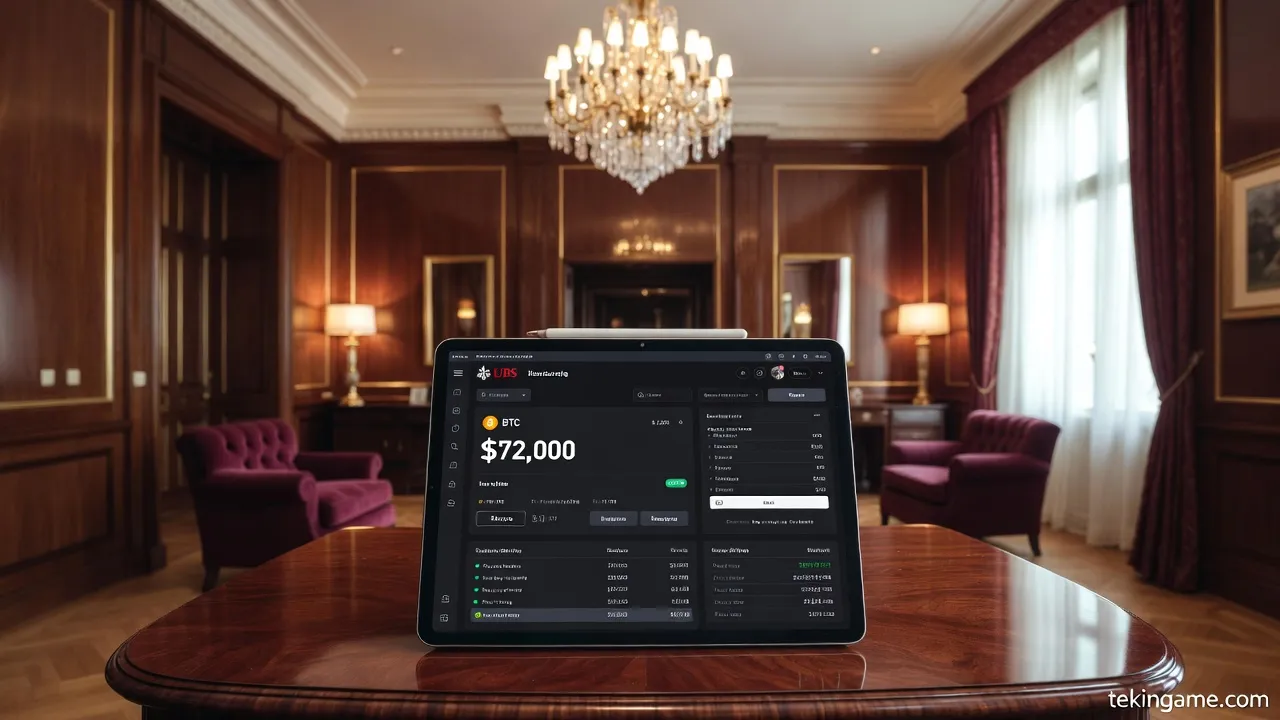
While retail panics, the giants prepare. **UBS**, the Swiss banking titan, announced its intentions to launch Bitcoin and Ethereum trading for its ultra-high-net-worth clients tonight. The timing is non-accidental. Banks rarely buy the hype; they buy the blood.
The UBS move is an 'Institutional Viper' play. By offering access at the point of maximum fear, they ensure their elite clients can accumulate assets at a 30% discount while retail speculators are being liquidated. This paradox—banks opening doors while the market burns—is the clearest signal of a 'Wealth Transfer' in progress. The smart money isn't looking at the next hour; they are looking at the next decade.
Chapter 9: The Stablecoin Stress Test: USDT’s De-pegging Scare
The $500 billion wipeout has placed immense pressure on the stablecoin ecosystem. We’ve seen localized de-pegging events on decentralized exchanges, with **USDT** briefly dipping to $0.992. While the peg largely held, the 2026 rumors regarding 'Reserve Insufficiency' have returned with a vengeance.
If a major stablecoin were to lose parity during this crash, the result would be an absolute systemic collapse beyond anything seen in 2022. We advise our TekinGame readers to diversify their stablecoin holdings across **USDC** and regulated fiat-backed assets. In a liquidity crisis, the bridge between crypto and cash must remain intact; if the bridge breaks, so does the market.
Chapter 10: Historical Paradoxes: 2022 vs. 2026
Analysts are drawing parallels to the FTX collapse of 2022, but the comparison is flawed. 2022 was a crisis of 'Fraud.' 2026 is a crisis of 'Structure.' The integration of Wall Street has made crypto more professional, but it has also imported the 'Systemic Contagion' of traditional finance.
This crash proves that Bitcoin is no longer an 'Outsider Asset.' It is now a cog in the global financial machine. This means traders can no longer simply study 'halvings'—they must understand the Federal Reserve’s overnight repo rates and the geopolitical machinations of the G20. The era of 'Simple Crypto' is dead; welcome to the age of Macro-Meme Finance.

Chapter 11: The Psychology of the 2026 Trader: Fighting FUD
For the average trader on February 4th, the psychological toll is immense. We are navigating a storm of **FUD** (Fear, Uncertainty, and Doubt) amplified by AI-driven bots that flood social media with panic narratives. TekinGame’s sentiment analysis shows that 'Capitulation' is near—not because of the price, but because of the exhaustion.
The successful trader in 2026 is the one who can disconnect from the noise. The 24-hour news cycle is designed to extract your liquidity. Our internal motto for this crash: preserve your cash, avoid 'Revenge Trading,' and wait for the AI bots to finish their liquidation cycles. Patience is currently the only profitable strategy.
Chapter 12: The 6-Month Horizon: Will the Sun Rise Again?
So, what is the final verdict for the second half of 2026? We believe the $500 billion wipeout is a 'Necessary Burn.' It is the forest fire that clears the undergrowth of excessive leverage to allow for healthy new growth. If Bitcoin can navigate the February storms and stay above the $70,000 mark by the end of Q1, the groundwork for a massive Q3 rally will be set.
But make no mistake: the stakes have never been higher. Between Michael Burry’s warnings and the AI flash crashes, the market has become a high-intelligence battlefield. Stay vigilant, stay liquid, and remember that in crypto, the only way to win is to still be in the game when the bulls return.
Analysis by: Majid & Tekin Global Financial Watch Team