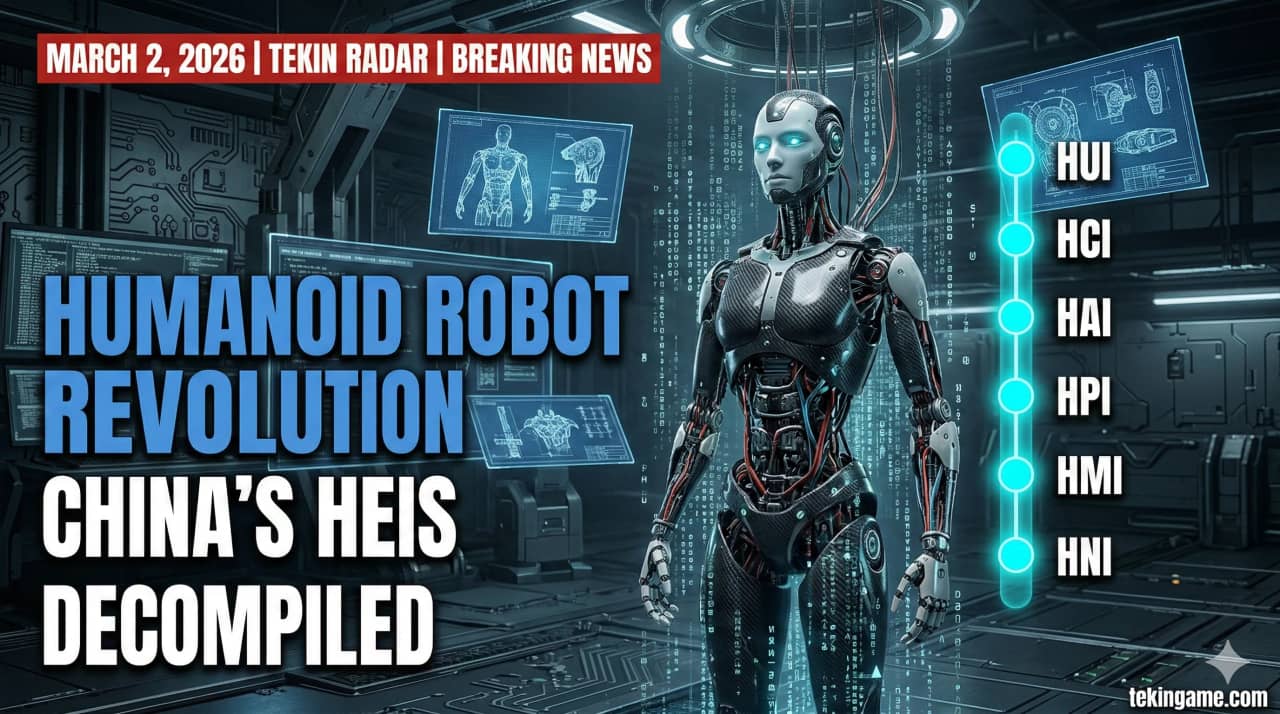
China has unveiled HEIS 2026, the world's first national standard for humanoid robots and embodied AI. With 140+ manufacturers, 330+ models, a 62,500-unit target, and prices from $13,500 to $80,000, the 6-layer standard unifies brain computing, limbs, safety, and ethics across the industry.
Tekin Radar: China Unveils the World's First National Standard for Humanoid Robots—With 140+ Manufacturers and 330+ Models, the Embodied AI Revolution Begins in 2026
As a System Architect, when monitoring the world's foundational technology currents, my eyes remain fixed on one location on the map: East Asia, and specifically, Beijing. In late February 2026, China's Ministry of Industry and Information Technology (MIIT) made an unprecedented move, officially unveiling the world's first "Humanoid Robot and Embodied Intelligence Standard System" (HEIS 2026 Edition). This document is not merely bureaucratic paperwork; it is a comprehensive, systematically engineered architecture that places the entire value chain of the humanoid robot industry—from artificial brain transistors to safety and ethics protocols—under a single unified standard framework. While the United States and Europe remain mired in legislative debates and regulatory deliberations, China has laid the industrial groundwork for mass-producing humanoid robots with military-grade engineering velocity. Let us dissect the hidden architecture of this standard and its seismic implications for the global robotics industry.
1. Dissecting the 6 Layers of the HEIS Standard: From "Artificial Brain" to "Machine Ethics"
The HEIS 2026 standard is the product of collaborative effort by more than 120 research institutions, technology companies, and industrial users, organized under the MIIT's technical committee for HEIS standardization (established December 2025). The 6-layer architecture of this standard reveals an extraordinarily mature systems-level thinking:
- Layer 1 - Basic Commonality: Defines shared terminology, physical parameters, measurement units, and standardized communication interfaces. This layer ensures that components from different manufacturers are fully interoperable—analogous to what USB accomplished in consumer electronics.
- Layer 2 - Brain-like Computing: Standardizes neuromorphic processors, reinforcement learning models, and real-time decision-making protocols. This layer defines how a robot's "brain" should reason and how quickly it must make decisions.
- Layer 3 - Limbs & Components: Technical specifications for actuators, sensors, dexterous hands (12+ degrees of freedom), and joints. This layer serves as the ISO equivalent for automotive parts—but for the robot body.
- Layer 4 - Complete Machines & Systems: Integration requirements for hardware-software unification, performance testing, and quality metrics for the finished product.
- Layer 5 - Applications: Deployment protocols across multiple sectors: automotive manufacturing, consumer electronics, semiconductors, logistics, and services. Each industry receives its own application profile.
- Layer 6 - Safety & Ethics: Encompasses emergency stop protocols, biometric data privacy, human-robot interaction laws, and legal liability in case of accidents. This is the most critical and contentious layer of the entire standard.
System Architect Analysis:
This 6-layer architecture directly mirrors the OSI model in computer networking. Just as the OSI model's 7 layers transformed the internet from a military project into a global infrastructure, the HEIS standard aims to accomplish the same for humanoid robotics: transforming a laboratory technology into a mass-production industry with interchangeable components. The strategic genius is in the interoperability mandate.

2. The Mass Production Tsunami: 62,500 Humanoid Robots in 2026—In China Alone!
The production numbers emerging from China's humanoid robot sector in 2026 are staggering, signaling a decisive shift from the "exhibition" phase to the "industrial" phase. Projections indicate that domestic shipments of humanoid robots in China will reach 62,500 units in 2026—a 247% surge from 18,000 units in 2025. In 2025 alone, over 140 domestic manufacturers introduced more than 330 different humanoid robot models, and global sales in the sector exceeded $500 million.
- UBTECH Walker S2 — The $80,000 Industrial Soldier: UBTECH targets production of 5,000 units in 2026 and 10,000 by 2027. Priced at $80,000 per unit, the company plans 20–30% annual cost reductions. Current order books have surpassed 1.4 billion yuan (~$200M), with the Walker S2 already deployed on automotive, electronics, and semiconductor production lines.
- Unitree G1/R1 — The $13,500 Kung Fu Robot: Unitree aims to ship 20,000 units in 2026 (up from 5,500 in 2025). The G1 robots autonomously performed kung fu at the 2026 Chinese New Year Gala—a demonstration that went viral globally. The new H2 model features complex biomechanical movements, while the R1 is positioned as the market's most affordable humanoid.
- Fourier GR-2 — The Open-Source Robotics Platform: The GR-2 features 12-degree-of-freedom dexterous hands, a swappable battery, and an open SDK—designed to function as the "Android of humanoid robots." A platform where any developer can build their own applications.
- XPeng — From Electric Cars to Robot Factories: The automotive giant XPeng announced it will establish the industry's first full-chain mass production base for humanoid robots by end of 2026. This signals the automotive industry's massive pivot into the robotics market.
"China's mass production numbers for humanoid robots in 2026 mirror its EV production figures from 2019—the exact moment nobody believed China could become the global leader. Five years later, BYD dethroned Tesla. The same scenario is about to unfold in the robotics industry, and the HEIS standard is the official roadmap for this quantum leap." - System Architect Deep Dive
3. The Robot Cold War: China vs. America and Japan — A Geopolitical Industry Analysis
The release of the HEIS standard cannot be viewed as a purely technical measure. In the current geopolitical landscape, this move sends profoundly strategic signals to Washington and Tokyo. China is creating a network effect in the robotics industry through this standard—precisely the same strategy it deployed with 5G standards (under Huawei's leadership) in telecommunications.
When a country defines the first comprehensive industrial standard, all other players are forced into a binary choice: either adopt the same standard (accepting technological dependency) or build their own parallel standard (consuming years of time and astronomical resources). Currently, neither the United States nor the European Union has published any remotely comparable standardization document for humanoid robots.
- First-Mover Advantage in Standardization: The country that sets the standard first builds the entire ecosystem—suppliers, testing labs, and industrial certifications—around itself. Chinese companies producing to HEIS specifications will automatically become the de facto global standard.
- American Competitors Lagging Behind: In the US, companies like Boston Dynamics (owned by Hyundai), Tesla Optimus, and Figure AI possess impressive prototypes, but no unified industrial standard framework exists. Tesla's Optimus remains in testing phase, and Boston Dynamics focuses more on quadruped industrial robots than humanoids.
- Japan: The Sleeping Robotics Giant: Japan, with Honda (Asimo), Toyota, and SoftBank (Pepper), has a long robotics heritage. But mass production of humanoid robots at China's scale? Nowhere close. Japan is rapidly losing its strategic window of opportunity in this market.
- Impact on Global Supply Chains: When Chinese robots enter the global market at $13,500–$80,000 (compared to $150,000+ for American alternatives), their price advantage becomes insurmountable. This mirrors the "cheap Chinese EV" pattern that conquered the European market.
System Architect Analysis:
From a system architecture perspective, China's strategy is a classic "Platform Play." They are building a standardized industrial platform with interchangeable components, portable software, and an open developer ecosystem. Any robotics startup worldwide that wants to use affordable Chinese components involuntarily enters the HEIS standard orbit. This is precisely the mechanism Google's Android used to conquer the mobile world.

4. The Hidden Infrastructure: What Is Embodied AI and Why Is It More Important Than the Robot Itself?
One of the most fascinating dimensions of the HEIS 2026 standard is that it's not merely about "robots"—it's about "Embodied Artificial Intelligence." This concept is fundamentally different from chatbots and Large Language Models (LLMs). Embodied AI means intelligence that possesses a physical body, interacts with the real world, touches objects, senses weight, and learns through physical experience.
- From Language to Action: The New Learning Paradigm: Language models like GPT-5 learn from text. But a humanoid robot must learn from real physics: how to lift a fragile glass without shattering it, how to walk on uneven surfaces without falling. This type of learning requires massive sensor data (tactile sensors, gyroscopes, depth cameras) and complex physics simulations (like NVIDIA Isaac Sim).
- HEIS and Sensor Data Unification: The "Brain-like Computing" layer in the HEIS standard defines standardized formats for sensory data. This means data collected by a UBTECH robot can be used to train AI models for a Unitree robot. This "Data Portability" holds extraordinary strategic value for accelerating machine learning at the national level.
- Comparison with the American Approach: In the US, each company (Tesla, Figure, Boston Dynamics) uses its own unique data format and communication protocol. No shared standard exists for exchanging sensory data between manufacturers. Result? Each company starts from scratch. In China, the HEIS standard creates a "shared data ocean" that increases progress at an exponential rate.
Golden Insight:
Embodied AI is the final frontier of AGI. When an artificial intelligence can move in the physical world, learn, and make decisions, we have crossed beyond chatbots. China, with the HEIS standard, is building the data and industrial infrastructure for this leap—and this initiative is more strategically important than any flashy robotics exhibition.
5. System Architect's Forecast: The 2026–2030 Roadmap and Impact on the Global Labor Market
If we extrapolate current figures using the forecasted compound annual growth rate (CAGR), a spectacular—and simultaneously alarming—picture of the near future emerges. Global humanoid robot hardware sales are projected to surge from $500 million in 2025 to $2.9 billion by 2027—roughly a 6x increase in just two years.
- Wave 1 (2026–2027): Industrial Deployment: Robots are deployed on factory production lines. Repetitive, hazardous, and triple-shift tasks are delegated to machines. UBTECH's Walker S2 is already operational on automotive and electronics assembly lines.
- Wave 2 (2027–2028): Services and Logistics: Robots enter warehouses, airports, hospitals, and hotels. As prices drop below $10,000 (Unitree's projection), SMEs gain purchasing power as well.
- Wave 3 (2029–2030): Entering Homes: Domestic robots capable of cooking, cleaning, and elderly care. This phase will be the most revolutionary and controversial, carrying profound social, economic, and ethical implications.
- Impact on the Labor Market: Estimates project that by 2030, humanoid robots could replace 5–15% of repetitive physical manufacturing jobs. This percentage may seem modest, but at China's workforce scale (800+ million), it translates to tens of millions of positions. The Chinese government, acknowledging this challenge, embedded the "Safety & Ethics" layer in the HEIS standard to provide a framework for managing this social transition.
"Humanoid robots are the electric vehicles of the 2030s. The country that controls the standard infrastructure, supplier ecosystem, and training data will control the future robotics economy. China, with the HEIS standard, has simultaneously built all three pillars and set the rest of the world back by years." - System Architect Strategic Analysis

6. Behind the Curtain: The Startup Ecosystem and the Chinese Government's Role in Accelerating the Humanoid Robot Industry
One of the most critical factors transforming the HEIS standard from paper into industrial reality is China's unparalleled startup ecosystem in robotics and embodied AI. AGIBOT, which in 2025 became the world's largest humanoid robot manufacturer by revenue (surpassing even UBTECH and Unitree), is a prime exemplar of this ecosystem. AGIBOT, with its laser focus on intelligent industrial robots and its pioneering use of Large Language Models (LLMs) for robot control, has shattered the traditional boundaries between AI software and robotics hardware. The top three Chinese companies (AGIBOT, Unitree, and UBTECH) alone captured over half of the global humanoid robot sales revenue in 2025.
The Chinese government has also converted this industry into a national priority through long-range strategic planning. Following the successful execution of the "Made in China 2025" initiative—which catalyzed the transformation of the electric vehicle and semiconductor industries—the new axis of this strategy now centers on advanced robotics and embodied AI. Combined public and private investments in the sector surpassed $5 billion in 2025, and local governments in Shanghai, Beijing, Shenzhen, and Hangzhou have established dedicated robotics industrial zones with tax incentives and advanced testing and certification infrastructure.
- Venture Capital Surge: Chinese investment funds such as Sequoia Capital China and Zhangmen Capital invested over $2.3 billion exclusively in humanoid robotics startups in 2025. This figure represents a 3x increase over 2024, signaling deep market confidence in the sector's future.
- Mature Supply Chain Advantage: China's humanoid robotics industry benefits directly from the mature, cost-efficient supply chain originally built for electric vehicles. Electric motors, lithium batteries, LiDAR sensors, and depth cameras—all originally developed for EVs and autonomous vehicles—are now being repurposed into humanoid robots with minimal modifications. This "Technology Spillover Effect" has driven Chinese robot production costs 40–60% below American and European competitors.
- Knowledge Transfer from Auto to Robot: The entrance of EV companies like XPeng, BYD, and NIO into the robotics sector demonstrates that China's automotive engineers and production lines are redefining their mission. The skills required to mass-produce complex electromechanical products at the million-unit scale are precisely the capabilities needed for humanoid robot mass production. This Industry Convergence creates a competitive moat that is virtually impossible for rivals to replicate.
[ Verdict // System Architect Final Ruling ]
China's HEIS 2026 standard is not just a technical document; it is Beijing's strategic war map for conquering the global robotics industry. With 140+ manufacturers, 330+ models, and a production target of 62,500 units per year, China has entered the era of humanoid robot mass production while Western competitors remain stuck in R&D phases. The combination of competitive pricing ($13,500 Unitree to $80,000 UBTECH), unified standard infrastructure, and massive government support has created an unstoppable growth engine. The message to the global industry is crystal clear: whoever writes the standard controls the game—and China is writing the rules of the robotics future right now.
📸 Supplementary Image Gallery



The System Architect's Final Verdict — Tekin Control Room
China is consuming the robotics market at a staggering pace. The new national standard and the high number of manufacturers show that 2026 will be the year of silicon earthquakes in robotics. The Tekin Army is closely monitoring this advance.