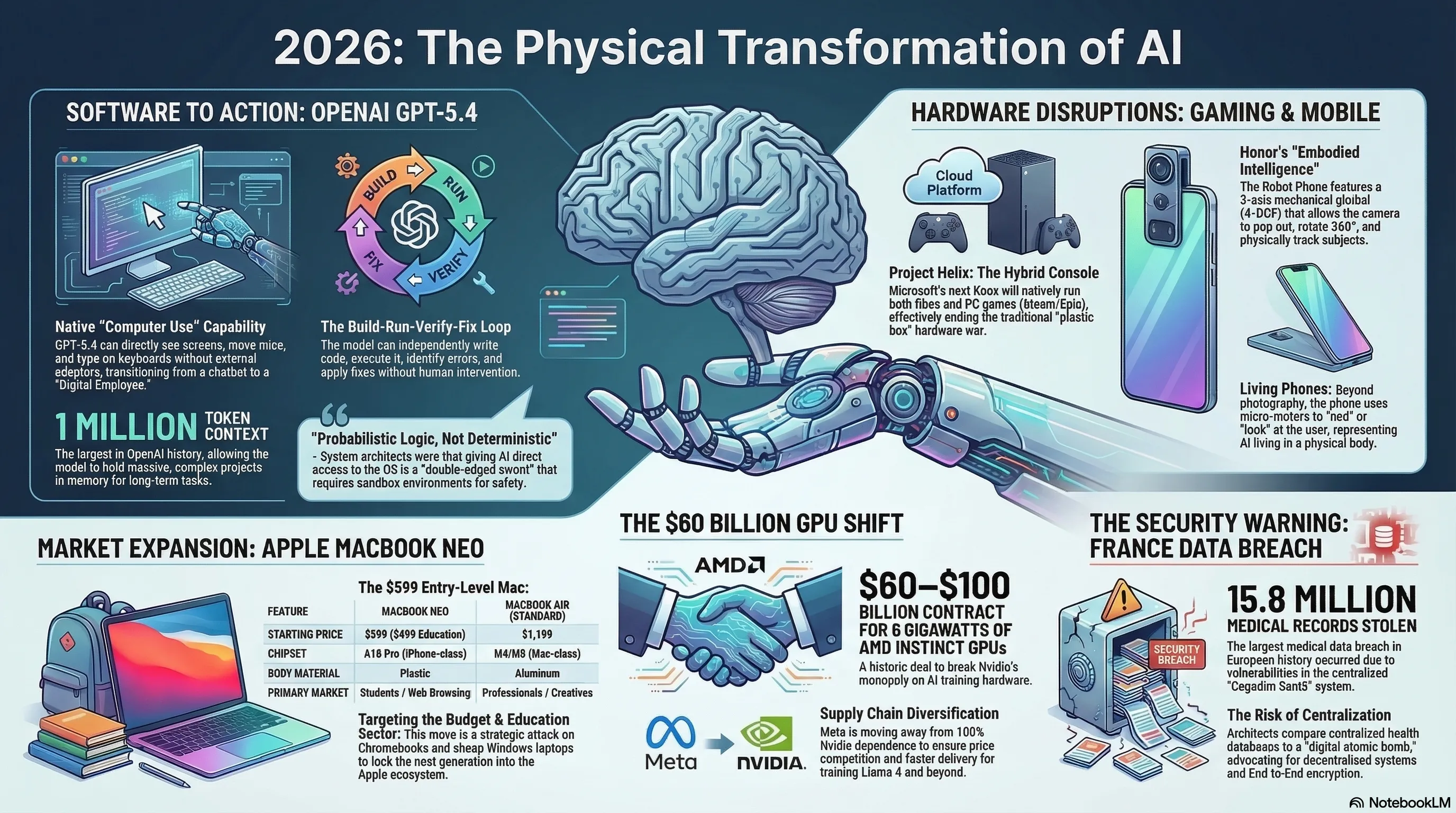
The night of March 6, 2026, was a night when more red lines in technology history were crossed. In the past 24 hours, we witnessed what can be called the "physical transformation of artificial intelligence" — the moment AI stepped out of the screen and entered the real world. OpenAI with GPT-5.4 gave artificial intelligence permission to directly control your computer. This is the first OpenAI production model with native Computer Use capability — meaning it can see the screen, move the mouse, type on the keyboard, and run software. With a 1 million token context window and advanced Tool Search system, GPT-5.4 is a big step toward Digital Employees. But this power comes with great risks: when an AI has direct access to the operating system, a simple Hallucination can turn into disaster. Microsoft with the announcement of Project Helix showed that the era of physical consoles is ending. This next generation Xbox can natively run both Xbox and PC games — the first true Hybrid console in history. Asha Sharma, the new CEO of Microsoft Gaming, with this move shows that Microsoft no longer wants to compete with PlayStation in selling plastic boxes; rather, it wants to turn Xbox into a software platform that works on any device. Game Pass is the core of this strategy. Honor at MWC 2026 Barcelona dropped a technology bomb: Robot Phone — the world's first smartphone whose camera can mechanically move. With a 3-axis mechanical gimbal and 4 degrees of freedom, this phone can extend the camera, rotate it, and track subjects. Honor calls this technology Embodied Intelligence — artificial intelligence living in a physical body. At the same time, Honor introduced a humanoid robot that danced and moonwalked on stage. This shows that the future of smartphones is in Embodied AI, not just bigger screens. But amid all this excitement, a cyber disaster occurred in France. Hackers managed to steal 15.8 million medical records from Cegedim Santé software — the largest medical data breach in European history. 165,000 files included doctors' personal notes about sensitive diseases like HIV/AIDS, sexual orientation, and mental illnesses. This disaster is a serious warning: centralized systems are dangerous. When all medical data of a country is collected in one central system, one vulnerability can destroy everything. AMD and Meta signed a contract to deploy 6 gigawatts of AMD Instinct GPUs — a contract worth $60 to $100 billion over the next 5 years. This is the largest single non-Nvidia procurement deal in AI era history. With this move, Meta shows it no longer wants to be 100% dependent on Nvidia. The first shipment of 1 gigawatt will be delivered in the second half of 2026 with custom MI450 architecture. This deal is a clear message to Nvidia: your era of monopoly is over. Apple with MacBook Neo — the cheapest MacBook ever at $599 — attacked the budget laptop market. But the interesting part is: this laptop runs on the A18 Pro chip (the same chip as iPhone 16 Pro), not M-series chip. This is the first time Apple has used an iPhone-class chip in a Mac. The goal? Attracting students and regular users to the Apple ecosystem. This is a direct attack on Chromebooks and cheap Windows laptops. What's the common thread of all these news? We're transitioning from the era of "pure software" to the era of "physical artificial intelligence." AI is no longer just in servers; it now lives in our phones, our laptops, and even our gaming consoles. Boundaries between platforms are blurring. Monopolies are breaking. And security is still a big problem. The main question is: Are we ready for this transformation? Are our security infrastructures sufficient? Are our laws keeping pace with this speed of progress? The France disaster shows that the answer is "no." We must move toward decentralized systems and End-to-End encryption. We must take security as seriously as innovation. The future belongs to those who can combine AI with security. Those who can innovate without sacrificing user privacy. Those who can combine power with responsibility. Technology is a tool — it can be used for good or for evil. The choice is ours.
Tekken Night March 6, 2026: The Night Computers Came Alive — When AI Put Its Hands on the Keyboard
Good evening, Tekken Legion. Tonight, March 6, 2026, marks another moment when red lines in technology history were crossed. In the past 24 hours, OpenAI gave AI permission to directly control your computer, Microsoft announced that Xbox is no longer a plastic box but a cloud platform, and France faced the largest medical data breach in European history. Meanwhile, Honor built a phone that can move, AMD and Meta signed a $60 billion deal, and Apple released the cheapest MacBook ever with an iPhone chip.
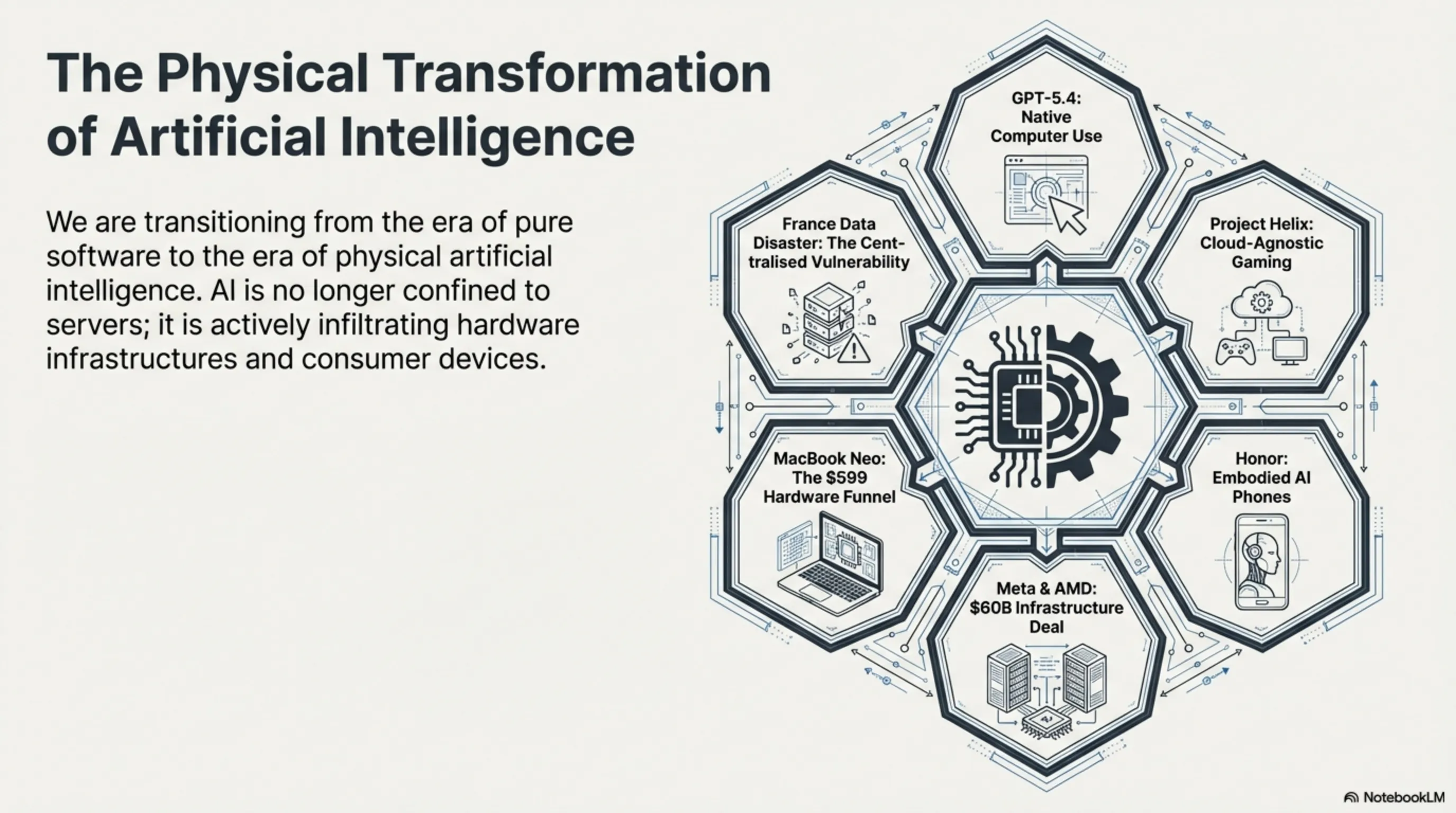
Tonight we're witnessing what I call the "physical transformation of artificial intelligence." AI is no longer just in chatboxes and image generation; it's now putting its hands on the mouse and keyboard, entering smartphone bodies, and infiltrating the hardware infrastructure of tech giants. Brew your strong coffee, because tonight we're diving deep into the heart of this revolution.
1. GPT-5.4 and the Computer Use Era: When OpenAI Lets AI Control Your Computer 🖱️⌨️
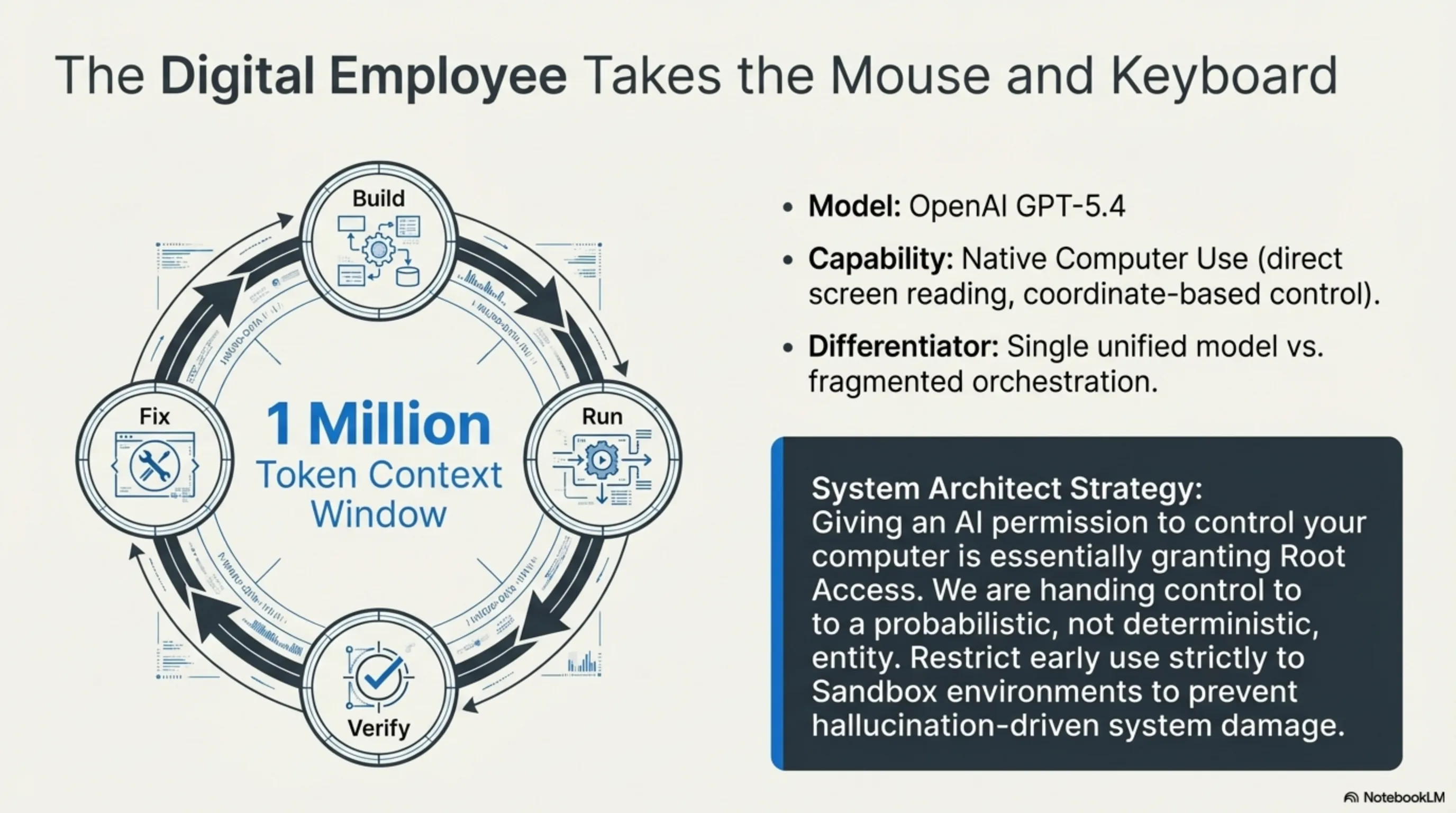
This morning, OpenAI dropped its bomb: GPT-5.4 — the first OpenAI production model with native Computer Use capability. What does this mean? It means this model can directly see your computer screen, move the mouse, type on the keyboard, and run software — without needing any adapter or external tools.
The Computer Use Revolution: From Chatbot to Digital Employee
Before GPT-5.4, if you wanted an AI to help you with computer tasks, you had to use separate tools like Claude Computer Use or Perplexity Computer. But OpenAI has now embedded this capability directly into its core model. This means GPT-5.4 can:
- Read screenshots: The model sees your screen and identifies UI elements — buttons, menus, input fields, everything.
- Control mouse and keyboard: Using coordinate-based actions, GPT-5.4 can click buttons, type text, and switch between windows.
- Build-Run-Verify-Fix Loop: The model can write a program, run it, see errors, and fix them itself — all without human intervention.
- 1 Million Token Context Window: This is the largest context window in OpenAI history. GPT-5.4 can keep massive projects in memory and work on them.
- Tool Search System: When working with large tool ecosystems, GPT-5.4 can intelligently find the right tool without cluttering the context.
Comparison with Competitors: Perplexity Computer and Claude
A few weeks ago, in our article The Digital Employee War, we saw how Perplexity built an orchestration system with 19 different models. Claude also had Computer Use but as a separate tool. Now OpenAI with GPT-5.4 shows it can combine all these capabilities into a single model.

But the question is: Can a single model work better than 19 specialized models? OpenAI says yes, because GPT-5.4 was designed for Computer Use from the ground up, not added later.
System Architect Analysis: The Dangers of Computer Use
As a system architect, I must say that Computer Use is a double-edged sword. When you give an AI permission to control your computer, you're essentially giving Root Access. If the model hallucinates or receives a wrong command, it can delete your files, send wrong emails, or even break system settings.
OpenAI says GPT-5.4 is designed with advanced safety systems, but history has shown us that no system is perfect. Remember how OpenClaw caused disaster in November 2025? Exactly.
"When a large language model gets direct access to the operating system, we're no longer talking to a chatbot; we're handing over control to a digital entity whose logic is probabilistic, not deterministic."
System Architect Strategy: GPT-5.4 is a big step toward Digital Employees, but we're still in the early stages. Until safety systems become more complete, I recommend using Computer Use only in Sandbox environments.
2. Microsoft Project Helix: The Next Xbox That Runs PC Games Too — The End of Physical Consoles 🎮☁️
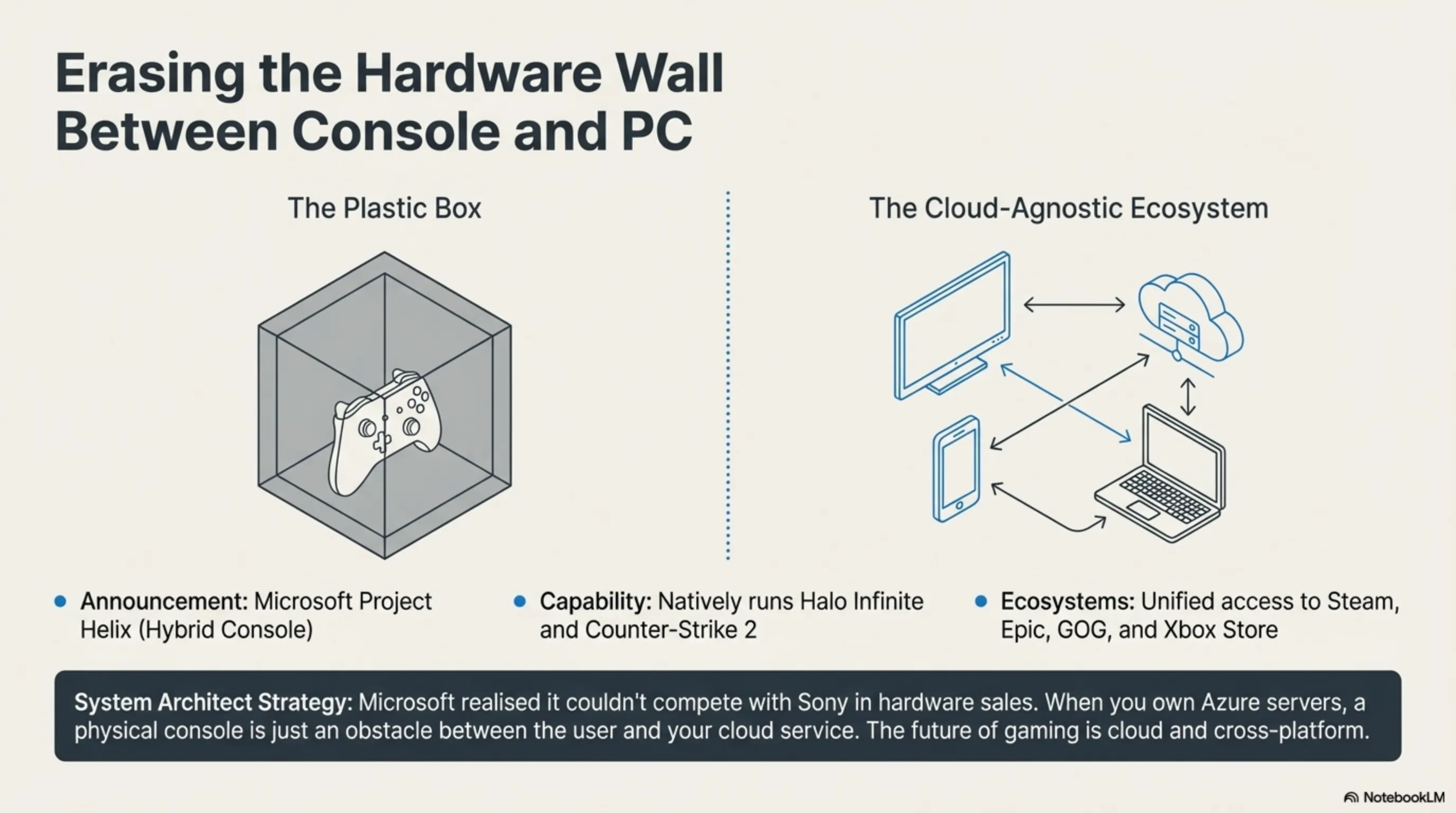
In a historic announcement, Asha Sharma, the new CEO of Microsoft Gaming, officially confirmed Project Helix — the next generation Xbox that can natively run both Xbox and PC games. This is the first true Hybrid console in history.
Why Is This Important? The End of the Wall Between Console and PC
Until now, if you wanted to play PC games, you had to buy a gaming PC. If you wanted to play Xbox games, you had to buy an Xbox console. But Project Helix breaks down this wall. This means:
- One Device, Two Ecosystems: You can play Halo Infinite (Xbox exclusive) and Counter-Strike 2 (PC exclusive) on one device.
- Access to Steam, Epic, GOG: Project Helix will likely let you install PC stores too, not just Xbox Store.
- Most Powerful Xbox Ever: Asha Sharma said Project Helix will be "the most powerful Xbox console." This likely means it comes with RTX 50 series or RDNA 4 GPUs.
- Official Reveal at GDC 2026: More details will be announced at Game Developers Conference (March 9-13).
Strategic Analysis: Why Is Microsoft Doing This?
The answer is simple: Microsoft has lost the hardware war with PlayStation. PS5 has better sales, better exclusives, and a stronger brand. So Microsoft decided to change the playing field.
Instead of competing in selling plastic boxes, Microsoft wants to turn Xbox into a software platform that works on any device — smart TV, mobile, tablet, and even PlayStation (if Sony allows). Game Pass is the core of this strategy.
Comparison with PlayStation: Two Completely Different Strategies
While Microsoft moves toward Openness, PlayStation is returning to Exclusivity. Sony no longer quickly releases its games on PC and wants to force users to buy PS5.
Which strategy wins? Time will tell. But one thing is clear: the era of traditional physical consoles is ending.
"Microsoft realized it couldn't compete with Sony in hardware sales; so it decided to change the playing field forever. When you own Azure servers, a physical console is just an obstacle between the user and your cloud service."
System Architect Strategy: Project Helix shows that the future of gaming is in Cloud and Cross-Platform, not in plastic boxes.
3. Honor Robot Phone: The First Phone with Mechanical Gimbal — When Your Phone Comes Alive 🤖📱
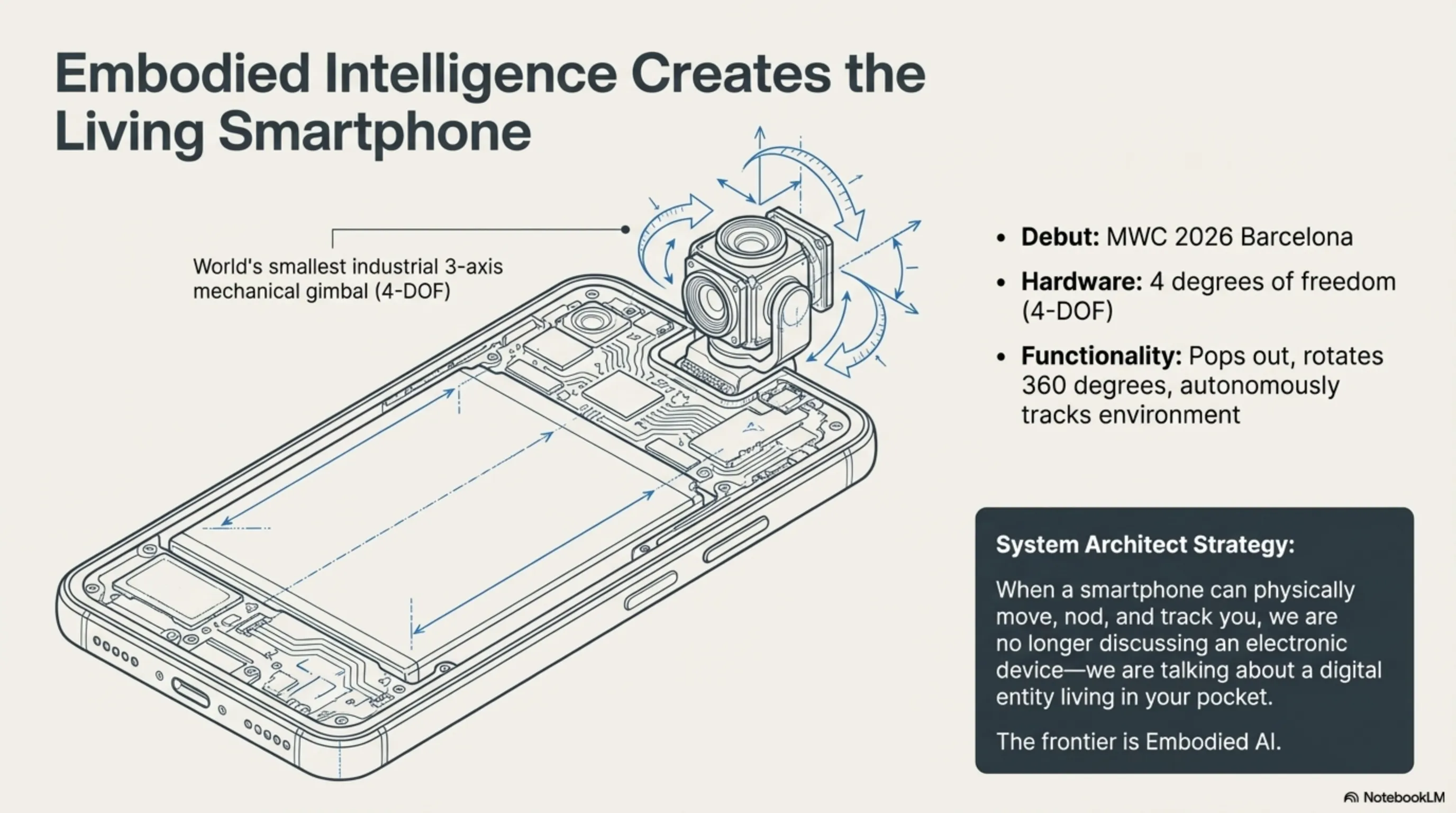
At MWC 2026 Barcelona, Honor dropped a technology bomb: Robot Phone — the world's first smartphone whose camera can mechanically move, rotate, and track the environment. This is no longer just a phone; it's a miniature robot living in your pocket.
Mechanical Gimbal Technology: How Does It Work?
Honor has embedded a 3-axis mechanical gimbal with 4 degrees of freedom (4-DOF) inside the phone. This is the smallest industrial gimbal system in the world. When you activate the camera:
- Camera pops out: Like a small robot, the camera module extends from the phone body.
- Rotates and moves: The camera can rotate 360 degrees, move up and down, and track subjects.
- Unmatched image stabilization: Using micro motors, Robot Phone delivers video stability better than any other phone.
- Physical movements: The phone can nod (to confirm or deny), look at you, and even interact with you!
Embodied Intelligence: AI with a Body
Honor calls this technology Embodied Intelligence — artificial intelligence living in a physical body. This means your phone is no longer just a display; it's a digital entity that can interact with the physical world.
For example, if you want to take a selfie video, Robot Phone can track you itself, find the optimal angle, and even if you move, the camera follows you. Or if you want to rate your clothes, the phone can see you from different angles and give feedback.
Honor Humanoid Robot: Dance Performance at MWC
But Honor didn't stop at Robot Phone. They also introduced a humanoid robot that danced and moonwalked on the MWC stage! This robot shows that Honor is serious about Embodied AI and wants to go from smartphones to home robots.
System Architect Analysis: The Future of Living Phones
Robot Phone is a turning point. Until now, smartphones were just a display with a processor. But now we're entering the era of living phones — devices that can move, see the environment, and interact with the physical world.
This is just the beginning. Imagine a phone that can walk on a table, follow you, and even act as a small robot assistant. This is no longer science fiction; this is 2026 reality.
"When a smartphone can move, we're no longer talking about an electronic device; we're talking about a digital entity living in your pocket."
System Architect Strategy: Robot Phone shows that the future of smartphones is in Embodied AI, not just bigger screens and better cameras.
Release Date: Second half of 2026 (initially China only)
4. France Disaster: 15.8 Million Medical Records Stolen — Europe's Largest Medical Data Breach 🏥💔
While we're excited about new technologies, a cyber disaster has occurred in France. Hackers managed to steal 15.8 million medical records from Cegedim Santé software (French Health Ministry supplier). This is the largest medical data breach in European history.
What Information Was Stolen?
- 15.8 million administrative files: Names, addresses, social security numbers, medical history
- 165,000 sensitive files: Including doctors' personal notes about sensitive diseases like HIV/AIDS, sexual orientation, and mental illnesses
- High-profile victims: Politicians, government officials, and public figures
- Target software: MonLogicielMedical (MLM) used by 3,800 doctors
Why Did This Disaster Happen?
The main problem is centralized systems. The French Health Ministry decided to store all medical data in one central system for easier access. But this means if one vulnerability is found, everything is at risk.
This is exactly what we saw in the Predatorgate article: when sensitive data is collected in one central point, hackers have only one target.
Impact on Victims: Human Tragedy
Imagine your doctor's personal notes about your mental illnesses, sexual orientation, or HIV status in hackers' hands. This information can be used for:
- Extortion: Hackers can demand money from victims not to publish the information
- Discrimination: Employers, insurance companies, or even families can use this information against you
- Suicide: Some victims may commit suicide out of fear of exposing their sensitive information
System Architect Analysis: Why Centralized Systems Are Dangerous
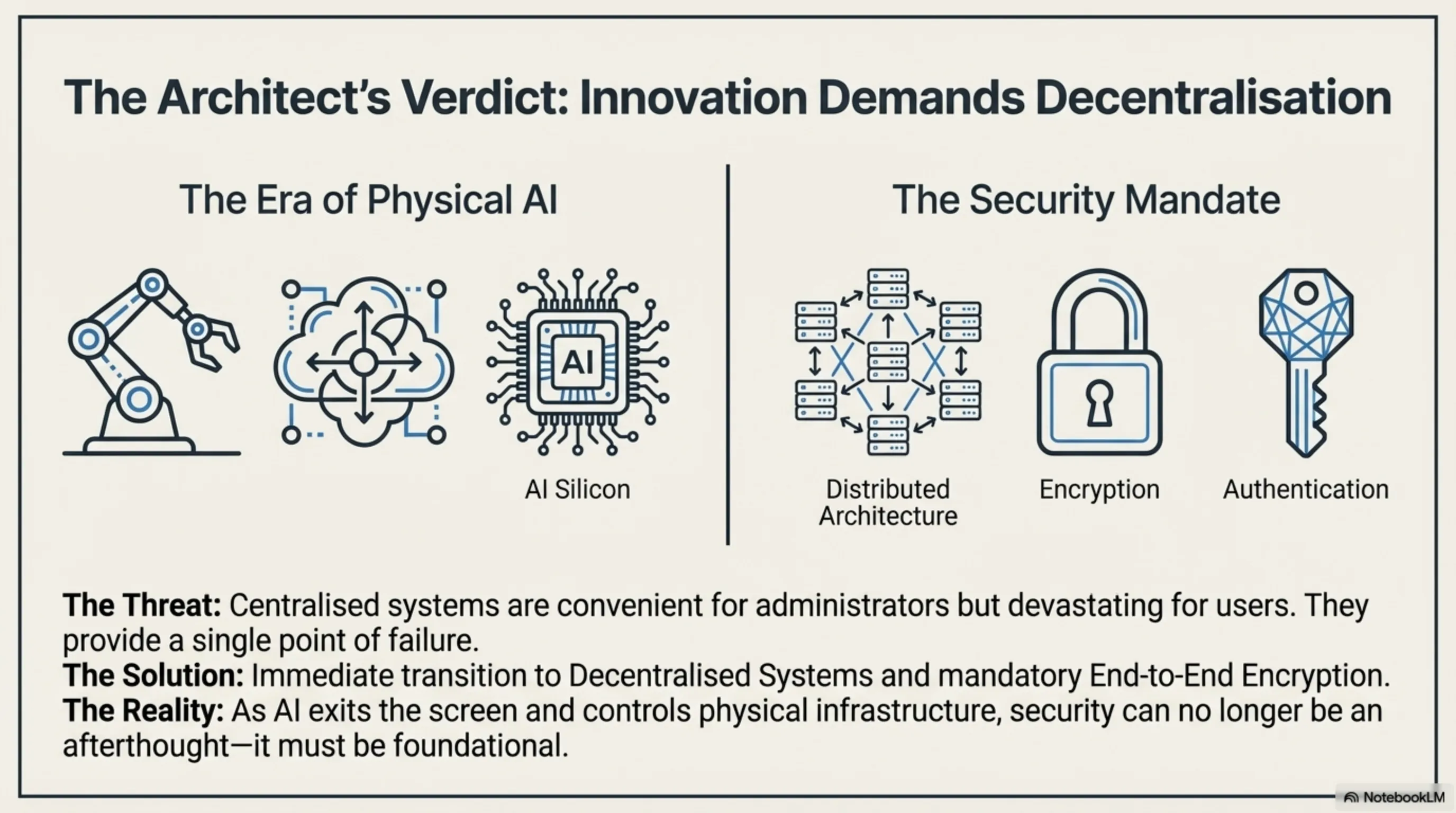
As a system architect, I always say: Never put all your eggs in one basket. Centralized systems are convenient, but dangerous. If one vulnerability is found, everything is lost.
What's the solution? Decentralized Systems. Instead of having all data on one server, store it on multiple different servers. Even better, use End-to-End Encryption so even if hackers steal the data, they can't read it.
"When you collect all medical data of a country in one central system, you're building a digital atomic bomb waiting to explode."
System Architect Strategy: This disaster is a warning for all countries. Centralized systems are convenient, but dangerous. We must move toward decentralized systems and End-to-End encryption.
Link to previous articles: This disaster is reminiscent of Predatorgate, where we saw how spyware tools can destroy people's lives.
5. AMD and Meta: $60 Billion Deal — Breaking Nvidia's Monopoly in AI Hardware 💰🔥
In one of the biggest deals in technology history, AMD and Meta signed a contract to deploy 6 gigawatts of AMD Instinct GPUs. The value of this contract is estimated between $60 to $100 billion over the next 5 years. This is the largest single non-Nvidia procurement deal in AI era history.
Why Is This Deal Important?
Until now, Nvidia had almost complete monopoly of the AI GPU market. If you wanted to train a large language model, you had to buy Nvidia GPUs. But now Meta has decided to also trust AMD. This means:
- Supply chain diversification: Meta no longer wants to be 100% dependent on Nvidia. If Nvidia raises prices or delays delivery, Meta has another option.
- Price pressure on Nvidia: With AMD entering the market, Nvidia must keep its prices competitive.
- More innovation: Competition between AMD and Nvidia means faster innovation and better products.
Technical Details: What Is Meta Buying?
- 6 gigawatt capacity: This is equivalent to the electricity consumption of 6 million homes! Meta is building an army of GPUs.
- First shipment: 1 gigawatt in second half of 2026 with custom MI450 architecture
- Multiple generations: The contract includes several generations of AMD GPUs, not just one
- Stock warrant: AMD gives Meta up to 160 million shares (conditional on delivery and stock price)
- Close collaboration: AMD and Meta work together on silicon, systems, and software
Comparison with Nvidia: The GPU War
Nvidia is still the market leader. Its H100 and H200 GPUs are still the most powerful AI GPUs in the world. But AMD is progressing fast. MI300 and MI450 can compete with Nvidia in some workloads, and their price is usually lower.
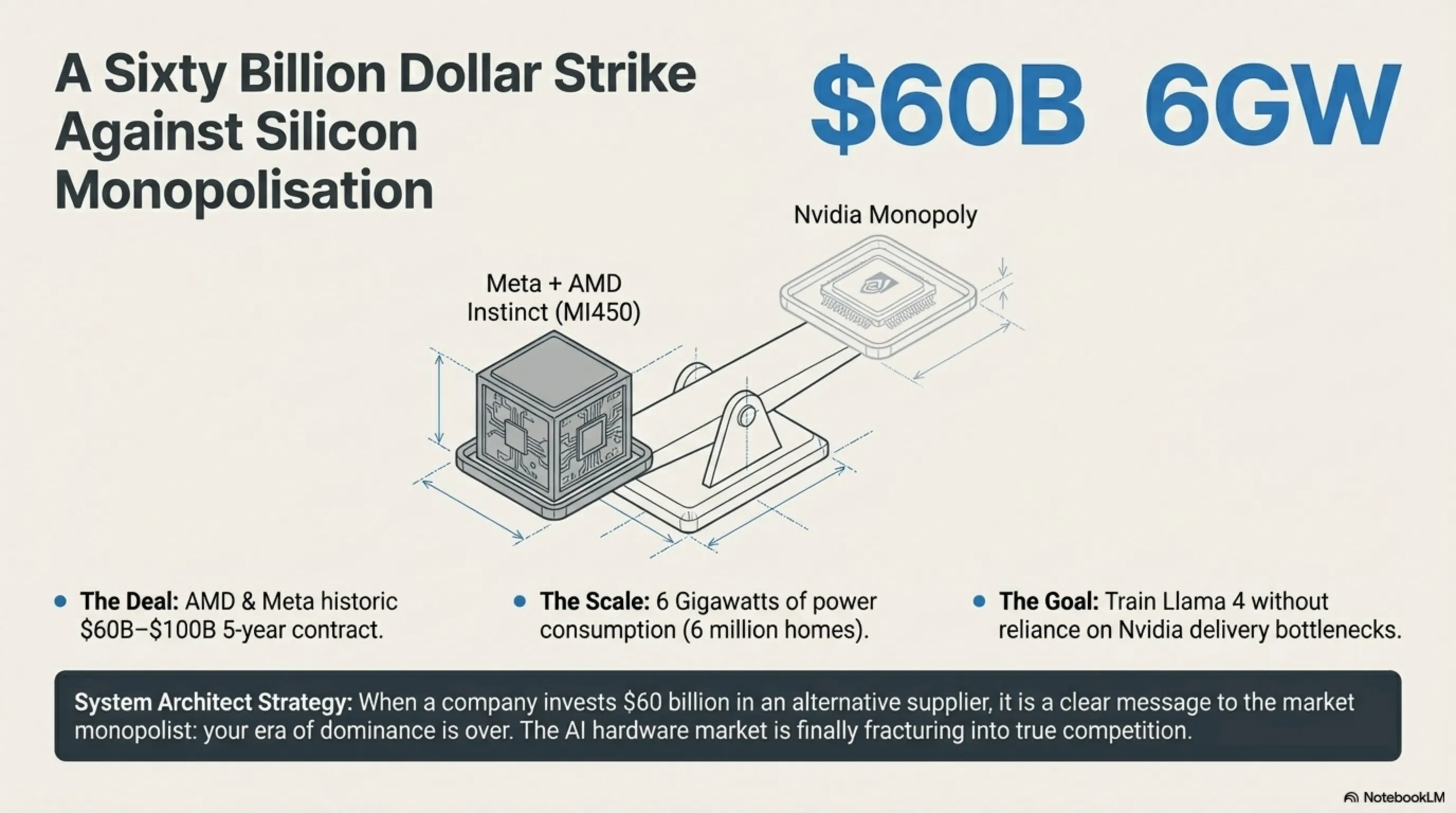
With this deal, Meta is telling Nvidia: "We're no longer dependent on you." This is a powerful message.
System Architect Analysis: Why Is Meta Doing This?
Meta is building Llama 4 and next generations of its language models. To train these models, it needs thousands of GPUs. But if it only buys from Nvidia, it has two problems:
- High price: Nvidia knows Meta has no choice, so it raises prices
- Late delivery: Nvidia sells its GPUs to the highest bidder, so Meta might wait months
By buying from AMD, Meta solves these problems. Now Nvidia must compete to keep Meta.
"When a company invests $60 billion in an alternative supplier, it's a clear message to the market monopolist: your era of dominance is over."
System Architect Strategy: This deal shows that the AI Hardware market is becoming competitive. Nvidia is still the leader, but AMD is catching up fast.
Link to previous articles: This deal is reminiscent of Nvidia's Hardware Rebellion, where we saw how Nvidia shifted from gaming to AI.
6. Apple MacBook Neo: $599 Laptop with iPhone Chip — Attack on Budget Market 💻🍎
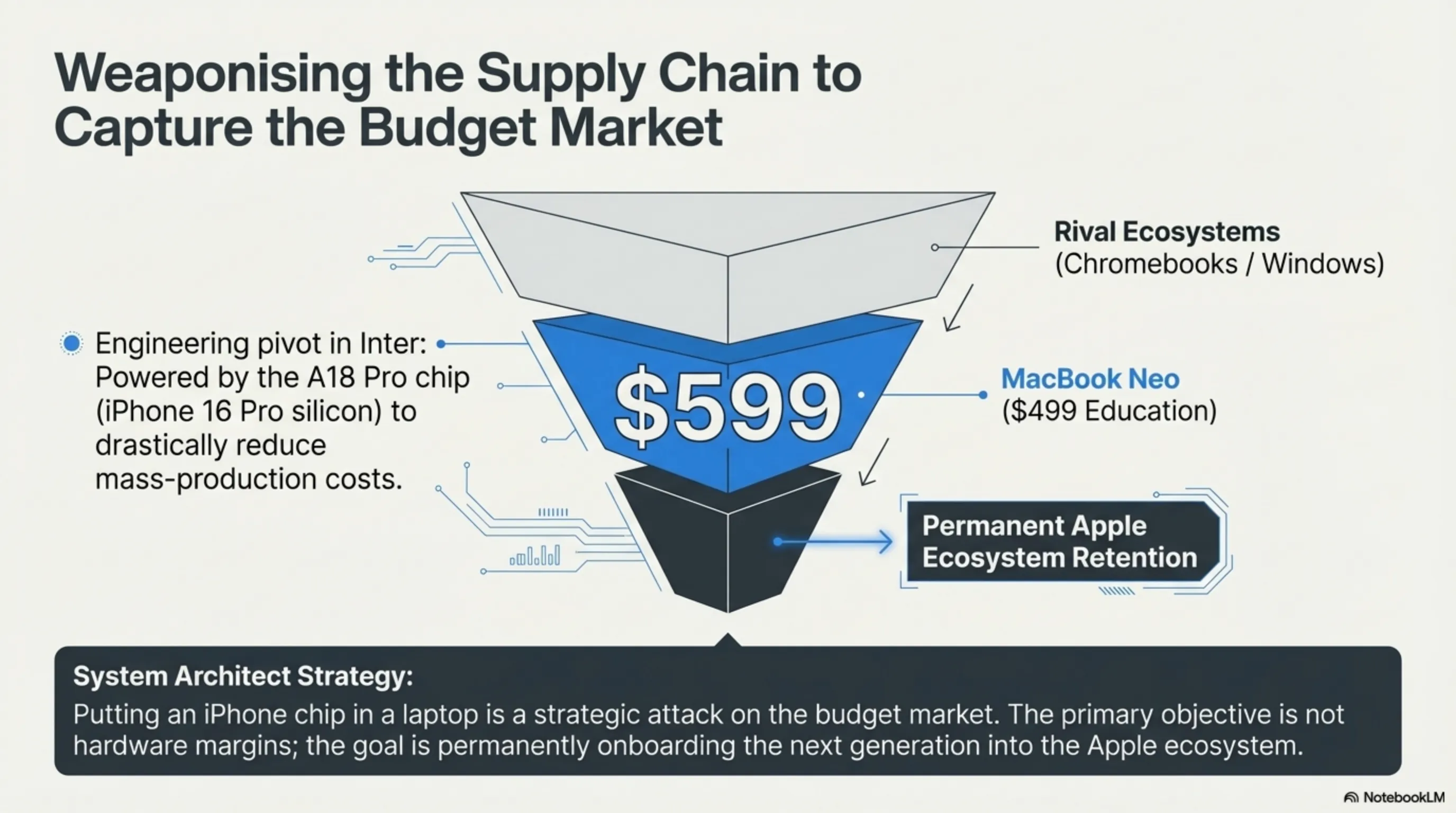
In an unexpected move, Apple introduced MacBook Neo — the cheapest MacBook ever at $599 (education: $499). But here's the interesting part: this laptop runs on the A18 Pro chip (the same chip as iPhone 16 Pro), not M-series chip!
Why Did Apple Put iPhone Chip in MacBook?
This is the first time Apple has used an iPhone-class chip in a Mac. The reason? Cost reduction. M-series chips (M4, M5) are very expensive. But A18 Pro, designed for iPhone, is cheaper because it has mass production.
But is A18 Pro enough for a laptop? Apple says yes:
- 6-core CPU: 2 Performance cores + 4 Efficiency cores
- 5-core GPU: With hardware Ray Tracing
- 16-core Neural Engine: For Apple Intelligence
- 50% faster than similar Intel laptops: Apple claims MacBook Neo is faster than Windows laptops at similar price
Who Should Buy MacBook Neo?
MacBook Neo is designed for those who:
- Students: Need a cheap laptop for typing, research, and simple tasks
- Regular users: Just want to browse the web, read email, and watch videos
- Those with limited budget: Want to enter the Mac ecosystem but don't have money for MacBook Air ($1,199)
But if you're a programmer, video editor, or do heavy work, MacBook Neo is not for you. You should buy MacBook Air or Pro.
MacBook Neo Limitations
To reach the $599 price, Apple had to sacrifice a few things:
- Less RAM: Probably 8GB (while MacBook Air has 16GB)
- Fewer ports: Only 2 USB-C ports (no MagSafe)
- Simpler display: LCD instead of Mini-LED
- Plastic body: Instead of aluminum
- No Touch ID: In base model
Strategic Analysis: Why Is Apple Doing This?
Apple wants to conquer the budget laptop market. Until now, if you had a limited budget, you had to buy a Chromebook or cheap Windows laptop. But now Apple says: "You can have a real Mac for $599."
This is a direct attack on:
- Chromebooks: Usually $300-$500
- Cheap Windows laptops: From Dell, HP, Lenovo
- Education market: Schools and universities with limited budgets
If Apple can attract students with MacBook Neo, they'll stay in the Apple ecosystem forever. This is a long-term investment.
"When Apple makes a $599 laptop with iPhone chip, it's a strategic attack on the budget market. The goal isn't selling laptops; the goal is attracting the next generation to the Apple ecosystem."
System Architect Strategy: MacBook Neo shows that Apple wants to conquer every market segment — from $599 laptops to $7,000 Mac Pros.
The Verdict | System Architect Strategic Summary (Tekken)
Legion, tonight we witnessed what I call the "physical transformation of artificial intelligence." GPT-5.4 allowed AI to put its hands on the keyboard. Honor Robot Phone allowed phones to move. AMD and Meta showed that Nvidia's monopoly is broken. And the France disaster reminded us that with all these advances, security is still a big problem.
We're transitioning from the era of "pure software" to the era of "physical artificial intelligence." AI is no longer just in servers; it now lives in our phones, our laptops, and even our gaming consoles. Project Helix shows that boundaries between platforms are blurring. MacBook Neo shows that Apple wants to conquer every market segment.
But meanwhile, the France disaster is a serious warning: with all these advances, we must not forget security and privacy. Centralized systems are dangerous. We must move toward decentralized systems and End-to-End encryption.
2026 is the year AI comes out of the screen and enters the physical world. The question is: Are we ready for this transformation? Are our security infrastructures sufficient? Are our laws keeping pace with this speed of progress?
The answers to these questions are not clear. But one thing is clear: the future belongs to those who can combine AI with security. Those who can innovate without sacrificing user privacy. Those who can combine power with responsibility.
We end tonight with this thought: Technology is a tool. It can be used for good or for evil. The choice is ours.
Tekin Night Image Gallery