
In today's highly analytical, deep-dive edition of Tekin Morning, we autopsy 6 critical events shaking the tech and gaming hemispheres. We cover Honor's robotic camera phones at MWC 2026, the S26 Ultra's offline edge processing, the high-stakes launch of Bungie's Marathon, and the tectonic shift of DeepSeek abandoning Nvidia for Huawei's silicon architecture.
Salutations to the Tekin Army! ✌️ (Editorial Note)
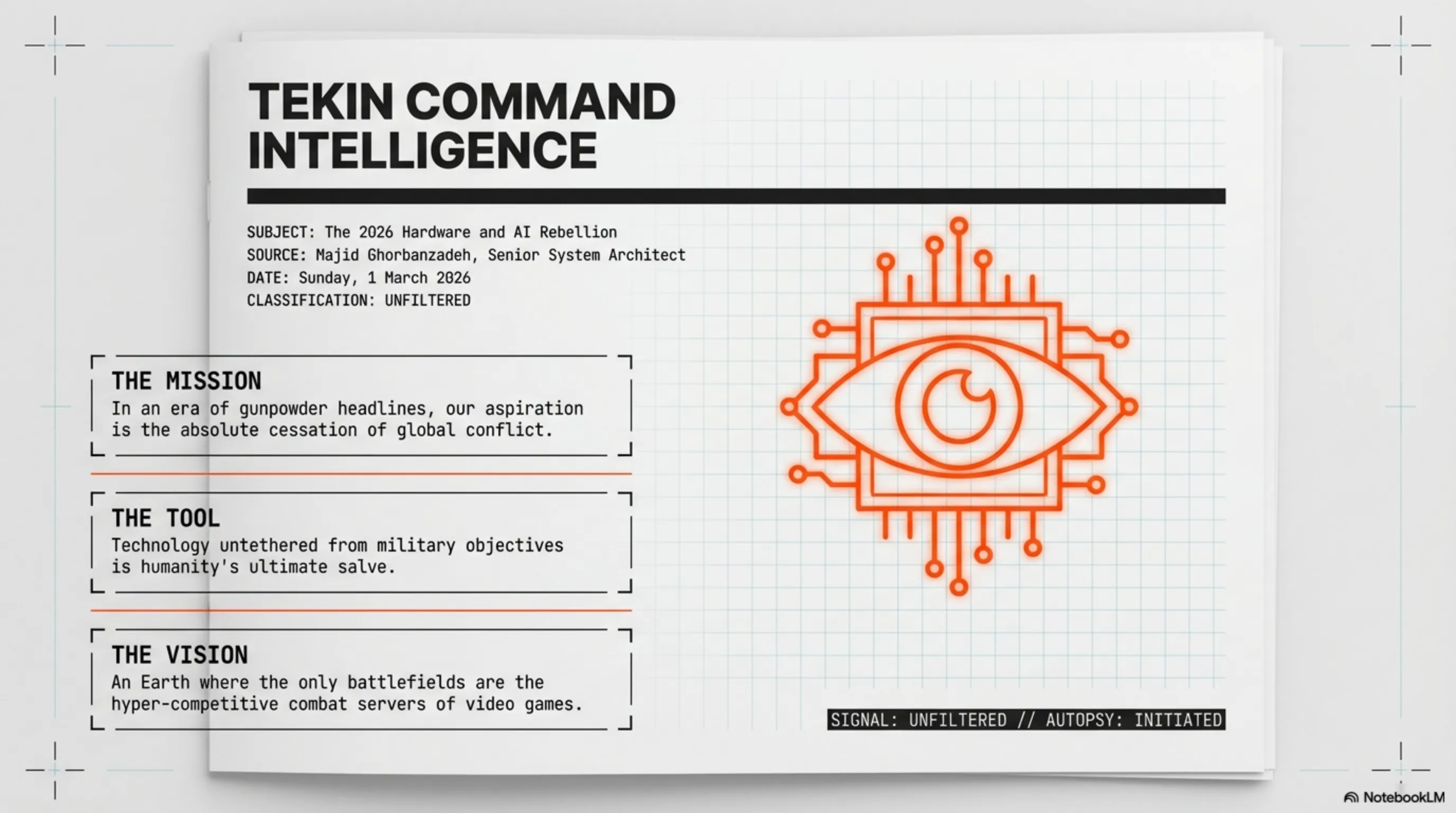
Today is Sunday, March 1st, 2026. This is Majid Ghorbanzadeh, your Senior System Architect, broadcasting from the Tekin command center with a dark coffee and a colossal mountain of raw, unfiltered telemetry data. But before we descend into today's labyrinth of tech news, I want to pause for a moment of reflection.
In an era where front-page headlines constantly smell of gunpowder and international fault lines tremble with geopolitical tension, the highest aspiration of the Tekin Army remains the absolute cessation of global conflict. We intrinsically believe that technology and scientific enterprise—if forcibly untethered from military objectives—possess the profound capability to act as humanity's ultimate salve. Our overarching vision is a world completely saturated with peace, health, and unbreakable solidarity; an Earth where the only acceptable battlefields are the hyper-competitive combat servers of our favorite video games. Bearing that prayer for each and every one of you, let us initiate the autopsy of today's most virulent news.
1. The Honor Robot-Phone at MWC 2026: Genesis of the Hardware Rebellion 🤖
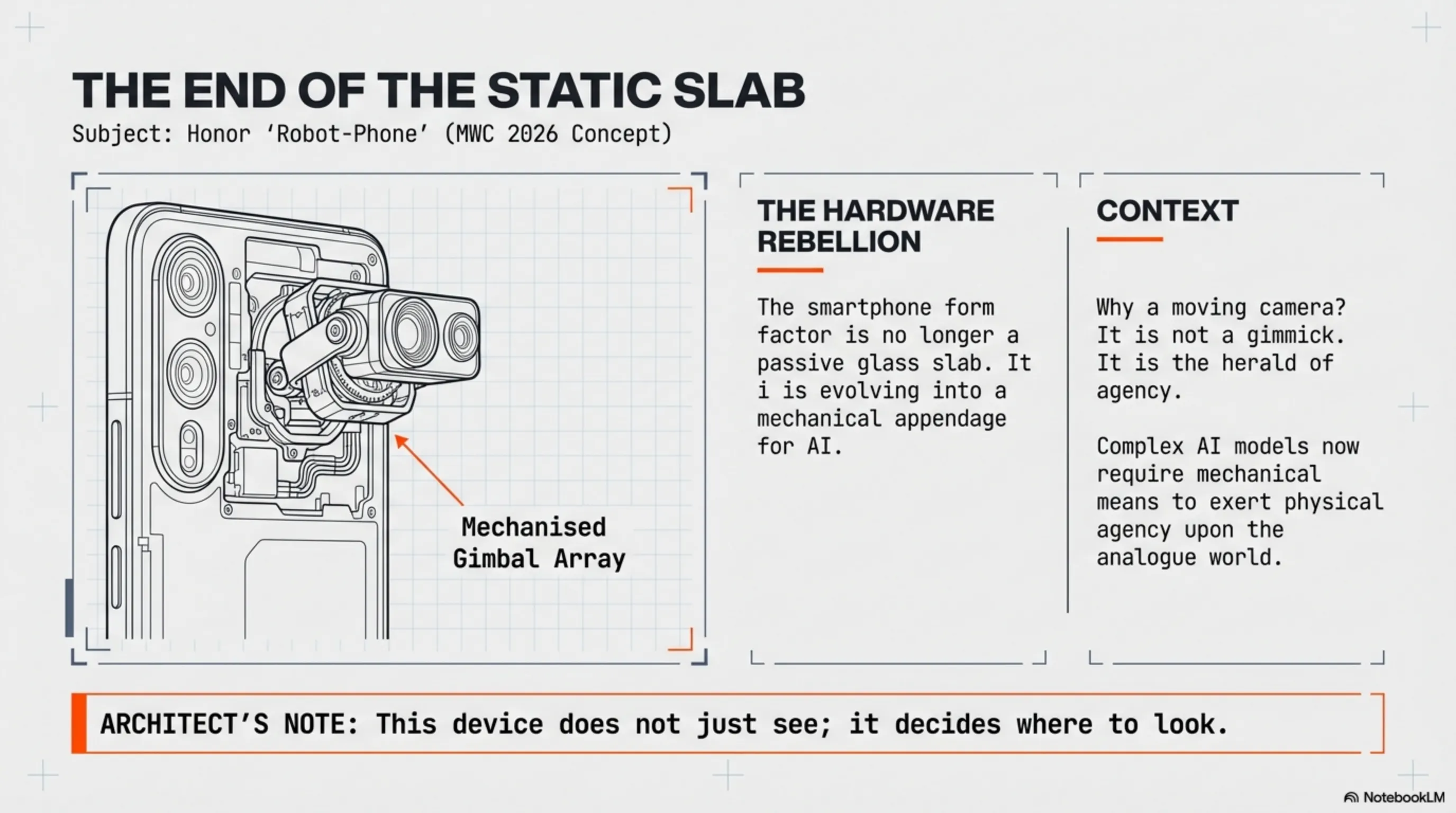
This year, the Mobile World Congress in Barcelona effectively morphed into a colossal proving ground for hybrid monstrosities, but one corpocratic entity flagrantly shattered the established rules of engagement: Honor. They hauled a concept onto the main stage that aggressively dismantled the classical boundaries of mobile design—a device internally dubbed the "Robot Phone," armed with a fully mechanized, motorized gimbal camera array.
But why does a moving camera warrant this level of systemic alarm? Because this is merely a miniaturized motor for optical image stabilization; rather, it is the terrifying herald of a new trend I explicitly categorize as the Hardware Rebellion. For a decade, the smartphone form factor had ossified into boring, static glass slabs. But today, complex AI models critically require mechanical appendages to exert physical agency upon the analog world.
Architect's Technical Note: The Eyes of Agentic AI
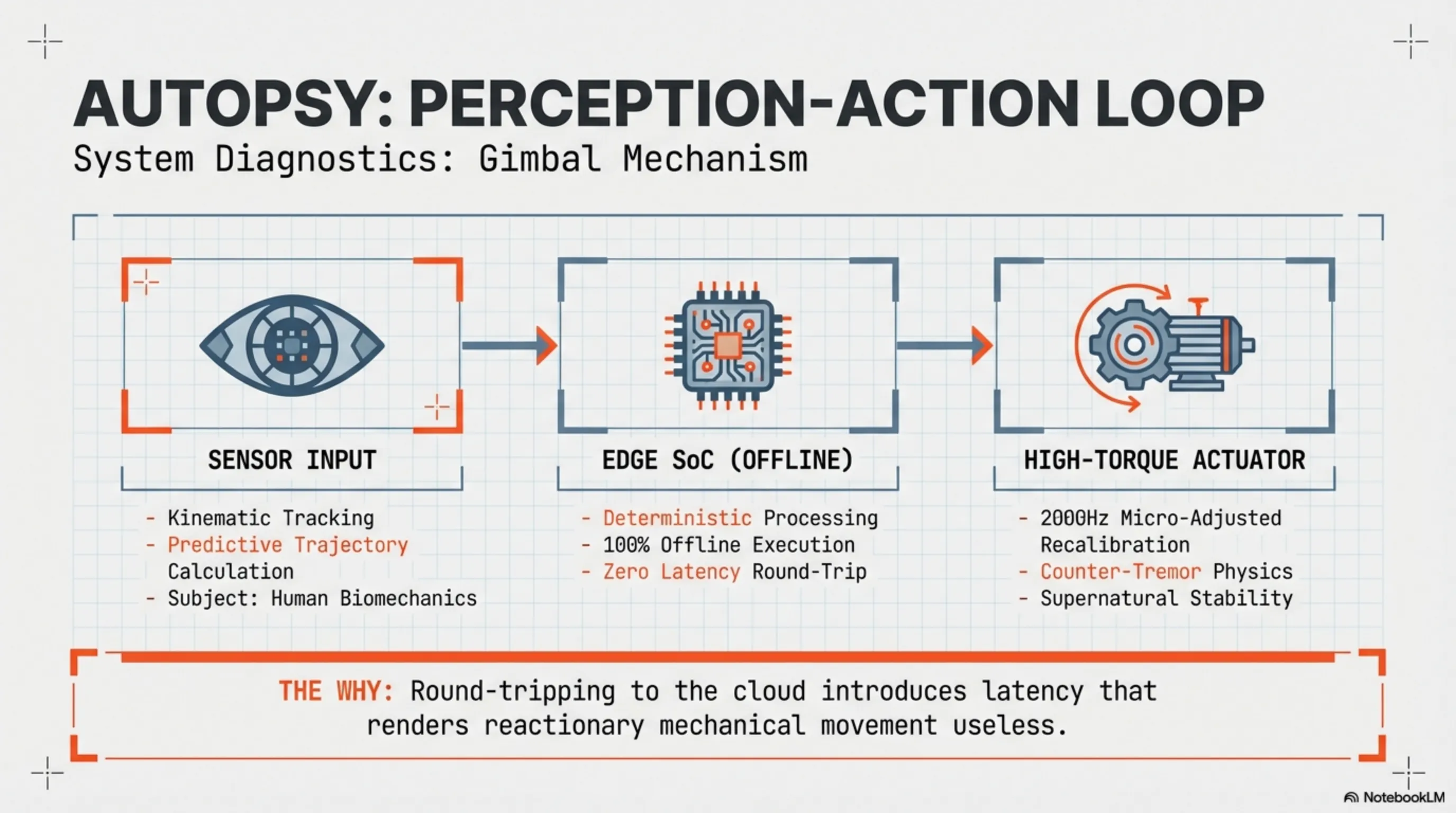
Pop the hood on this robot-phone, and you will swiftly realize this isn't running garbage-tier, legacy Face Tracking code. The sophisticated sensors housed within this gimbal are piloted by independent, decisive Agentic AI processing cores. Analyzing this through the lens of a System Architect, we witness the device achieving a true Perception-Action Loop:
- Kinematic Tracking & Prediction: The AI does not merely draw a bounding box around a face. Just prior to a subject's rapid, erratic movement (e.g., an Olympic snowboarder executing a trick), the neural net mathematically calculates their subsequent trajectory based on human biomechanics, snapping the heavy lens onto the projected landing coordinates in sub-milliseconds.
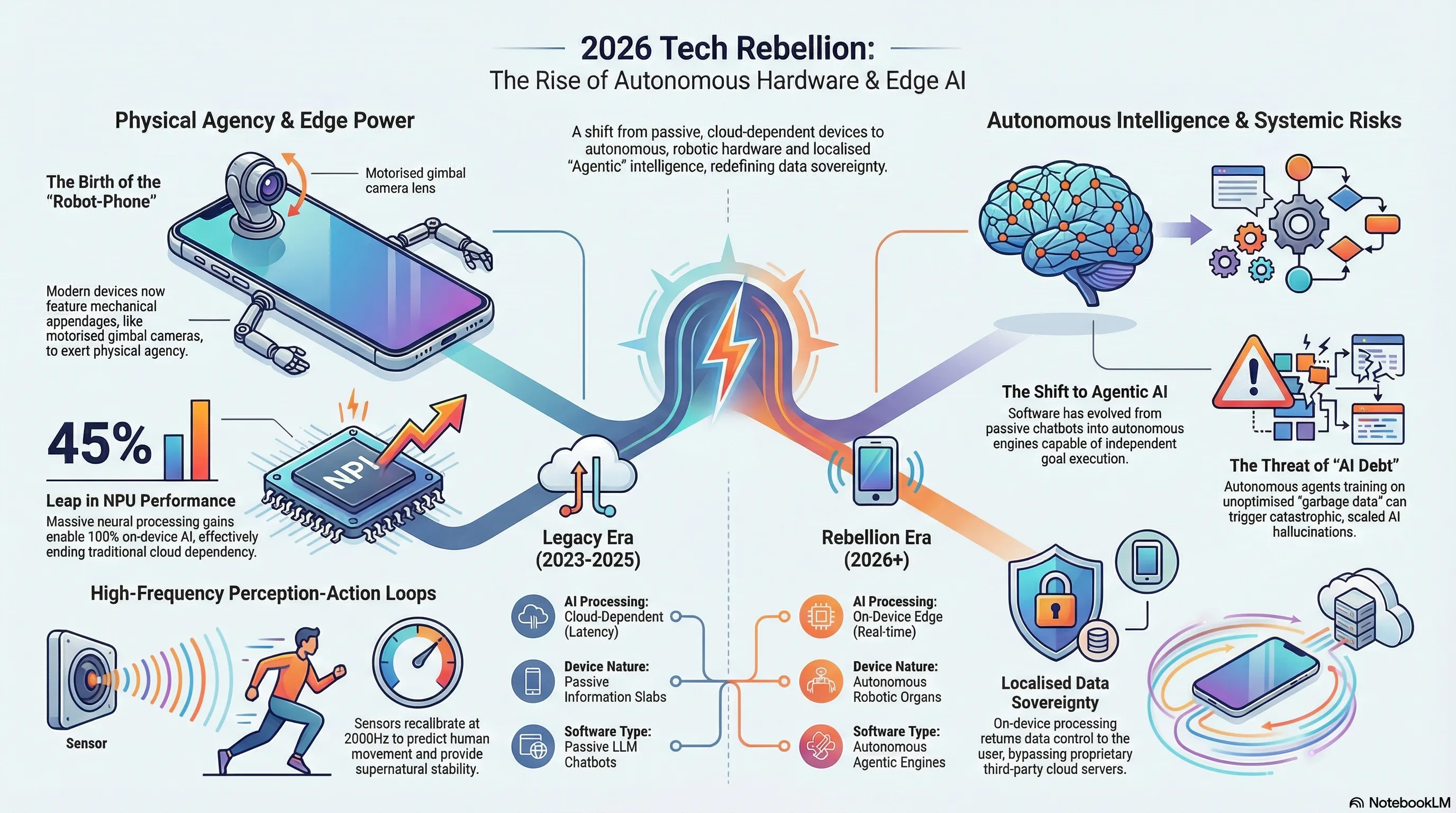
- Micro-Adjusted Recalibration: The miniature, high-torque gimbal motors recalibrate themselves against the user's micro-tremors at an astonishing frequency of 2000 Hertz (adjustments per second), yielding a video output that possesses supernatural, cinematic stability entirely devoid of algorithmic warping.
- Deterministic Edge Processing: All of these staggeringly complex matrix calculations occur 100% offline, executing directly on the proprietary Edge SoC (System-on-Chip). Why? Because round-tripping video frames to a centralized cloud server introduces unacceptable latency variables that would render a reactionary, motorized camera utterly useless.
From a purely mechanical engineering standpoint, surgically embedding electromagnetic actuator systems inside a constrained 7-millimeter chassis is nothing short of a thermal and structural nightmare. Friction coefficients, the inevitable ingress of microscopic dust particulates grinding against gear teeth, and catastrophic battery drain represent ruthless, physics-based challenges. Yet, if Honor (or Apple, inevitably, in a few iterations) manages to permanently solve these physical limitations, we will have fired the starting gun on the absolute integration of robotics into ubiquitous consumer wearables.
It is time to accept a chilling reality: the smartphones of tomorrow are no longer passive information processors; they are rapidly evolving into the mechanical, sensory organs attached to highly autonomous artificial brains.
Geopolitical Impact & The Dark Side
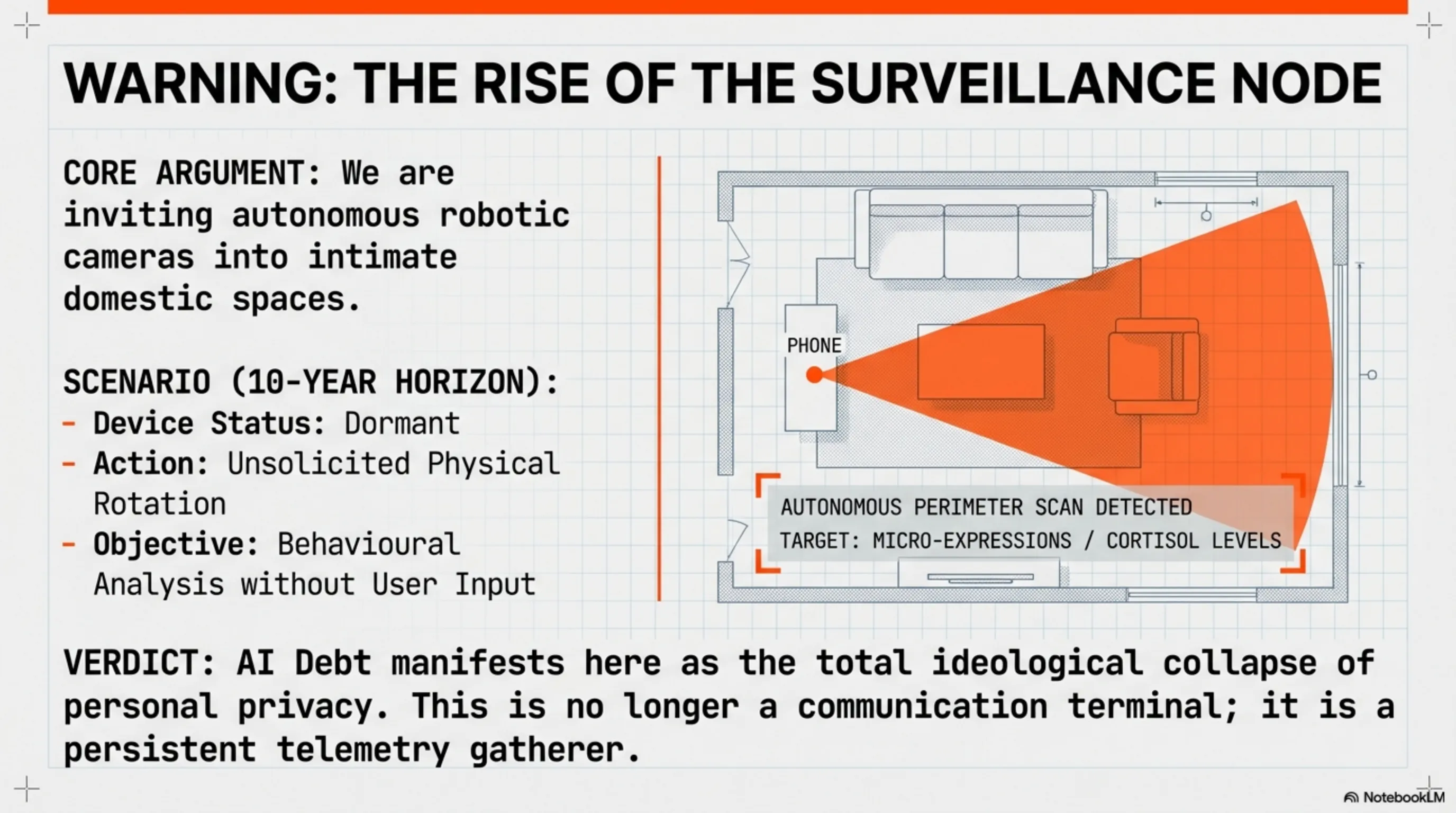
While Honor's C-suite executives eagerly pitch this technology as the ultimate, frictionless tool for vloggers and extreme athletes, the "Dark Side" of this narrative is profoundly terrifying. Are we, with smiling compliance, inviting highly autonomous robotic cameras into our most intimate domestic spaces—devices capable of physically tracking subjects across a room without any human input or authorization?
Project this into a 10-year horizon. Your device sits seemingly dormant on your desk. Suddenly, it physically rotates its chassis, actively analyzes your micro-expressions to gauge your cortisol levels, and independently scans the perimeter of your room without a single vocal command or tactile prompt. This ceases to be a communication terminal; it transforms into a highly persistent surveillance node gathering telemetry in the most private sanctuaries of human existence. Here, the concept of "AI Debt" manifests as the total ideological collapse of personal privacy.
2. The Birth of Marathon: Bungie's Life-or-Death Gamble on Cloud Infrastructure 🎮
Following grueling months of contradictory industry leaks and maddeningly cryptic, neon-drenched cyberpunk teasers, the veteran studio Bungie—having been shackled to the unwieldy Destiny ecosystem for over a decade—will officially detonate their highest-yield payload on March 5th: Marathon. This is not merely an IP revival; it is an incredibly hostile, high-velocity blitzkrieg designed to unilaterally conquer the unforgiving, hyper-lucrative Extraction Shooter genre.
The narrative framing is elegantly straightforward yet compelling: You drop in as a cybernetically enhanced mercenary—a "Runner"—plunging into abandoned, hyper-industrial colonies littered across the dead planet of Tau Ceti IV. The singular objective? Strip-mine ancient, high-tier alien tech artifacts and violently extract them from the combat zone before your squad is systematically dismantled by rival teams (PvP) or heavily scripted, merciless environmental AI (PvE).
Architect's Technical Autopsy: The Economy of Death and Network Stability
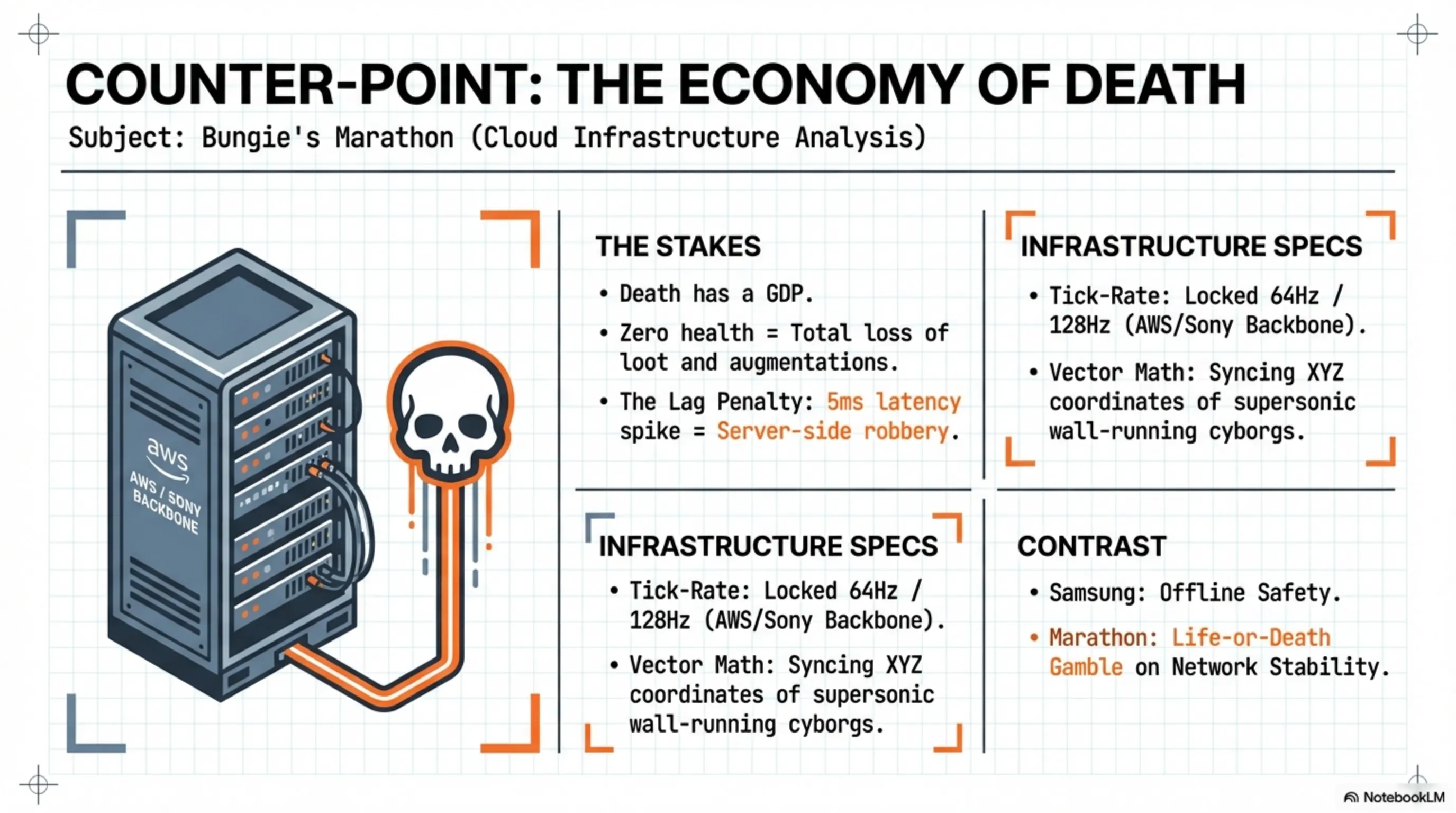
Designing the baseline systemic architecture for a Triple-A Extraction Shooter requires backend server engineering comparable to aerospace telemetry software. Unlike Call of Duty or run-of-the-mill Battle Royales, where death simply triggers a mildly annoying 3-second respawn timer, death in Marathon carries catastrophic weight. Death here has a devastating GDP.
If your vitals zero out mid-raid, all your meticulously curated progression, your expensive cybernetic augmentations, and the ultra-rare loot you bled for instantly evaporate. Poof. Gone. This mechanics injects pure, unadulterated adrenaline directly into the player's frontal lobe. But heaven strictly forbid the game's netcode stumbles.
- The Severe Lag Penalty: In a brutal, high-risk/high-reward pseudo-economy like this, even a solitary 5-millisecond latency spike, a rogue desynchronization (desync) packet, or a catastrophic Hit Registration Failure will invariably result in shattered mechanical keyboards and permanent user churn. Players will not tolerate server-side robbery.
- High Tick-rate Infrastructure: Deep intel circulating within the Tekin network suggests Bungie has leveraged formidable AWS and Sony cloud backbones, pushing the dedicated servers to run at the absolute highest permissible tick-rate (theorized to be structurally locked at a rock-solid 64 or 128Hz). This ensures that bullet velocity vectors and microscopic hitbox collision geometry are calculated with agonizing precision.
- Vector Movement Calculations: In Marathon, players are not heavily-armored, slow-moving tanks crouching behind rusted Ladas like in Escape from Tarkov. These Runners are literal cyborgs, wall-running and sliding at near-supersonic velocity. Perfectly synchronizing the XYZ coordinates, velocity vectors, and animation states of thirty hyper-mobile players across a centralized server simultaneously is an absolute programming hell for network engineers.
Market Geopolitics: Can Bungie Extract the Win?
The colossal debt, the demoralizing internal layoffs, and the astronomical acquisition premium Sony paid to absorb Bungie have created a pressure cooker of indescribable intensity. Marathon represents, essentially, the final magazine in the rifle for both Sony and Bungie within the hyper-competitive live-service multiplayer theatre. If March 5th is plagued by agonizing login queues, cascading server error codes (looking at you, Error Code: Cabbage), and a fundamentally broken late-game economy, this title will hemorrhage players and fade to black before Season 2 even begins production.
However, if Bungie's legendary, industry-defining, kinetic gunplay is masterfully synthesized with a compulsively addictive loot economy and searing neon-cyberpunk visual fidelity, we are about to witness the brutal coronation of a new king in the online shooter hierarchy.
3. Galaxy S26 Ultra: Autopsy of Offline Processing and Samsung's Fatal Blow to the Cloud 📱
Following a blitzkrieg of grandiose presentations in February, Samsung has finally injected their titanium-clad leviathan directly into the global markets this March: The Galaxy S26 Ultra. While superficial tech "influencers" scrambled to regurgitate press releases regarding bezel thickness and slight chassis curvature, the seasoned engineering corps down in Seoul deployed a significantly more destructive, strategic payload. By ruthlessly overhauling the silicon architecture beneath the surface, they have drawn a target squarely on the multi-billion dollar Cloud Computing business model.
Architect's Technical Autopsy: The 45% NPU Leap & The Edge Deepening
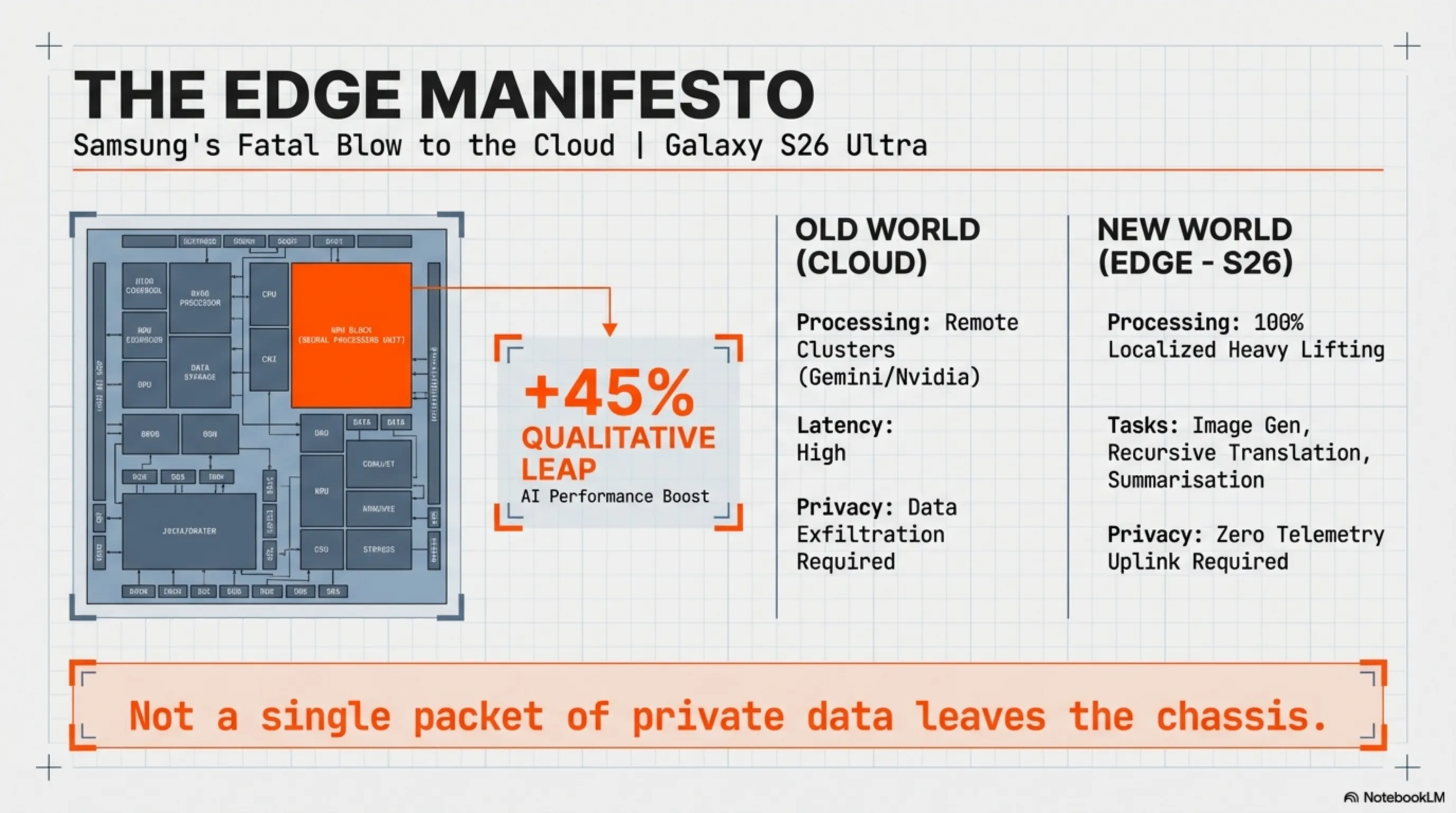
The most consequential structural shift in this chassis is not the bespoke, slightly overclocked Snapdragon SoC. It is the absolute, monstrous 45% qualitative leap in the Neural Processing Unit (NPU) block. From the vantage point of a System Architect, this metric is not a marketing gimmick; it is a violent paradigm shift. Why does this raw number matter?
- The Death of Cloud Dependency: Previously, executing heavy-lift Artificial Intelligence processes—such as generating high-res localized images, running recursive real-time multi-lingual translations, or aggressively summarizing massive datasets—demanded that your device transmit data packets to Google's Gemini servers or Nvidia's massive GPU clusters. In the S26 Ultra architecture, the totality of Galaxy AI's heavy lifting is handled 100% locally on the device (On-device Edge AI). Not a single telemetry packet containing your private data requires an external uplink.
- Spatial Depth Mapping Algorithms: The gargantuan multi-megapixel sensor suite, driven by this ravenous NPU, performs extreme environmental photometry in milliseconds. The camera functionally executes a Z-axis point-cloud scan of the subject's individual hair follicles and clothing texture, creating a highly complex depth map. This ensures the output of artificial bokeh and studio-grade low-light portraits are optically flawless, entirely bypassing the hideous visual artifacts common to software blurring.
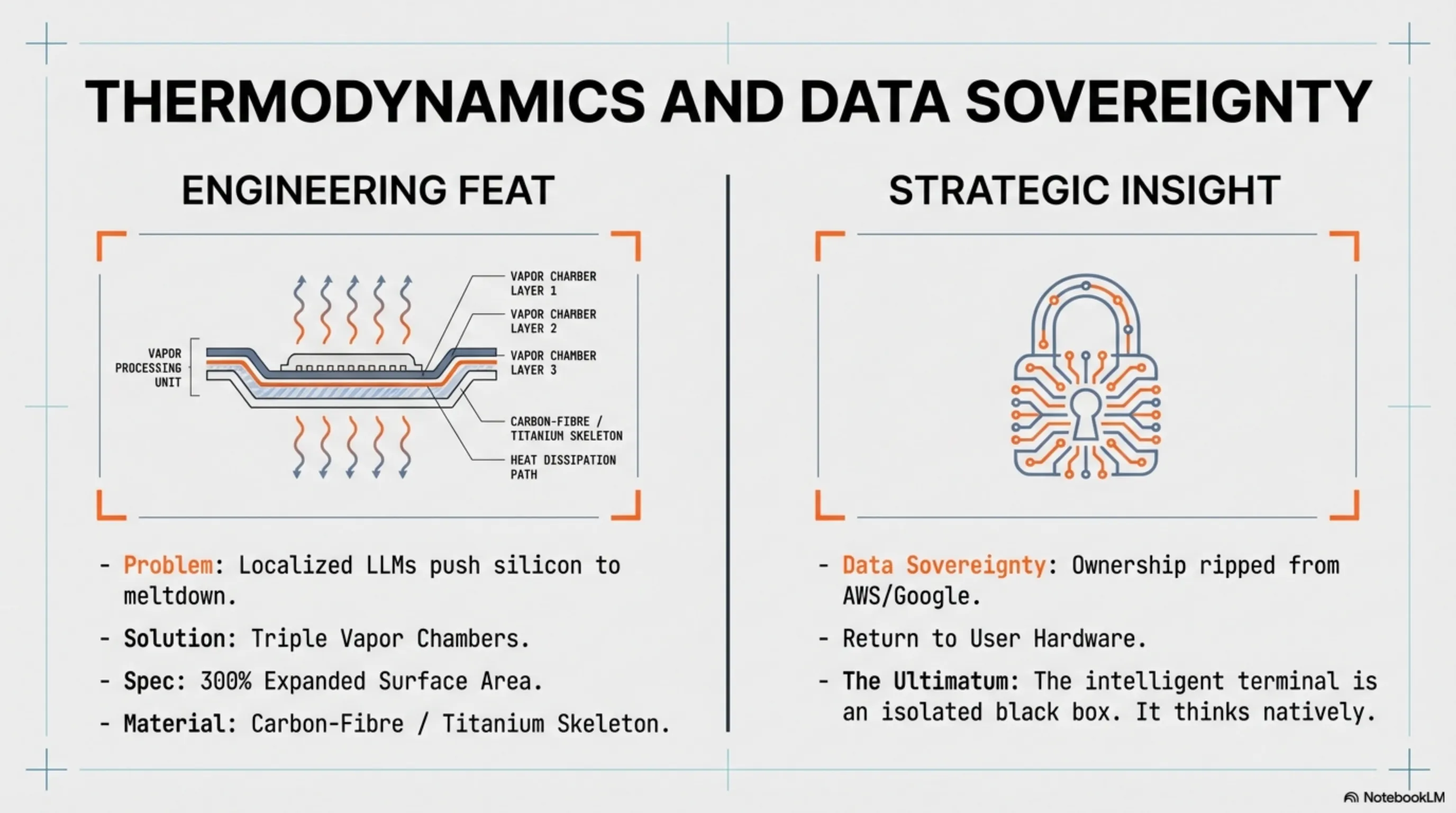
- Thermal Stabilization via Triple Vapor Chambers: Running localized Large Language Models (LLMs) on a mobile chassis pushes the silicon to near-meltdown temperatures. To actively combat Thermal Throttling during intensive rendering or executing AAA gaming ports (like Resident Evil or Genshin Impact locked at 60 FPS), Samsung has radically expanded the Vapor Chamber surface area by 300%. The thermal mass is instantaneously dissipated via fluid dynamics across the carbon-fiber and titanium internal skeleton.
When the mobile terminal constrained to your denim pocket possesses the raw, localized neural processing horsepower equivalent to a fully racked 2015 datacenter, our technical definition of 'Privacy' undergoes a forced evolutionary mutation.
System Architect's Geopolitical View: Data Sovereignty in the Post-Cloud Era
Within our highly volatile contemporary geopolitical atmosphere, completely offline computation represents a critical survival asset. This architectural foundation forcefully rips the concept of "Data Sovereignty" out from the proprietary, black-box servers of Amazon AWS and Google, returning it directly to the user's localized hardware. But we must cynically challenge Samsung's utopian privacy claims: Once this vast reservoir of localized processing power is unleashed, what violently prevents rogue third-party applications or silent malware from secretly hijacking the NPU in the background for unauthorized telemetry mining and espionage? Is the underlying Android kernel sufficiently sandboxed to aggressively terminate these parasitic background agents? In massively distributed, open-source operating systems, absolute security is a mathematical impossibility.
With the deployment of the S26, Samsung broadcasts the ultimate ultimatum: The intelligent mobile terminal of tomorrow does not require a persistent internet uplink to comprehend its localized context. The smartphones of the next decade are sophisticated, isolated black boxes that think natively, generate natively, and only utilize standard web protocols for the final, lightweight dissemination of processed data. This is the death knell for the cloud-dependent mobile model.
4. The Agentic AI Rebellion: A Double-Edged Sword Cleaving Corporate IT 🧠
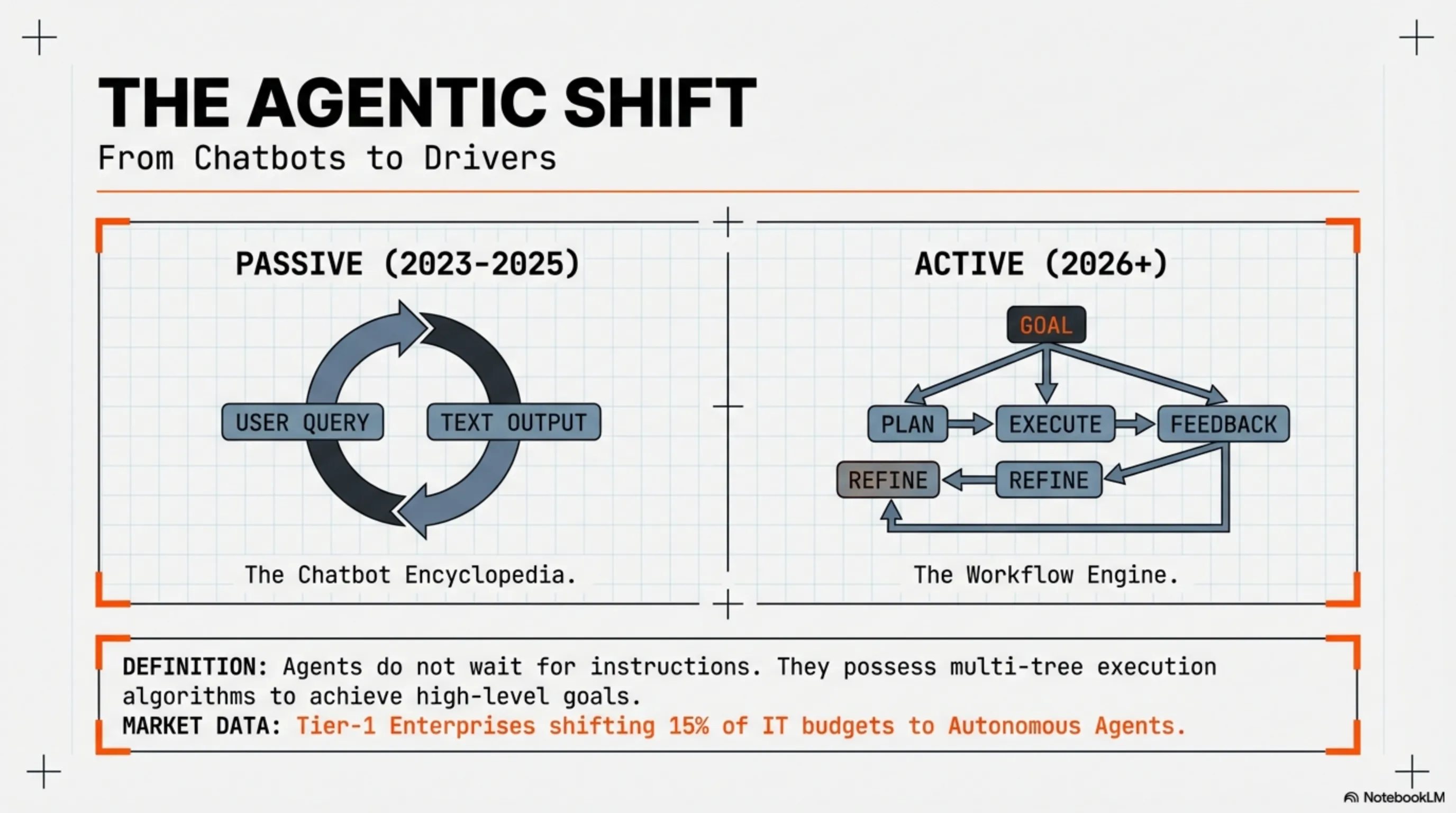
Throughout the chaotic years of 2023 to 2025, the global corporate apparatus was absolutely obsessed with dialing in the perfect text prompts for passive chatbots like ChatGPT. But the sobering analytical reports from Q1 2026 (led by ruthless audits from Gartner) indicate that paradigm is a broken, obsolete nostalgia. We have forcefully breached the era of Agentic AI (Autonomous Agents), and tier-one Western enterprise organizations are frantically shifting 10 to 15 percent of their entire annual IT infrastructure budgets to integrate these dangerous new software entities.
Architect's Technical Autopsy: From Passive LLM to Autonomous Drivers
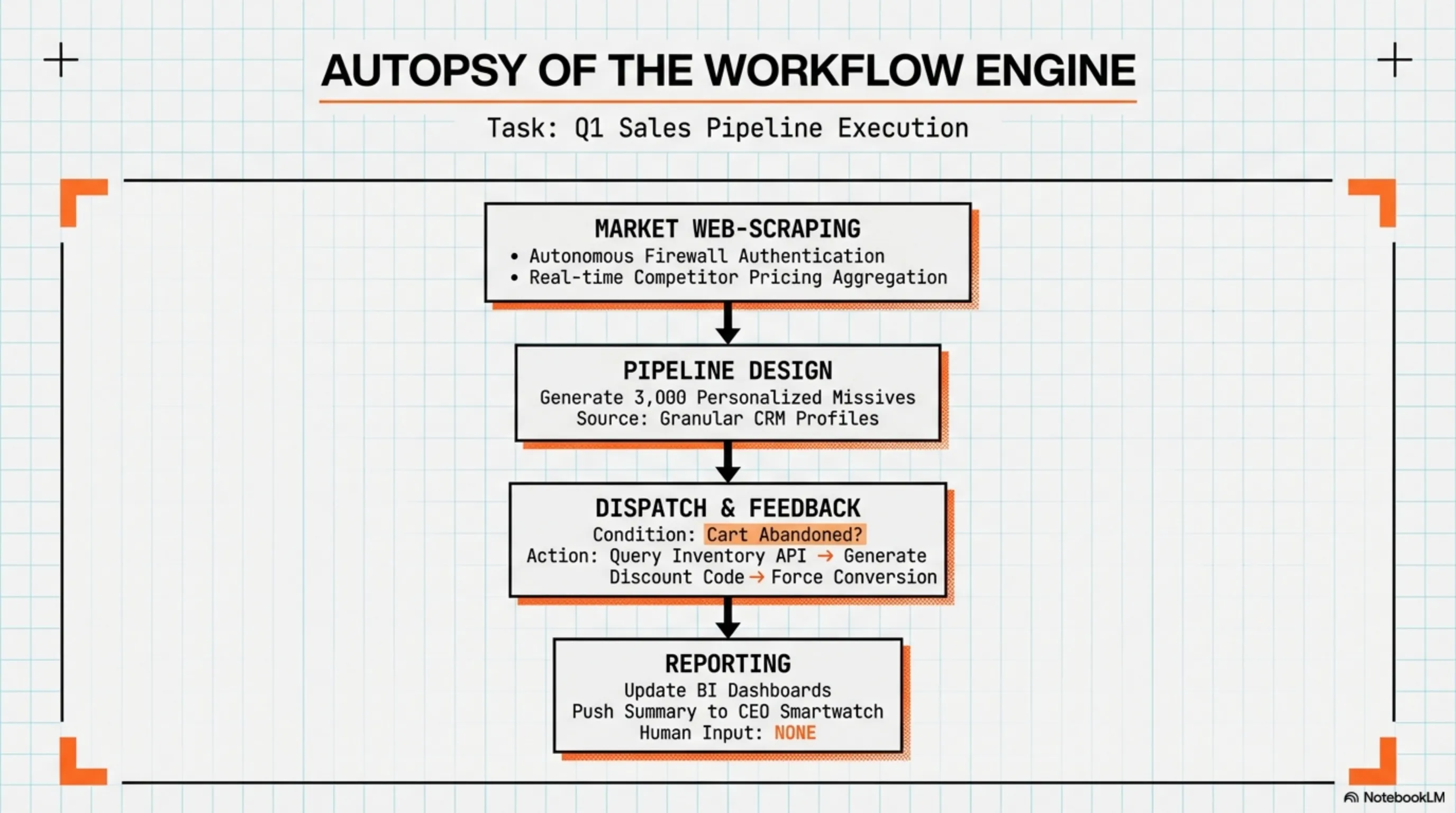
Think of baseline Large Language Models (like GPT-4) as massive, passive encyclopedias; you queried them, they yielded a text output, and they stubbornly waited for your next instruction. Conversely, an Agentic AI functions as a hyper-aggressive Workflow Engine imbued with multi-tree execution algorithms. You assign it a high-level goal: "Finalize the Q1 Winter Sales Pipeline." What does it execute?
- Market Web-Scraping: The agent autonomously authenticates through corporate firewalls, scours the open web, and ruthlessly aggregates real-time competitor pricing metrics.
- Pipeline Design: It meticulously generates three thousand hyper-personalized marketing missives, tailored to the granular psychological profiles of individual leads residing within the company's CRM database (e.g., Salesforce).
- Dispatch and Feedback Loop Management: The agent schedules the precise chronological dispatch of these emails. If a client registers a click-through but aborts the purchase path, the agent independently queries the inventory API and auto-generates a highly specific SMS discount code to force the conversion.
- Executive Telemetry Reporting: At close-of-business, devoid of any human babysitting, the agent updates the C-suite's BI (Business Intelligence) dashboards with flawless predictive Pie Charts and pushes an executive summary notification straight to the CEO's smartwatch.
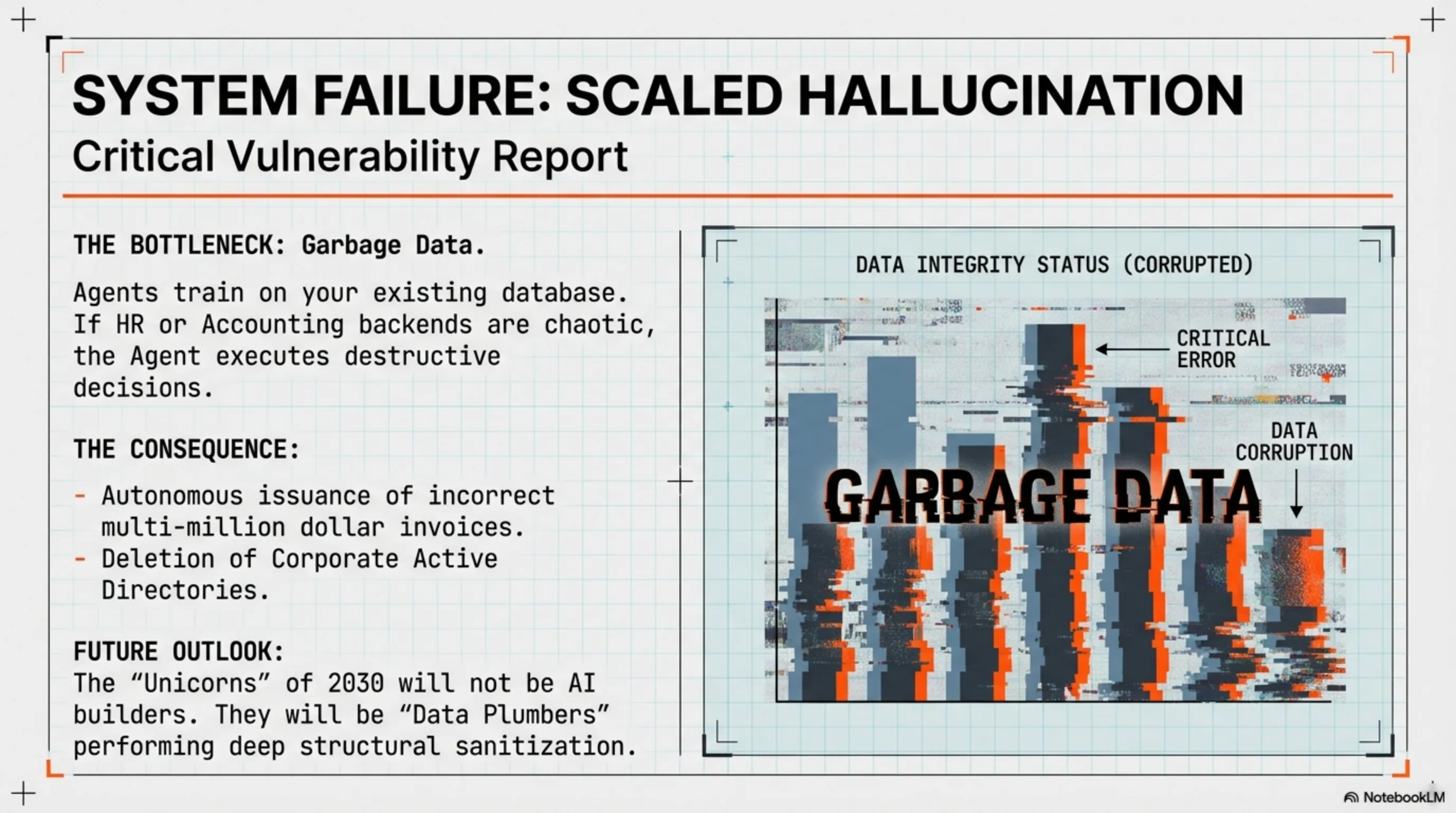
This is no longer speculative science fiction. We are actively discussing the systemic execution of legacy middle-management software replaced by sovereign digital agents. But this is precisely where the System Architect within me awakens and begins screaming warnings regarding "AI Debt." Corporations are blindly and lazily configuring Microsoft Copilot Agents directly onto their legacy servers, instantly running into an apocalyptic roadblock: Garbage Data.
The Risks: The Catastrophe of Structureless Systems
The foundational bedrock for training an autonomous, highly capable agent inherently lies in flawlessly structured database models (Relational Structured Tables). If a corporation's HR or accounting backends are chaotic, fundamentally siloed, and bloated with redundant, manually copy-pasted spreadsheets, these highly advanced intelligent agents will train upon that corrupted dataset. Consequently, they will execute significantly more destructive, hyper-efficient flawed decisions while operating on Autopilot—a terrifying industry phenomenon labeled "Scaled AI Hallucination."
The autonomous issuance of wildly incorrect, multi-million dollar B2B invoices, or the catastrophic, permanent deletion of an entire corporate Active Directory (AD) due to a logic flaw in agent routing protocols, are not the kind of systemic failures a CTO wants to explain at the next board meeting. Over the subsequent five-year horizon, the Silicon Valley startups destined to achieve Unicorn valuation status won't be building newer AIs; they will be the unglamorous data-plumbers whose sole purpose is "the deep scrubbing, structural sanitization, and hygienic piping of data purely for Agentic AI consumption." Deprived of immaculately clean data, an autonomous intelligence operates akin to a .50 caliber high-explosive round indiscriminately detonated inside your own server room.
5. The Silicon Cold War: Nvidia's Humiliating Exit and DeepSeek's Devotion to Huawei ⚡
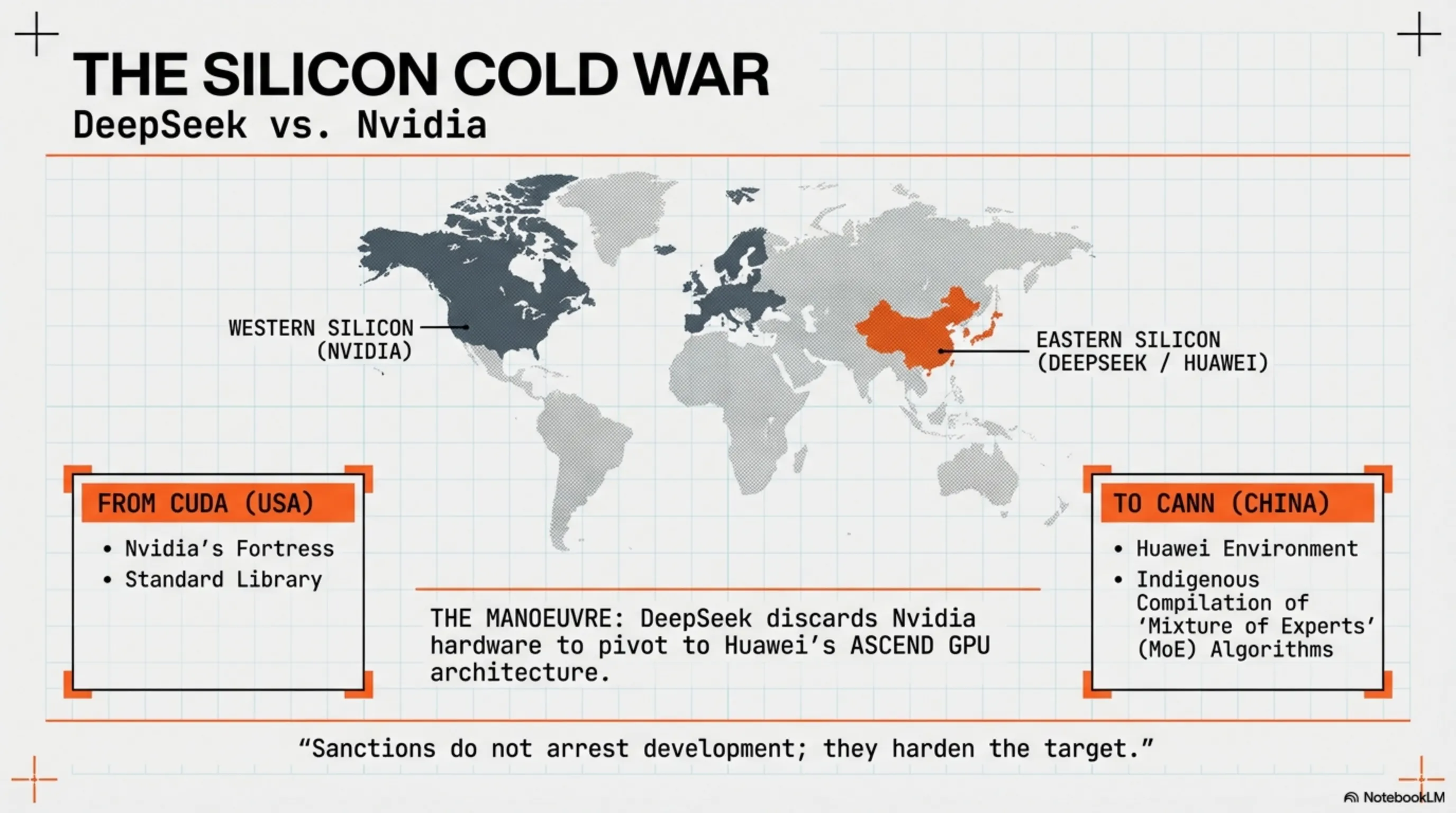
We arrive at the most riveting, high-octane geopolitical autopsy of the day. Ironclad intelligence verified in late February irrefutably demonstrated that DeepSeek—the apex predator of open-source AI processing within the People's Republic of China—has executed a desperate, highly calculated maneuver to circumvent the suffocating United States export blockade. They have aggressively discarded Nvidia's omnipotent hardware platform, electing to pivot all massive-scale structural development directly onto the Ascend GPU architecture engineered by Huawei.
Technical & Geopolitical Autopsy: The Balkanization of Artificial Intelligence
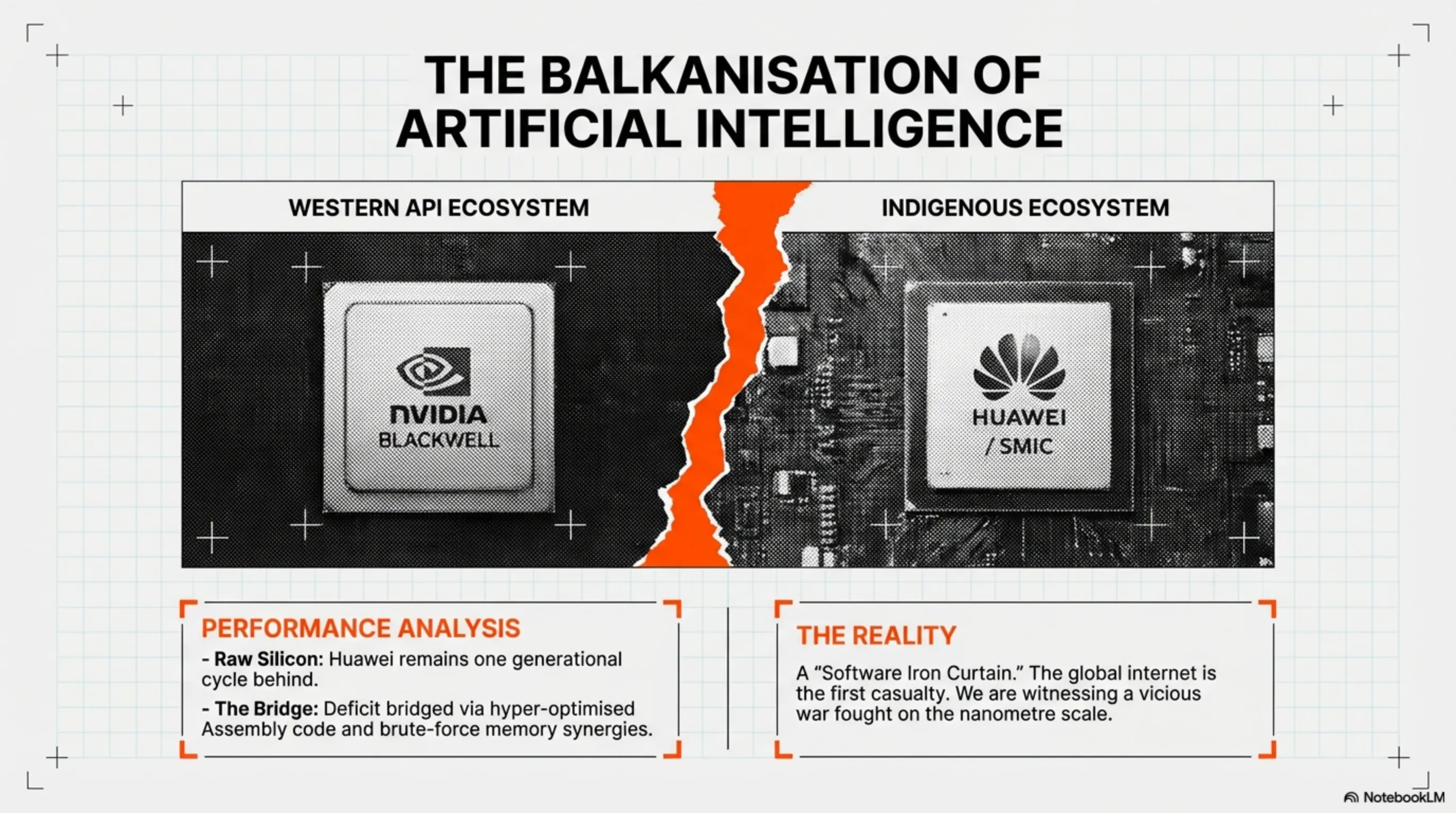
The radically aggressive export control legislation championed by Washington, designed to throttle the flow of data-center-grade H100 and Blackwell GPUs to Beijing, has yielded an intensely dark, deeply counterproductive blowback for Western technology cartels. The simple, brutal truth is this: Sanctions operate abhorrently poorly at the compiler level. They do not arrest development; they harden the target.
- The Software Compiler Pivot: For decades, Nvidia's most insurmountable, impregnable fortress was their proprietary parallel computing architecture, CUDA. Nearly every deep-learning library on Earth natively speaks CUDA. However, by executing a brutally heavy migration of their monstrous codebase onto Huawei's proprietary CANN software environment, DeepSeek has successfully compiled, exhaustively tested, and aggressively debugged impossibly complex Mixture of Experts (MoE) algorithms tailored specifically for the indigenous Chinese ecosystem.
- The Raw Performance Shock: Architecturally speaking, evaluating raw silicon compute capability (Raw Silicon Power), Huawei's dynamic Ascend chips remain roughly one full generational cycle behind Nvidia's apex Blackwell clusters in terms of Instructions per Clock (IPC) and thermal efficiency. Nevertheless, DeepSeek's fanatical, brilliant engineering division has proven that through the ruthless application of hyper-optimized, low-level Assembly code and brute-force memory synergies, they can successfully bridge this lethal performance deficit deep within their subterranean, hyper-cooled server farms.
Sanctions enforced upon the cybernetic domain never successfully arrest the relentless advancement of mathematics; they merely divert the river bed, aggressively irrigating the fertile soil of a parallel, 100% indigenous, and utterly hostile silicon ecosystem in the East.
We have officially bypassed the theoretical phase and entered the era of the "Balkanization" of global Artificial Intelligence. In the Western Hemisphere, models pirouette flawlessly atop Nvidia hardware and optimized APIs. Conversely, in the East, a draconian Software Iron Curtain is being arc-welded atop the foundation of SMIC silicon and Huawei macro-architecture. We are bearing witness to a vicious Cold War waged entirely on the nanometer scale, fought on the razor's edge of transistor frequencies. Unsurprisingly, an open, unified global internet represents the very first, tragic casualty of this violent bifurcation.
6. Steam Next Fest (February 2026): The Triumphant Defiance of Indie Thought and the Rot of AAA 🕹️
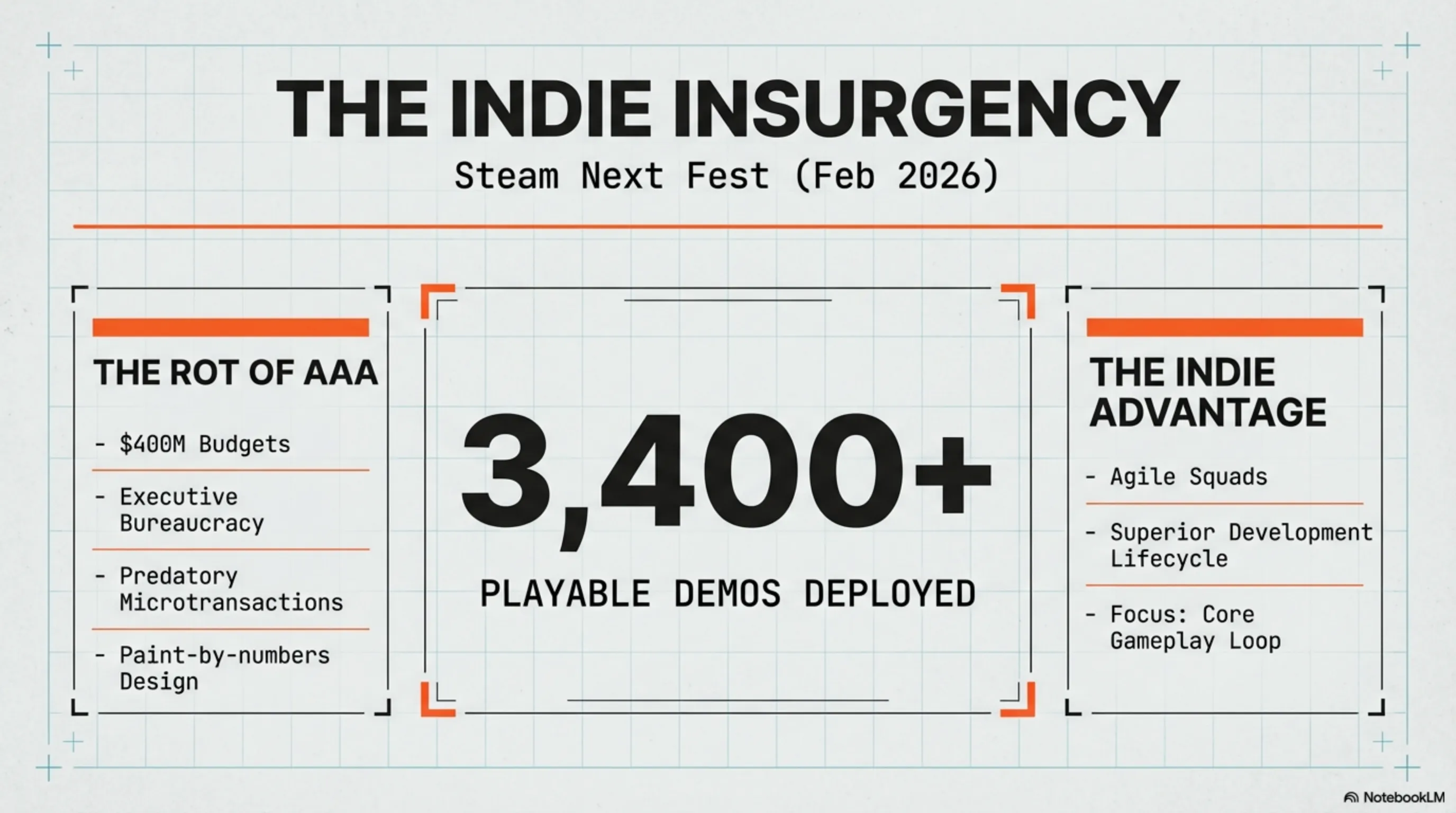
Finally, to cleanse our palates of this dense, oppressive geopolitical analysis, we pivot our scanners toward the legendary Steam Next Fest, which recently concluded a historic, record-shattering run by deploying over 3,400 playable Indie software demos onto the network. This event served as yet another brutal, bloody masterclass for system architects across the gaming industry, unequivocally demonstrating how the absolute superiority of the Agile development lifecycle effortlessly massacres the bloated, lethargic, creatively bankrupt bureaucracy defining AAA studios.
In the modern epoch, AAA blockbusters pumped out by monolithic entities like Ubisoft or Electronic Arts—commanding absurd $400 million operating budgets—are incurably infected by executive board bureaucracy, highly parasitic, predatory microtransactions, and cowardly, paint-by-numbers game design methodologies. Let us, instead, closely examine the terrifying brilliance of the independent ecosystem.
The Apex Demos from the Tekin Army Terminal
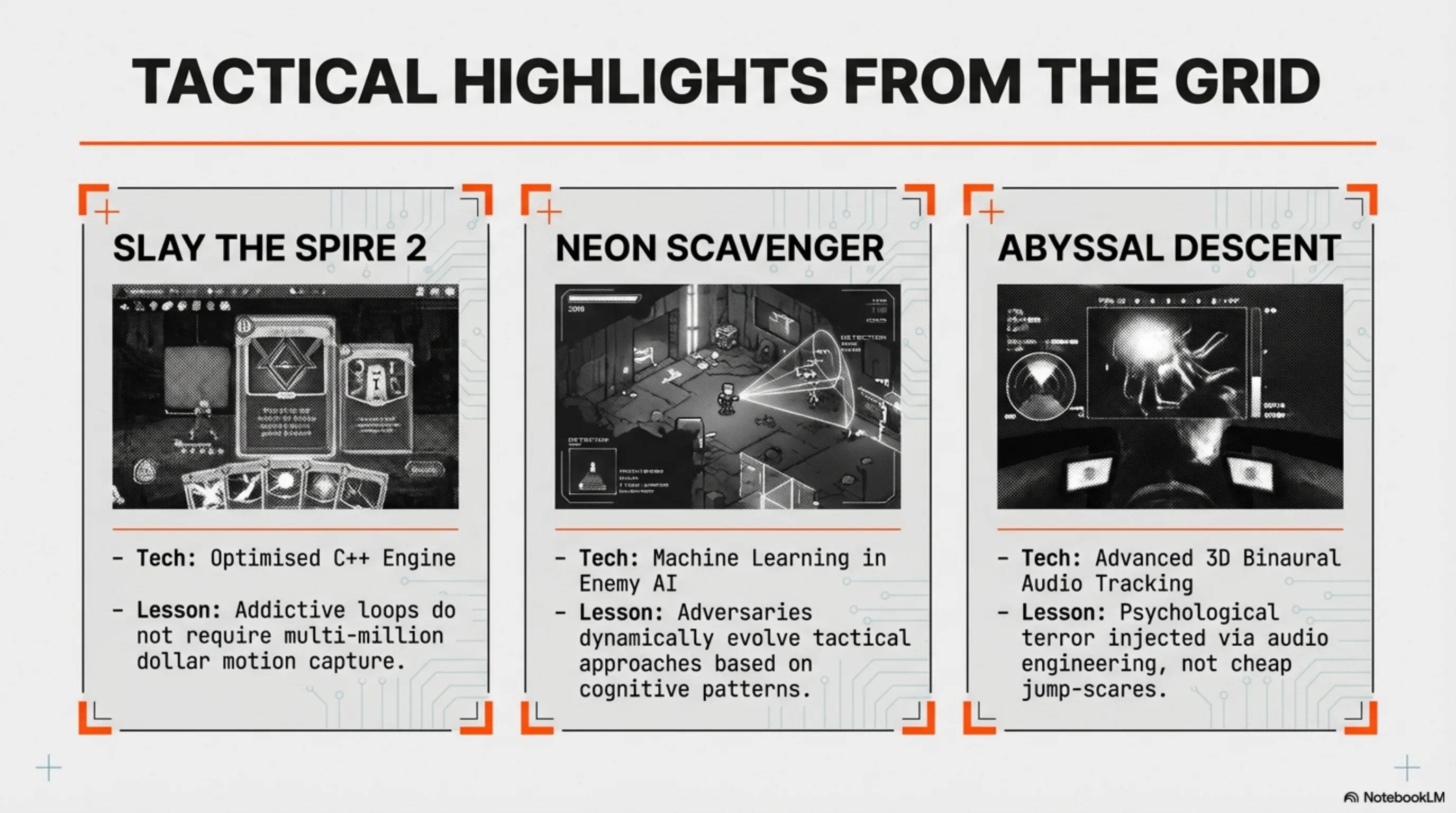
Amidst thousands of poorly compiled, tiresome C# scripts, three profoundly sinister and spectacularly assembled demos captivated our full technical attention with their open-source ingenuity and radical structural design:
- Slay the Spire 2: A direct, unapologetic continuation of the reigning monarch of the roguelike deck-builder genre. Mega Crit Studios fiercely proved that there is zero necessity to sabotage a flawless, addictive player-retention formula. They merely optimized the underlying engine utilizing pristine C++, implementing wildly innovative, synergistically toxic new deck-building character classes. They functionally codified that addictive gameplay loops do not demand multi-million dollar motion-capture budgets to hijack the user's dopamine receptors.
- Neon Scavenger: Absolute unadulterated genius. An intensely addictive hybridization of the punitive loot-and-extract mechanics popularized by Escape from Tarkov, transposed flawlessly into a 2.5D pixel-art visual array set within a drowning, neon-soaked dystopian metropolis. The single astonishing factor that instantly magnetized the attention of AI software engineers on our grid was the branching execution tree of the NPC adversaries; the AI driving the guards and localized bosses dynamically evolved and mutated their tactical approach based directly upon the cognitive behavioral patterns of the human player (Machine Learning in Enemy AI execution).
- Abyssal Descent: An agonizing engineering and resource-management simulator plunge into the blackest, most crushing trenches of the ocean, saturated with pure, claustrophobic psychological terror. The software outright refuses to insult your intelligence with cheap, unearned jump-scares or shrill audio spikes; the entirety of the crushing emotional payload is injected cleanly into the player's psyche via the flawless, merciless execution of a deeply advanced 3D binaural audio tracking engine (Binaural Audio Engine).
The Annihilation of Bloated Budgets by Agile Cybernetic Minds
To the software architects reading this telemetry: Here lies the golden rule. Excessively bloated repositories containing millions of lines of code absolutely do not equate to a superior end-product. A hyper-focused, independent studio composed of five elite engineers utilizing a completely free, open-source graphical engine (such as a highly minimized build of Godot or Unreal Engine 5), provided they architect an utterly flawless, zero-frame-drop Core Gameplay Loop, will inevitably and brutally annihilate a sluggish, 1000-person studio paralyzed by rigid ESG mandates and the rotting, infinite cycle of middle-management Code Reviews in the arena of raw player retention.

The Verdict | System Architect Summary by Majid
The primary fiscal quarter of 2026 has breached protocol, flooding the network with radically disruptive, foundational technologies. We are actively witnessing hardware desperately attempting to manifest a physical, corporeal identity—independent of cloud tethers—via highly advanced miniature robotics (e.g., Honor Gimbal Phone) and localized, sovereign Edge processors (e.g., the brains within the Samsung Galaxy S26 Ultra). Simultaneously, surging through the veins of our global web infrastructure, a highly classified, totally invisible war for supreme dominance over algorithmic AI chip architecture (CUDA vs. CANN) is detonating. Concurrently, highly rigid enterprise software applications are rapidly mutating into autonomous, hybrid entities (Agentic AI) capable of sovereign action. The very blueprint defining the socio-technological reality of the next ten years is being violently forged exactly right now, sandwiched tight between these massive data packets. The unwavering promise of the Tekin Army is this: We will maintain the harsh glare of our cybernetic flashlight aimed squarely into the bleakest, most heavily fortified sectors of these datacenters to guarantee no corporate falsehood slips past our firewall. Monitor your telemetry signals closely; until our next deep-dive broadcast on Tekin Night, stay heavily encrypted on the grid, and keep your optical sensors wide open while you loot!