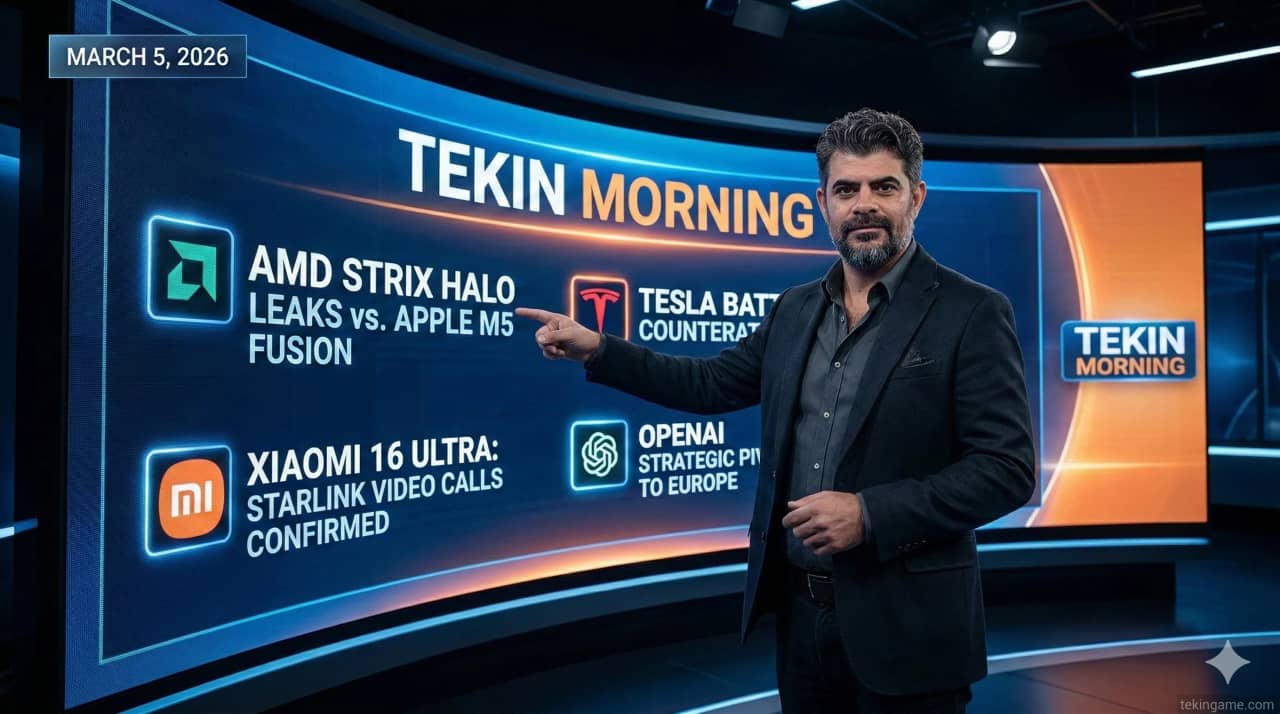
In the Tekin Morning strategic bulletin for March 5, 2026, we dissect six defining events reshaping the global technology and investment landscape. We analyze AMD's engineering counter-offensive to Apple's M5 via the Strix Halo architecture, OpenAI's multi-billion dollar clash with the European AI Act enforceability, Tesla's 4680 silicon-anode battery breakthrough, leaked hardware patents for the Sony PlayStation 6 (PSSR 2.0), the massive commercial deployment of Boston Dynamics Atlas robots in Amazon fulfillment centers, and Xiaomi's geopolit
Tekin Morning — March 5, 2026: From AMD's Silicon Monster to Xiaomi's Satellite Defiance
Good morning, Tekin Army! Today is Thursday, March 5, 2026, and the tech world is at an unprecedented crossroads of engineering triumphs and regulatory brick walls. While Apple made waves last night with the M5 Fusion, AMD unleashed its own overarching compute beast this morning. Conversely, OpenAI has surrendered to European regulators, depriving an entire continent of autonomous AI agents. Meanwhile, Xiaomi launched a flagship phone globally that bypasses traditional telecom filters entirely through direct satellite communication. This is a special edition Tekin Morning where every word is worth its weight in market foresight for the global tech ecosystem.
Strategic Layer 1: AMD Ryzen AI 400 (Strix Halo) Architecture — The Counter-Strike to Apple M5
Just 12 hours after Apple unveiled the M5 chip, AMD introduced the **Ryzen AI 400 series (Codename: Strix Halo)**, signaling that they will not surrender the laptop processor sector. This chip represents AMD's largest gamble to date: fusing desktop-class CPU processing with console-class graphics onto a single monolithic die.
1.1 ZEN 6 Hybrid Architecture vs. Unified Memory
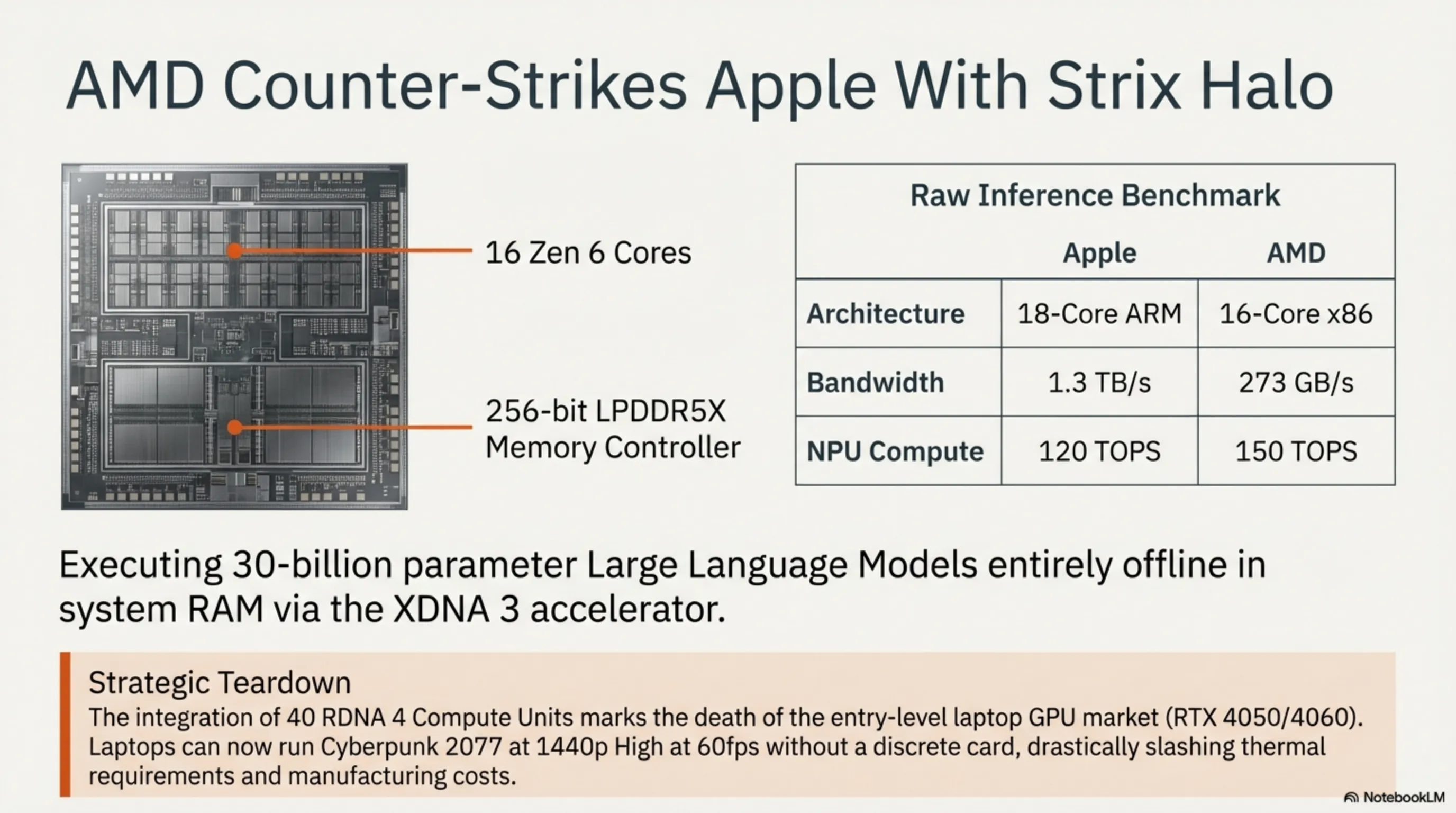
The Strix Halo processor features 16 full-fat ZEN 6 cores. Rejecting the big.LITTLE design philosophy, AMD provides all 16 as Performance Cores directly to the software scheduler. The true ace up their sleeve is a massive 256-bit LPDDR5X memory controller, pushing system memory bandwidth to an astounding **273 GB/s**. This directly challenges Apple's Unified Memory architecture, obliterating the traditional data-transfer bottleneck between CPU and GPU in the x86 ecosystem.
1.2 RDNA 4 Integrated Graphics: The Death of Entry-Level GPUs
The integrated GPU in Strix Halo boasts 40 Compute Units (CUs) based on the RDNA 4 architecture. For context, the PlayStation 5 only utilizes 36 RDNA 2 units. This chip can run *Cyberpunk 2077* at 1440p High settings at 60 fps without requiring a discrete graphics card. This effectively marks the death of the entry-level laptop GPU market (e.g., RTX 4050/4060). For laptop manufacturers worldwide, removing the discrete GPU slashes power consumption, thermal requirements, and manufacturing costs.
📊 Strategic Hardware Benchmark: AMD vs. Apple (Raw Inference)
| Engineering Metric | Apple M5 Max | AMD Strix Halo |
|---|---|---|
| Processor Architecture | 18-Core ARM | 16-Core x86 (Zen 6) |
| Memory Bandwidth | 1.3 TB/s | 273 GB/s (Relative Weakness) |
| AI NPU Compute | 120 TOPS | 150 TOPS (Absolute Edge) |
1.3 XDNA 3 Accelerator: 150 TOPS Edge Inferencing
The Neural Processing Unit (NPU) powered by XDNA 3 architecture achieves a staggering 150 Trillion Operations Per Second (TOPS). This horsepower allows for the execution of 30-billion parameter Large Language Models (like Llama 3) entirely offline in system RAM. For international developers facing cloud service outages or corporate privacy restrictions, this hardware sovereignty holds immense strategic value.
Silicon Teardown: Apple changed the rules with M5, but AMD flipped the table with Strix Halo. Flagship Windows laptops finally have the power to challenge MacBooks in 3D rendering without requiring a 1,000W charging brick.
Strategic Layer 2: OpenAI vs. EU AI Act — The Blackout of Reasoning Agents
Today, OpenAI officially announced the revocation of "Reasoning Autonomous Agents" for all users and corporate clients within the European Union. This marks the most significant executive aftershock of the EU AI Act entering its final enforcement phase in 2026.
2.1 EU AI Act Constraints
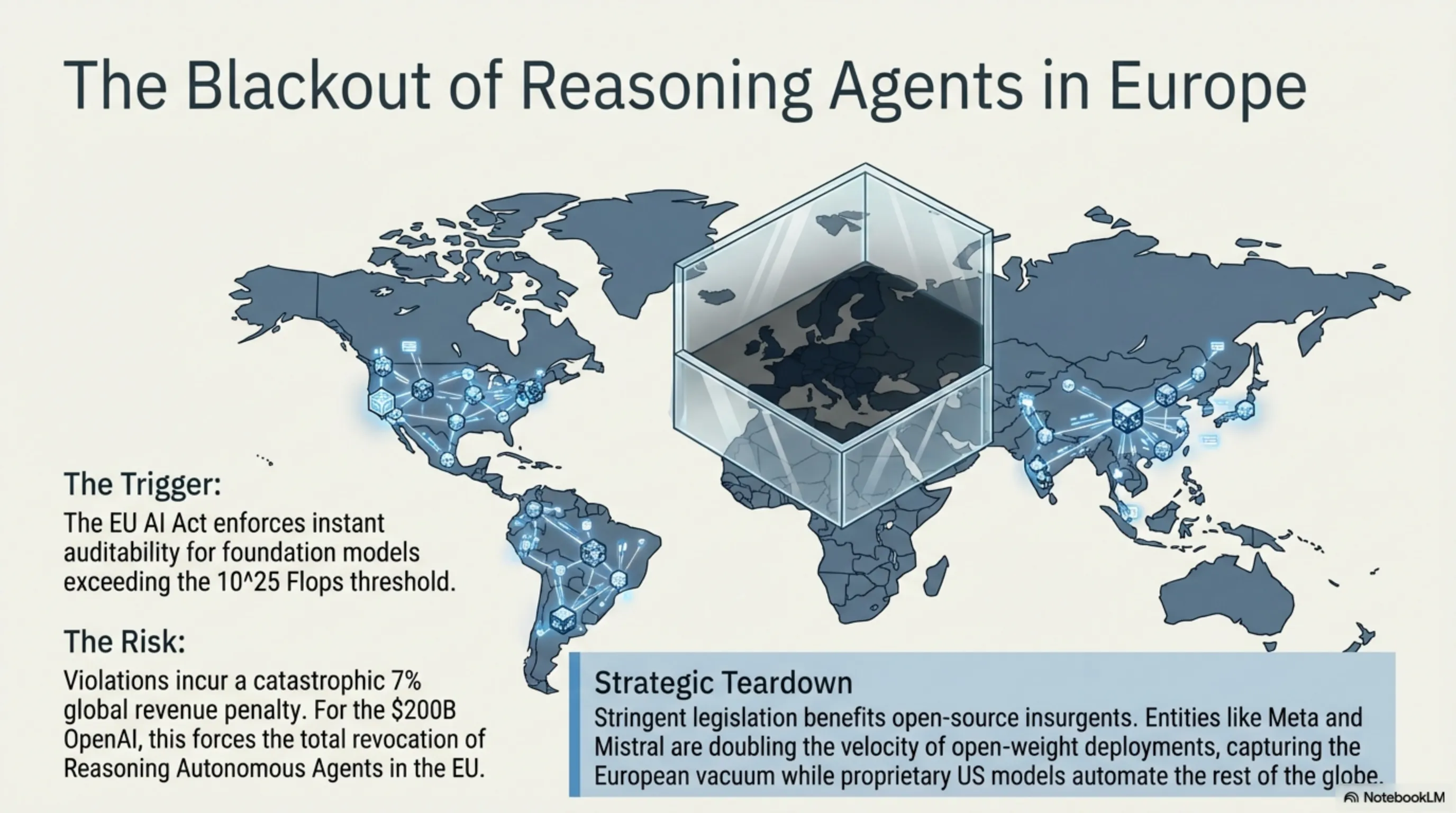
The EU AI Act classifies foundation models with computational power exceeding 10^25 Flops as "High-Risk Systems." Under this law, any AI agent capable of executing autonomous financial or software actions must be instantly auditable, and its error tolerance must be certified by EU compliance agencies.
2.2 The Muting of Autonomous Reasoning Models in Europe
The penalty for violating these regulations is a catastrophic 7% of a company's global revenue. For OpenAI, now valued at over $200 billion, this equates to billions in potential fines. Consequently, OpenAI has opted to "brick" agentic capabilities (tools that write, debug, and execute code autonomously on servers) in Europe, keeping only basic, sandboxed chat-models online.
2.3 Sovereign Open-Source Opportunities
When Europe rejects advanced US proprietary models, the velocity of Open-Source development in Silicon Valley and Europe doubles. Entities like Meta and France's Mistral are leveraging this vacuum to deploy open-weight models that meet auditability standards. The geopolitical reality is that heavy-handed regulation favors open-source ecosystems; Europe is building a "glass wall" around itself while Silicon Valley agents continue to automate the rest of the globe.
Geopolitical Strategy: Stringent legislation almost always benefits open-source insurgents. Europe is cordoning itself off, while unconstrained agents conquer the global south and North American markets.
Strategic Layer 3: Tesla's 4680 Battery Leap — Silicon Anodes and the 7-Minute Charge
Just one day after Chinese automaker BYD unveiled its 8C (5-minute) charging technology, Elon Musk revealed Tesla's secret weapon in the battery war: the third generation of 4680 cylindrical cells equipped with pure silicon anodes.
3.1 Tesla's Metallurgical Counter to BYD 8C
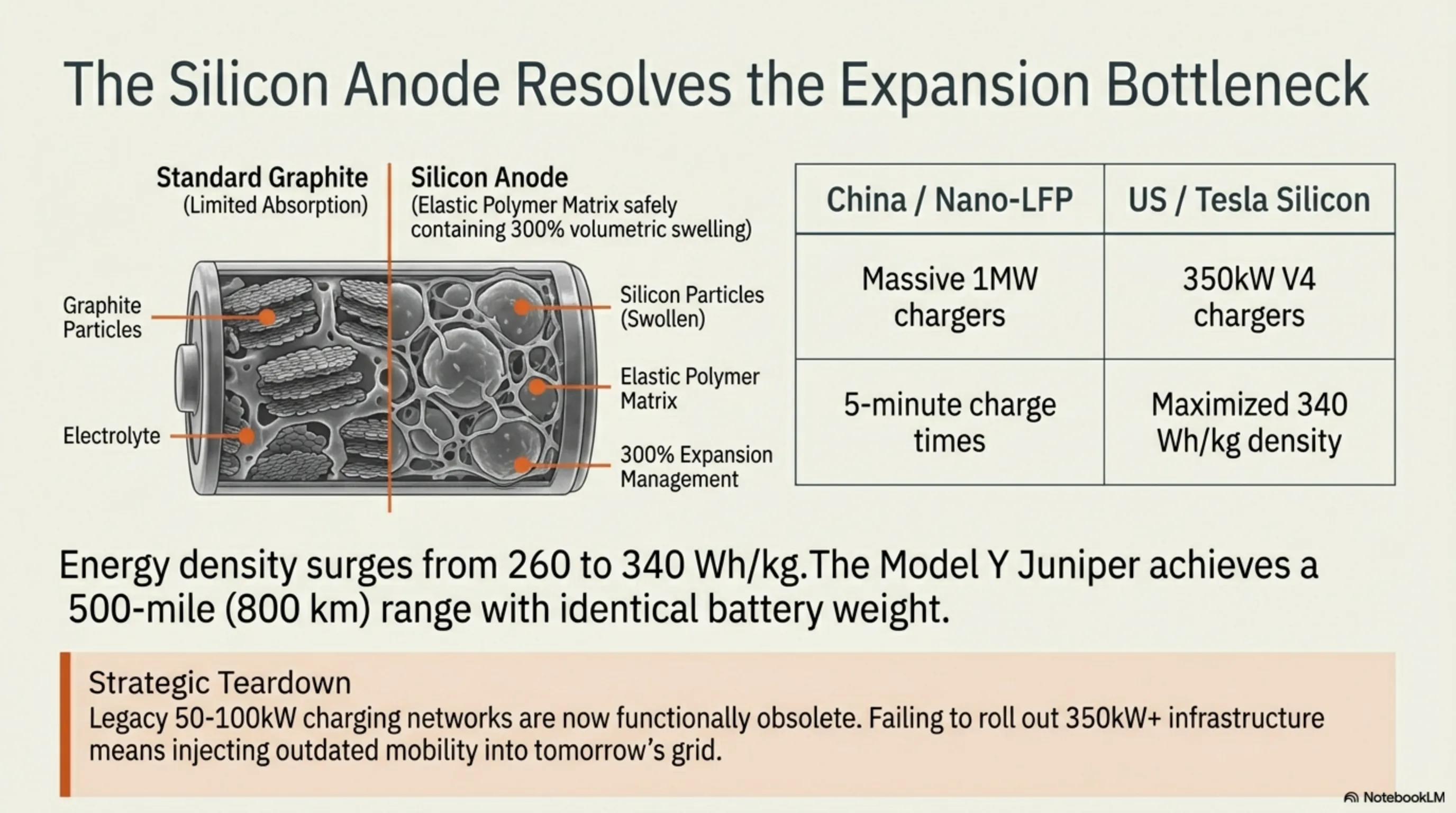
Traditional graphite anodes have been the primary bottleneck for fast charging due to their limited lithium-ion absorption rate. By implementing silicon anodes, Tesla has increased ion absorption capacity by 10x. The historical challenge with silicon is extreme volumetric expansion (swelling) during charging, leading to cell degradation. Tesla engineers resolved this utilizing an elastic polymer matrix that structurally manages this 300% expansion constraint.
3.2 30% Energy Density Surge in Model Y Juniper
The new 4680 generation boosts energy density from 260 to 340 Wh/kg. This means the upcoming Tesla Model Y (Juniper refresh) can achieve a 500-mile (800 km) range with identical battery weight. Charge rates on V4 Superchargers are capped at a sustained 350kW—less than BYD's megawatt peak, but optimized to guarantee 10-year battery lifespan without severe degradation.
3.3 Silicon Economics & Infrastructure
While the market absorbs legacy EV tech (standard LFP), the pivot toward silicon-anode and 8C charging dictates that existing 50-100kW charging networks are functionally obsolete. Failing to roll out 350kW+ infrastructure means injecting outdated mobility into tomorrow's grid.
Metallurgical Matrix: The war has crystallized between Silicon (US) and Nano-LFP (China). China bets on massive 1MW chargers; Tesla bets on supreme energy density and longer intervals between charges.
Strategic Layer 4: Sony PlayStation 6 Patent Leaks — The Dawn of PSSR 2.0
This morning, several patents filed by Mark Cerny (PlayStation Lead Architect) at the USPTO became public. These documents expose the beating heart of the PlayStation 6, indicating Sony's total departure from traditional hardware rasterization in favor of entirely neural network-driven rendering.
4.1 Machine Learning Upscaling Unit (MLUU)
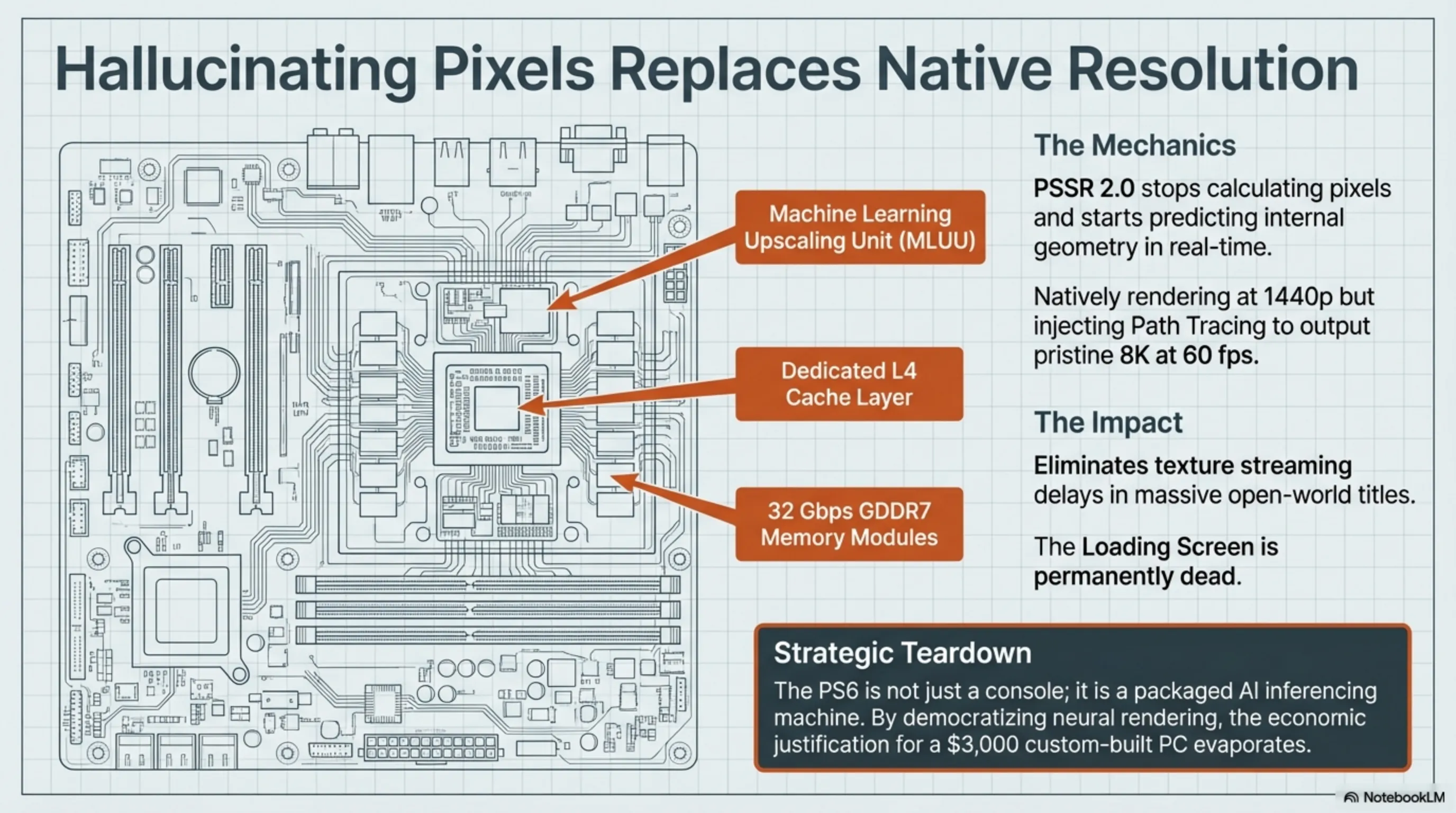
The patents detail a processing block dubbed **PSSR 2.0 (PlayStation Spectral Super Resolution)**. Unlike the PS5 Pro version which merely upscaled static frames, PSSR 2.0 predicts internal geometry in real-time. The console natively renders at 1440p, but the dedicated Machine Learning hardware (similar to Apple's M-Fusion logic) injects Path Tracing reflections and outputs pristine, true 8K resolution at 60 fps for next-gen displays.
4.2 CPU/GPU Unified Architecture
Sony has engineered a dedicated L4 cache layer within the processor that hooks directly into ultra-fast GDDR7 memory modules (pushing 32 Gbps). This architecture eradicates texture streaming delays in massive open-world titles like *GTA VI* or *Death Stranding 2*, burying the concept of the "Loading Screen" permanently.
4.3 Impacts on the Global Gaming Market
Game consoles remain the ultimate compass for consumer hardware trends. Since the PS6 is fundamentally a packaged AI inferencing machine tailored for gaming, the economic justification for a $3,000 custom-built PC evaporates for most users. The PS6 is not just a console; it is the most democratized gateway to neural rendering worldwide.
Gaming Analyst Note: Sony is killing native resolution. The PS6 is a mathematical black box that doesn't just calculate pixels; it hallucinates them. AI-generated frames are the new reality.
Strategic Layer 5: Boston Dynamics Atlas in Amazon Centers — The Fall of Human Operators
Amazon announced today that it has transitioned out of the pilot phase, officially deploying over 500 units of the new generation **Boston Dynamics Atlas** humanoid robots into active fulfillment center shifts. This is the largest commercial deployment of bipedal humanoid robotics in logistics history.
5.1 Zero-Leakage Electric Actuators
The previous Atlas generation, famous for its parkour routines, utilized loud, leak-prone hydraulic pumps. The new Atlas is Fully Electric. Its custom rotary actuators grant joints a range of motion exceeding 360 degrees. An Atlas robot can pick up a 30kg package from the floor and place it on a rear shelf simply by swiveling its torso completely backward—a biomechanical impossibility for the human operators it is replacing.
5.2 Commercial Deployment & ROI in 2026
According to Amazon's filing, the operational and charging cost per Atlas unit equates to just $4.50 per hour—compared to the $22 minimum hourly wage for a US fulfillment worker. Crucially, robots do not suffer from joint wear-and-tear liabilities, nor do they require sick leave. These metrics are a seismic tremor for US labor unions.
5.3 The Future of Supply Chain Automation
These deployments translate to immediate reductions in warehouse forklift accidents. Atlas's head-mounted LiDAR and vision processors map out thousands of pallets in the cloud in real-time. Unlocking this tier of automation requires ultra-stable, private 5G mmWave factory networks—a shift that makes connectivity the most vital element of physical supply chains.
Automation Market: Robotics has exited the demo stage. When Amazon invests aggressively, it means the total cost of ownership has under-cut base human labor—the dawn of silicon supply-chain colonization.
Strategic Layer 6: Xiaomi 16 Ultra Global Launch — Bypassing Towers via Satellite Video
At its global keynote, Xiaomi revealed the **Xiaomi 16 Ultra**. Beyond its Leica optics and Snapdragon 8 Gen 4 processor, this device is the first commercial smartphone capable of **Bilateral Satellite Video Calling**, transcending basic text or voice SOS features.
6.1 Bypassing Terrestrial Cell Towers
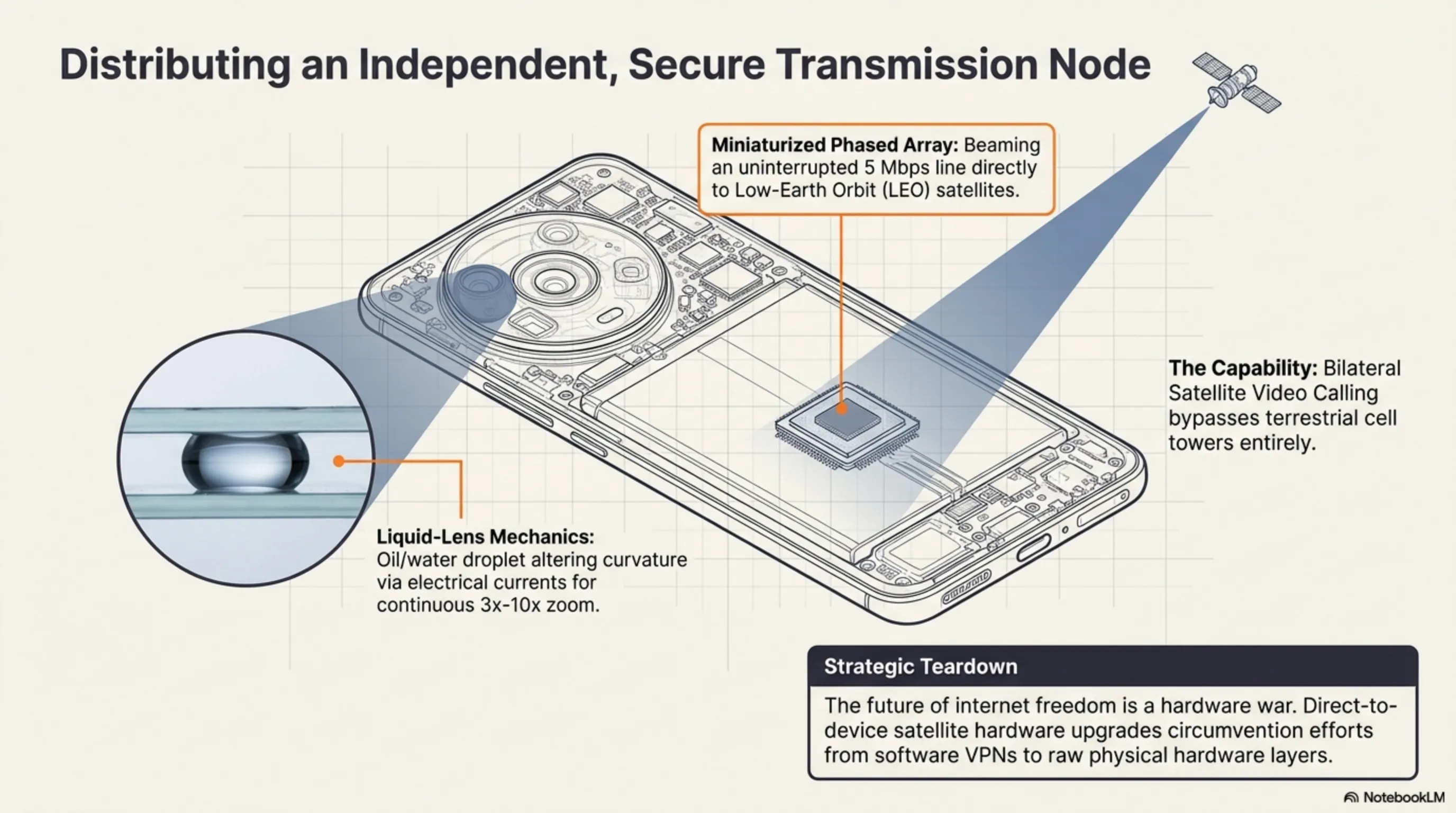
Unlike the iPhone, which relies on text-only satellite connectivity for emergencies, the Xiaomi 16 Ultra is equipped with a miniaturized Phased Array antenna. This component steers radio signals electronically (without moving parts) to lock onto Low-Earth Orbit (LEO) satellite constellations dynamically.
6.2 Circumventing Regional Disruptions
With a stable 5 Mbps bandwidth link directly to space, users can transmit end-to-end encrypted high-definition video from the middle of the Sahara or during total terrestrial blackout events. For international journalists, enterprises, and users in heavily restricted internet zones, direct-to-device satellite hardware is the ultimate paradigm shift, upgrading circumvention efforts from software VPNs to raw physical hardware layers.
6.3 Liquid-Lens Periscope Mechanics
Optically, Xiaomi utilizes "Liquid-Lens" technology inside its telephoto camera, enabling Optical Continuous Zoom from 3x to 10x. By applying electrical currents to an oil/water droplet, the lens curvature alters instantaneously, adjusting focal length in milliseconds—mirroring the biological speed of the human eye.
Strategic Teardown: Xiaomi didn’t just build a phone; they distributed an independent, secure transmission node. The future of internet freedom is a hardware war between terrestrial regulators and stealth phased-array antennas.
⚖️ The Final Architect's Verdict
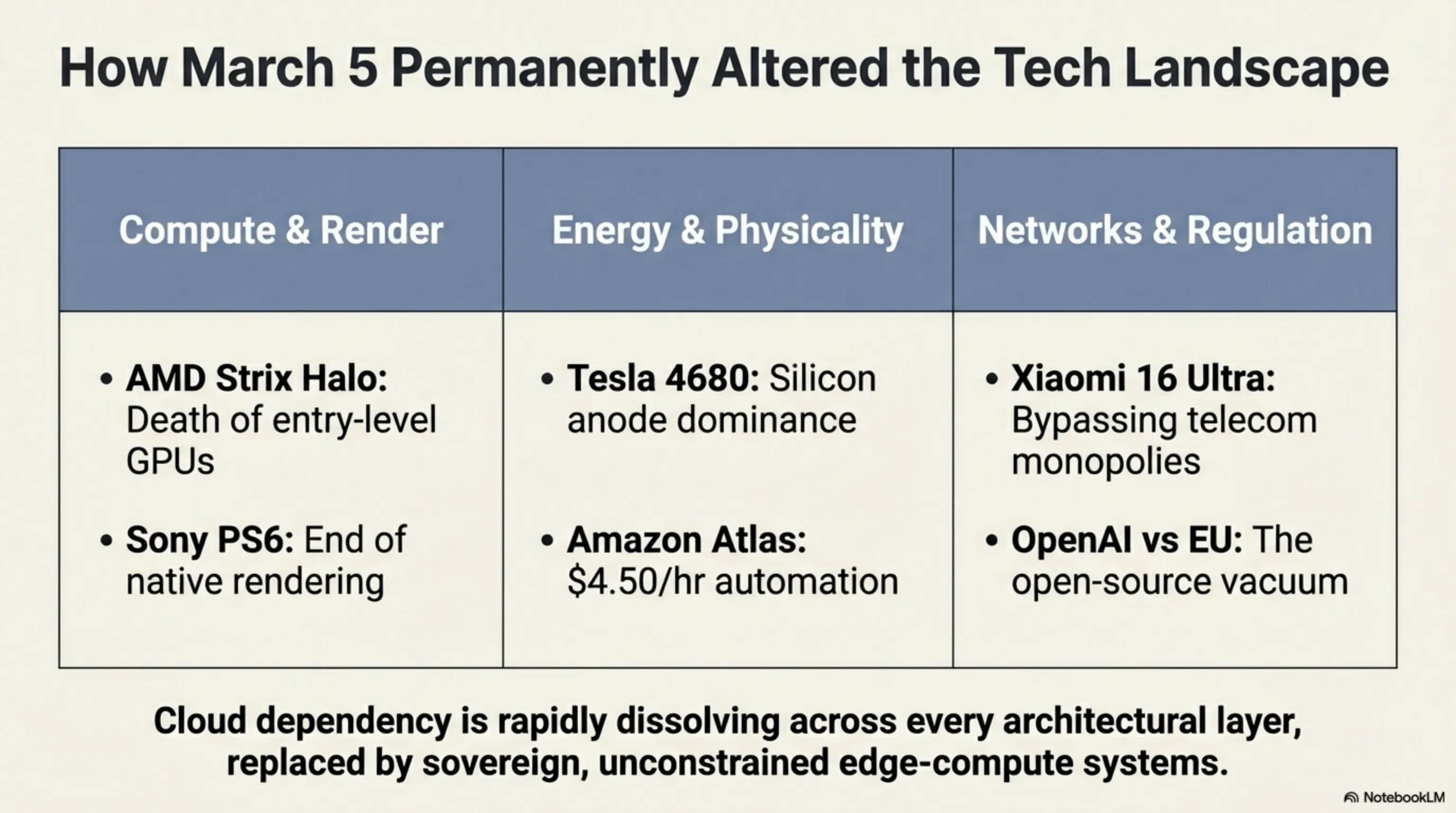
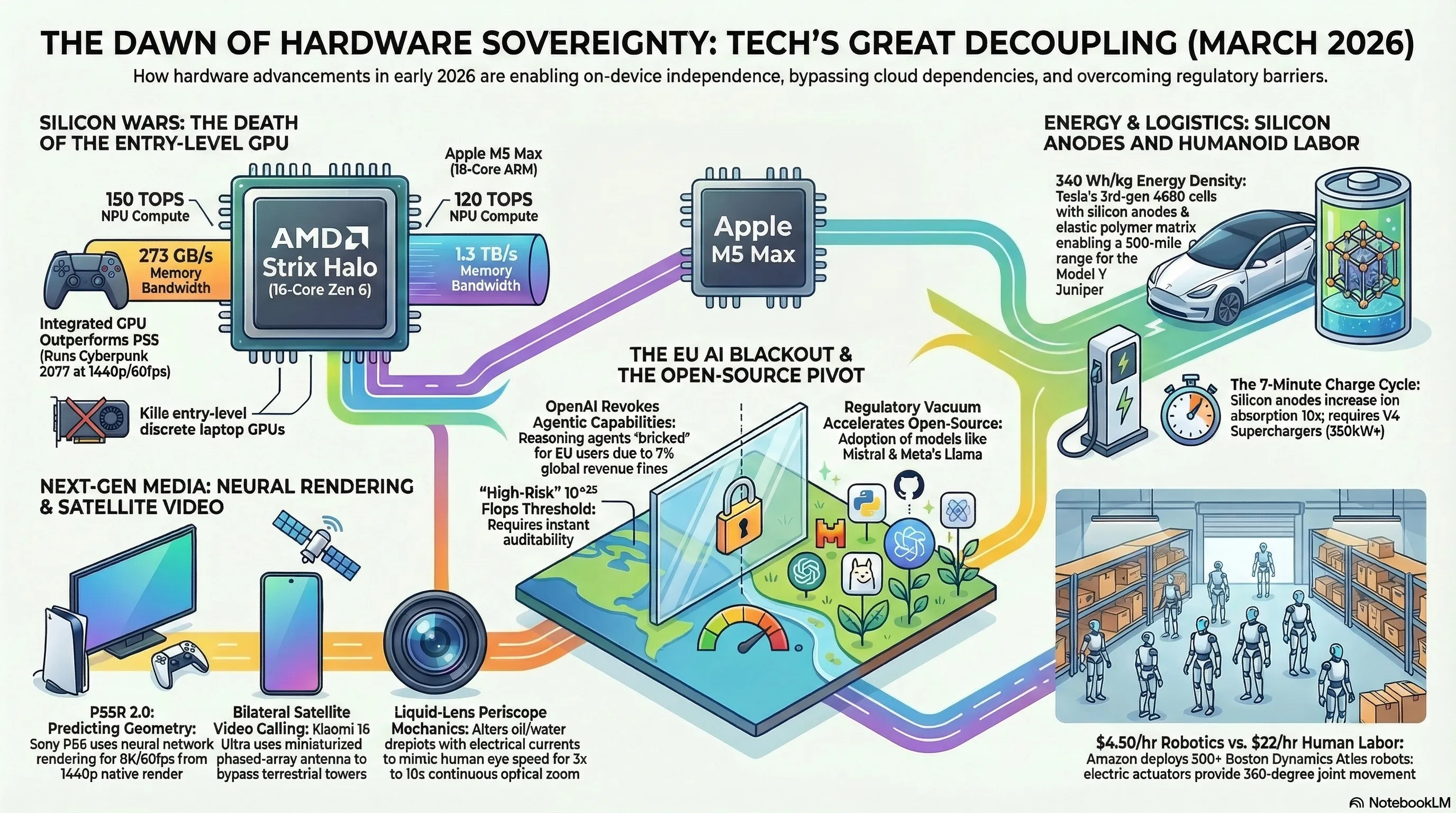
The events of March 5, 2026, paint a definitive picture of tomorrow: absolute power is consolidating back into on-device hardware. As AMD's Strix Halo democratizes heavy AI computation away from cloud dependencies, and PlayStation 6 leverages neural upscaling to bypass physical rendering limits, the urgency for massive remote cloud infrastructure lessens. Extreme geopolitical regulations like the EU AI Act prove that attempting to control logic only accelerates the adoption of untraceable open-source edge-agents. Concurrently, sovereign communication devices like the Xiaomi 16 Ultra dismantle local internet monopolies via satellite backhauls. The era of hardware independence has arrived. If you lack the hardware, you are merely a tenant in the digital domain.