
Tekin Analysis: Today, we bypass the hardware and strike at the core of the entertainment industry: game engines. Epic Games' Unreal Engine 6 integrates Generative AI directly into the rendering pipeline. Environments are no longer manually built with polygons; they are "hallucinated" in real-time by artificial intelligence. This dossier dissects the shift from traditional 3D designers to "Prompt Architects" and what this technological earthquake means for the future of AAA game development.
Welcome to the daily briefing at Tekin Garage. While gamers continue their endless debates over frame rates and resolutions, we are inspecting the very factories that manufacture these digital illusions. Today, our radars are locked onto a magnitude 9.0 earthquake in the entertainment industry: the silent but devastating reveal of Unreal Engine 6. If you thought Lumen and Nanite were the pinnacle of technology, you are gravely mistaken. UE6 is no longer just a "design tool"; it is a "synthetic brain." Instead of calculating and rendering physical polygons, it uses Generative AI to "hallucinate" worlds in real-time. Drink your coffee black; today we are dissecting the end of traditional programming and the birth of the "Prompt Architects."
> MORNING_RADAR_SLOTS:
- [01] The Fall of the Polygon Dictatorship: Unpacking UE6 Architecture
- [02] The Death of 3D Designers? The Rise of "Prompt Architects"
- [03] Hallucinative Rendering: When Your GPU "Guesses" the Environment
- [04] The End of 5-Year Development Cycles: AAA Games in Six Months
- [05] Survival Strategy and the Tekin Analysis Verdict
1. The Fall of the Polygon Dictatorship: Unpacking UE6 Architecture
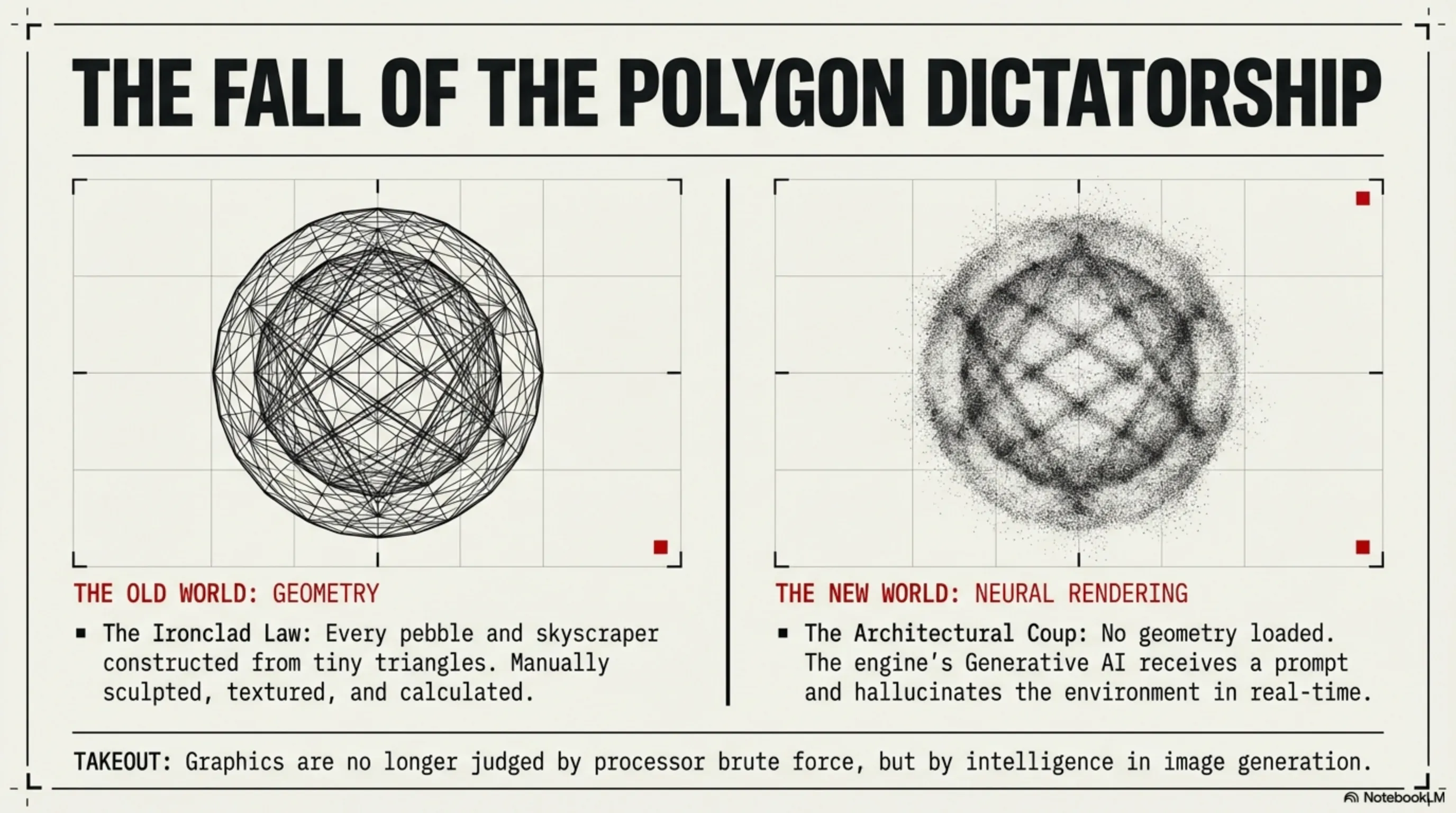
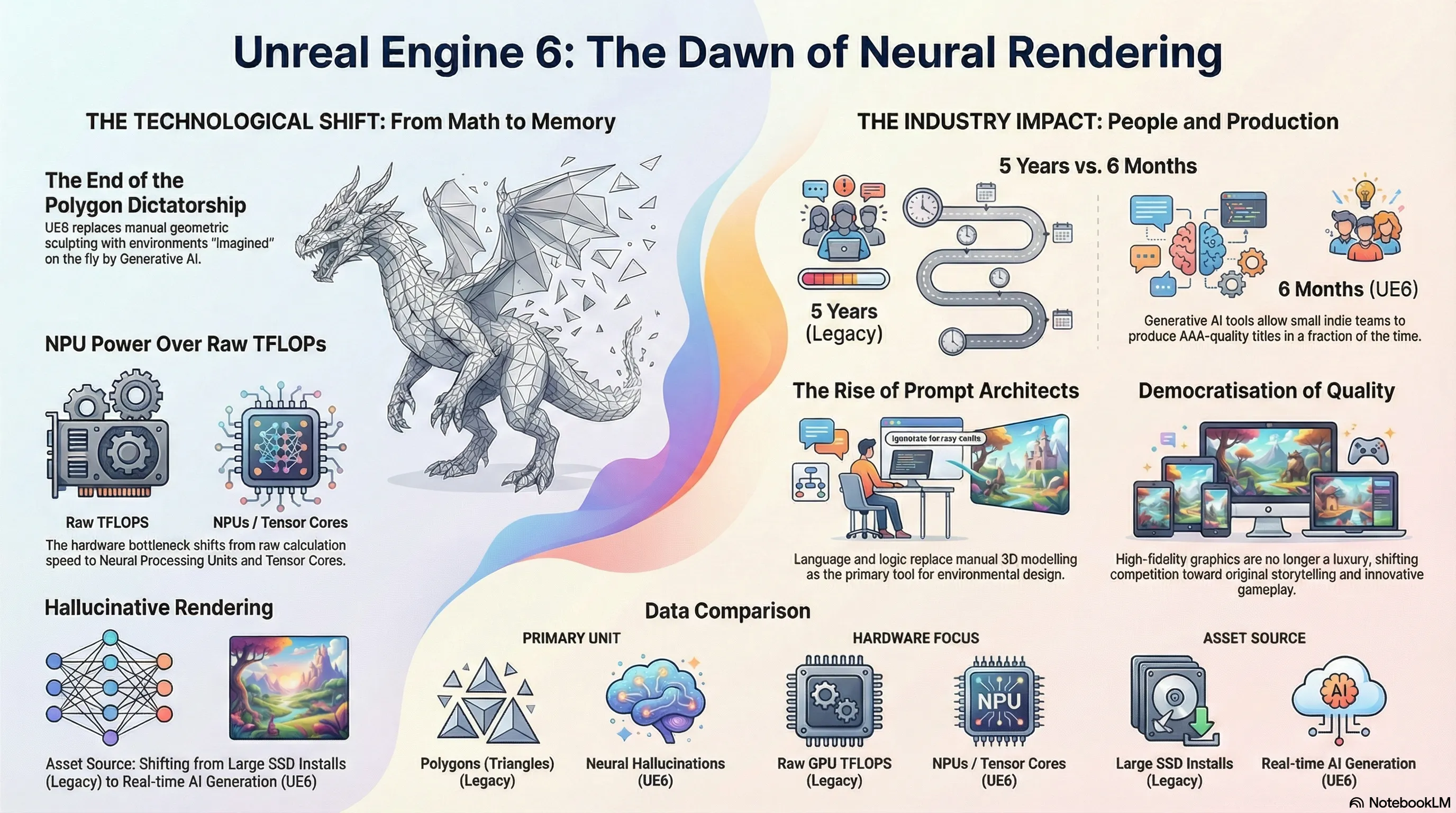
Since the dawn of 3D graphics, an ironclad law has governed the gaming industry: every object, from a tiny pebble to a towering skyscraper, had to be constructed from tiny triangles known as Polygons. Designers had to manually sculpt these triangles, paint textures over them, and the engine's job was to calculate light bouncing off this complex geometry. However, in Unreal Engine 6, we are witnessing an "Architectural Coup." Epic Games is transitioning from traditional geometry-based rendering to Neural Rendering.
In this new engine, you don't need to load millions of polygons to build a forest. The engine's core Generative AI, receiving a simple prompt, generates the entire environment in a fraction of a second and loads it directly into the VRAM. These environments are not pre-built; they are "imagined" on the fly by artificial intelligence. This marks the end of geometric limitations and the beginning of an era where a game's graphics are judged not by a processor's brute force in drawing triangles, but by its intelligence in image generation.
🌐 Strategic Radar (The Rendering Shift):
By eliminating the heavy processing required for polygons, the main hardware bottleneck shifts from raw GPU power (TFLOPS) to Neural Processing Units (NPUs and Tensor Cores). In 2026, a graphics card boasting high TFLOPS but weak AI processing capabilities is essentially dead silicon.
2. The Death of 3D Designers? The Rise of "Prompt Architects"
This technological earthquake will claim its biggest victims from human resources. For years, massive game studios have employed armies of environment artists, 3D modelers, and texture artists to spend months meticulously designing a city's details. The harsh, unforgiving reality of Unreal Engine 6 is this: a vast majority of these jobs are becoming obsolete.
Does this spell the end of art in game development? No, but the medium has mutated. We are witnessing the emergence of a new class of creators: Prompt Architects. These individuals do not need to master the intricacies of Maya or Blender. Their expertise lies in "Word Engineering" and directing the game engine's AI. A professional Prompt Architect knows how to tweak linguistic parameters and mathematical variables in UE6 to conjure a flawless cyberpunk city in mere hours. Their primary tool is no longer a mouse drawing lines; it is "Language and Logic."
3. Hallucinative Rendering: When Your GPU "Guesses" the Environment
The crown jewel of Unreal Engine 6 is its departure from "physically accurate rendering" to what we call "Hallucinative Rendering." In legacy methods (like Rasterization or even Ray Tracing), the system had to physically calculate the path of every single light ray. In the new architecture, the game engine operates like a human brain; instead of mathematical calculation, it "guesses" the next frame based on its highly-trained neural network.
When your character turns their head to look down a dark alley, UE6 does not load that alley from the SSD. In that exact microsecond, it "generates" the alley based on the game's art style and initial prompts. This technology drastically reduces the need for massive storage drives, as you no longer need to install thousands of gigabytes of pre-rendered textures. Games are evolving from massive graphical assets into pure "Algorithms."
🧠 Architectural Autopsy (Neural Rendering):
Hallucinative Rendering means your graphics card in 2026 is a "Painter," not a "Calculator." Nvidia's DLSS was merely a warm-up; UE6 elevates this concept from simple image upscaling to Full Frame Generation from absolute zero.
4. The End of 5-Year Development Cycles: AAA Games in Six Months
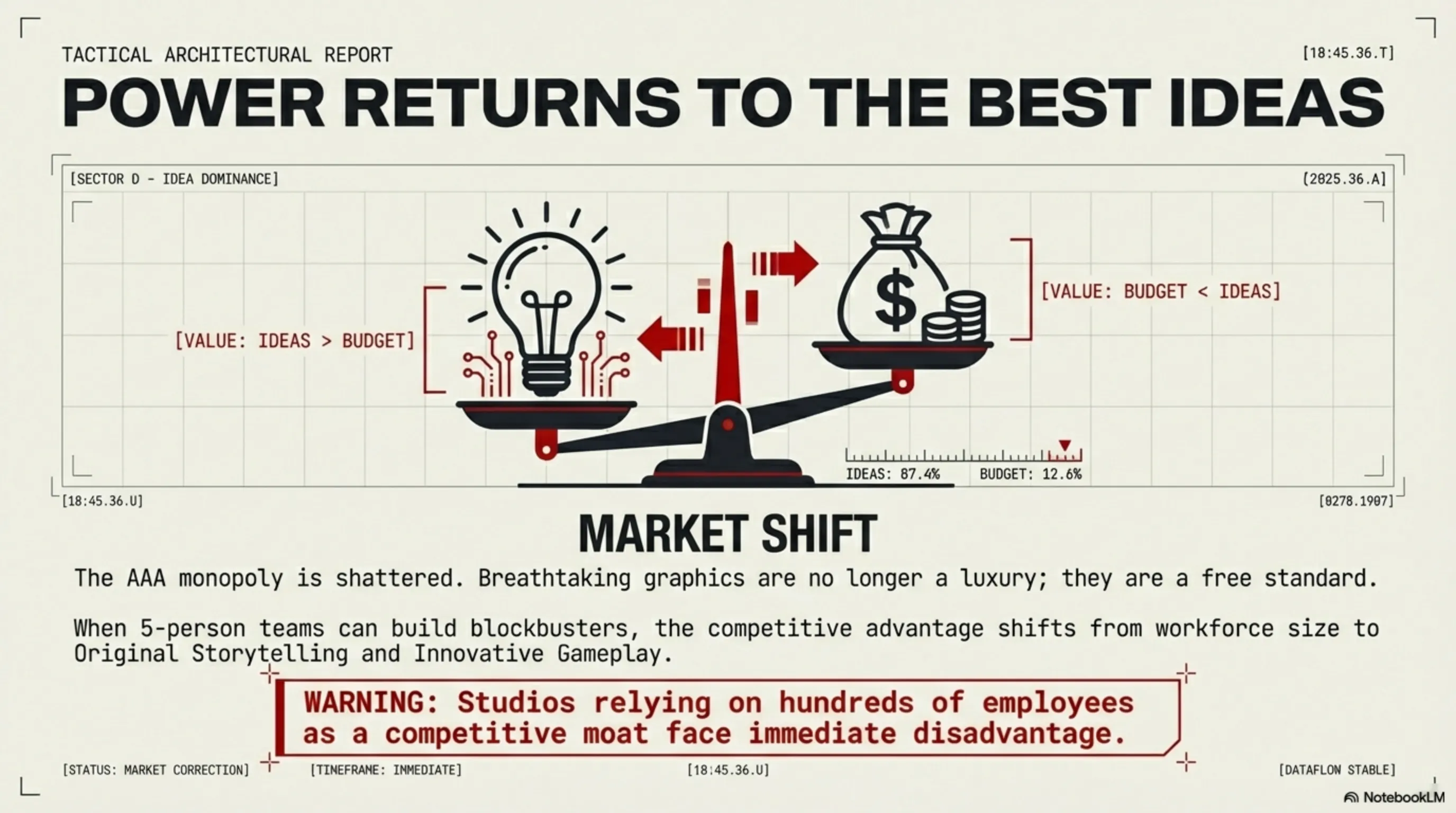
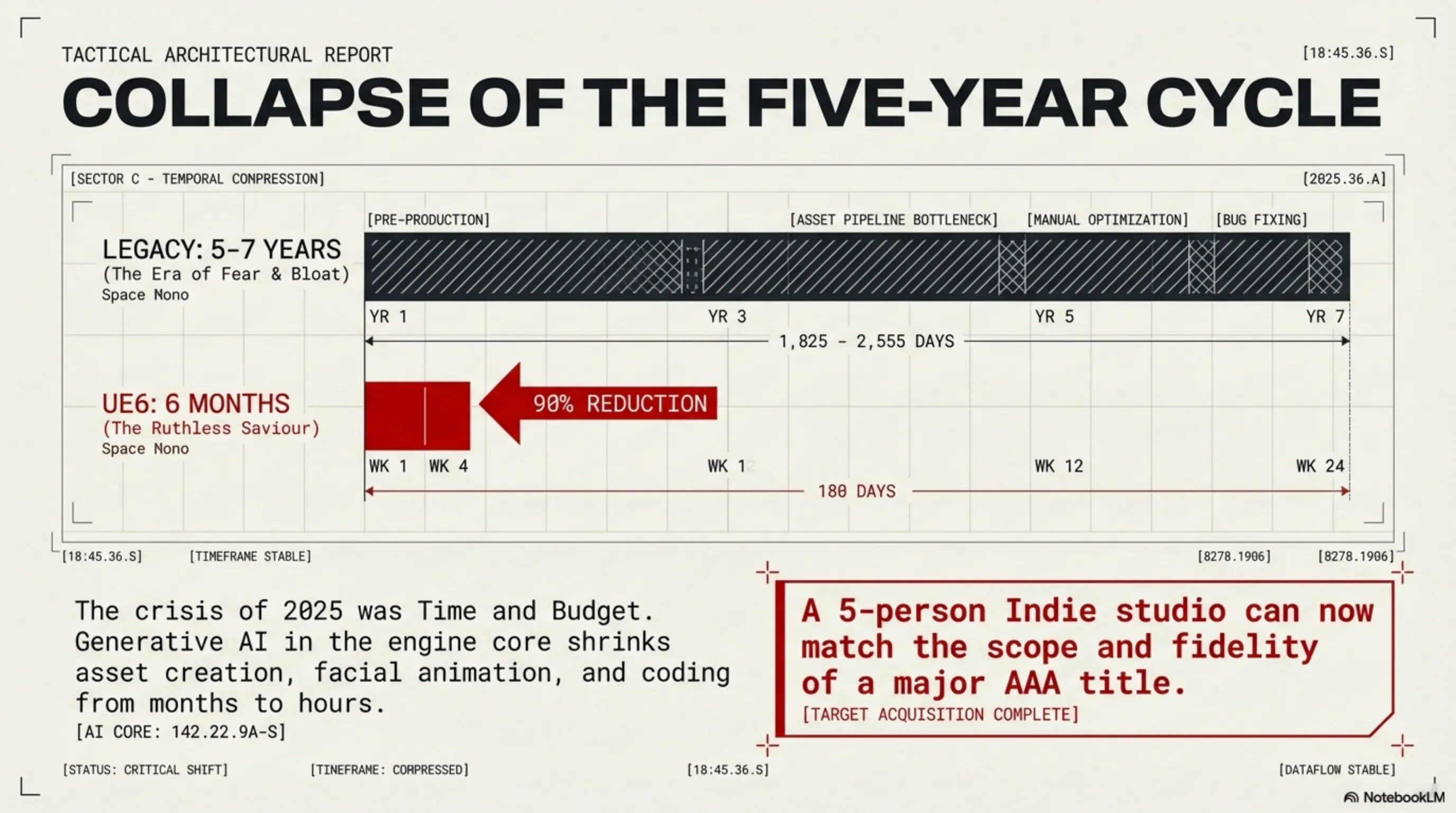
If you asked studio executives what the biggest crisis in the gaming industry was back in 2025, they would point to "Time and Budget." Building a game on the scale of GTA VI or Cyberpunk 2077 required 5 to 7 years and hundreds of millions of dollars. These bloated cycles paralyzed studios with fear, forcing them to rely purely on safe, repetitive sequels. Unreal Engine 6 enters here as a ruthless savior.
By injecting Generative AI into the engine's core, the time required for asset creation, facial animation, and even coding enemy AI shrinks from months to hours. A 5-person Indie studio can now build a game with the scope and fidelity of a Naughty Dog title in less than six months. UE6 shatters the AAA monopoly, handing absolute power back to those with the "Best Ideas," rather than those with the biggest budgets.
5. Survival Strategy in the Age of Creative Machines: Who Survives?
With the deployment of Unreal Engine 6, a mass extinction event is imminent for studios that refuse to adapt. In this new world order, having hundreds of employees is no longer a competitive advantage; the true advantage in 2026 is "Agility in AI Implementation." At Tekin Garage, we define the survival strategy in this ruthless ecosystem across three core pillars:
- Hardware Upgrade to NPU: Gamers and developers must abandon their obsession with raw TFLOPS. A system lacking robust AI processing cores (like advanced Tensor Cores) will be completely paralyzed when attempting UE6's hallucinative rendering.
- Skill Shift to "System Architecture": Traditional designers must learn to evolve from manual texture painters to "AI Art Directors." Mastering the interaction with Generative AI models within the game engine is the only viable career lifeline.
- The End of Publisher Monopolies: Independent (Indie) developers now wield a weapon capable of producing graphics on par with billion-dollar studios. The focus must aggressively shift toward "Original Storytelling" and "Innovative Gameplay," because breathtaking graphics are no longer a luxury; they are a free standard!
🌒🚀 The Tekin Analysis Verdict
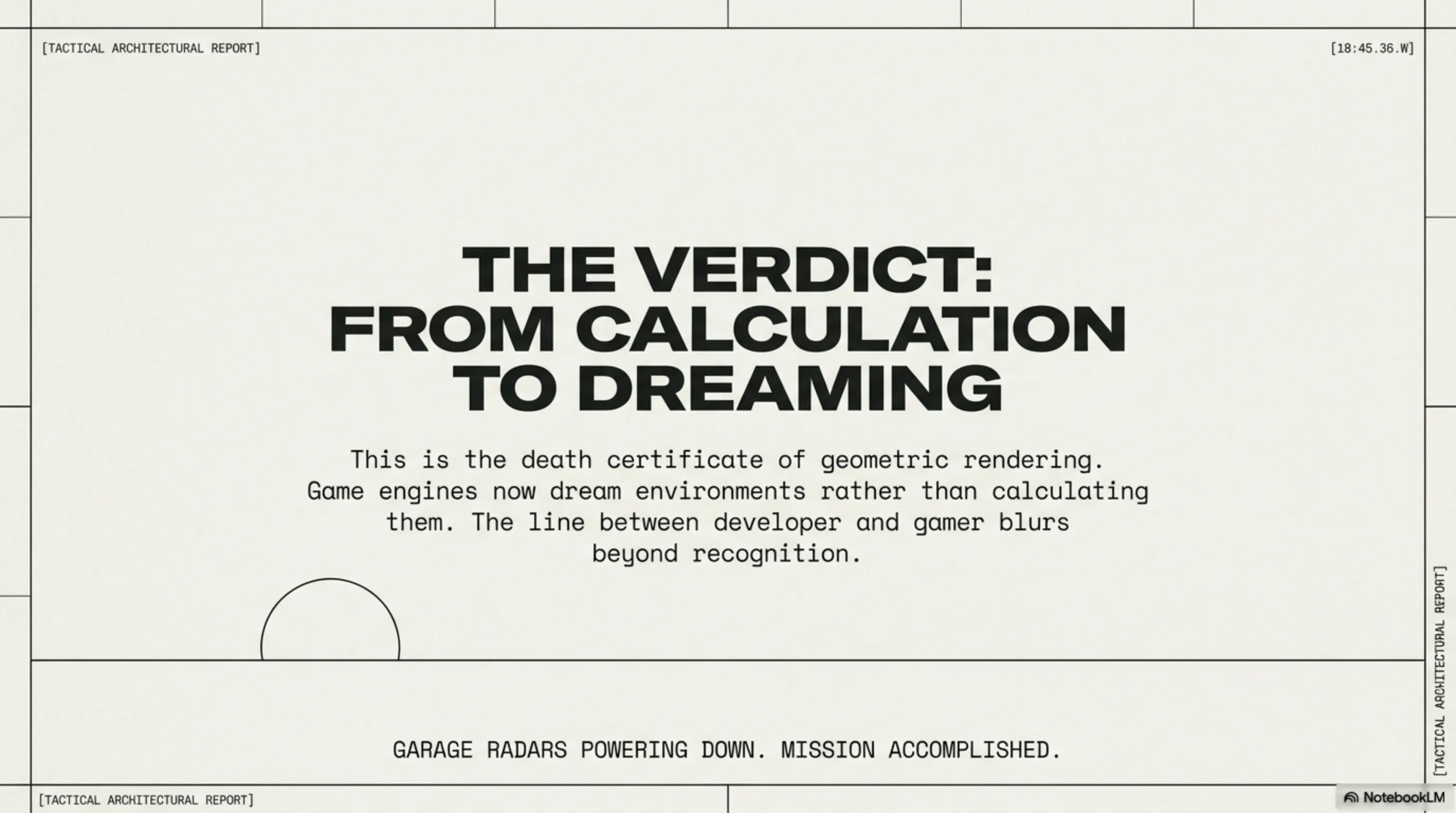
Tekin Army, we are crossing the finish line of an era. The unveiling of Unreal Engine 6 is not just a software update; it is the death certificate of geometric rendering and the birth of neural rendering. Game engines no longer calculate environments; they "dream" them, summoning them for you in real-time. In this new frontier, the line between developer and gamer will blur beyond recognition, and hardware that cannot speak the language of AI will be relegated to technology museums. Brace yourselves for the seismic shifts of 2026. The Garage radars are powering down; mission accomplished.