
1. Design & Ergonomics: When "Glasses" Are Actually Glasses (98g)
The first time you pull Orion out of the box, you are shocked. This is not a ski mask. It looks like your grandfather's reading glasses, perhaps with slightly thicker wayfarer frames (D-frame).
Miniaturized Engineering: Meta has managed to compress all sensors, eye-trackers, and projectors into a magnesium alloy frame. The weight? Just 98 grams. For comparison, the Apple Vision Pro hovered around 650 grams. You can wear Orion all day and forget it’s there.
Of course, there is a catch: the battery and the main processor are not in the glasses. They reside in a separate device called the "Compute Puck," which sits in your pocket and connects wirelessly to the frames.
2. Visual Magic: Silicon Carbide Lenses & The End of Pass-through
The biggest differentiator between Orion and its competitors is "how you see the world."
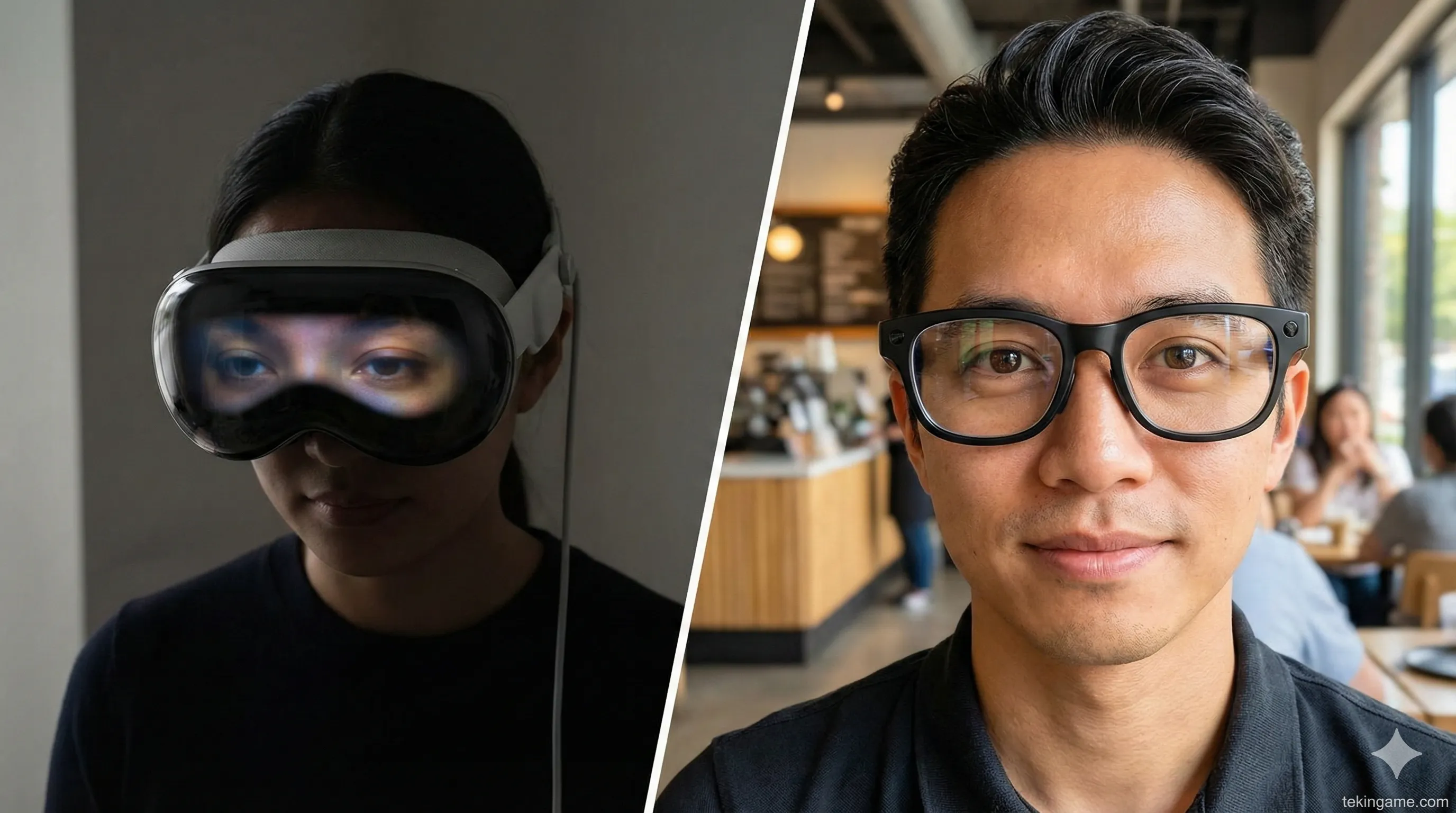
In the Apple Vision Pro, you see the real world through cameras (Video Pass-through). No matter how high the resolution, your brain knows you are watching a video feed.
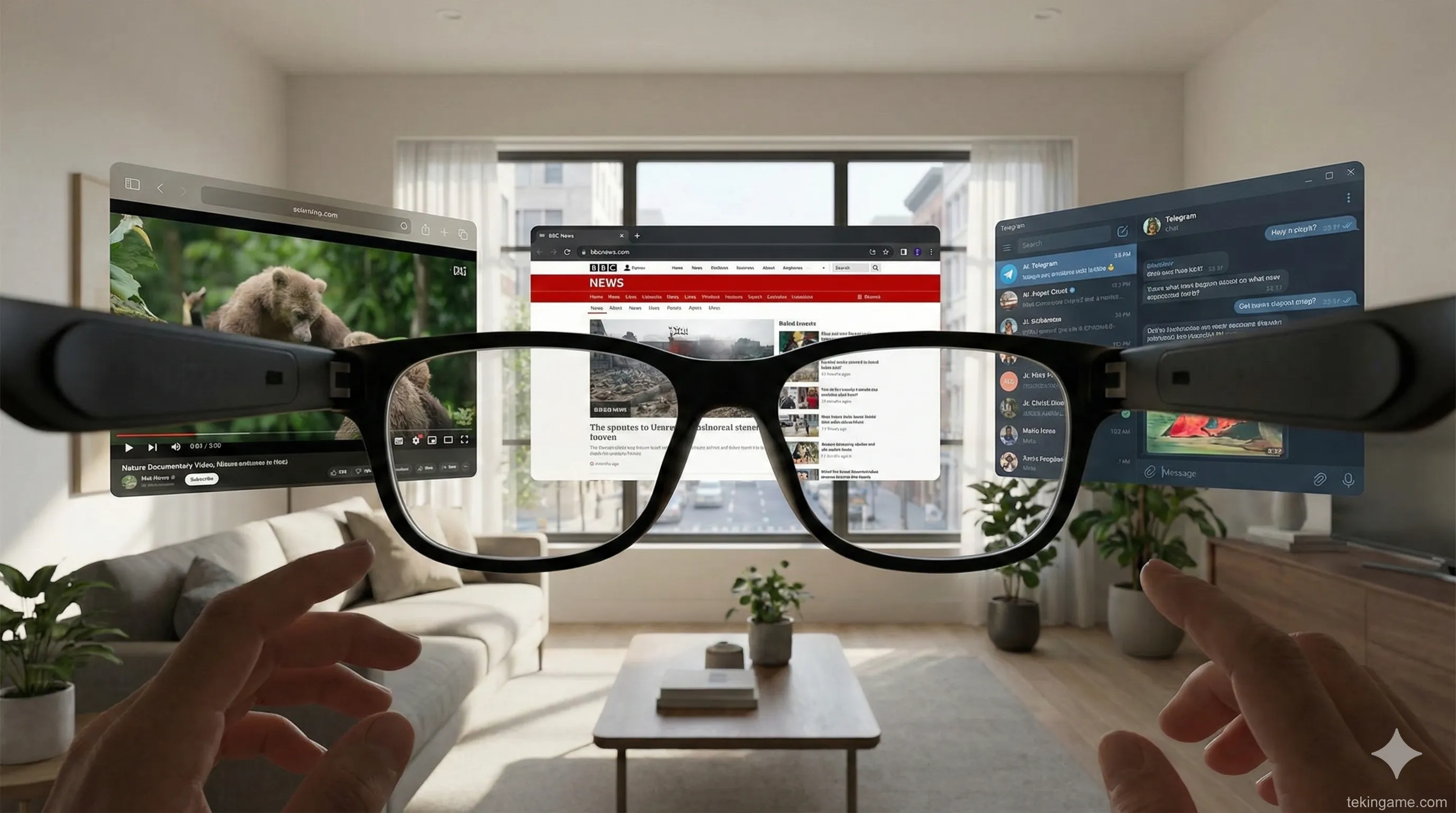
In Orion, the lenses are See-through. You are looking at the actual world through transparent material. But Meta didn't use standard glass.
💎 Why Silicon Carbide (SiC)?
Meta replaced glass or plastic with Silicon Carbide (a material typically used in EV chips and space rockets).
Technical Reason: SiC has an incredibly high Refractive Index. This allows light from the projectors to be bent at extreme angles, enabling a wide 70-degree Field of View (FOV).
The Result: Holograms aren't confined to a tiny postage stamp in the center of your vision; they fill your peripheral view. You can pin a 100-inch cinema screen to your wall, and it stays locked in place.
3. Light Engineering: How Do MicroLED Projectors Work? (Tech Deep Dive)
You might ask, how does the image get onto the glass? The secret lies in the arms of the glasses.
Meta utilizes MicroLED Projectors that are impossibly small (roughly the size of a grain of rice). These projectors fire light into the edge of the Silicon Carbide lenses.
Waveguide Architecture: Etched inside the lenses are billions of nano-scale channels that act like "invisible fiber optics." They capture the light, distribute it across the surface, and release it precisely in front of your pupil.
The Brightness Challenge: In the prototype phase, holograms washed out in sunlight. But in Orion v2, brightness hits 5,000 nits. This means you can read floating emails clearly even at high noon.
4. Neural Interface (EMG): Mind Reading via the Wrist
This is where Orion crosses the line into "Space Tech." How do we interact without a mouse, keyboard, or touchscreen? By waving our hands in the air like maniacs? No.
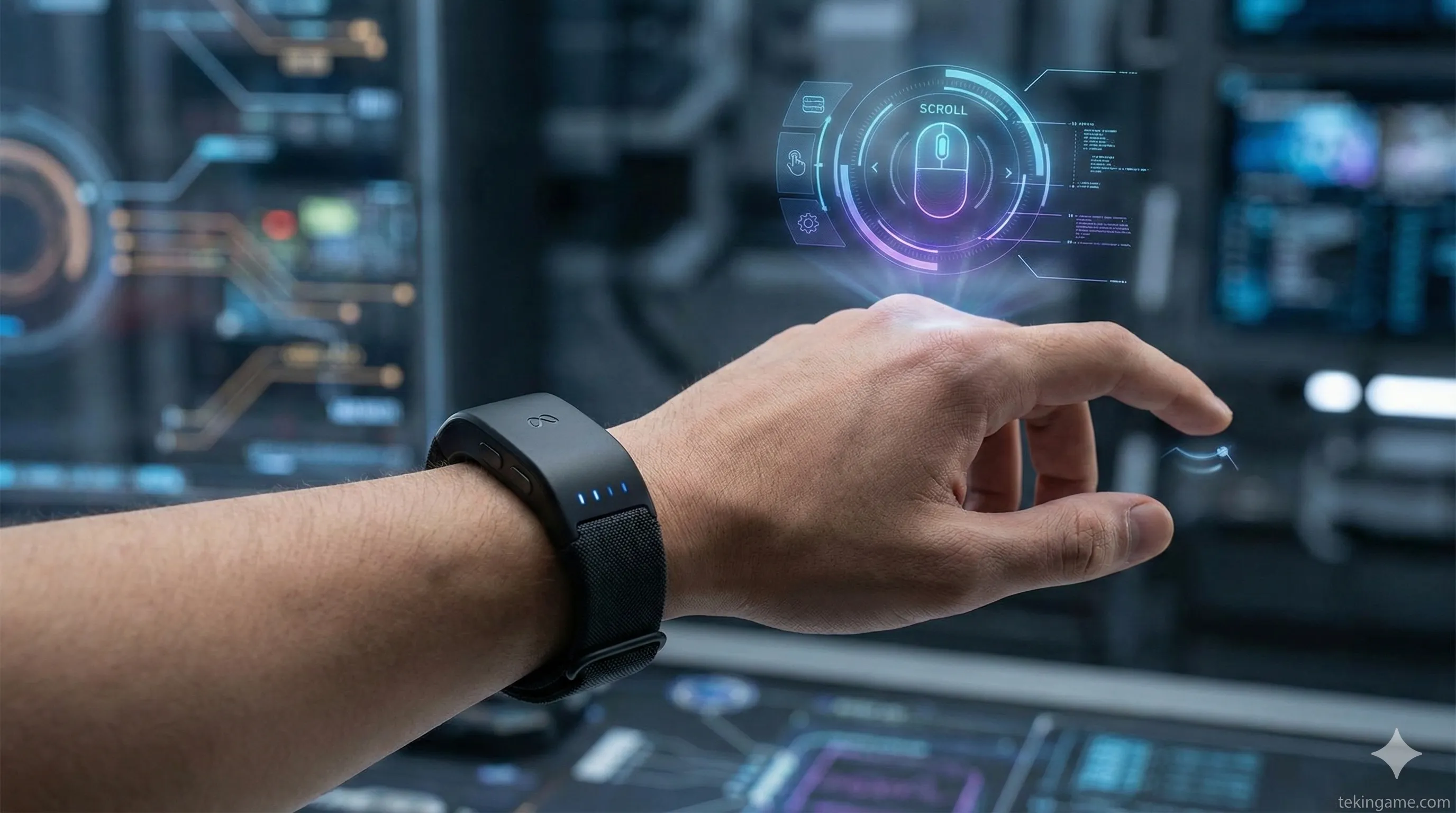
Accompanying the glasses, you wear a simple Black Wristband. This band utilizes Electromyography (EMG) technology.
How it Works:
When you "think" about moving your index finger, your brain sends an electrical signal to your wrist. Even if you don't actually move your finger (just a micromillimeter twitch), the wristband intercepts this neural signal.
Magical Experience: You can keep your hands in your pockets and, with tiny finger twitches, click, scroll, and type in mid-air. No one around you knows you are sending a text message. It is, effectively, "Digital Telepathy."
5. User Experience (UX): Daily Life with Holograms
During my one-week test, I attempted to leave my phone in the drawer. What was it like?
- Cooking: The recipe floated above the pot, and individual timers hovered over each gas burner.
- Navigation: On the street, directional arrows were painted onto the pavement (like in racing games). No need to look down at a map.
- Meetings: My colleague in London appeared as a photorealistic "Codec Avatar" sitting on the sofa opposite me. The quality was so high I felt genuine "Presence."
- Meta AI: The glasses' cameras constantly scan the environment. I looked at my open fridge and asked, "What can I cook with this?" The AI instantly projected three recipe options next to the ingredients.
6. Horizon OS 2.0: Turning Walls into Apps
Hardware without software is just expensive scrap metal. In 2026, Meta's proprietary OS has matured.
Spatial Anchoring: This is Orion's killer feature. You can open a YouTube window and "nail" it to your kitchen wall.
It doesn't matter if you turn your head or even leave the house and come back; that YouTube window remains physically locked to the kitchen wall. Orion stores the physical location of digital objects in the cloud. This means you can decorate your entire home with virtual notes, photo frames, and monitors that only you (and other Orion wearers) can see.
7. Orion vs. Vision Pro: The War of Philosophies (Transparency vs. Isolation)
2026 is the battleground of two distinct visions:

| Feature | Apple Vision Pro (Gen 2) | Meta Orion (v2) |
|---|---|---|
| Philosophy | Virtual Reality (VR) with Cameras | True Augmented Reality (AR) |
| Eye Contact | Artificial (EyeSight Screen) | Natural (Transparent Glass) |
| Interaction | Hand & Eye Tracking | Neural Wristband (EMG) |
| Primary Use | Home Entertainment / Static Work | Phone Replacement / Daily Life |
8. The Achilles' Heel: Battery, Heat, and the "Compute Puck"
Can we throw away our phones tomorrow? Not quite yet.
1. Battery Life: The "Compute Puck" in your pocket manages only 3 to 4 hours of continuous use. To wear Orion all day, you need to be tethered to power banks.
2. Puck Dependency: Without that wireless puck, the glasses are essentially useless. So, you haven't really eliminated the "phone"; you've just turned it into a "screen-less processing brick."
3. Resolution: While the FOV is excellent, the resolution doesn't yet match the iPhone's Retina display. Reading tiny text for hours is still straining.
9. Privacy & The 'Dork' Factor: Will Society Accept Us?
The biggest hurdle for Google Glass in 2013 wasn't tech; it was the "creepiness" and social rejection. Meta has learned this lesson well.
Ray-Ban Collaboration: Orion doesn't look like alien tech. Designed in partnership with Ray-Ban, the frames are matte and classic. When the display is off, no one (from a meter away) knows you are wearing a $10,000 computer on your face.
Virtual Eyes: Unlike Vision Pro which hides your eyes, Orion's lenses are transparent. Your conversation partner can see your pupils. This is critical for maintaining "Human Connection." Zuckerberg emphasized that tech should enhance eye contact, not block it.
10. Price & Release: Luxury Toy or Public Utility?
Meta hasn't officially locked the price, but analysts estimate the manufacturing cost of the current unit at around $3,000 (mostly due to the insanely expensive Silicon Carbide).
Zuckerberg stated: "Our goal is to bring the price down to flagship phone levels ($1,000) by 2028."
Therefore, in 2026 and 2027, Orion remains a "Pro-sumer" product—for tech enthusiasts and developers—rather than a mass-market utility.
🕵️♂️ Inspector's Final Verdict
Meta Orion is the "iPhone of 2007."
The first iPhone had many flaws (no 3G, no App Store), but it showed us what the future looked like. Orion does the same.
These glasses prove that smartphones are not the "pinnacle" of technology, but merely a "temporary bridge." We won't throw away our phones in 2027, but for the first time in history, we can clearly see the day when we will.
If you have the money and love the future, Orion is your ticket. If not, wait; the future is getting cheaper.
💬 The Discussion Pit
Are you willing to sacrifice privacy for the superpowers of these glasses?
Do you think wearing these in public is "cool" or "cringe"? Drop your take below! 👇