
Samsung Electronics and South Korea’s KT Corporation have recently achieved a historic milestone in testing ultra-high bandwidth and data transfer speeds in real-world environments using the 7GHz frequency band and revolutionary X-MIMO (Extreme MIMO) technology within the foundational framework of 6G telecommunications. This test, conducted directly on South Korean soil, clearly signals that we are bypassing the limitations of 5G much faster than anticipated. In this comprehensive and rigorous analytical piece, we dissect this engineering milestone from both a technical and an investor's perspective. We examine why the Upper Mid-band (7 GHz) has become the new battleground for tech giants and regulatory and standardizing bodies, and precisely how ultra-dense multiple antenna arrays (X-MIMO) bypass the formidable physics of signal attenuation. Furthermore, we analyze this event through a strategic lens for the global market, particularly focusing on North American and European telecom players, 3GPP standardization wars, and the geopolitical race against China's Huawei, as this infrastructure forms the absolute lifeline for the AI-driven economic future.
Introduction: In an era where achieving sub-millisecond latency on 5G networks remains an elusive dream for many enterprises and consumers worldwide, internet architects and telecom behemoths in the highly classified laboratories of Seoul and Silicon Valley are busy hammering the final nail into the coffin of network "lag." Samsung Electronics, in a strategic alliance with KT Corporation—South Korea's premier telecommunications operator—has recently achieved a stunning historical inflection point: the successful transmission of massive data blocks over the 7GHz frequency spectrum utilizing an extraordinarily complex and dense array of antennas known as X-MIMO. This news transcends a mere public relations bulletin or superficial marketing jargon; it is the starting pistol for a frantic, multi-hundred-billion-dollar race to secure total dominance and intellectual property rights over the global 6G standard. In this highly technical and profound analysis, we break down the pieces of this puzzle to illustrate how the physics of electromagnetic waves, steroidal silicon antennas, and fierce geopolitical rivalry are converging to shape the architecture of the sixth-generation internet.

Welcome to the Control Room. Today, we speak the language of short-frequency wave mechanics and massive data blocks. 🫡📡
Many superficial analysts and casual observers believe that 6G technology is merely a flashy marketing gimmick designed solely to push new batches of consumer smartphones. But the absolute, uncompromising technical truth is that humanity is terrifyingly close to hitting the theoretical ceiling of 5G capacities. The explosive ascent of interactive AI, fully autonomous Level 5 vehicles, industrial economies radically dependent on the Internet of Things (IoT), and real-time cloud inference has generated a ravenous, unprecedented demand for bandwidth. Above all, it has created an absolute necessity for "zero latency." The organic alliance between Samsung and KT reflects a paradigm shift in infrastructure engineering philosophy. Instead of a stubborn, economically unviable focus on the highly attenuated and rapidly degrading extremely high frequencies in the Terahertz (THz) region, they have honed their efforts on a golden, highly promising focal point: the 7GHz frequency band.
1. Anatomy of a Leap: When 5G is No Longer Enough
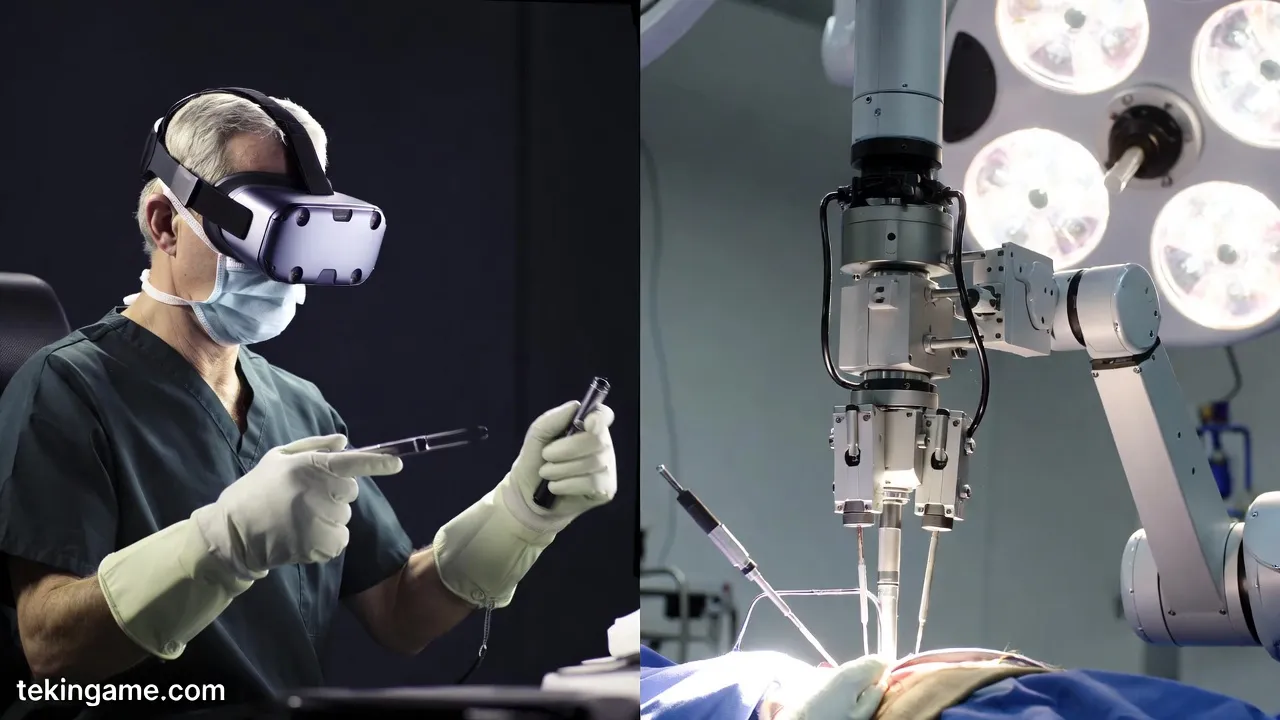
Despite all the revolutionary promises and glittering slogans that accompanied the rollout of fifth-generation (5G) mobile communications, the network has suffered from evident flaws in its global implementation methodology. To avoid the astronomical capital expenditures (CapEx) associated with deploying dense millimeter-wave (mmWave) antennas, most telecom operators worldwide resorted to relying on relatively lower frequencies (Sub-6 GHz). The unfortunate end result was that the 5G user experience in most parts of the globe failed to deliver the fundamental, paradigm-shifting difference promised over Advanced 4G LTE. Latency, which was theoretically supposed to plunge below the one-millisecond mark, currently fluctuates between 10 to 30 milliseconds in practical, real-world scenarios. While this might be entirely sufficient for streaming high-definition YouTube videos or quickly scrolling through social media, it is an absolute and fatal catastrophe when dealing with a complex surgical robot controlled from 500 kilometers away, or a swarm of high-speed autonomous drones that must make life-or-death decisions in a fraction of a second to avoid catastrophic mid-air collisions.
From this critical technical shortcoming arises the urgent need for 6G standardization efforts to take center stage. The International Telecommunication Union (ITU), in intensive collaboration with the 3rd Generation Partnership Project (3GPP), is currently architecting rules and protocols aimed at an organic, total integration between space-based data traffic (via Low Earth Orbit satellites) and traditional terrestrial networks (Space-Air-Ground Integration). Under this staggering engineering framework, the peak data rate is projected to hit an insane 1 Terabit per second (1 Tbps). The logical question that strongly presents itself is: How can anyone force an ocean of data through a narrow pipe? This is precisely the challenge that Samsung resolved to tackle with an exceptionally clever innovative response: expanding the "size of the pipe" (the frequency bandwidth) using a methodology that does not force operators to plant a cell tower every 10 meters along city streets, while never compromising on peak transfer speeds or the steadfast reliability of the transmission.
| Key Performance Indicators (KPIs) | 5G Network (Current Commercial Standard) | 6G Network (Samsung 2030 Vision) | Leap / Improvement Factor |
|---|---|---|---|
| Peak Data Rate | 20 Gbps (Ideal Lab Environment) | 1 Tbps (Equivalent to 1000 Gbps) | 50x Increase |
| Latency | 1 Millisecond | Sub-0.1 Millisecond Range | 10x Improvement (Reliability & Speed) |
| Connection Density | 1 Million devices per Square Kilometer | 10 Million devices per Square Kilometer | 10x Greater Scalability |
2. Engineering the 7GHz Frequency (Upper Mid-Band): Why This Band is Telecom's New Gold
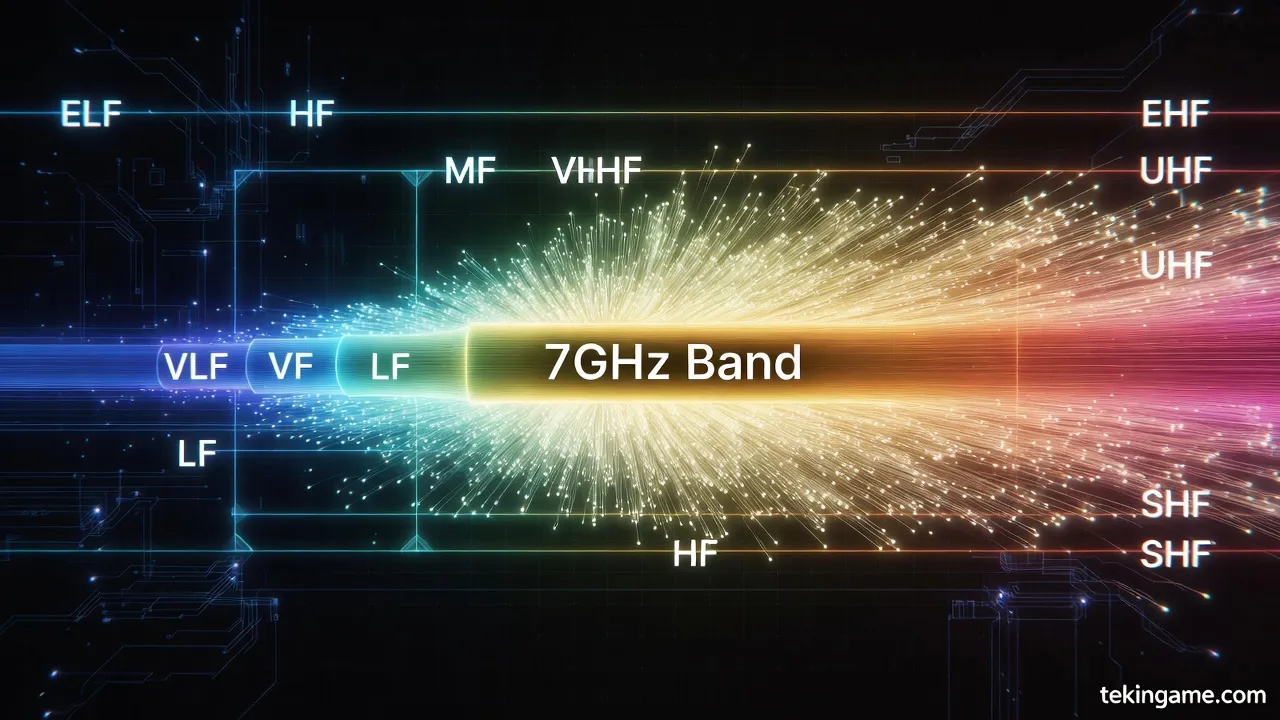
Let us now dive deeply—and perhaps a bit harshly—into the mechanics and strict behaviors of electromagnetic waves. In the highly complex science of wireless telecommunications, a simple yet unforgiving universal physical law dictates: "The higher the frequency utilized (in the greedy pursuit of wider bandwidths and infinite peak speeds), the shorter the wavelength becomes. Consequently, the ability of this weakened, miniaturized wave to penetrate thick physical barriers—such as concrete walls, foliage, or even heavy rain—drops drastically, degrading its capacity to propagate." In older generations, operators heavily bet their CapEx on frequencies well below the 3 GHz mark (the so-called "Sweet Spot"). At those frequencies, a single cell tower could effortlessly blanket a geographic radius spanning several kilometers, easily piercing through residential and commercial buildings. However, with the advent of 5G and mmWave (e.g., the 28 GHz band), speeds became astronomically high, but the fatal flaw was that even a single tree leaf could severely disrupt, scatter, and shatter the signal. This forced telecom companies to adopt a deployment model requiring dozens, if not hundreds, of micro-antennas scattered across streets and malls—an approach that proved to be a terrifying economic burden and largely unviable for major operators seeking broad coverage.
In its pioneering joint test with KT, Samsung deliberately targeted a highly attractive geographic and frequency territory, a perfectly balanced golden medium known conventionally as the Upper Mid-band (ranging from 7 to 24 GHz). Specifically, this recent historical technical test centered exactly on the 7 GHz spectrum block. Why 7 GHz? This frequency band represents a brilliantly intelligent engineering pivot point, a radiant strategic compromise. On one hand, it provides a massive, wide bandwidth containing hundreds of megahertz of completely empty blocks—more than capable of flushing the colossal data payloads characteristic of 6G. On the other hand, its propagation characteristics remain remarkably robust, maintaining structural integrity to a degree that effectively nullifies the need to aggressively plant independent microcells at incredibly short, economically irrational distances. Samsung has overwhelmingly proven that this formidable frequency band does not demand sacrificing peak data rates for the sake of wider coverage radius, nor does it require incinerating the CapEx budgets of telecom providers on endless tower proliferation. Achieving this technological feat is akin to modern-day alchemy in the realm of applied sciences.
3. X-MIMO Technology (Extreme MIMO): Breaching the Wall of Physics with Steroidal Antennas
The dilemma of poor coverage and low penetrability in higher bands (the unforgiving laws of physics mentioned earlier) still inherently exists. However, Samsung’s genius maneuver was not to "cure" the problem by shifting back to lower frequencies. Instead, they boldly flanked the bottleneck by directing the heavy artillery of modern technology straight at the heart of physics, breaching its barriers directly! Their exceptional innovation and key to the solution is an evolved system termed Extreme Multiple-Input Multiple-Output, or simply X-MIMO. If you possess a modest technical familiarity with the structure of Massive MIMO currently prevalent in 5G networks (which consists of large antenna panels studded with 64 or 128 transceiving elements), then you must understand that X-MIMO is essentially that exact underlying technology, but heavily injected with technological steroids! It packs thousands of frequency elements into a highly orchestrated array.
During this monumental test, Samsung’s massive antennas successfully directed high-powered beams via advanced Beamforming toward the client devices. Rather than broadcasting the signal aimlessly in all directions and squandering energy, the 7 GHz wave strikes the target device like a precision laser. This drastically elevates the Antenna Gain, miraculously compensating for the propagation shortcomings inherent to the 7 GHz band. Telemetry recorded by KT’s network technicians showcased bandwidth and throughput that shattered commercial standards, proving the stability of communication links even in partially obstructed environments.
As architects and builders of future infrastructure foundations, we know with absolute certainty that engineering, designing, and manufacturing a terrifying X-MIMO antenna panel—one that houses hundreds of components on its facade while achieving record thermal efficiency and rational low power consumption—requires employing ultra-precise silicon metallurgy and complex industrial chemistry for exclusive, proprietary RF (Radio Frequency) chips. This is exactly one of the strategic technological trenches where Samsung has blatantly and clearly demonstrated to the entire world its financial, investment, and technical supremacy. It asserts its sovereign dominance in hardware manufacturing over monumental competitors deeply rooted in the legacy European telecom schools, such as Ericsson and Nokia.
4. The Samsung and KT Alliance: Implications for 3GPP Standards and the Geopolitical Race
In the world of Telecom, simply possessing and building the latest technology is not enough; you must project your technical power so that it becomes the absolute global standard. The legislative body and finish line steering this global unification is 3GPP. Currently, we are in the midst of a technological arms race—one that can easily be described as a Cold War—between the United States and its allies (like South Korea) and the Chinese dragon represented by telecom giant Huawei, battling to dictate the foundational standard essential patents (SEPs) that will govern 6G.
The successful 7GHz test by Samsung and its partner KT is a potent signal and a fiercely tactical offensive message aimed directly at Huawei's radar and the deep-decision-making corridors of the Chinese government. South Korea, which previously secured the honor of being the first nation on earth to activate a commercial 5G network, continuously aspires to lead and monopolize the foundational laying of 6G networks at the World Radiocommunication Conference (WRC) and at the forefront of global standardization. By proving that the Upper Mid-band, coupled with X-MIMO, is entirely viable and cost-effective for commercial use, the Koreans are heavily tipping the scales of standardization in their favor. Should 3GPP adopt the 7GHz band and Samsung’s X-MIMO system as the backbone of Phase 1 6G, Samsung could transform into the sole or primary network equipment provider for colossal operators from AT&T in America to Vodafone in Europe. This scenario would cause shares in Samsung's Networks division to pump to unprecedented heights.
5. The 6G Economy: From Remote Surgery to Live Holographic Communications
Why must we violently chase after, adopt, and build an internet subscription and local connection with the power, speed, and data-injection capacity of a full 1 Terabit per second? This is exactly the prevailing question among the architects of the multi-billion-dollar industrial maps of 2026. Let us address this bluntly, stripping away the Californian media hype: 6G was never built so you could download a movie in half a second; 6G is designed to achieve true, instantaneous synchronization between the physical, material world and digital realms.

The critical secret lies firmly in revolutionary Use Cases where even a two-millisecond delay is a matter of life and death. The 6G economy revolves around several key axes:
- Mobile Holographic Communications: 5G networks could never flawlessly process streams of 3D holograms or Extended Reality (XR) avatars on mobile devices. Using X-MIMO in the 7GHz band allows us to pump massive 3D Point Cloud data at historical speeds without lag or jitter.
- High-Fidelity Digital Twins: Imagine an entire smart city or a complete industrial production line whose simulation is duplicated digitally. Ensuring this copy synchronizes in sub-milliseconds with the real world demands the bandwidth that 6G provides as the magic wand for Central AI.
- Neurological and Medical Reactive Robotics: In advanced automation, when AI for machines (like autonomous vehicles or surgical arms) is processed not on the robot’s onboard chip but on a cloud processor thousands of miles away, any lag means tragedy. 6G is engineered to guarantee this Mission Critical stability deep within its DNA.

6. The Global Telecom Challenge: Spectrum Wars and Wall Street's Verdict
As we pan out to the global stage, particularly looking at North American and European markets, the narrative of 6G (and specifically the 7GHz band) transforms into a brutal spectrum war and a focal point for Wall Street analysts. In the United States, spectrum allocation is notoriously complex and heavily contested between commercial telecom operators (like Verizon, AT&T, and T-Mobile), the Department of Defense (DoD), and satellite operators. The 7GHz to 8.4GHz range is historically crowded with federal and military use cases. Samsung and KT’s success sends a massive wake-up call to the Federal Communications Commission (FCC) and the National Telecommunications and Information Administration (NTIA): If the US does not rapidly clear and auction the Upper Mid-band for commercial 6G, American operators will essentially be forced to deploy substandard, severely restricted networks, conceding the global innovation lead to Asia.
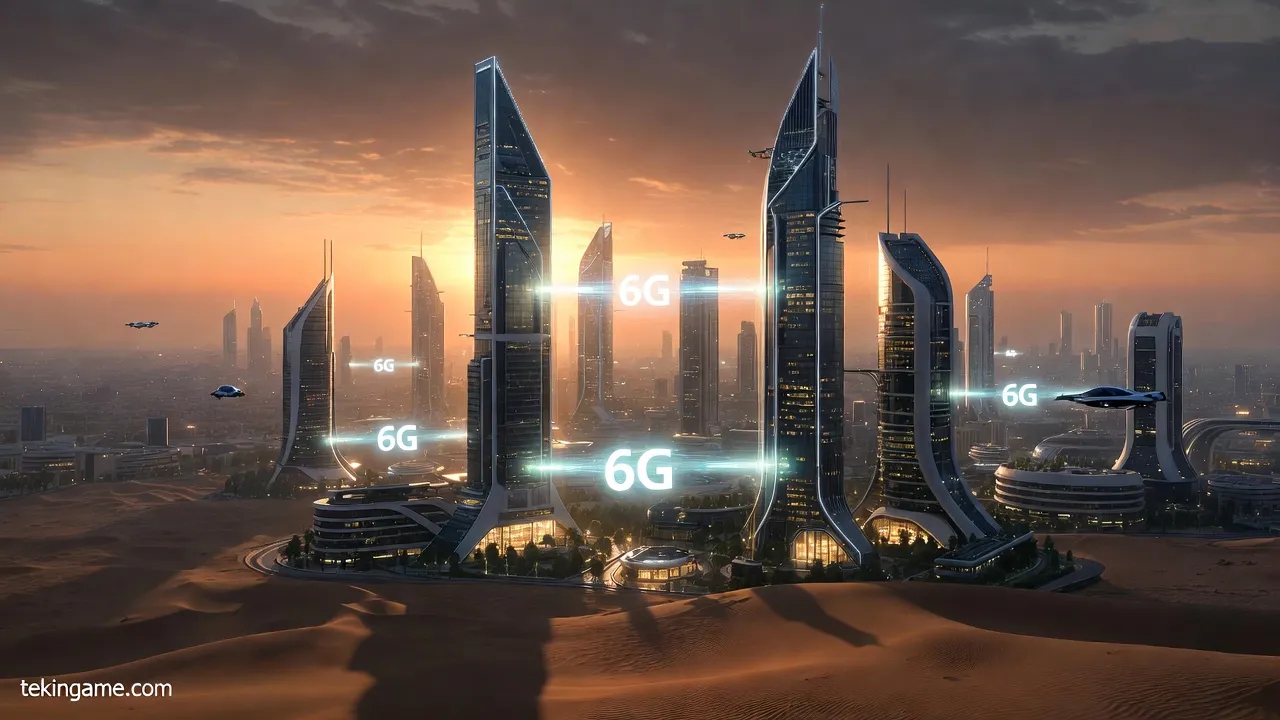
From an investor's standpoint, Wall Street is watching this meticulously. Telecom operators are already heavily leveraged from the expensive 5G rollouts, which largely failed to deliver the promised immediate enterprise ROI. Investors demand that 6G be capital-efficient. Samsung’s X-MIMO specifically answers this demand by proving that operators won't need to rebuild their entire macro-cell grid from scratch; they can achieve Tbps speeds using existing tower spacing by leveraging the superior propagation of 7GHz combined with hyper-focused beamforming. This makes telecom stocks—and specifically RAN (Radio Access Network) hardware providers like Samsung—incredibly attractive for long-term growth portfolios, as they offer operators a cost-effective path to the next generation.
7. Strategic Conclusion for Infrastructure Industry Players
The joint alliance and resounding success in the benchmark tests conducted by Samsung and KT teams on the 7GHz spectrum and X-MIMO capabilities send an intensely clear warning and telegram to all operators, tech companies, stock market investors, and the hardware industry: The 6G race has officially shifted from theoretical papers to live silicon, and short-frequency technologies utilizing massive antenna arrays will utterly dominate the technology landscape of the next decade.

Unlike the excessively marketed consumer hype of 5G, 6G has been meticulously engineered from inception to serve the AI and cloud-computing-based economy. Legacy telecom companies must aggressively invest in the manufacturing and integration technologies of dense silicon antennas. Simultaneously, governments—if they wish to remain relevant in global commerce—must immediately commence legislative processes and allocate the Upper Mid-band for their telecom carriers. The deep war has inherently ignited within the laboratories of Tokyo, Seoul, and Silicon Valley; its waves will soon echo across global servers, authoring an entirely new, thrilling chapter in the history of human networks.